“The Hostility of Life Outdoors”

Gustave Moreau’s “Triumph of Alexander the Great”

This poem by the Chilean writer Roberto Bolaño is based on the above painting. I thought it was interesting to match a poem with a painting, especially when the poet is as interesting a writer as Bolaño. The title of this poem is “The Outsider Ape.”

Remember the Triumph of Alexander the Great, by Gustave Moreau?
The beauty and terror, the crystal moment when
all breathing stops. But you wouldn’t stand still under that dome
in dim shadows, under that dome lit by ferocious
rays of harmony. And it didn’t take your breath away.
You walked like a tireless ape among the gods,
For you knew—or maybe not—that the Triumph was unfurling
its weapons inside Plato’s cavern: images,
shadows without substance, sovereignty of emptiness. You wanted
to reach the tree and the bird, the leftovers
from a humble backyard fiesta, the desert land
watered with blood, the scene of the crime where
statues of photographers and police are grazing, and the hostility of life
outdoors. Ah, the hostility of life outdoors!


Chilehead

These Used To Be the Hottest Chiles on Record, But Things Have Changed

It was several years ago, when my brother was living in Paso Robles near California’s Central Coast. When I would go to visit him, we usually went shopping together at the farmers’ market at nearby Templeton. Once, one vendor selling olives stuffed with chile habaneros (see photo above) offered Dan and me the opportunity to taste one, all the while grinning as if he expected us to spit them out. We ate the proffered olives, smiled, and asked for more. The vendor looked at us as if we were from the hot side of Mercury.

My brother and I are bona fide chiliheads. It’s one of the things we enjoy most about getting together, because both of us are surrounded by people who blanch at the thought of biting into a sliver of jalapeño, and who carefully remove all pepperoncinis from their salads. We came by this through our mother, Sophie, who used to cook a Hungarian dish called lecso (pronounced LETCH-o), a kind of Hungarian adaptation of Spanish rice seasoned with hot Hungarian banana peppers. When I was growing up, I thought that lecso was altogether too spicy for me. Now I rather like it. (My father, however, did not: He was one of the digestively challenged.)

There is a means of measuring the hotness of chiles called the Scoville Heat Scale. Here is a summary of relative hotness of chiles:

Mexi-Bells, New Mexica, New Mexico, Anaheim, Big Jim, Peperonicini, Santa Fe Grande, El Paso, Cherry     1 100-1,000
Coronado, Mumex Big Jim, Sangria, Anaheim     2 1,000-1,500
Pasilla, Mulato, Ancho, Poblano, Espanola, Pulla     3 1,500-2,500
Hatch Green     4 2,000-5,000
Rocotillo     5 2,500-5,000
Yellow Wax, Serrano, Jalapeno, Guajillo, Mirasol     6 5,000-15,000
Hidalgo, Puya, Hot Wax, Chipotle     7 15,000-30,000
Chile De Arbol, Manzano     8 30,000-50,000
Santaka, Pequin, Super Chile, Santaka, Cayenne, Tobasco, Aji, Jaloro     9 50,000-100,000
Bohemian, Tabiche, Tepin, Haimen, Chiltepin, Thai, Yatsufusa    10 100,000-350,000
Red Savina Habanero, Chocolate Habanero, Indian Tezpur, Scotch Bonnet, Orange Habanero, Fatali, Devil Toung, Kumataka, Datili, Birds Eye, Jamaican Hot    11 350,000-855,000
Ghost Pepper (Bhut Jolokia, a.k.a. Naga Jolokia), Naga Viper, 7 Pot Primo, 7 Pot Douglah, Trinidad Moruga Scorpion, Carolina Reaper    12 855,000-2,200,000

I can eat chiles up to about half a million Scoville units, namely the habaneros or Scotch Bonnets. If I were to make a large pot of soup, I could put half a chopped habanero in the pot—but no more! As for the superhot chiles such as the Carolina Reaper or Ghost Chiles, they are really too hot for comfortable human consumption, even by chiliheads. I have had powdered ghost chiles on occasion, but only in m-o-d-e-r-a-t-i-o-n.


My Rattlesnake Story

Just Like the One I Encountered

It was about twenty years ago. I was hiking by myself at Point Mugu State Park. I approached the park from the north and parked near the Satwiwa Interpretive Center. Unfortunately, I started a bit too late, so this turned out to be a hike that I had to abort in the middle. I was walking along the Upper Sycamore Canyon Trail, which eventually merged with Sycamore Canyon Road, which was a level walk back to the parking lot. As it was late afternoon, I got a little anxious because the junction was farther along than I thought, and the parking lot gate was closed at 5 pm.

So I had to walk down one of the narrow paths that connected the trail with the road. I didn’t like the look of any of these paths, because some of them seem to disappear midway down. Finally I chose one and was halfway down before I noticed a rattlesnake coiled up beneath a bush that pretty much hogged the trail. To the left of the bush was a cliff down; to the right, a cliff up. I had to get past that rattler without sustaining a load of its venom.

I was wearing thick leather hiking boots that went up above my ankles, so I was safe if the snake went low. But what if it went high? I also had with me a sturdy ash hiking staff. I noticed that the path along the edge of the cliff gave me about six inches to walk around, so I started to plunge the staff down hard every few inches to encourage the snake the bite the staff while I edged around the bush. It did make a feint at the staff, but did not bite. I managed to circle around the bush and resume my hike, returning to the parking lot with only a few minutes to spare.


Serendipity: Cabot Yerxa and Rattlesnakes

Western Diamondback Rattlesnake

This is an entire article that Cabot Yerxa wrote for The Desert Sun on May 8, 1952 about his encounters with rattlesnakes. I myself have encountered rattlers several times during my hikes in the Santa Monica Mountains. Perhaps I will tell you later about my scariest encounter, which occurred in Point Mugu State Park about twenty years ago.

I have had many close calls with rattlesnakes. Then one night came a new one. It was quite dark, I was walking gingerly through a patch of cholla cactus, slowly making my way so as not to contact the vicious spiny stalks which I could barely distinguish in the gloom. Twice the noise of my feet crunching on rocks had disturbed snakes and I heard the buzzing, so I knew this was snake country.

Perhaps I was giving most of my attention to the cactus. Anyway, all of a sudden, without warning, I stepped right in the middle of a large coiled diamondback rattlesnake! He was asleep or would have rattled. Or perhaps his mama did not teach him to rattle. But this rude awakening made him mad, and he buzzed angrily. I could feel the strong coils twist and squirm under my feet, even now, and its head thrashing about my legs. You can be assured that I made two or three big steps. Fortunately my boots were heavy, because I still had five miles to walk in the dark.

On one occasion Bob Carr and I were walking from the railroad to the mountains on this side of the desert in snake season and after dark. We both had on just ordinary city shoes of rather thin leather, with no protection for our legs. First one man would lead and the other follow until it was embarrassing, then he would take the lead for a while and the other fairly thankfully follow along. We several times heard buzzing near us, but reached home safely. In those times it was rather silly to be out at night without some protection.

On moonlit nights, rattlesnakes cast a narrow shadow, and if watching closely it is quite easy to see them. In fact I have on occasion gone out on moonlit nights to find rattlers for my snake pit. At the old ranch house I kept 15 or 20 snakes and chuckwallas for pets. They were in a pit five feet deep and 13 feet square. Many people came to look at these, which brought in some revenue.


Favorite Movies: Rio Bravo and El Dorado

Ricky Nelson, John Wayne, and Dean Martin in Rio Bravo (1959)

Over a period of eight years, director Howard Hawks filmed virtually the same story twice—both films starring John Wayne—with the only differences being some minor script changes and a different set of supporting actors. The films were Rio Bravo (1959) and El Dorado (1967). Interestingly, both films hold up pretty well today.

Both films were a reaction to Fred Zinnemann’s High Noon (1952), in which Sheriff Gary Cooper tries and fails to enlist the help of his fellow townspeople in fending off an attack of several bad guys seeking vengeance for having jailed several of them. In contrast, John Wayne turns away several offers of help in the Hawks pictures and beats the bad guys anyway. Both times, the sheriff is under attack by wealthy ranchers who bring in hired guns to assist them.

Here are the major cast differences:

  • John Wayne plays himself in both pictures, though in El Dorado, he is a gunfighter assisting his friend, the sheriff, played by Robert Mitchum.
  • Dean Martin plays the drunk lawman in Rio Bravo; Robert Mitchum, in El Dorado.
  • The young gun is played, respectively, by Ricky Nelson and James Caan, in his first major role.
  • The female lead is played, respectively, by Angie Dickinson and Charlene Holt.
  • The deputy comic sidekick is played, respectively, by Walter Brennan and Arthur Hunnicutt.

John Wayne and James Caan in El Dorado (1967)

I just saw Rio Bravo again for the nth time yesterday afternoon. I will summarize it here because it is fresh in my memory. John Wayne and Dean Martin arrest Claude Akins for shooting an unarmed man. Unfortunately, scapegrace though he is, he is the brother of powerful rancher John Russell, who is determined to spring him before the U.S. marshal comes to town in six days. He besieges the jailhouse with his men and orders the musicians in his saloon to play El Deguëllo nonstop. This was a bugle call played by Santa Anna’s Mexican troops during the 1836 siege of the Alamo. Eventually, Russell’s men manage to kidnap Dean Martin. Wayne arranges for an exchange of Martin for Akins at a warehouse at the edge of town. The good guys prevail.

There is a third Howard Hawks film with a similar story, Rio Lobo (1970), which was the director’s last film. Although I love Hawks’s works, this is one you can skip.


Tuna (Not the Fish)

In Spanish, Tuna Refers to the Fruit of the Prickly Pear Cactus

Although the prickly pear cactus grows in all fifty states of the United States, I believe that only in the Southwest does it bring forth an edible fruit. In Spanish, that fruit is called Tuna. It is full of seeds which are easy to spit out, and is not excessively sweet the way some fruits are. In Mexico, it is cheap and readily available. I remember once in the 1980s buying a whole bag for fifty cents, more than I could finish in a month.If you ever visit the Southwest, you should give it a try, as it is not only tasty but incredibly nutritious.

But if you go to Mexico, be careful about ordering a tuna sandwich. The word for tuna (the fish) in Spanish is atun.


Cabot Yerxa: A Life in the Desert

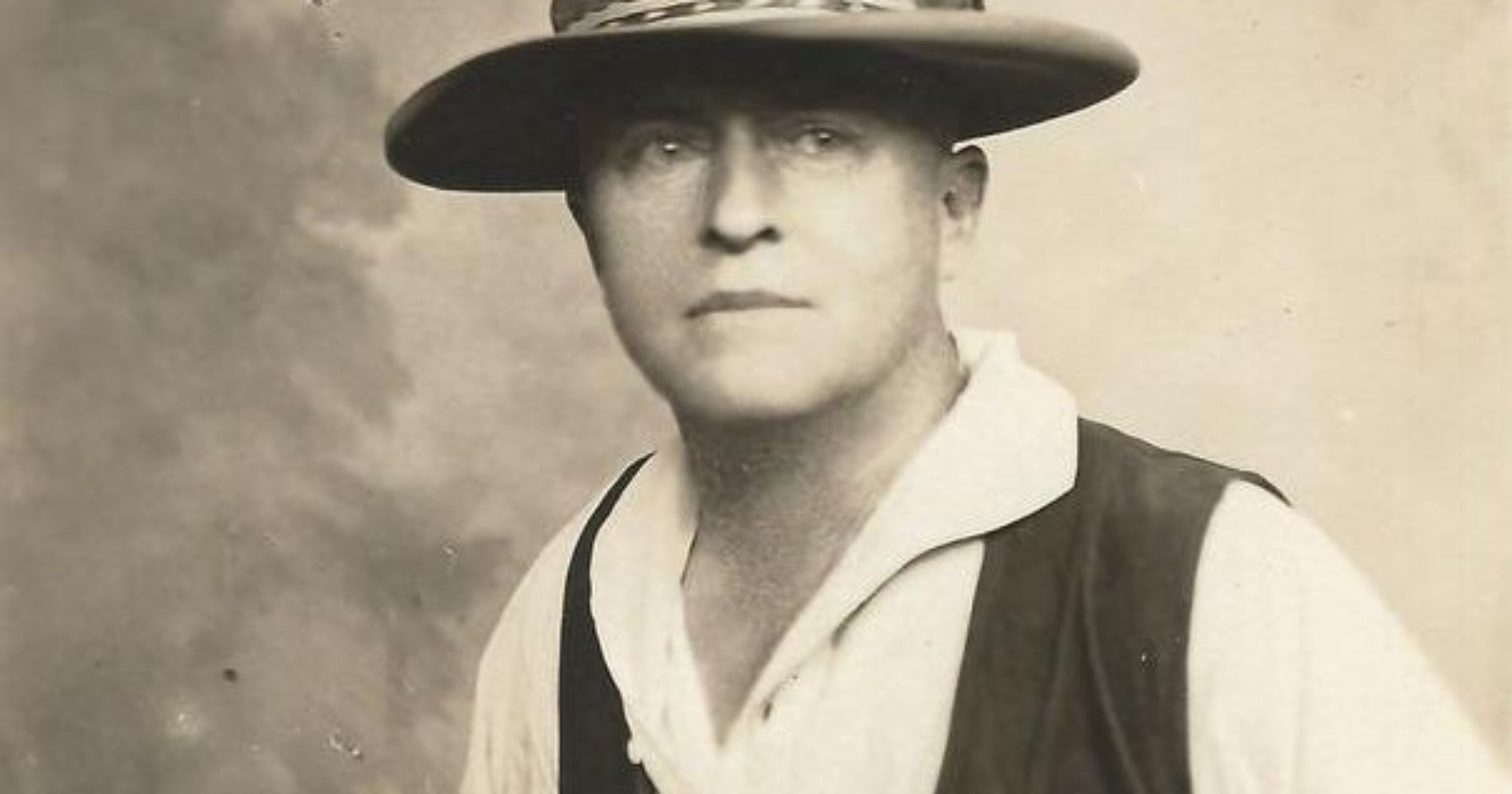
Cabot Yerxa as a Young Man

In that great migration westward that characterized the 19th century and the beginning of the 20th, there were many men of genius such as Mark Twain, who wrote Roughing It; Frank Hamilton Cushing, the ethnologist who studied the Zuñi Indians of New Mexico; John Muir, the great Scottish-born naturalist; and Cabot Abram Yerxa (1883-1965) who, in discovering the eponymous springs of Desert Hot Springs (DHS), embarked on a fascinating life full of creativity at every turn.

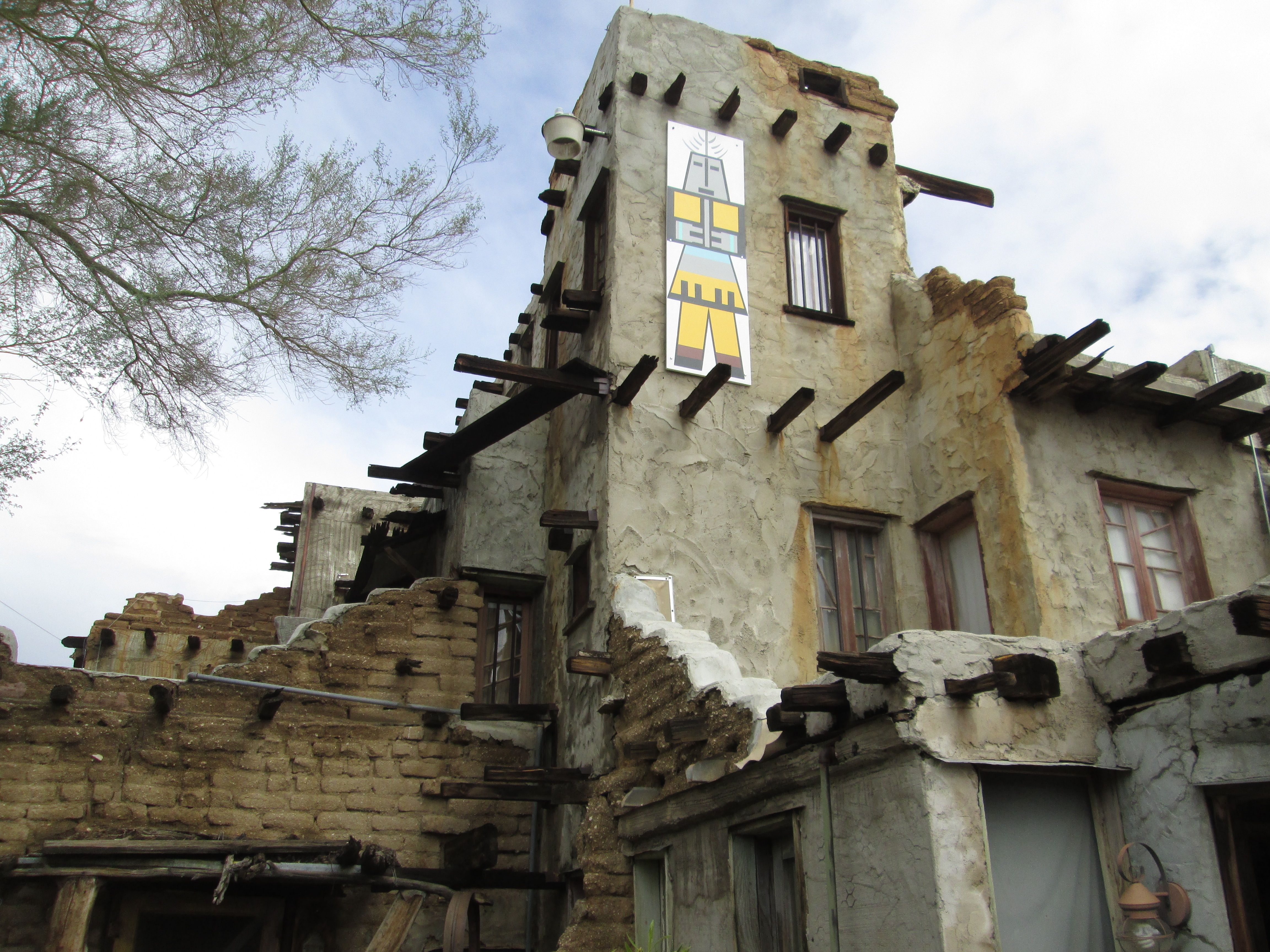
Today he is mostly remembered by a school in DHS named after him, but most especially for the pueblo he built of mostly found materials in imitation of Hopi pueblo architecture.

The Cabot Museum in Desert Hot Springs That Served as Yerxa’s Home

Last Sunday, my brother Dan and I attended a Mexican Day of the Dead festival (more about which in a following post) at the Cabot Museum. There were unfortunately too many attendees for us to take the guided tour of the inside, so that will have to wait for another visit.

When Yerxa first settled in DHS, he had to walk thirteen miles to the nearest known well. Using a dowsing stick, he discovered a well on his own property and commenced to dig. What he found were the first hot springs. That was fine for bathing, perhaps, but not for drinking. Taking up his dowsing stick again, he located another possible candidate and, this time, found cold water not too many feet away from the hot springs. DHS is right on the San Andreas fault, so there is a large underground aquifer in the area that is being replenished by runoff from the surrounding mountains.

The Pueblo Contains Many Examples of Pueblo Indian Art

During the 1950s, Yerxa wrote a series of newspaper columns for The Desert Sun during the 1950s describing his life on the desert. The Cabot Museum Foundation published these columns along with other biographical information in a volume entitled On the Desert Since 1913. In the weeks to come, I intend to reprint some of these columns for this blog.


Serendipity: Nabokov’s Mademoiselle

Vladimir Nabokov (L) with Brothers and Sisters

I am in the process of reading one of the greatest biographies ever written: Vladimir Nabokov’s Speak Memory: An Autobiography Revisited (1967). It ranks in my estimation with James Boswell’s Life of Samuel Johnson and the Journals of Sir Walter Scott. For many years in his childhood, he had had a French-speaking Swiss nurse called, in his autobiography, simply Mademoiselle. Here, years after she had retired, he describes seeing her in her old age:

Before leaving for Basle and Berlin, I happened to be walking along the lake in the cold, misty night. At one spot a lone light dimly diluted the darkness and transformed the mist into a visible drizzle. “Il pleut toujours en Suisse” [“It always rains in Switzerland”] was one of those casual comments which, formerly, had made Mademoiselle weep. Below, a wide ripple, almost a wave, and something vaguely white attracted my eye. As I came quite close to the lapping water, I saw what it was—an aged swan, a large, uncouth, dodo-like creature, making ridiculous efforts to hoist himself into a moored boat. He could not do it. The heavy, impotent flapping of his wings, their slippery sound against the rocking and plashing boat, the gluey glistening of the dark swell where it caught the light—all seemed for a moment laden with that strange significance which sometimes in dreams is attached to a finger pressed to mute lips and then pointed at something the dreamer has no time to distinguish before waking with a start. But although I soon forgot that dismal light, it was, oddly enough, that night, that compound image—shudder and swan and swell—which first came to my mind when a couple of years later I learned that Mademoiselle had died.

She had spent all her life in feeling miserable: this misery was her native element: its fluctuations, its varying depths, alone gave her the impression of moving and living. What bothers me is that a sense of misery, and nothing else, is not enough to make a permanent soul. My enormous and morose Mademoiselle is all right on earth but impossible in eternity. Have I really salvaged her from fiction? Just before the rhythm I hear falters and fades, I catch myself wondering whether, during the years I knew her, I had not kept utterly missing something in her that was far more she than her chins or her ways or even her French—something perhaps akin to that last glimpse of her, to the radiant deceit she had used in order to have me depart pleased with my own kindness,* or to that swan whose agony was so much closer to artistic truth than a drooping dancer’s pale arms; something, in short, that I could appreciate only after the things and beings that I had most loved in the security of my childhood had been turned to ashes or shot through the heart.

* Nabokov had bought her deaf old nurse a hearing aid which she said made it possible to hear her former charge’s voice perfectly, except that Nabokov had not said anything.


Stuck on Cactus

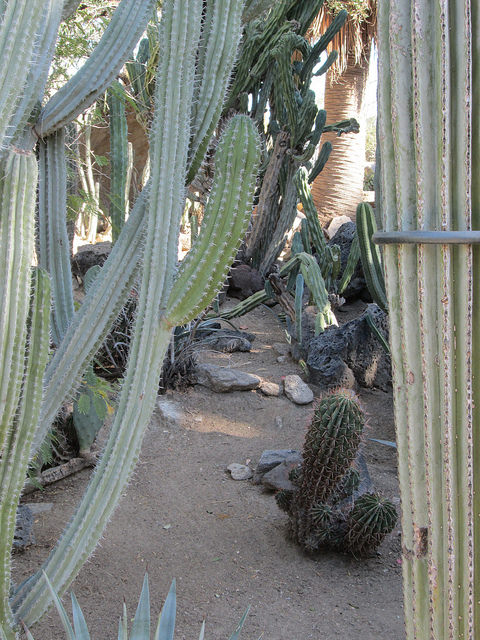
As I Sat and Rested, I Loved This View

This morning, I returned from a restful and enjoyable weekend with my brother and sister-in-law in the Coachella Valley. It seems that it takes half again as long to return to Los Angeles as it does to leave it. That’s because I usually leave early in the morning, a full hour before rush hour begins. It means staring into the rising sun as I approach Corona, but that lasts less than an hour. As Dan was working on building a home on Friday, I re-visited the Moorten Botanical Garden and hung out there for a couple of hours: It seems I never get bored looking at cacti. Then I went to Sherman’s Deli & Bakery for lunch, and spent the afternoon at a large Barnes & Noble close to where Dan lives. I picked up copies of Henry Green’s Back and Ross Macdonald’s The Way Some People Die. By then, Dan was back, and I drove the mile or so to my final destination.

Saturday was a special day, about which I will probably write a number of postings. In Desert Hot Springs, there is a museum named after and started by Cabot Yerxa, the man who discovered the hot springs at Desert Hot Springs. There was a Mexican Dia de los Muertos celebration, a few weeks before the November 2 date that is the Feast of All Souls in the Catholic Liturgy. Dan and I wandered around the premises, but did not take the tour because of the number of people present. I promised myself to return to Cabot’s Museum and lose myself in the wonderful zaniness of one of those original minds that seemed to blossom in the deserts of the Southwest.

Sunday, Dan, his wife Lori, and I went to see Damien Chazelle’s First Man (2018) starring Ryan Gosling about the space launches that culminated in the U.S. astronauts first walking on the surface of the Moon. The film was so intense that I was not conscious of two and a half hours passing, which I normally would be. I highly recommend this film.