The Pacific Red Cars

Martine at the Orange Empire Railroad Museum (2016)

If you have ever seen the movie Who Framed Roger Rabbit (1988), you’ve heard one theory why the best intraurban transportation system in America was destroyed. I think I can assure you that Judge Doom’s hatred of cartoon characters was not the reason why the Pacific Red Cars stopped running around the 1950s. If you’re looking for a reason, you could blame the construction of new freeways, the desire of General Motors to put every American behind the wheel of a Chevrolet, or the aging of the Pacific Electric rolling stock.

My late friend Bob Klein even wrote a novel in which the Red Cars figured—The Road to Mount Lowe—an enjoyable work (if you can get your hands on a copy of it).

The Pacific Red Car Network at Its Height

For whatever reason, the Pacific Red Cars were replaced; and, L.A., which once had a world class public transportation system, wound up with bupkis. When I first came to Southern California, there were the buses of the Rapid Transit District (RTD), which were grossly inconvenient. For instance, going from West Los Angeles to Long Beach took upward of three hours or even more. Then the RTD gave way to the Metropolitan Transit Authority (MTA), and things slowly began to change for the better. First of all, the old Red Car right of way between downtown and Long Beach was rebuilt as the Blue Line. Two subway lines were built: the Red Line, connecting downtown to North Hollywood/Studio City, and the Purple Line, from downtown to Western Avenue. (The latter will eventually extend slightly west of the UCLA campus.) Then there was a Green Line connecting Norwalk to El Segundo. (Why didn’t they run from Norwalk to the airport? Politics?) Finally, the Expo Line now connects downtown L.A. to the beach at Santa Monica.

I am a regular rider of the Expo Line, allowing me to go downtown for thirty-five cents instead of paying twenty plus dollars for parking.

Although the present network is still nowhere as extensive as the original Red Cars, it’s nice to know that the public transportation scene in Southern California is no longer going into eclipse.


Calaveras

One of Posada’s Calaveras: Street Cleaners

John Webster was a Jacobean dramatist known for the grimness of his plays. According to the first stanzas of a poem by T. S. Eliot called “Whispers of Immortality”:

Webster was much possessed by death
And saw the skull beneath the skin;
And breastless creatures under ground
Leaned backward with a lipless grin.

Daffodil bulbs instead of balls
Stared from the sockets of the eyes!
He knew that thought clings round dead limbs
Tightening its lusts and luxuries.

Donne, I suppose, was such another
Who found no substitute for sense,
To seize and clutch and penetrate;
Expert beyond experience,

He knew the anguish of the marrow
The ague of the skeleton;
No contact possible to flesh
Allayed the fever of the bone.

I cannot think of these lines without think of José Guadalupe Posada (1852-1913), who is famous for his depictions of cavorting skeletons.

Posada’s “The Day of the Dead”

As I am thinking once again of going to Mexico this next winter, I am thinking of the country’s great artists, including José Clemente Orozco, Diego Rivera and Frida Kahlo, David Siqueiros, and Rufino Tamayo, to name just a few. And Posada belongs on that list, though perhaps in a more minor key.

Unlike most Americans, the people of Mexico do not sweep the idea of death under a carpet. In fact, November 2, called All Souls Day in the Catholic Church, is the Dia de los Muertos, the Day of the Dead, throughout Mexico. Families visit their dead in the cemeteries with a picnic lunch and with all their children in tow. I remember a long intercity bus ride back in the 1980s on this day on which most of the passengers were joyfully looking forward to their Day of the Dead festivities. The children had white sugar calaveras, or skulls, which are a special treat available throughout the country.

This feeling about death goes back to the Maya and the Aztecs, who fought wars just to get prisoners to serve as sacrificial victims, whose hearts were cut out still steaming from their bodies with an obsidian knife and dedicated to the gods.

Along the San Andreas Fault

The San Andreas Fault Cutting Through the Carrizo Plain

Yesterday, as we were motoring along the Soda Lake Road through the heart of the Carrizo Plain, Bill Korn said something that made me sit up. “Those mountains on the right have nothing to do with the ones on the left.” The truth of that remark hit me between the eyes. The Plain was a boundary between two tectonic plates—the North American Plate on the right, which was moving ever so slowly to the southwest, and the Pacific Plate, containing most of the population of California, was as slowly heading northwest in the direction of Alaska. And Bill was right, the two mountain chains, separated from each other by only a few miles, had no resemblance.

The movement amounts to an average of only a few millimeters a year, but there have been times that the motion has been more catastrophic. In 1857, the Fort Tejon Earthquake created the strange Chinese scenery of the Devil’s Punchbowl on the north slope of the San Gabriels. Then there was the 1906 temblor and fire that leveled San Francisco and the 1989 Loma Prieto quake. There will be more, a lot more, but hopefully spread over many years. I have lived through the 1971 Sylmar Quake and the 1994 Northridge Quake, both of which had me gelid with fear.

A Map of the San Andreas Fault

Perhaps I dwell too much in my blog posts about volcanoes, earthquakes, hundred year floods, and other disasters. That is because I realize how fragile our lives are. Most people would rather not think about such things, even if they are inevitable. So they build unreinforced brick houses on fault lines or live on the banks of rivers that frequently overflow their banks. Then there are those Guatemalan peasants who live on the slopes of volcanoes because the earth there is so conducive to growing coffee beans and other crops.


The Carrizo Plain

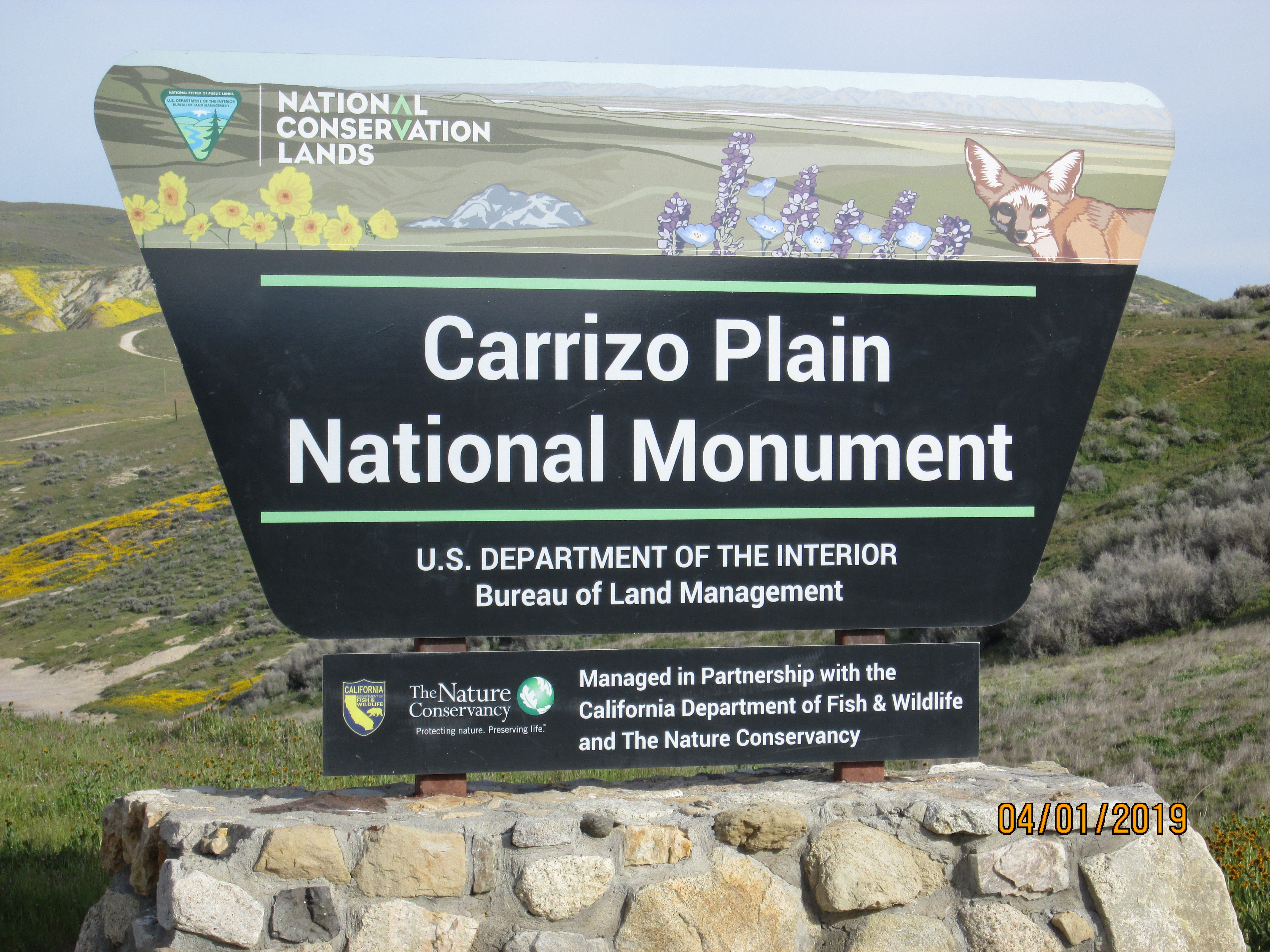
Welcome Sign at the South Entrance

My friend Bill Korn and I have been talking about seeing the wildflower blooms at the Carrizo Plain for several years now. As long as I worked doing taxes, however, I was never able to go before April 15; and by that time, the show was all over. Now, being retired, I jumped at the chance. Bill and I met at a Western Bagel in Valencia—he started his trip in far-off Altadena—and we set out in his Prius.

On the way, we passed through Frazier Park and the high country around Mount Pinos before descending some four thousand feet to the level of the Carrizo Plain.

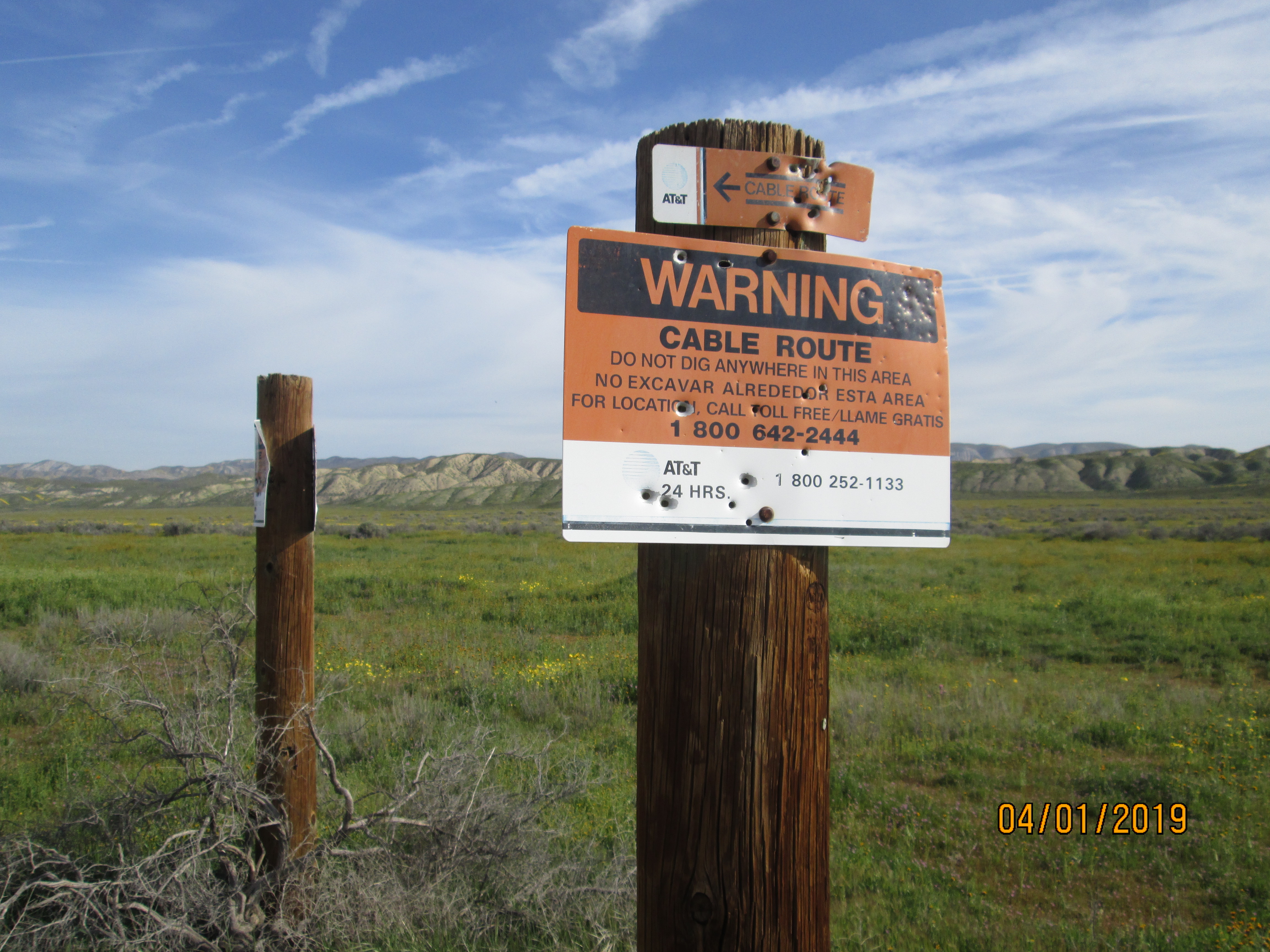
The AT&T Cable Runs Through the Park

The Carrizo Plain National Monument is different from most national parks I have visited. There is no one to collect admission fees at the entrances, and no park rangers were in evidence (though I suspect they exist). Though it was a Monday, there were a lot of cars, particular in the northern part of the park. Most of the action is along the main route called Soda Lake Road that runs the length of the park, paved for approximately half its length, and oiled dirt and gravel for the other half. There were numerous dirt roads that led to subsistence ranches and places that were inaccessible because of deep mud lingering from the heavy rains earlier in the year.

One interesting feature of the park is that Soda Lake Road runs side by side with the San Andreas Fault. I plan to write about this tomorrow if I have the time.

Wildflowers in Great Abundance

This park is probably the largest single section of California grassland that is more or less intact. I didn’t get the feeling that the few ranches we passed made much of a negative impact on the wildness of the place.

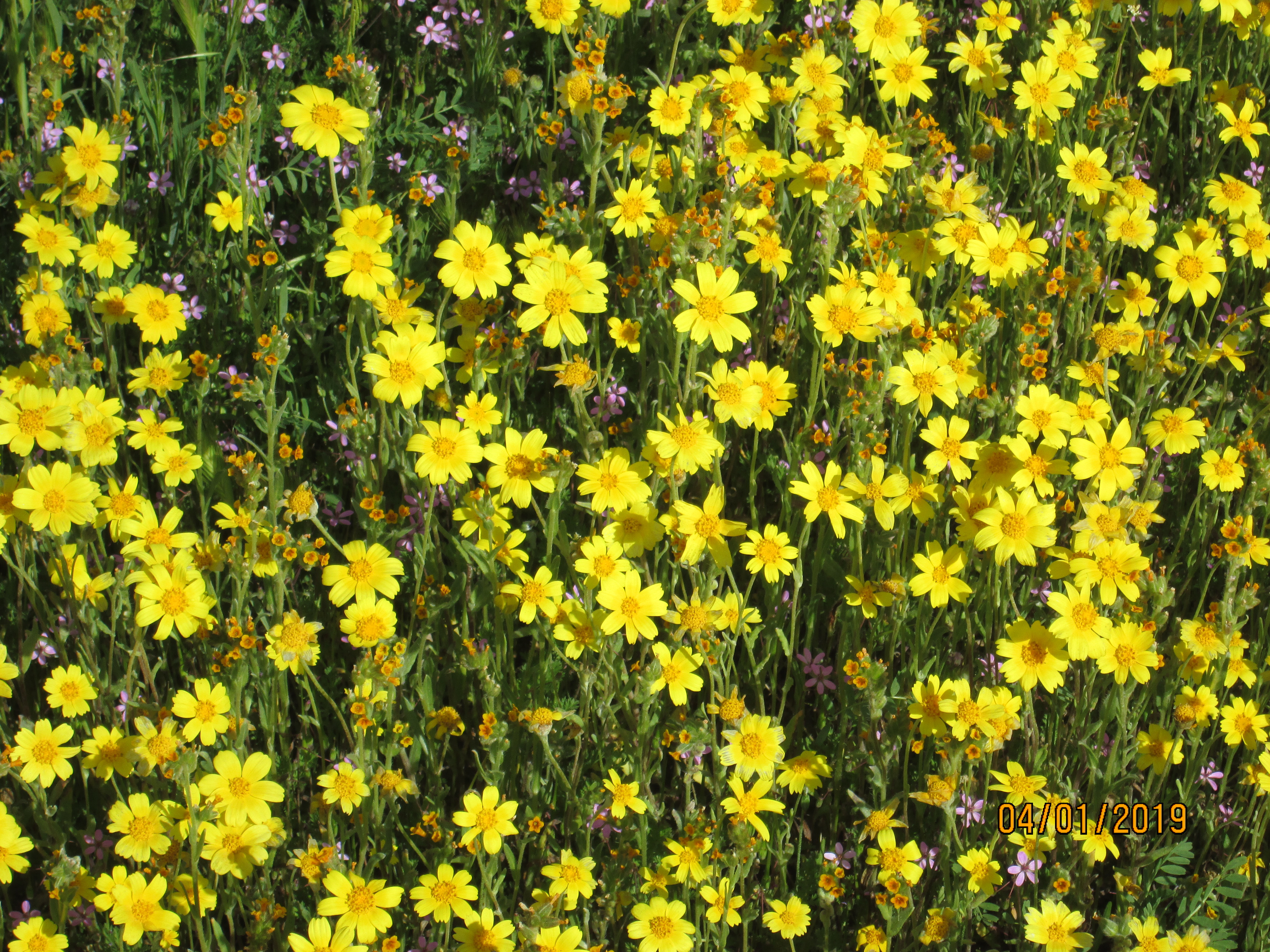
Wildflowers Close Up

I will not soon forget the beauty of the Carrizo Plain. I hope I can return some day after another spectacular peak wildflower bloom.