La Merced

Basilica and Convent of Nuestra Señora de la Merced in Lima, Peru

In the historic center of Lima, Peru, on the Jirón de la Union, sits one of the oldest churches in South America. When I visited Peru five years ago, I would have the taxi driver let me off at the south end of the Jirón so that I could pass by the elaborate Churrigueresque façade of La Merced and wander in. When I dropped in at these old churches I frequently found myself attending Holy Mass as I was gaping at the gorgeous decorations. I always stayed to the end, out of respect for the religious orders which built such splendid edifices to worship God.

I do believe that the Spanish kings only got a fraction of the gold that was mined in the New World, and that the lion’s share went to the Church and is visibly on display.
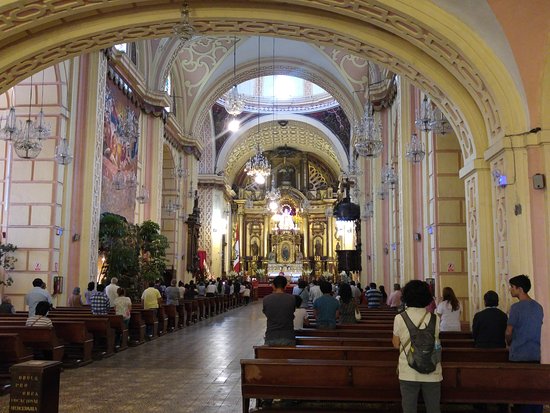
Interior of La Merced

As I have said on other occasions, I visited Peru because of the Incas, but what really caught my eye were the old Catholic churches, some dating back almost 500 years. La Merced was built around 1535 by the Mercedarians, short for the Royal, Celestial, and Military Order of Our Lady of Mercy and the Redemption of Captives. In fact, if I were to visit Peru again—as I hope to—I would skip Machu Picchu and spend more time viewing the Catholic churches and their related ecclesiastical art.


Favorite Films: Chinatown (1974)

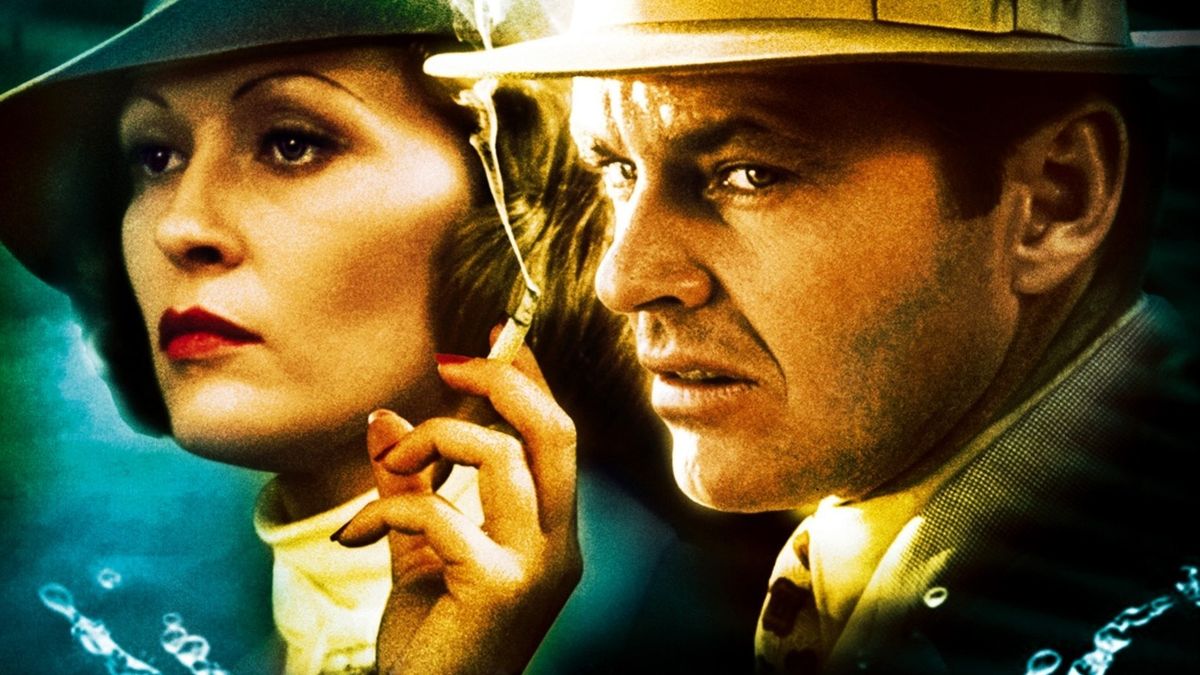
Faye Dunaway and Jack Nicholson in Chinatown

I have always loved film noir, a uniquely American genre that reveals the dark underbelly of life in the U.S. It gets particularly interesting when that revelation is from a foreign filmmaker who succeeds in seeing us for what we are. And, of course, although he is a great film artist, Polanski has been driven from our shores for statutory rape several years after his lovely pregnant wife, Sharon Tate, was mutilated and murdered by Charles Manson’s followers.

Last night I saw the unrelentingly vicious The Sweet Smell of Success (1957) with Burt Lancaster and Tony Curtis, directed by a Scotsman—Alexander Mackendrick—known mostly for such British comedies as Whisky Galore, The Ladykillers, and The Man in the White Suit. Tonight, after a long absence, I saw Chinatown (1974), one of the greatest (and last) noir masterpieces.

Director Roman Polanski in a Bit Part as a Thug

The film presents us with a conundrum about the strange murder of L.A. water commissioner Hollis Mulwray. Detective Jake Gittes (Nicholson) is hired by a woman posing as Mrs Mulwray to find the woman that her husband is seeing on the side. It turns out that the real Mrs Mulwray (Dunaway) did no such thing. But Gittes begins to uncover so many weird secrets relating to water delivery and real estate chicanery that the ultimate secret finally starts to make itself known. Film director John Huston as multimillionaire Noah Cross plays a pivotal role in pushing the film to its shocking conclusion.

We do not usually encounter a hero who is forced to submit to raw, naked power the way that Jake Gittes is forced to; and that is a more European contribution from the film’s Polish director. We are used to seeing our film heroes prevail against insuperable odds. Of course, that doesn’t usually happen in real life.

Chinatown is a film worth seeing many times. After all these years, I am only now beginning to understand it.


“Field Flowers”

“certainly / you don’t look at us”

I was eating lunch at the Westfield Mall in Culver City when I was struck by a few lines from a poem by Louise Glück which originally appeared in The New Yorker on February 16, 1992. When I got home, I hunted down the full text of the poem and decided to share it with you here:

Field Flowers

what are you saying? that you want
eternal life? are your thoughts really
as compelling as all that? certainly
you don’t look at us, don’t listen to us,
on your skin
stain of sun, dust
of yellow buttercups: i’m talking
to you, you staring through
bars of high grass shaking
your little rattle—o
the soul! the soul! is it enough
only to look inward? contempt
for humanity is one thing, but why
disdain the expansive
field, your gaze rising over the clear heads
of the wild buttercups into what? your poor
idea of heaven: absence
of change. better than earth? how
would you know, who are neither
here nor there, standing in our midst?

There is something about this poem, with its view of humanity from the point of view of wildflowers. I thought it was nicely done.


Serendipity: A Halloween Gift

American Author Sarah Orne Jewett (1849-1909)

As a special Halloween present for you, I give you a paragraph from a wonderful ghost story from Mike Ashley’s Great American Ghost Stories: Chilling Tales by Poe, Bierce, Hawthorne and Others. The tale in question is Sarah Orne Jewett’s “Lady Ferry,” the tale of a woman who has lived has been cursed with an incredibly long life, reminding one of Wagner’s Flying Dutchman and Eugène Sue’s The Wandering Jew.

Although I wished to see my father and mother, I cried as if my heart would break because I had to leave the ferry. The time spent there had been the happiest time of all my life, I think. I was old enough to enjoy, but not to suffer much, and there was singularly little to trouble one. I did not know that my life was ever to be different. I have learned, since those childish days, that one must battle against storms if one would reach the calm which is to follow them. I have learned also that anxiety, sorrow, and regret fall to the lot of every one, and that there is always underlying our lives, this mysterious and frightful element of existence; an uncertainty at times, though we do trust every thing to God. Under the best-loved and most beautiful face we know, there is hidden a skull as ghastly as that from which we turn aside with a shudder in the anatomist’s cabinet. We smile, and are gay enough; God pity us! We try to forget our heart-aches and remorse. We even call our lives commonplace, and, bearing our own heaviest burdens silently, we try to keep the commandment, and to bear one another’s also. There is One who knows: we look forward, as he means we shall, and there is always a hand ready to help us, though we reach out for it doubtfully in the dark.


Devil Winds for Halloween

Wind-Driven Fires for Halloween

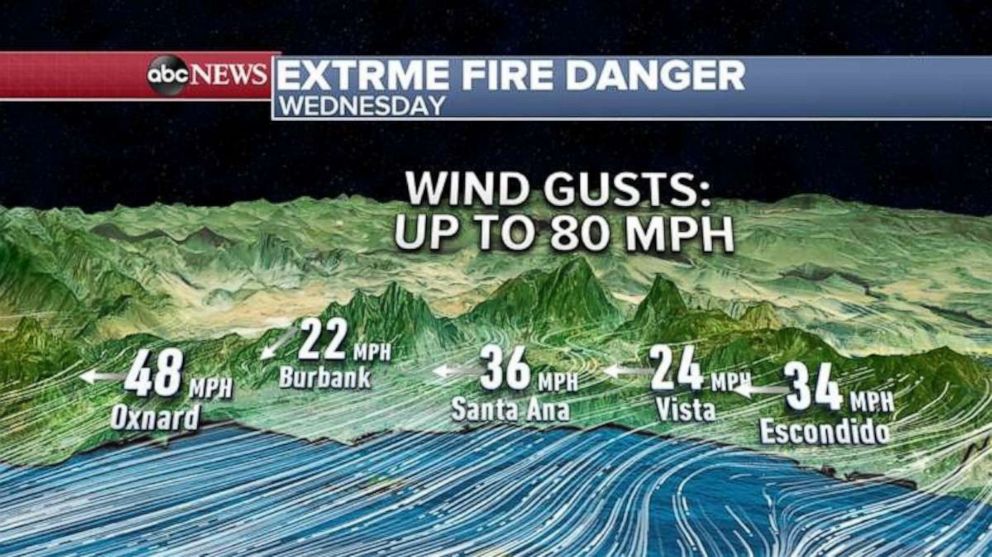
At one point this afternoon, there were ten active wind-driven brush fires in Southern California. Although Martine and i do not live in any of the affected canyon areas, we felt the devil winds of the Santa Anas juddering against the walls, windows, and doors of our apartment.

The winds are so powerful, in fact, that they blew away the second “e” in EXTREME. Do you suppose they could have meant EXTRUME or EXTRIME?


Manzanar Revisited

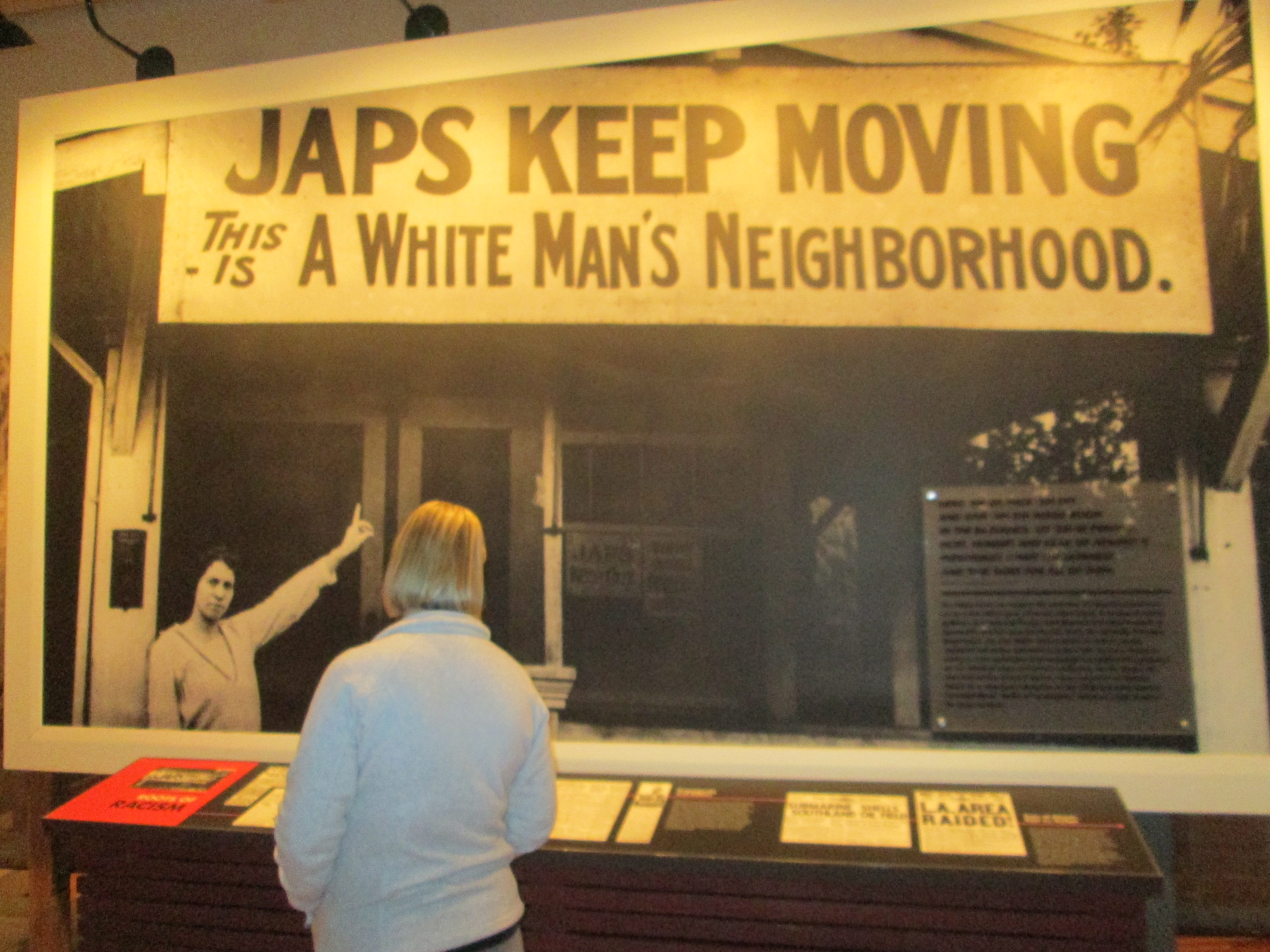
White Racism at Its Ugliest

Living in Los Angeles as I have for over half a century, I have lived and worked with many Japanese whom I regard as my friends. They are also as American as apple pie—if not more so. So it strikes me as one of America’s crimes that 112,000 Japanese Nisei and issei were interned in some ten concentration camps scattered across the Western States.

The most famous of these camps is Manzanar, located midway between Lone Pine and Independence in the Eastern Sierras. The former camp is now the Manzanar National Historic Site, managed by the National Park Service (NPS). Martine and I had visited it in the past, perhaps as much as three times. Last week, we visited it again. We were happy to see that the NPS had reconstructed four buildings in Block 14 of the camp: two barracks, a women’s latrine, and a mess hall. (Beware of dinner on Tuesdays, when the infamous Slop Suey was served.)

In the crazy divided political world of today, it is nice to see a park whose reason for existence is an indictment of American racism during World War II. Yes, the Japanese were our enemy; but so were the Germans, and we didn’t intern any of them. More’s the pity: Perhaps our current Presidente might never have been born.

If you are driving up (or down) Highway 395, it is worth spending an hour or two visiting Manzanar. And be sure to see the 22-minute video shown every half hour.


Oasis

The Mount Whitney Fish Hatchery

As each breath I take fills my lung with ash from the Getty Fire, which is just a few miles north of my front door, I look back to the unexpected highlight of last week’s trip to the Eastern Sierras. I am referring to the Mount Whitney Fish Hatchery in Independence, California.  Built in 1916, the hatchery was run by the California Department of Fish and Game until 1996, when the State found they couldn’t afford its upkeep. It was then that a nonprofit organization called the Friends of Mt. Whitney Fish Hatchery was formed to run the former hatchery as a museum, with an interpretive center and gift shop.

The real highlight are the grounds, which include a pond well stocked with rainbow trout and visiting ducks. A small number of fish (mostly trout) are still hatched there as part of the museum.

Martine fell in love with the gift shop, which included two items of special interest to her: some attractive and reasonably-priced quilts made by a woman in Bakersfield and a bucket filled with packets of fish food. We purchased one of the quilts, and several packets of fish food.

It turns out that the ducks were more aggressive about begging for the fish food than the trout. That was all right with Martine, as she enjoyed feeding the ducks more, while I thought of them as shameless beggars.

We actually visited the Fish Hatchery on both Thursday and Friday last week. It was a beautiful and peaceful place.

A wildfire in July 2007 burned 55,000 acres west of the hatchery. Then, a year later that same month, a heavy thunderstorm caused a mudslide that damaged part of the hatchery as well as two of the employee residences. I am delighted that the Friends of the Mt. Whitney Fish Hatchery managed to clear the damage and re-open the facility.

If you find yourself on Highway 395 and desire a couple of peaceful hours in a beautiful locale, I highly recommend a visit to the hatchery. And say alone to the ducks and trout for me.


The Alabama Hills Trifecta

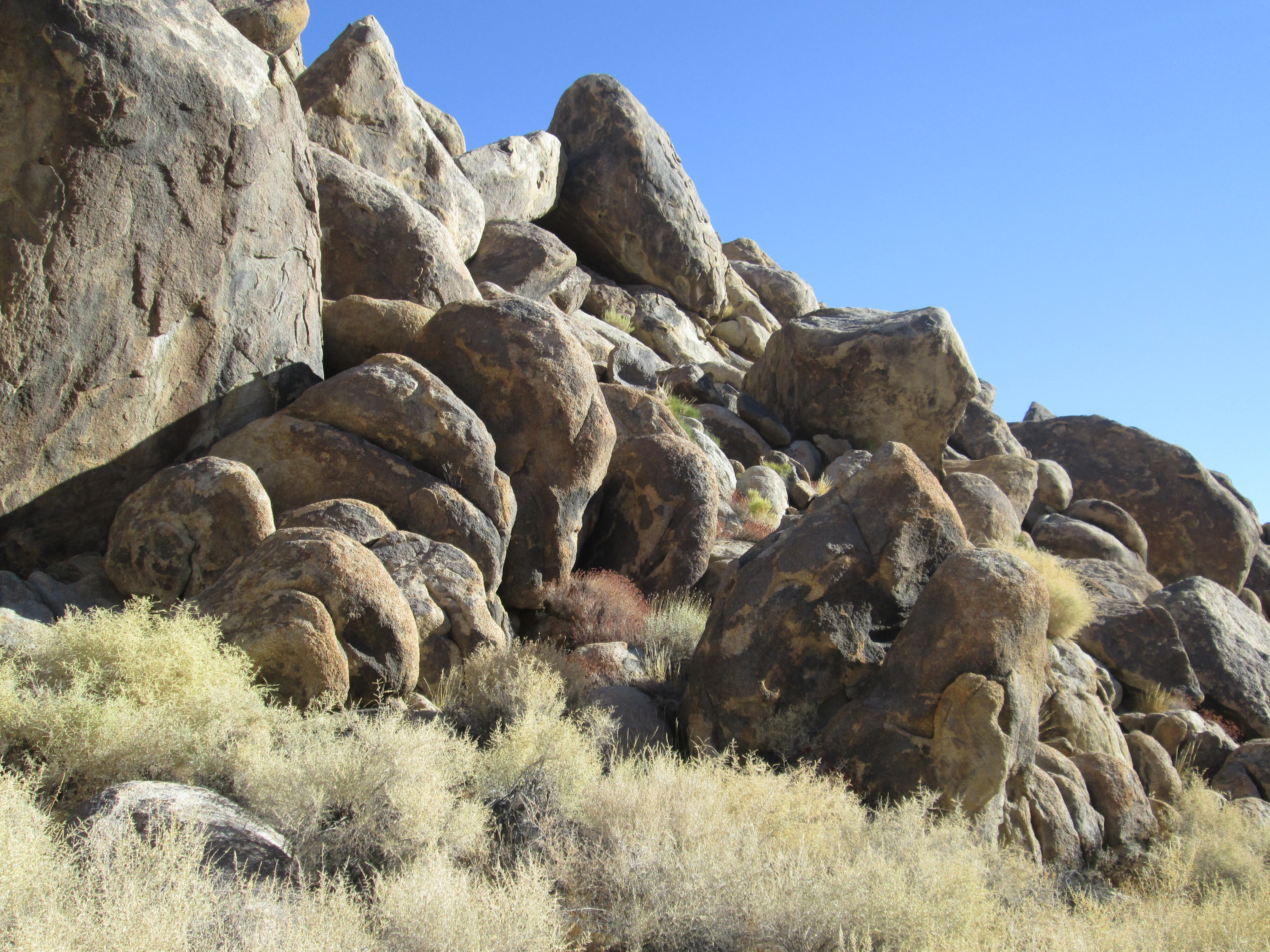
Seemingly Endless Piles of Rounded Rocks

Just west of the town of Lone Pine are a strange set of foothills comprised of picturesque rounded rocks piled up for hundreds of feet or more, behind which are the tallest peaks of the Sierra Nevada, including Mount Whitney. Among these rounded rocks were shot hundreds of Westerns, not to mention horror films, sci-fi, and you-name-it. Following is a ridiculously partial list:

  • 3 Godfathers (1948), with John Wayne and directed by John Ford
  • Around the World in 80 Days (1956), with David Niven
  • Bad Day at Black Rock (1955), with Spencer Tracy
  • Chaplin (1992), with Robert Downey, Jr.
  • Django Unchained (2012), directed by Quentin Tarantino
  • Gladiator (2000), with Russell Crowe
  • Gunga Din (1939), with Cary Grant
  • High Sierra (1941), with Humphrey Bogart
  • Lost Horizon (1937), with Ronald Colman
  • The Ox-Bow Incident (1942), with Henry Fonda
  • Ride Lonesome (1959), with Randolph Scott
  • Riders of the Purple Sage (1925), with Tom Mix
  • Zabriskie Point (1970), directed by Michelangelo Antonioni

And the list goes on and on, including whole series of Westerns with the Lone Ranger, Jack Hoxie, Hopalog Cassidy, Randolph Scott, Tim Holt, Ken Maynard and others too numerous to mention. Not for nothing is there a Lone Pine Western Film History in town. In fact, the perfect visit to Lone Pine should include a visit to the museum (allow two to three hours) and a morning visit to the Alabama Hills, where so many films were shot.

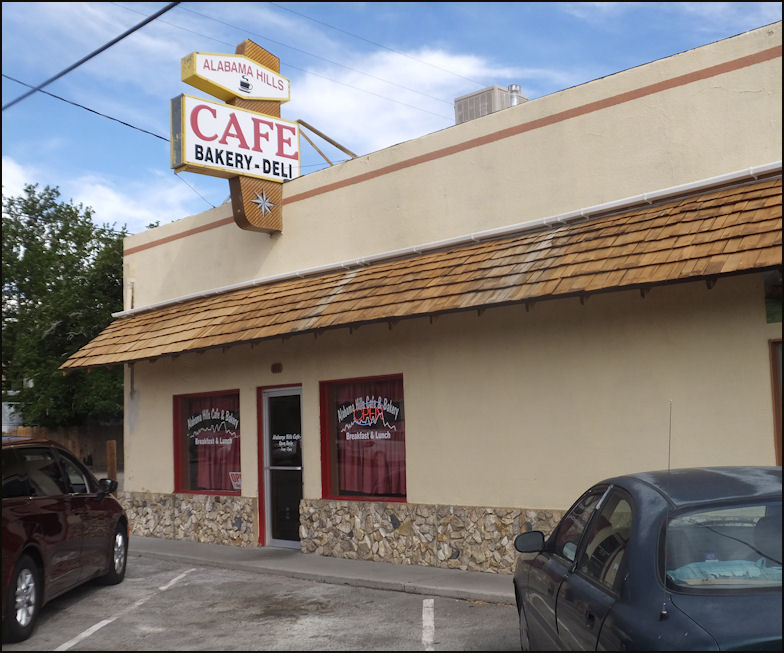
The Alabama Hills Cafe on Post Street in Lone Pine

Actually, why not make a Trifecta out of your visit? Eat breakfast or lunch at the Alabama Hills Cafe and Bakery for absolutely delicious food lovingly prepared. On our trip last week, Martine and I ate there for three meals: one breakfast and two lunches. The restaurant is closed for dinner, and you may have to wait for a table. (If necessary, do so: It’ll be worth your while.)


California Burning

Scene from the Tick Fire

Today, as Martine and I returned from the Eastern Sierras, we passed where the Tick Fire jumped the Highway 14 Freeway and turned the wooden posts holding up the steel guardrails into a line of torches. We also looked toward the summit of a hill and saw a ruined mansion which had been burned to a crisp. The traffic slowed to a crawl as the motorists stared at the devastation—and this was just the southern boundary of a fire that had scorched 4,600 acres (1,862 hectares) as of a couple hours ago.

As we drove south, we weren’t 100% certain that Highway 14 (the Antelope Valley Freeway) was open to southbound traffic. It was only when we drove into Mojave for lunch that we were relieved we didn’t have to go by way of Tehachapi and Bakersfield to Interstate 5, which would have added more than an hour to an already long ride.

The climate change which so many nincompoops deny seems to be turning the Golden State into charcoal.

Martine and I live in the flatlands of Los Angeles, which are not susceptible to brush fires. It’s bad enough, however, to have one’s lungs filled with fine ash. It makes me sneeze so hard that I burst the capillaries in my nose and have to cope with a stubborn nosebleed.