Of Ideological Purity

Nuclear Power Plant Cooling Tower

One of the reasons the Democrats have such a hard time winning the hearts and minds of voters for the presidency is that they hamstring themselves with an insistence on ideological purity—even where it doesn’t matter. Take the issue of nuclear power, for instance. We know from Three Mile Island, Chernobyl, and Fukushima that nuclear power can be deadly. So instead of improving the safety of nuclear power, many U.S. politicians have decided that all nuclear power is potentially deadly.

In a rush to legitimize the LGBTQRSTUV &c &c population, we have created a minefield on the subject of gender identity. And even more, with the #MeToo movement, while attempting to eliminate sexual harassment from the social sphere and workplace, we have created another minefield—one that has ensnared such relative innocents as Joe Biden and Al Franken.

To What Extent Is This Serious Sexual Harassment?

Granted that Biden’s and Franken’s touchie-feelie incidents are in poor taste, to what extent have they they done anything more than remind us that sometimes people can behave inappropriately while not at the same time criminally. Do such acts merit political banishment for all time?

Now we are finding that—if ever one went around in blackface for any reason and irrespective of time period—they are racist. Again, I just think such persons were being merely inappropriate.

Consider that our current president is one of the most inappropriate human beings on the planet. And he has gleefully admitted to behaving boorishly on issues relating to sex, race, religion, and just about any other issue about which people are insensitive. So why are Democrats doing Trump’s work for him, by banishing politicians for venial sins while the major malefactor laughs up his sleeve?


 

Repeat Performances

I Frequently Re-Read Books That Have Impressed Me

This year I have re-read ten books since the start of 2019, such as Joseph Conrad’s Lord Jim. It has been eleven years since I have read any Conrad, back when I had finally finished Under Western Eyes, which I had started back in college. The main reason I ever re-read a book is to see whether I have somehow changed in the intervening years. Very occasionally, I forget that I have read a particular work in the past and go through it a second time, not realizing my mistake until I check my reading log. Below is a list of 2019 re-reads:

  • Joseph Conrad: Lord Jim
  • Laurence Sterne: The Life and Opinions of Tristram Shandy, Gentleman
  • Sean O’Casey: Juno and the Paycock
  • Virginia Woolf: Monday or Tuesday, Eight Stories. I re-read this one by accident.
  • John Lloyd Stephens: Incidents of Travel in Central America, Chiapas and Yucatán and Incidents of Travel in Yucatán. I will probably re-read a number of other books about Mexico in the next few months, most of which I have not touched for over 30 years.
  • William Shakespeare: Hamlet. Multiple re-reads.
  • G. K. Chesterton: Robert Louis Stevenson and The Poet and the Lunatics. I frequently re-read Chesterton for sheer enjoyment.
  • J. E. Neale: Queen Elizabeth I

A Joy to Read Any Number of Times

As my Yucatán vacation draws close, I will probably re-read Fanny Calderón de la Barca’s Life in Mexico; Charles Macomb Flandrau’s Viva Mexico!; and Malcolm Lowry’s Under the Volcano and a few other books.


Real Genius

Hank Williams (1923-1953)

Where is the real artistic genius of America to be found? Sad to say, it’s not literature. It’s not painting or sculpture. Near as I can say, what the United States will be most remembered for is music—not only jazz, blues, soul, bluegrass, rockabilly, zydeco, gospel, country & western, but much of rock & roll as well. Names like Elvis Presley, Hank Williams, Miles Davis, Muddy Waters, John Coltrane, and a host of others will answer the question: What has America produced that will stand the test of time?

As a self-proclaimed intellectual, I am aware that such a title cuts no mustard in the U S of A. Far from it. It’s almost a term of opprobrium.

Mississippi John Hurt (1892-1966)—A Favorite of Mine

Curiously, in such a racist country as ours, it’s the only place that comfortably cuts through the racial divide.Black artists copied from the whites, though not nearly as much as white artists copied from African-Americans.

Of course, there is no Nobel Prize for music. It registers in the heart—and, typically American, at the Box Office.

Cogitus Interruptus

Sir Joshua Reynolds’s Portrait of Laurence Sterne

He was a Yorkshire Anglican clergyman who just happened to write one of the five greatest novels ever written, Laurence Sterne (1713-1768) gave us The Life and Opinions of Tristram Shandy, Gentlemen (1759-1761), a book that can be read and re-read with pleasure over an entire lifetime. It was in the mid 1960s that I first encountered it in Chauncey C. Loomis’s class on “The Eighteenth Century English Novel.” Loomis was my favorite professor of English, which happened to be my major at Dartmouth. I am still re-living that class and re-reading the books that he assigned. That makes his class one of the best I ever took.

Tristram Shandy revolves around four plot points that would seem to be pretty thin. All the plot points involve either interruptions or “abridgments” of various sorts:

  1. Just as Mr Shandy and his wife are approaching orgasm, the latter asks her husband if he has rewound their clock.
  2. When Tristram is being born, the forceps of Dr Slop, who presides at the birth, crush the little lad’s nose.
  3. As a result of a miscommunication with one of the servants, the new baby is christened Tristram instead of Trismegistus.
  4. Tristram is accidentally circumcised when a window crashes down upon his foreskin.

How these four main plot points are stretched out over some five hundred pages of warmth and hilarity is a major miracle. The plot is positively Ptolemaic, with little epicycles and interruptions that create hilarious interludes.

It has always amazed me that it is the young Tristram Shandy who is narrating the novel. Yet he is not born until midway through the book, after we have been exposed to numerous incidents which the young Shandy could not have experienced as he was still in utero.

I can see myself coming back to Tristram Shandy again and again, paging at random to the beginning of a sequence, and reveling in it again … and again.

Serendipity: The Marbled Page

The Notorious Marbled Page in the Middle of Tristram Shandy

One of the oddest novels ever published is Laurence Sterne’s The Life and Opinions of Tristram Shandy, Gentleman (1759-1761). I first encountered it in college in a class on the 18th Century English Novel. I fell in love with its eccentric charms when I was scarce nineteen years old. Upon re-reading it, I love it all the more. The novel seems to start several times in its nine books, and there is a marbled page (see above) several hundred pages in. I have a whole lot more to say about this book in a future post. Below is the first paragraph of the book:

I wish either my father or my mother, or indeed both of them, as they were in duty both equally bound to it, had minded what they were about when they begot me; had they duly consider’d how much depended upon what they were then doing;—that not only the production of a rational Being was concerned in it, but that possibly the happy formation and temperature of his body, perhaps his genius and the very cast of his mind;—and, for aught they knew to the contrary, even the fortunes of his whole house might take their turn from the humours and dispositions which were then uppermost;—Had they duly weighed and considered all this, and proceeded accordingly,—I am verily persuaded I should have made a quite different figure in the world, from that in which the reader is likely to see me.—Believe me, good folks, this is not so inconsiderable a thing as many of you may think it;—you have all, I dare say, heard of the animal spirits, as how they are transfused from father to son, &c. &c.—and a great deal to that purpose:—Well, you may take my word, that nine parts in ten of a man’s sense or his nonsense, his successes and miscarriages in this world depend upon their motions and activity, and the different tracks and trains you put them into, so that when they are once set a-going, whether right or wrong, ’tis not a half-penny matter,—away they go cluttering like hey-go mad; and by treading the same steps over and over again, they presently make a road of it, as plain and as smooth as a garden-walk, which, when they are once used to, the Devil himself sometimes shall not be able to drive them off it.


At the Cabrillo Marine Aquarium

Fish Tank at the Cabrillo Marine Aquarium

Yesterday, Martine and I visited the Cabrillo Marine Aquarium in San Pedro. Situated as it is within hailing distance of the Port of Los Angeles, the Aquarium is as much a scientific oceanographic institution as it is an aquarium purely for show. The Aquarium of the Pacific in Long Beach is only a few miles east and is primarily an aquarium for show.

We spent several hours looking at the various tanks and asking questions of the highly educated staff. What impressed me the most was feeding largish sea snails with algae. They seemed to suck in the algae as if they were smoking a joint.

One of the highlights was watching a video produced by the institution about how they went about collecting specimens for research and display.

One of the Features of the Southern California Coastline Are the Vast Kelp Forests

We had visited the Cabrillo some twenty years earlier and were surprised to see how much the institution has grown over the years. I was impressed by the fact that admission was by voluntary donation, and that the beach parking was reasonably priced ($1.00 per hour). Expect a visit to take somewhere between two and three hours.


King of the Bs

Filmmaker Edgar G. Ulmer (1904-1972)

Back in the day that the big Hollywood studios ran the film market, there were two categories that were offered to movie exhibitors. There were the A films and the B films. The idea was to offer two films to exhibitors for the price of one. The A film was the big draw and almost always the more expensive to produce. Then there were the B films, which were run second on the double features. Sometimes, the big studios produced them, but they also offered products from various small studios that were collectively known as “poverty row.” These studios included:

  • Republic Pictures
  • Monogram Pictures
  • Eagle-Lion Pictures
  • Producers Releasing Corporation (PRC)

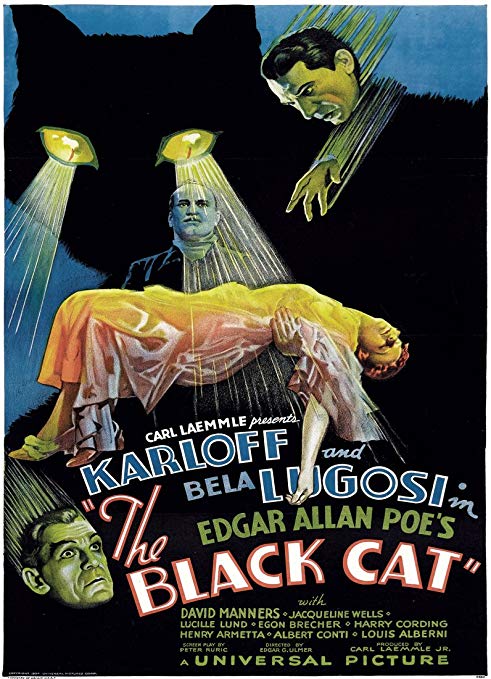
The leading director for PRC was Austrian-born Edgar G. Ulmer who, despite the fact that he rarely worked for the majors, made several dozen films, some of which are masterpieces. My favorite of the lot is a horror film that starred both Bela Lugosi and Boris Karloff, The Black Cat (1934), which he made for Universal. Although the film made money, studio chief Carl Laemmle fired Ulmer for having an affair with one of his married execs. Ever after, Ulmer skirted the edges of the industry.

Incidentally, although the film poster claims that the story for the film was from Edgar Allan Poe, I challenge anyone to explain to me which scenes were from the story. There is a black cat that occasionally appears, but the tale is not Poe’s.

Poster for The Black Cat (1934)

Another great is Detour (1945), a film noir starring Tom Neal and Ann Savage. It’s an amazing film that stands up to repeated viewings. I also liked Bluebeard (1944) with John Carradine. Both films were made for PRC.

I recently saw a film about Ulmer which included an interview with the director. Again and again, when asked how long it took to shoot a named film, he uniformly answered “six days.” This is a man who knew how to produce a creditable work quickly and with a down-to-bone budget.


Mexican Bus Travel Anecdotes

Toltec Ruins at Tula

After yesterday’s post on intercity buses in Mexico, I thought I’d present a few anecdotes about my experience riding the roads of la Republica over the years. For the most part, my experiences were good—though not all. But they were always interesting.

The worst was in the 1980s when I decided to take a bus trip to Tula to view the Toltec ruins there. I had no trouble getting there, but the return trip started on a bad note. While still on the streets of Tula, the Second Class Autotransportes Valle de Mezquital bus I was taking rear-ended a truck. Fortunately, no one was injured, and eventually the driver, ayudante, and passengers were all able to exit onto the roadway. The company was informed and sent another bus to complete the journey to the giant North Bus Terminal in Mexico City.

In 1979, my brother and I took a Transportes Lacandonia bus from Palenque, where we were visiting the Mayan ruins, to San Cristóbal de las Casas. Again, it was a Second Class bus, and the road was nowhere as nice as it is now. On the way, we saw another bus from the same company coming from the other direction off the road ensconced in a ditch. The driver and passengers were standing around waiting to be picked up and complete their journey. We stopped for a few minutes while the drivers compared notes.

On the same trip, near Ocosingo, our bus was stopped by a Mexican army checkpoint. We were near the Guatemalan border, and the army were checking for arms smuggling connected with the insurgency across the border, which was to go on until a truce was signed almost twenty years later.

That same trip, Dan and I took an all-night bus from San Cristóbal to Oaxaca on a first class bus. (I think it was the Cristóbal Colon line.) As we tried to drop off to sleep, we noticed a parade of cockroaches traveling along the base of the sliding windows. We shrugged and nodded off.


Taking Intercity Buses in Mexico

A Bus Ticket from Campeche to Merida in 1984

Americans do not like to take buses. That includes my brother, almost all of my friends and former co-workers. In Los Angeles, the private automobile is king—to the extent that public transportation is seen solely as for bums, crazies, and immigrants. In fact, intercity buses in the United States are mostly run by Greyhound Lines, a British company under the control of FirstGroup; and they do appear to be patronized mostly by bums, crazies, and immigrants.

In Latin America, it’s a different story altogether. If you have ever read Paul Theroux’s The Old Patagonian Express: By Train Through the Americas, you might think that it is possible to travel by rail through Latin America. Although there are a few exceptions—mostly tourist only trains in a few countries—most people in Latin America travel by bus. In many cases, these buses are far better than anything found in our country. In Argentina, I was able to get a good night’s sleep lying horizontally on seats that stretched out. These buses contained clean restrooms, stewards who served free meals, and (negligible) movies in Spanish.

I have traveled some 1,500 miles by bus in Mexico in the 1970s and 1980s. Almost all these buses were manufactured in Mexico and were every bit as good or better than Greyhound buses. This was especially true of First Class buses, which are theoretically direct to destination with few or no intermediate stops. Second Class buses can be hailed anywhere and can be rumbling rat-traps. I can think of the Unión de Camioneros de Yucatán (UCY) buses that I boarded in Uxmal enroute to Campeche in 1984 and 1992.  The windows were broken and the shocks were almost nonexistent, but they did get us to our destination. Some Second Class buses in Central Mexico, such as those of Flecha Amarilla were almost as good as First Class.

Model of an ADO Bus With 1980s Logo

The main First Class bus companies in Mexico include Autobuses de Oriente (ADO), Enlaces Terrestres Nacionales (ETN), Estrella de Oro, and Omnibuses de Mexico, as well as a few other carriers. Note that my ticket above assigns me to a particular seat (#16), and that for First Class buses, I usually reserved in advance by visiting the bus station the day before. With Second Class buses, you just hail them wherever, pay the ayudante (conductor), usually a young man, and take your seat, if you can find one.


“Limits”

A Street Corner in the San Telmo Neighborhood of Buenos Aires

Below is one of my favorite poems from the Argentinian Jorge Luis Borges. It is called “Limits.”

Limits

Of all the streets that blur in to the sunset,
There must be one (which, I am not sure)
That I by now have walked for the last time
Without guessing it, the pawn of that Someone

Who fixes in advance omnipotent laws,
Sets up a secret and unwavering scale
for all the shadows, dreams, and forms
Woven into the texture of this life.

If there is a limit to all things and a measure
And a last time and nothing more and forgetfulness,
Who will tell us to whom in this house
We without knowing it have said farewell?

Through the dawning window night withdraws
And among the stacked books which throw
Irregular shadows on the dim table,
There must be one which I will never read.

There is in the South more than one worn gate,
With its cement urns and planted cactus,
Which is already forbidden to my entry,
Inaccessible, as in a lithograph.

There is a door you have closed forever
And some mirror is expecting you in vain;
To you the crossroads seem wide open,
Yet watching you, four-faced, is a Janus.

There is among all your memories one
Which has now been lost beyond recall.
You will not be seen going down to that fountain
Neither by white sun nor by yellow moon.

You will never recapture what the Persian
Said in his language woven with birds and roses,
When, in the sunset, before the light disperses,
You wish to give words to unforgettable things.

And the steadily flowing Rhone and the lake,
All that vast yesterday over which today I bend?
They will be as lost as Carthage,
Scourged by the Romans with fire and salt.

At dawn I seem to hear the turbulent
Murmur of crowds milling and fading away;
They are all I have been loved by, forgotten by;
Space, time, and Borges now are leaving me.

As I drive and walk through the streets of Los Angeles, I, too, wonder which streets I am seeing for the last time. Is it Airlane Avenue in Westchester? Lemac Street in Van Nuys? Adelaide Street in Santa Monica? What about Paseo de Montejo in Mérida, Yucatan? Florida in Buenos Aires? The Royal Mile in Edinburgh? As we live, we eventually complete the circuits of our lives.