Putting Myself Down

I Have Always Underestimated Myself…

When I was young, I was always one of the shortest kids in my class—and one of the sickest. The result was that I habitually underestimated myself. Everyone else looked taller, happier, and more accomplished than me. And that even after I was the valedictorian of my class at Chanel High School in Bedford, Ohio. In fact, it was not until I reached the age of forty that I realized what I had been doing to myself. That was the age at which I was finally able to drive. Before that, I was on a medication (Catapres) that made me fall asleep whenever I got into a moving vehicle.

Within weeks after I got off Catapres, I took driving lessons and passed with flying colors. But then something happened to my picture of other people: The moment I saw drivers who committed moving violations at the rate of once every hundred feet or so, I began to revise my impressions of the rest of the human race.

Politics also stepped in to lower my estimation of my fellow Americans. I first became aware of political conservatism during the 1964 election, when Barry Goldwater was trounced by Lyndon Johnson. Conservatism was to become my bête noire during the following decades, where now I regard most Republicans and Trump followers to be mental defectives. Now that so many of these so many of these Trumpists are advocating a return to normalcy during a dreadful epidemic, I now look at people such as the individuals in the above photograph as suicidal fools who would think nothing of infecting their friends, neighbors, and families with a potentially fatal disease.

Do I have any regrets for being so hard on myself all those years? Not a bit. I think that I am happier than most people and less likely to be played like a marionette out of baseless fears.


A Ghost Town in the Mountains

Martine in Bodie, California, by Old Gas Pumps

During this awful quarantine year (soon to become the awful quarantine decade), I keep thinking back to the places I’ve been. Just to maintain social distancing, most of my favorite destinations in the U.S. and Latin America are severely curtailed. One of my favorite places along U.S. 395 is the ghost town of Bodie, California midway between Mono Lake and the Mono County Seat of Bridgeport.

There is nothing Disneyfied about Bodie. It was abandoned over a period of years, during which people just left their stuff behind them because it was just too difficult to cart away. That includes coffins, hearses, dishes, furniture, and all manner of things.

Horse-Drawn Hearse Left Behind

Unlike many other ghost towns, Bodie is run as a park in which the buildings and mining equipment are in a state of “arrested decay,” in which repairs ae made to prevent roofs and walls from falling in. The exception is for several houses which are kept up for State Park rangers and their families who stay year-round to protect the premises.

The cemetery at Bodie is one of my favorite features of the town. Life in Bodie could be nasty, brutish, and short, as attested by the tombstones.

One Little Girl Who Died Young

Part of the reason for the high mortality rate among the residents were the horrible winters. The altitude of Bodie is 8,375 feet (2,553 meters). It is some twenty-odd miles from the main highway and is susceptible to blizzards and high winds. And that’s besides the usual Old West killers as alcohol, gunfights, and mining accidents.


The Truest Grit

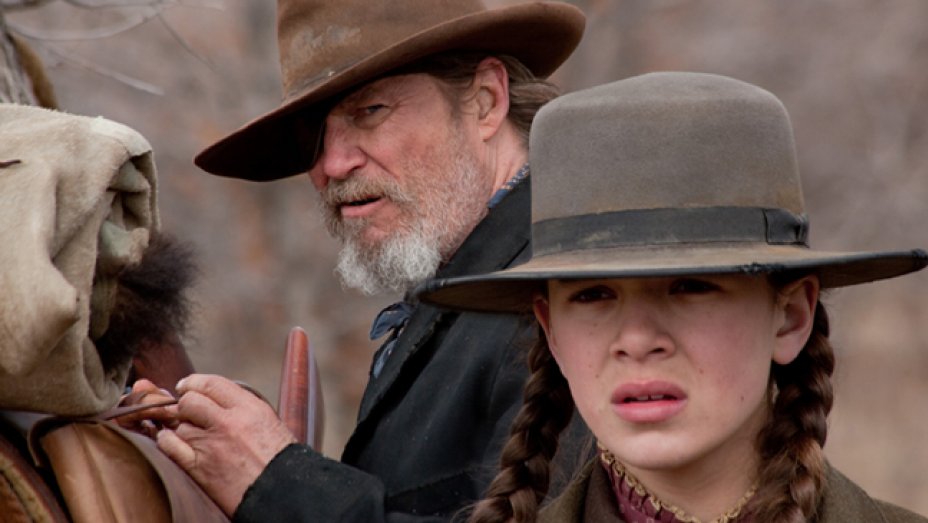
Jeff Bridges and Hailee Steinfeld in the 2010 Version of True Grit

It is generally considered a truism that a film remake is nowhere near as good as the original. Most of the time, that’s true. One case where it is not is the 2010 version of True Grit directed by Joel and Ethan Coen. I liked the John Wayne version with Kim Darby well enough, though I did not like Kim Darby near so much as I liked Hailee Steinfeld as the redoubtable Mattie Ross.

So today I decided to read Charles Portis’s 1968 novel. Earlier this year, I had read Dog of the South and Gringos and found in Portis a novelist very much to my liking. True Grit was even better. So good that I read straight through it, reveling in its language, which reminded me of the best of Mark Twain.

Novelist Charles Portis (1933-2020) with John Wayne as Rooster Cogburn in the Background

One of the things that struck me about Portis was how true he was to the idiom and the culture of his native Arkansas, even when he was setting his fiction in Mexico. Portis was not only authentic, but he was often funny and wildly entertaining. The ides of a 14-year-old-girl hiring a U.S. marshal to go after the killer of her father is by itself promising, but Portis made Mattie Ross into one of the most beloved girl characters in all of American fiction—all just by being fanatically true to her place and time.


The Prisoner [of Coronavirus]

The 1960s British Television Series That Epitomizes Our World

On one hand I am imprisoned by the dread ’Rona; on the other, I am liberated by it. I have been binge-watching the 1967 British television series The Prisoner, starring (an co-created by) Patrick McGoohan. Thanks to my being a member of Amazon Prime, I have access to a wealth of movies and television shows streaming at little or no cost to me. So far, I have seen all but the last five episodes of the series, which I have found to be a liberating experience.

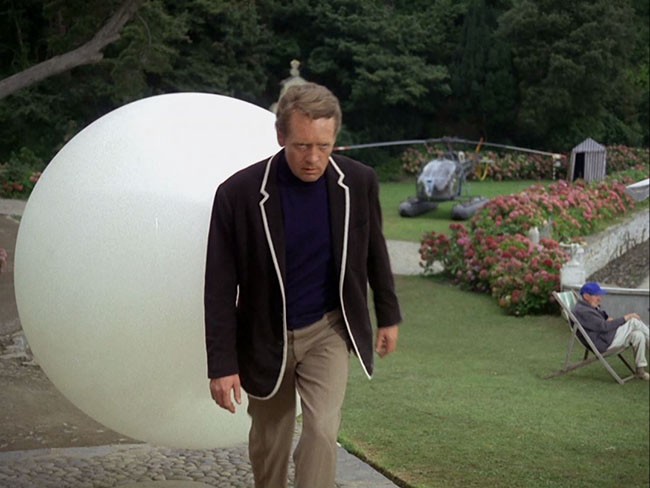
If you are not familiar with The Prisoner, it is about an unnamed spy for British intelligence who resigns suddenly and is carried off to a prison community referred to as “The Village,” in which everyone is known by a number. Our hero is Number 6. The village is headed by by a mysterious Number 1, whom thus far I have not seen, but is managed by a Number 2, who changes from one episode to the next—sometimes even within a single episode. Number 6 wants more than anything else to escape the village.

Number 6 Being Stalked by an “Enforcer Balloon”

One of the strange things about the village is that both the prisoners and the warders look alike, wearing overly cheery British resort wear, including multicolored capes and twirling multicolored umbrellas. It gives the prisoners a kind of manic appearance, as if most of them are enjoying their captivity.

When the series first came out in the U.S., it was too difficult for me to tune in at the same time on days it was broadcast. Now, as prisoner of the coronavirus, I can enjoy the series. (The same goes for Deep Space Nine, which I am binge-watching in parallel.)

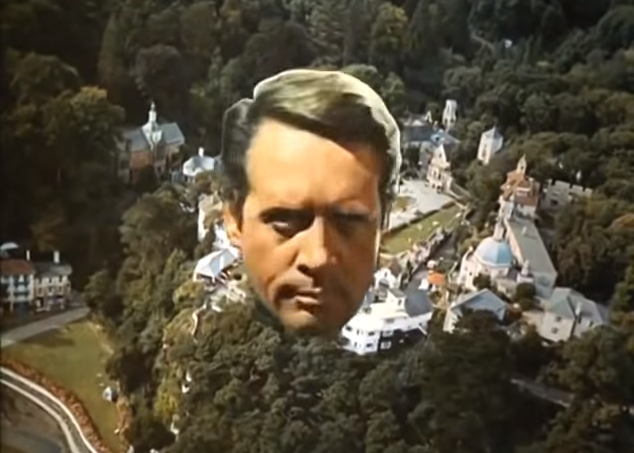
The Image of Number 6 Superimposed Over “The Village”

ddly, “The Village” is a real place: Portmeirion in Wales. You can stay there and dine in its restaurant without being answerable to Number 2.


Serendipity: A Plea from the Pagans

Winged Victory (Nike) bronze statue against background of Trajan’s Column and dome of Santa Maria di Loreto church. Rome, Italy.

I have always been fascinated by the period of transition from the Paganism of Ancient Rome to the Christianity of the last days of the Western Roman Empire. It was in AD 313 when Constantine declared Christianity to be the official religion of the empire with his Edict of Milan; and it was in AD 476 when the Western empire fell.

Naturally, the transition was not sudden. In AD 375, the Emperor Gratian had the Altar of Victory removed from the Roman Senate, this despite the fact that most of the members of the Senate were still Pagans. On that occasion, Quintus Aurelius Symmachus complained to the emperor: “Grant, I implore you, that we who are old men may leave to posterity that which we received as boys.” He goes on:

All things … are full of God, and no place is safe for perjurers, but the fear of transgression is greatly spurred by the consciousness of the very presence of deity. That altar contains in itself the harmony of the members of our order and the good faith of each of them individually. Nor does anything so much contribute to the authority of the Senate’s decrees, as the fact that one body, sworn to the same oath, has resolved them. Greco-Roman Paganism is to us a ridiculous body of myths, but to the Roman Senators, making sacrifices to the Altar of Victory was not only patriotic but an act of piety.

Symmachus continues:

Let me use my ancestral ceremonies, she says, for I do not repent me of them. Let me live after my own way; for I am free. This was the cult that drove Hannibal from the walls of Rome and the Gauls from the Capitolium. Am I kept for this, to be chastised in my old age?… I do but ask peace for the gods of our fathers, the native gods of Rome. It is right that what all adore should be deemed one. We all look up at the same stars. We have a common sky. A common firmament encompasses us. What matters it by what kind of learned theory each man looketh for the truth? There is no one way that will take us to so mighty a secret. All this is matter of discussion for men of leisure. We offer your majesties not a debate but a plea.

This plea did not sit well with the new Christian orthodoxy of the empire. St. Ambrose wrote the official response, which was essentially that Christianity was replacing the old order of things.

Interestingly, it is now Christianity that seems to be on the defensive … to be replaced by—whatever.


The Best Laid Plans…

Chace Park Seen from the Air

In my post of July 3 entitled “Plotting a Holiday Picnic,” I wrote about my plans for a 4th of July weekend picnic for two (Martine and me). It’s sometimes laughable how circumstances can change. I decided to choose today, Sunday, July 5, for the picnic—because I suspected that there would be too many people with too many fireworks on Saturday.

Martine wanted to go to Chace Park in the Marina because, regardless how hot the weather was near us, it always had a comfortable sea breeze. Originally, I thought of getting a picnic lunch at Chick-Fil-A, but I forgot that the restaurant is closed on Sundays. So we headed to Bay Cities Italian Deli in Santa Monica, but saw a humongous line waiting to get in. Ditto for Trader Joe’s in Marina Del Rey. So on Martine’s suggestion, we got our lunches in the deli and produce sections of a nearby Ralph’s Supermarket.

The only real negative about going to Chace Park was that parking cost ten dollars on this holiday weekend. No matter, I paid the fee and resolved to make myself comfortable with the peninsula’s sea breezes. There were no seals in evidence today, but we were able to eat our lunch and take a walk around the peninsula.

There were a lot of young males who flouted the social distancing rule, but we managed to keep our distance from them as they attempted their abortive “herd immunity” practices. I kept thinking back to my days working with U.S. Census data. In the United States, there are 21 males born to every 20 females; but, by around the age of 18, the number of females exceeds the number of males. Why? Because young American males find their way to an early grave through sheer stupidity.


The Walk to the Dance

John Ford’s Tombstone, Arizona in My Darling Clementine (1946)

I wasn’t feeling all that well late this afternoon, so I switched on the television to Turner Classic Movies (TCM). They were just starting John Ford’s My Darling Clementine, one of the best Westerns ever made. It’s one of those films I’ve seen so often that I could anticipate the actors’ lines and gestures seconds before they appeared on film.

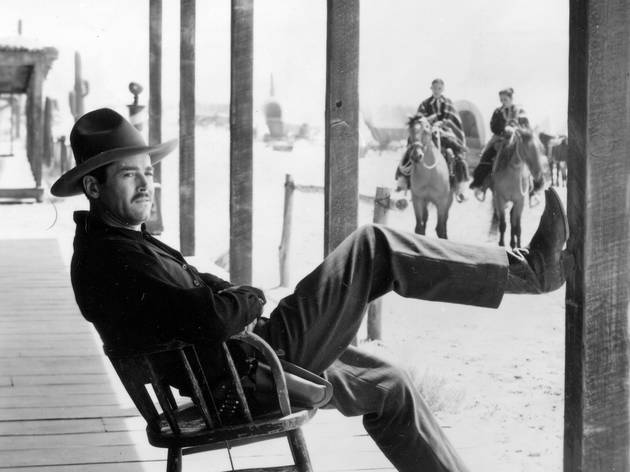
The film contains a whole sequence of what I call privileged moments. These are scenes that send shivers up my spine irrespective of how many times I see the film. The most incredible ones in My Darling Clementine appear in the middle of the film. Wyatt Earp (Henry Fonda) is lazing in a chair on the porch of his hotel, and Morgan (Ward Bond) and Virgil (Tim Holt) Earp are about to leave to visit the grave of their brother James. The Earp brothers notice a number of buckboards filled with people streaming into town. It turns out there will be a dance commemorating the building of a church.

Wyatt Earp Lazing in His Chair

Clementine Carter is about to leave on the outgoing stage, after having been told off by her old beau Doc Holliday (Victor Mature), but it is late that day. So Wyatt and Clementine walk down the main street of Tombstone to the church dance. This scene is conveyed in four or five shots that are among the best in any film I have ever seen. They arrive at the dance, and the church deacon invites them to dance. The scenes of the dance are again Ford at his best, with Wyatt’s stiff movements with the lovely Clementine in his arms. Folded in his arms during the dance is Clementine’s jacket.

Wyatt and Clementine at the Dance

These privileged moments are de rigeur for a film to be considered one of what I consider to be a great film. In future posts, I will try to sketch some more of these scenes—but only as I see the films again and the scenes are fresh in my memory.

Plotting a Holiday Picnic

Tongva Park Santa Monica from the Air

Now that Governor Newsom of California has come down hard on people doing any kind of celebratory activities, I am plotting a picnic for Saturday (July 4) or Sunday. At some point in the late morning, I will pick up two Chick-Fil-A chicken sandwiches with French fries, get a couple of cold beverages, and head with Martine to Tongva Park in Santa Monica, where I understand there are some benches and picnic tables. I hope to have a short picnic while we eat our lunch and enjoy the sea air (we will be across the street from the Santa Monica Pier).

If the local constabulary forbids us to use the park for fear of spreading virus to the plants, tables, and benches, we will look for another grassy place—I know several—and head to the alternates. There will just be the two of us. If anyone wants to join us, we will just have to throw rocks at them until they go away. We hardy survivors in the era of coronavirus don’t cotton to strangers.


Pining for the Pyramids

Maya King at Mérida Anthropology and History Museum

With the continuing bad news of the continuing ravages of the coronavirus, I begin to wonder whether I will ever again be able to travel. Of the countries that have encountered the virus, the United States has perhaps been the one nation whose people have been most incompetent at surviving. It doesn’t help that our national leadership seems to be intent on running up the totals of people infected and killed by the virus. I become increasingly furious at people who act as if Covid-19 didn’t exist.

My friend Peter tells me of seeing a wedding rehearsal at a park in San Pedro consisting of some two hundred people, none of whom were wearing face masks. Using the plague’s mortality statistics, it is likely that two of the people present will lose their lives, and possibly more will come down with the virus who are friends and family of the attendees.

There appears to be a large population that couldn’t be bothered with protecting themselves from the coronavirus. Either they see themselves as invincible, or they are resentful of politicians who are trying to enforce the quarantine, or they are f—ing stupid.

Admittedly, I don’t like wearing a face mask. When I am driving or walking outside in such a way that I could swing around people I encounter, I don’t wear a mask. Indoors, however, there is a danger that someone could cough or sneeze or even talk in my direction; so I don my mask and grit my teeth.

On my kitchen table is an old Lonely Planet guide to Mexico that I page through every day. I have found dozens of places that look interesting to me, from Baja California to Sonora to the Chihuahua al Pacifico Railroad … and the list goes on and on. My fingers are crossed that the stupidity of my fellow Americans does not turn me into an involuntary shut-in.


South for the Summer

Southern Plantation

For someone who is basically unsympathetic to Trump and his followers, I spend a lot of time reading Southern literature, particularly during the summer. Now that the days are getting warmer, I look forward to reading some more William Faulkner, who is by far my favorite 20th century American author. Joining him will be novels by John D. MacDonald (particularly the Travis McGee series), James Lee Burke’s Dave Robicheaux novels set in Louisiana, Tennessee Williams, and Charles Portis—to name but a few. To that will be added one or more histories of the Civil War.

That also goes for Southern cooking. I love grits and sausage, and tomorrow I will prepare some jambalaya for Martine and me. (It won’t be authentic, as I do not use roux as a base, but it will be recognizable.) In fact, I may share the recipe in a future post.

Tomorrow, I begin reading Faulkner’s The Sound and the Fury for perhaps the third or fourth time. I will have at my side several reference books that will help me track down some of the author’s more obscure references. Difficult as the book is, I will enjoy it immensely, just as I did before.

Some day, when travel once again becomes possible, I would love to visit New Orleans—preferably for the two or three days of the year when the weather verges on the tolerable. It would be fun visiting some of the better Cajun restaurants and the sights of a city that has flown so many flags during its history.