Plague Diary 6: Good News from My Dentist

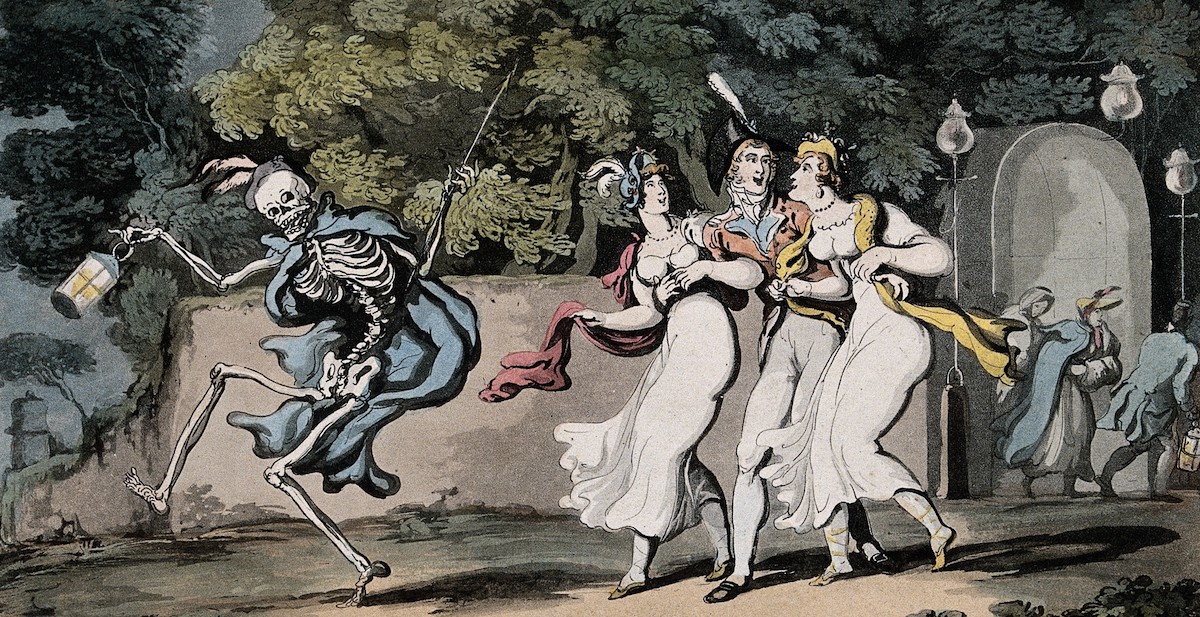
Watching the News These Days Is Like the Dance of Death

There’s nothing like a spell of plague to make one doubt one’s sources of information. And mainly, I mean the news.

On Saturday, I bit into some fruit, only to have one of my dental crowns pop out. Inwardly, I cursed. Can the crown be glued on? Will a new super-expensive crown be necessary? Or is the underlying tooth rotten, requiring an implant? Fortunately, my dentist was able to see me today. It looks like I’ll need a new crown.

During our conversation, I learned a few things that seem to go against most of the news stories I’ve been seeing lately about the coronavirus. (And really, it seems that over 75% of the news is about just that.)

My dentist came in just for me, her office being closed for more routine dental procedures. So the atmosphere was more casual than usual. We started talking about the “plague” that is gobbling up all the news services. She expected that she expected that the virus would be old news within a couple of weeks. All viruses have a life of somewhere around four to six days. The two weeks isolation described by the news services was because many people are infected by contact with multiple carriers of the virus.

It turns out that the UCLA Dental School, with which she is affiliated, will be re-opening within a couple of weeks. Why would they do that if there is any substantial danger to the dentists?

She re-iterated the usual advice about washing one’s hands, but added one very useful piece of information: Be sure to dry your hands. Viruses like a moist, warm environment.  Social distancing generally works. The main danger is being in close contact with someone who cynically does not believe in changing his or her lifestyle, which is a danger to the sick and elderly, who are most likely to die of the virus.


The Old World and the New

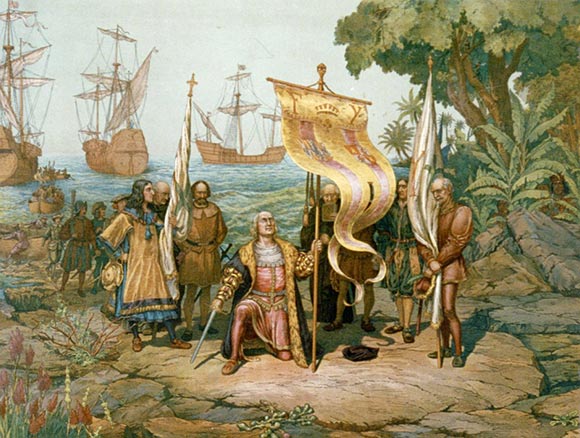
Columbus’s Landing on San Salvador in 1492

Because of my extensive travels in Latin America, I have become interested in the subject of how the discovery of the New World impacted on Europe. Due to the circumstances of my Coronavirus related social distancing, I have been reading up a storm. One thin book I noticed in my history collection was J. H. Elliott’s The Old World and the New 1492-1650 (Cambridge University Press, 1970).

The discovery of America was such a big event with so many aspects to it that Europeans had a difficult time wrapping their heads around it. Even though so much of the economy of Spain and the rest of Europe was affected by the flood of gold and silver brought to Seville by the treasure fleets, and even though so many new foods and social habits (smoking) spread across the continent, Europeans were somewhat nonplussed for the first couple of centuries after the conquest.

Elliott quotes 1 Corinthians 14:10-11 to summarize the effect:

There are, it may be, so many kinds of voices in the world, and none of them is without signification.  Therefore if I know not the meaning of the voice, I shall be unto him that speaketh a barbarian, and he that speaketh shall be a barbarian unto me.

In his essay “On Cannibals,” Montaigne speculated on the Brazilian natives through the eyes of the Greek philosophers:

These nations then seem to me to be so far barbarous, as having received but very little form and fashion from art and human invention, and consequently to be not much remote from their original simplicity. The laws of nature, however, govern them still, not as yet much vitiated with any mixture of ours: but ‘tis in such purity, that I am sometimes troubled we were not sooner acquainted with these people, and that they were not discovered in those better times, when there were men much more able to judge of them than we are. I am sorry that Lycurgus and Plato had no knowledge of them; for to my apprehension, what we now see in those nations, does not only surpass all the pictures with which the poets have adorned the golden age, and all their inventions in feigning a happy state of man, but, moreover, the fancy and even the wish and desire of philosophy itself; so native and so pure a simplicity, as we by experience see to be in them, could never enter into their imagination, nor could they ever believe that human society could have been maintained with so little artifice and human patchwork. I should tell Plato that it is a nation wherein there is no manner of traffic, no knowledge of letters, no science of numbers, no name of magistrate or political superiority; no use of service, riches or poverty, no contracts, no successions, no dividends, no properties, no employments, but those of leisure, no respect of kindred, but common, no clothing, no agriculture, no metal, no use of corn or wine; the very words that signify lying, treachery, dissimulation, avarice, envy, detraction, pardon, never heard of.

Sometimes, I still think that Europeans still are trying to wrap their heads around the New World.


Plague Diary 5: Social Distancing

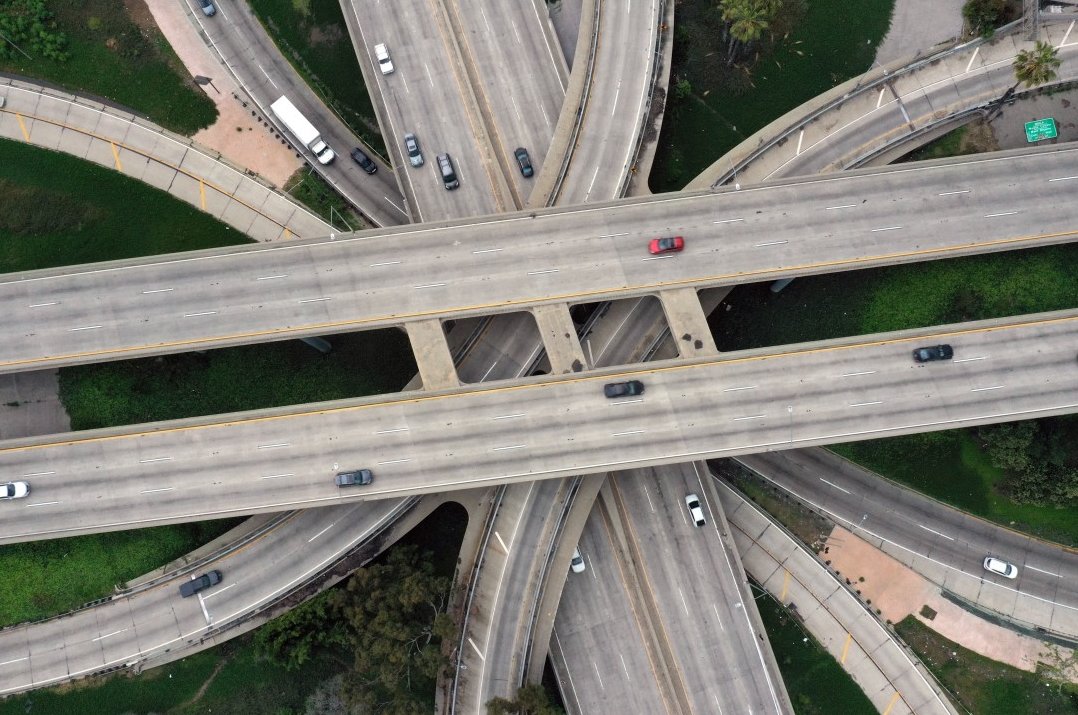
The Intersection of the 101 and 110 Freeways in Downtown L.A.

The above picture from the Los Angeles Times says it all: Even at 4 am, it is not otherwise so uncrowded. Of course, I haven’t been using the freeways lately, as there is quite literally nowhere to go. No restaurants, no parks, no museums—and no sun either. Ever since the “Stay in Place” order went out, Southern California has been assailed by an untypical chain of rainy weather for this time of year, what we call the Pineapple Express.

My main forays from my apartment have been unsatisfying trips to food markets to pick over the bare bones of what the hoarders have left in their wake. And just to make things worse, I popped another crown on Saturday and have to make an appointment with my dentist to see whether it could be glued back in. Now I have partly or wholly missing teeth on both sets of my uppers. The wholly missing one will, with luck, be replaced by an implant … sometime in July.

Right now, the rain is falling steadily; and Martine is coming down with a sore throat. For now, I am watching old movies (Robert Aldrich’s 4 for Texas and Pier Paolo Pasolini’s Salò, neither of which I particularly liked) and reading books by authors with home I am unfamiliar (currently R. A. Lafferty). Also I am doing all the cooking. I have managed to scrounge up the ingredients to make a potato and cauliflower curry that should last us for a while.

It was nice talking to my brother this morning. I should call up more of my old friends. The problem is that I get too busy with cooking, reading, and TV film viewing to take the time out.


Plague Diary 4: The Empanadas Run

Our Local Empanada Take-Out Restaurant

Near the corner of Sawtelle and Venice is our local Argentinian take-out restaurant, called Empanadas Place. I have been to Argentina three times, and I find that Empanadas Place has tastier empanadas than the South American versions. I decided to pick up a bunch of them for Martine, myself, and my elderly Mexican neighbor Luis, who is particularly fond of the place.

So I drove down there and placed my order. The tables for the sit-down part of the restaurant were all in storage, except for one for people waiting for take-out. I had a nice chat with the owner, an Argentinian of Italian ancestry (like about 75% of all Argentinians). Because his business had always been heavily oriented toward take-out, his business did not seem to be suffering from the forced closure of all sit-down restaurants. Unlike most Americans, he did not see his business as a path to riches: He was quite happy to make a small living selling delicious empanadas to the residents of Culver City and West Los Angeles.

For myself, I got four items: an Arabe (lemon-flavored ground beef and onions), spicy beef with cheese, spinach, and potatoes with cheese. I ate two of them for lunch, saving the remainder for tomorrow. Luis was pleased with his empanadas. (I think I will try to do an occasional take-out run at least once a week for the duration of the plague.

A Selection of Goodies from Empanadas Place

In addition to the featured items, Empanadas Place also sells a selection of Argentinian groceries, such as yerba mate tea, dolce de leche, and cookies known as alfajores. You can also get sandwiches and salads, as well as a refreshing glass of iced yerba mate tea.


Mexican Folk Art: La Casa de los Venados

What It Feels Like to Stay at Home All the Time

I am about to take a break from my “Plague Diary” posts to remind myself that, somewhere, something like a normal life still exists. Toward the end of my vacation in Yucatán, I spent several days in Valladolid, home of one of the country’s best private collections of folk art at the Casa de los Venados. I loved the exhibits I saw throughout my trip of folk art. The combination of humor and brilliant color had me won over. Now that I am sitting out the plague in my apartment, sans restaurants, sans libraries, sans movie theaters, sans any humor or brilliant color. (Especially as it has rained all week.)

Dog Cart

Sometimes I feel as if North American culture is deficient, especially in the visual arts. It wasn’t always thus, but somehow I feel that abstract expressionism took all the fun out of painting. Seeing the collection at the Casa de los Venados, on the other hand, made me laugh out loud.

Mermaid


The amazing thing about Mexican folk art is that there is so much of it about and at such reasonable prices. Over several decades, you can have a great collection that might even rival the Casa de los Venados—and have loads of fun doing it.

Plague Diary 3: Making Adjustments

Small World Books in Better Days

No one knows how long the current plague restrictions will be in place. I have to assume it will be for several weeks. During that time, I cannot go to the movies or dine at a restaurant or visit a museum. For lunch, I visited Bay Cities Imports, Santa Monica’s primo Italian import grocery, and bought one of their Spaniard sandwiches. Based on a review at the Food GPS site:

The Spaniard isn’t made to order; you’ll find them wrapped in white butcher paper on the deli counter, along with other grab-and-go sandwiches, meaning they may sit for awhile. Still, my experience with The Spaniard still worked out well. The small-ish sandwich was stacked with jamon serrano, coppa seca, honey ham, Pamplona chorizo, Gruyere cheese, oregano, parsley, roasted tomatoes, olive oil, black pepper, and rosemary on a chewy baguette. Next time, I’ll probably beg to go back to The Godmother like some kind of guilt-ridden sandwich adulterer, but I enjoyed my brief fling with The Spaniard.

Since I could not eat lunch at the store, I took my lunch with me and drove to Venice, stopping at a parking meter and munching away while a parking enforcement officer kept circling my car seeing if she could ticket me. I waved my sandwich at her by way of greeting.

After I finished, I popped some quarters in the meter and walked to Small World Books. As you can see in the above photo, the bookstore is in the same building as the Sidewalk Cafe. As the bookstore is run by the wife of the cafe owner, it was not altogether surprising that it, too, is closed for the duration.

So I headed home and watched a DVD version of Krzysztof Kieslowski’s Blue (1993), which I loved. I plan to see the other two films in the trilogy—White and Red (both 1994)—within the next few months. After dinner, I read another hundred pages of Jan Neruda’s Prague Tales.


Plague Diary 2: Empty Shelves

It’s Bad All Over: The Above Picture Is From the UK

Last night I called my friend Bill Korn, who warned me that the supermarket shelves are likely to be all picked over by hoarders. As I do my main food shopping on Monday, I started the day with apprehension. I woke at 7 am to get to Ralphs Supermarket (owned by Kroger) by the 9 am opening time. When I arrived, I had trouble finding parking, could not get my hands on a shopping cart (except the one they always have on hand with square wheels), and found very little of what I was looking for.

Fortunately, I was able to find some ground turkey—seconds before the hoarders descended on it. Then I joined the checkout line that wound up and down the store aisles.

Later, I stopped at Trader Joe’s on Olympic Boulevard and found a similar situation, though the well paid staff was much better at restocking the shelves.

The dish I prepared was a non-spicy keema consisting of the ground turkey, various Indian spices, and a selection of frozen vegetables from my freezer. If this situation prevails over however many weeks the plague restrictions are in effect, I will have to be highly creative in my cooking. It’s already difficult to cook for Martine and myself because there are relatively few dishes we can agree on. It’s like the Mother Goose nursery rhyme:

Jack Sprat could eat no fat.
His wife could eat no lean.
But, together both,
They licked the platter clean.

Rather than fight with Martine about what I cook, I will gladly arrange for her to have any take-out meals she desires. She is considerate enough not to over-abuse this privilege.

Other than food shopping, I viewed a classic psychological horror film from 1943, Val Lewton’s The Seventh Victim. And I read about a third of Jan Neruda’s excellent 19th century Prague Tales. Jan is not to be confused with Pablo Neruda, who hi-jacked the Czech writer’s last name as his nom de plume.

Plague Diary 1: Kárpátok

I Violate the Plague Laws Prescribing Social Distance

In the new environment of worldwide plague, I must carefully pick and choose what I can and cannot do. I started out with a major violation by attending a folk dance performance given by the Kárpátok Hungarian Folk Dance Ensemble. It was well attended with several hundred audience members, many of whom within the six-foot danger zone of contagion.

Martine particularly loves the performances by Kárpátok, and so do I because I like to revel in my Hungarian background. Of late, I have used the Magyar language primarily to damn to hell cruise ship passengers in Mexico who try to use me as an information resource. At the United Magyar Ház in Los Angeles, where the concert was held, virtually everybody present could cuss me out more correctly and picturesquely than I can do. So I am on my best behavior.

The Kárpátok Hungarian Folk Dance Ensemble is one of the best things about Los Angeles. Martine and I have been attending their events for upwards of ten years.

It is unlikely that there will be other plague law violations in the weeks to come, mostly because just about everything is being closed down. The supermarket shelves are being emptied by hoarders of food, hand sanitizers, and toilet paper. When I go shopping tomorrow, I will have to be careful about confronting hoarders: Particularly in Southern California, people who are the most guilty are also the most aggressively defensive about their deeds.

My postings here in the next few weeks will discuss how my life has changed as a result of living in a plague zone. I anticipate that my life will change in many ways over the next few weeks. I remain hopeful, however, because of the following reasons:

  • I have a personal library of several thousand volumes, including all the classics
  • My cable television configuration includes about a dozen movie channels
  • Plus I have hundreds of DVDs
  • One of my hobbies is cooking—useful when many restaurants are closing or cutting back
  • I make a point of maintaining frequent telephone contact with my old friends

Strange New World

Who Could Have Expected This?

When I returned from Mexico on February 7, it was to a vastly different reality—one that grew increasingly strange with each passing day. With the cancellation of music festivals, sporting events, live audiences, and even schools and libraries, it is a strange and unexpected new world in which I find myself.

Tomorrow night, Martine and I are attending an event given by the Kárpátok Hungarian Dance Ensemble, which we both love. It is not a large event, and Martine and I plan not to stay for the socializing after the folk dances. Even a week ago, I would not have been so conscious of the danger of contracting Covid-19. Now, alas, I am: I am a walking encyclopedia of pre-existing medical conditions, including panhypopituitarism, type II diabetes, hypertension, asthma, and a few others not so prominent. If I caught the virus, I would likely be at risk not to survive it.

It has been a particularly strange week, partly because of the draconian measures to minimize casual social contact, and partly because of a rare week-long “Pineapple Express” rain event which is leaving us with a certain degree of cabin fever.

At present, an average of 350 people per day are officially identified as having come down with Covid-19. I suspect the number is actually much larger because of the nationwide shortage of test kits. Supposedly, something is being done about this—but then I don’t usually expect competence or any degree of helpfulness from the Trump administration.

The only good news about the coronavirus is that it has all but chased the 2020 presidential election from the news. But it has not replaced it with anything more palatable.


Zeppelin Orgy

Book Based on the Movie

No one could say that it’s a good movie, but it certainly is an outrageous one. Cecil B. DeMille’s Madam Satan (1930) starts out as a fairly standard bedroom farce and ends with an hour-long orgy aboard a zeppelin that starts out being tethered at a New York airport, and ends up being destroyed in a sudden electrical storm. Oh, and by the way, it’s a musical.

I first saw the film when it was screened by the Dartmouth Film Society in the mid 1960s. More than half a century later, I was still amazed by the film, which was screened tonight by Turner Classic Movies (TCM).

The zeppelin sequence begins with a song and dance number which, no doubt, was considered very advanced for the time:

An “Electrical” Song and Dance Number Aboard the Zeppelin

Cecil B. DeMille was famous for, on one hand publicly adhering to Puritan morality, and on the other pushing the “sin” routines for all they’re worth. The film was released well before the Motion Picture Code was adopted in 1934. Between the advent of sound and the censorship of the Hays Office, Hollywood produced some pretty racy films such as Red Dust (1932) with Jean Harlow, Baby Face (1933) with Barbara Stanwyck, and King Kong (1933) with Fay Wray.

I remember seeing a racy outtakes reel from the latter film in which Kong exposes Fay Wray’s breasts and crushes a black native underfoot as if he were a cockroach.

The pre-code talkies produced by Hollywood tried to walk a straight and narrow path of Protestant morality, but had a little hypocritical fun doing it. The result is at times curiously sexy.