Seven Questions

Poet Laureate of the United States Joy Harjo

I present for your enjoyment—and serious consideration—a poem about politics by Joy Harjo, the Poet Laureate of the U.S., who is also a Muscogee Creek Indian whose people have suffered grievously from lying, weaselly politicians of all stripes through their history as the first real Americans.

The poem is from her collection entitled An American Sunrise.

For Those Who Would Govern

First question: Can you first govern yourself?

Second question: What is the state of your own household?

Third question: Do you have a proven record of community service and compassionate acts?

Fourth question: Do you know the history and laws of your principalities?

Fifth question: Do you follow sound principles? Look for fresh vision to lift all the inhabitants of the land, including animals, plants, elements, all who share this earth?

Sixth question: Are you owned by lawyers, bankers, insurance agents, lobbyists, or other politicians, anyone else who would unfairly profit by your decisions?

Seventh question: Do you have authority by the original keepers of the lands, those who obey natural law and are in the service of the lands on which you stand?


I found interesting Joy’s use of the word principalities in the fourth question. She herself is a member of a sovereign nation that is affiliated with the U.S.

In the sixth question, I would have included real estate developers, who are in my book archvillains.

Looking at our current president, he comes off in honest answers to these questions as a suppurating vessel of gangrenous pus.


Going to the Desert

Joshua Trees at El Mirage Dry Lake

This next weekend, I will break quarantine for the first time to visit my brother Dan and sister-in-law Lori in Palm Desert, near Palm Springs. It will still be hot as Hades, but for the first time I will have a chance to talk face to face with someone other than just Martine.

She, by the way, will not be coming with me. Having lived and worked for a couple years at Twentynine Palms in the Morongo Valley, about an hour north of Dan, she hates the desert with a passion.

I would not live in the desert, as my brother does, but I enjoy visiting it from time to time—especially when the dead heat of summer begins to let up.

Perhaps I can visit a couple of places that I particularly like, such as the Thousand Palms Oasis or the Indian Canyons south of Palm Springs. More likely, I will be reading some books and taking advantage of Dan’s air conditioning and swimming pool. And, of course, his cooking.

As usual, I will be leaving L.A. before the sun rises. I will stop at Hadley Fruit Orchards In Cabazon to do some shopping before making a beeline to Palm Desert. Right around Cabazon, I will set my car radio dial to MOD-FM 107.3 to listen to their parade of classical 1950s hits with Frank Sinatra, Dean Martin, Sammy Davis, and their ilk.

My Vote Has Been Received

My Ballot Has Been Marked as Received by the Registrar of Voters

Last week, I filled out my mail-in ballot. In Los Angeles, all registered voters received mail-in ballots, which we had the option of:

  • Returning in the mail
  • Putting in one of 400 drop boxes scattered throughout the county
  • Handing in at a polling place

My drop box was at nearby Stoner Recreation Center. I chose it because it was locked away at night so that Red-Hatted Trumpist Yahoos could not destroy my ballot in the dead of night.

I was actually reassured by the steps that California is taking to make sure that everyone’s vote counts. That does not appear to be the case in the Confederate States of America.

Libtard Proclamation Uno

VP Joe Biden and Son Hunter

As I mentioned in an earlier post, I now consider myself a Libtard, unaffiliated with any existing political organizations. Earlier still, I dissociated myself from that circular firing squad that is the Democratic Party and—what is more—I no longer consider myself to be a member of the Caucasian Race. (A Hungarian-American, I see myself as being Finno-Ugric.)

Mighty oaks from tiny acorns grow, so I am hoping that the Libtard Party will become a factor on the American political scene. So although the National Libtard Alliance (NLA) currently has a membership of one, I see nothing but growth ahead.

Consider this to be the first White Paper of the NLA.

Let’s start with Hunter Biden, the Democratic nominee’s son. Right at the outset, I see several problems. Ukraine—that can’t be good. And again with the e-mails? Is this going to be a persistent problem for the Democrats? Trump doesn’t do e-mails. When he goes into covfefe mode, it’s usually when he Tweets. I don’t know: perhaps it would be better to put e-mail behind him. I mean, I do a lot of e-mails: Doesn’t that pretty much automatically disqualify me for higher office? (In Twitter, no one cares if you’re illiterate.)

E-Mails: Isn’t That What Sunk Hillary Clinton?

I’ve also heard that Joe Biden’s cousin Cunnegunda Milsop has run afoul of the law by dancing topless at a Wilmington titty bar. We cannot in good conscience support a man for president if is family does not radiate perfection all along the family tree.

Of course, that certainly disqualifies Trump, whose family verges on the non-human (particularly Don Jr).

Perhaps I should offer myself as a write-in candidate for November 3 as the nominee of the NLA. Drat, I’ve already voted; and I am afraid that whatever I urge, there is the embarrassing possibility that I would receive no votes.

Well, there’s always Kanye West. It would be interesting to have Kim Kardashian as first lady.

Kim Kardashian and Kanye West: Destined for Greatness?

Ceviche

Ceviche de Pescado con Limon

My last meal in Mérida before returning to the U.S. was at a grungy little seafood dive on Calle 62 called the Blue Marlin (Marlin Azul). It was a raw fish dish called ceviche de pescado that is “cooked” with the addition of fresh lime juice. Also it contains cut-up tomatoes, chiles, and cilantro. It is served cold and is an ideal lunch dish.

In Progreso, a few days earlier, I had a ceviche de pulpo made with the same ingredients, except that octopus replaces the fish. I was in hog heaven.

Actually the seafood dish I ate the most in Yucatán this last trip was filete de pescado veracruzana. It was a grilled filet of fish in a tomato sauce with onions, olives, and capers. I never got tired of it, especially when I was near the sea and knew that the fish was super fresh.

During this awful coronavirus outbreak, I dream of traveling by bus between various seaport cities in Baja California and living on fish tacos and other local specialties.

Baja Style Fish Tacos

When I was growing up in Cleveland, I didn’t think much of fish. Lake Erie, the shallowest of the Great Lakes, was for all intents and purposes a body of water noted for dead fish floating on its surface. I have had some good seafood in Los Angeles, but avoid shrimp and lobster, as I seem to be allergic to them—possibly because of the pollution of the Pacific Ocean around the coast of Southern California.

Traveling to places like Iceland or Mexico where the seafood is so fresh and interesting makes me dream of travel again. Sigh.

The God Abandons Antony

Marc Antony on Cleopatra’s Barge

It was in the first century AD that Plutarch first mentioned the tale that, as he was to face ultimate defeat from both Octavian (later Augustus) and his love Cleopatra, that he was visited by a strange vision:

During this night, it is said, about the middle thereof, while the city was quiet and depressed through fear and expectation of the future, all at once certain harmonious sounds from all kinds of instruments were heard, and shouts of a crowd with Evoes and satyric leapings, as if some company of revellers not without noise were going out of the city; and the course of the procession seemed to be through the middle of the city to the gate leading outwards in the direction of the enemy, and at this point the tumult made its way out, being loudest there. And those who reflected on the sign were of opinion that the god to whom Antonius all along most likened himself and most claimed kinship with was deserting him.

In his play Antony and Cleopatra, Shakespeare makes mention of this vision in Act IV, Scene 3.

But it was the Greek poet Constantine Cavafy, a citizen of Alexandria, who wrote one of his greatest poems on the subject:

Constantine P. Cavafy

The God Abandons Antony

When suddenly, at midnight, you hear
an invisible procession going by
with exquisite music, voices,
don’t mourn your luck that’s failing now,
work gone wrong, your plans
all proving deceptive—don’t mourn them uselessly.
As one long prepared, and graced with courage,
say goodbye to her, the Alexandria that is leaving.
Above all, don’t fool yourself, don’t say
it was a dream, your ears deceived you:
don’t degrade yourself with empty hopes like these.
As one long prepared, and graced with courage,
as is right for you who proved worthy of this kind of city,
go firmly to the window
and listen with deep emotion, but not
with the whining, the pleas of a coward;
listen—your final delectation—to the voices,
to the exquisite music of that strange procession,
and say goodbye to her, to the Alexandria you are losing.

The poem is mentioned in Lawrence Durrell’s Justine and even printed there, but in Durrell’s translation. I have chosen instead to include the translation by Edmund Keeley and Philip Sherrard.

Alexandria on the Pacific

The Port of Alexandria As It Is Today

Every once in a while, I re-read a book that has meant a lot to me in the past, in the hopes of somehow rediscovering myself as I was when I first encountered it. Around 1967-1968, I first delved into Lawrence Durrell’s Justine, the first volume of his Alexandria Quartet.

I had just reached the age of puberty in my early twenties thanks to regular injections of depo-testosterone. In September 1966, I had a pituitary tumor (chromophobe adenoma) removed by slicing through my forehead and hinging my brain upward. As a result, I was a strange sort of late-blooming virgin who was mightily puzzled by and preoccupied with sex.

The Edition I Read

Imagine me as I lie in the sand on Santa Monica Beach by lifeguard station 12 reading the following:

Five races, five languages, a dozen creeds: five fleets turning through their greasy reflections behind the harbour bar. But there are more than five sexes and only demotic Greek seems to distinguish among them. The sexual provender which lies to hand is staggering in its variety and profusion. You would never mistake it for a happy place. The symbolic lovers of the free Hellenic world are replaced here by something different, something subtly androgynous, inverted upon itself. The Orient cannot rejoice in the sweet anarchy of the body—for it has outstripped the body. I remember Nessim once saying—I think he was quoting—that Alexandria was the great winepress of love, those who emerged from it were the sick men, the solitaries, the prophets—I mean all who have been deeply wounded in their sex.

So there I was on the hot sands of Santa Monica, surrounded by women in bikinis, indulged in morose delectation.

Actually, Justine is pretty good, though it is quite arch at times. I am no longer the same unhappy young man on the beach. I read all four volumes of the Alexandria Quartet that one summer, and I loved it—however disturbing I found it.

House of Horrors

Mummified Corpses in Guanajuato’s Museo de las Momias

In this month of Halloween, I thought I would make mention of the most horrific museum I have ever visited, the Museo de las Momias (that is, Mummies) de Guanajuato.

Imagine to yourself a museum consisting of corpses dug up in a Mexican mining town that have been naturally mummified because of the mineral content of the soil. Many were interred during a cholera epidemic which filled the local cemetery to such an extent that the town had to charge a fee for the right to remain buried. According to Wikipedia:

The human bodies appear to have been disinterred between 1870 and 1958. During that time, a local tax was in place requiring a fee to be paid for “perpetual” burial. Some bodies for which the tax was not paid were disinterred, and some—apparently those in the best condition—were stored in a nearby building. The climate of Guanajuato provides an environment which can lead to a type of natural mummification, although scientific studies later revealed that some bodies had been at least partially embalmed. By the 1900s the mummies began attracting tourists. Cemetery workers began charging people a few pesos to enter the building where bones and mummies were stored.

When I visited Guanajuato in the late 1980s, my introduction to the museum was itself grim: A young father was carrying a child’s coffin on his shoulders to be buried, with no one else in the family following him.

Shades of Edgar Allan Poe: The Wikipedia entry continues with this grim fact:

One of the mummies who was buried alive was Ignacia Aguilar. She suffered from a strange sickness that made her heart appear to stop on several occasions. During one of these incidents, her heart appeared to stop for more than a day. Thinking she had died, her relatives decided to bury her. When her body was disinterred, it was noticed that she was facing down, biting her arm, and that there was a lot of blood in her mouth.

The only way I kept the contents of my stomach under control while I was in the museum was the extent to which I busied myself taking pictures. None of these are in this post, as they have yet to be converted to JPEG files from the Kodachrome slides I was then shooting.

Even a writer like Ray Bradbury had trouble seeing the displays of mummies in the museum:

The experience so wounded and terrified me, I could hardly wait to flee Mexico. I had nightmares about dying and having to remain in the halls of the dead with those propped and wired bodies. In order to purge my terror, instantly, I wrote ‘The Next in Line.’ One of the few times that an experience yielded results almost on the spot.

A Movie for 2020

Vincent Price as Prince Prospero and Patrick Magee as Alfredo

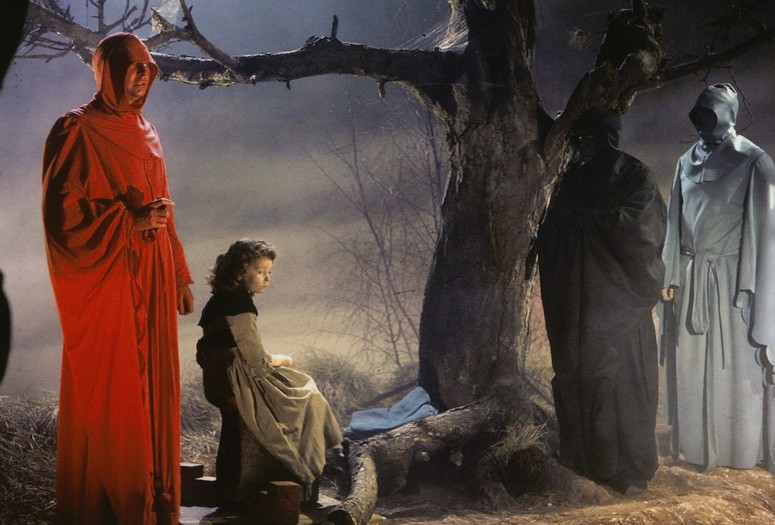
As we approach Halloween, I propose a 1964 film by Roger Corman as the perfect paradigm for our year of coronavirus and Trump—namely, The Masque of the Red Death.

The story concerns a gathering of wealthy friends (let’s call them billionaires) of Prince Prospero at his castle while the Red Death plague rages through the land. It is my favorite Roger Corman film, with elegant color photography by Nicholas Roeg.

Unfortunately, the character of Vincent Price’s Prospero, nasty as he may be, is played by too interesting an actor to be a stand-in for Donald J. Trump—though he wealthy guests are perfect. One can imagine the My Pillow Guy and the founder of Goya Foods at this party.

You might also want to read the Edgar Allan Poe story from which the film is drawn. You can find it here.

Death Is Stalking the Land in Masque of the Red Death

In the end, Prince Prospero and all his guests come down with the Red Death, which they had so studiously tried to avoid. And curiously, the character is plays the personification of the deathly plague is, once again, Vincent Price.

A Poem for Halloween

Jack O’ Lanterns

Here is a poem redolent of the season by the U.S.’s new Nobel Prize Winner in Literature for 2020: Louise Glück.

All Hallows

Even now this landscape is assembling.
The hills darken. The oxen
sleep in their blue yoke,
the fields having been
picked clean, the sheaves
bound evenly and piled at the roadside
among cinquefoil, as the toothed moon rises:

This is the barrenness
of harvest or pestilence.
And the wife leaning out the window
with her hand extended, as in payment,
and the seeds
distinct, gold, calling
Come here
Come here, little one

And the soul creeps out of the tree.


Poet Louise Glück