Christian Archeology

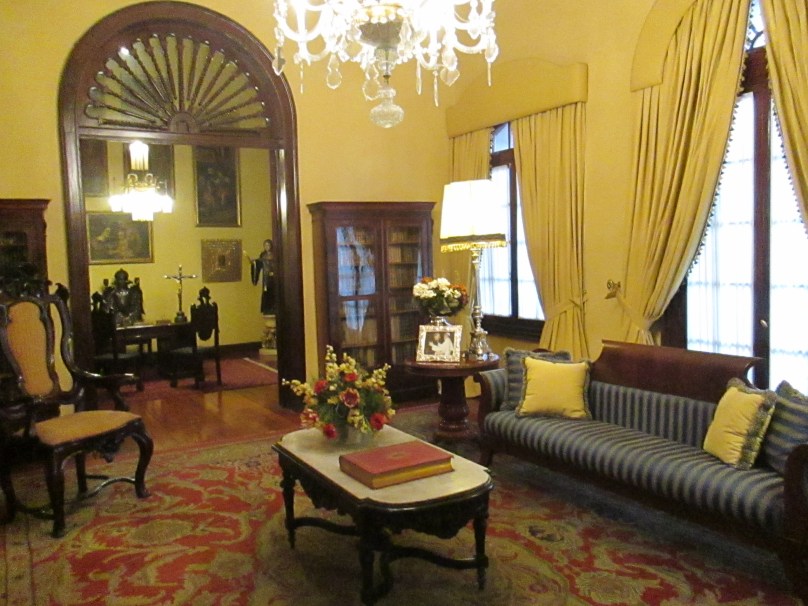
Interior of the Palace of the Archbishop, Lima, Peru

What shocked me more than anything during my 2014 visit to Peru was that the archeology of Spanish Catholicism in Peru was fully as interesting as the archeology of the Incas and other pre-Columbian peoples. The pictures here all come from my visit to the Palace of the Archbishop next to the Cathedral in Lima on November 9, 2014. I was guided through the Palace by a very cute young Peruvian nun who kept addressing me as “Gentleman.”

As I visited the Palace and the various churches and convents, I thought to myself that the Christian religion in Peru had passed its peak. What remained was partially syncretic, but in any case visually stunning.

Chalice Flanked by Two Monstrances

I have often thought that it was not the King of Spain who benefited from the wealth of gold and silver transshipped from South America, as much as Holy Mother the Church. The churches and monasteries in the historic center of Lima are glistening with gold, silver, and precious stones. At the Monastery of Santo Domingo are the remains of three 17th century Limeño saints: Rose of Lima, Martín de Porres, and Juan Macías—all of whom were affiliated with the Dominican Order.

Brought up as a Roman Catholic, I found myself spending a lot more time in the churches than at the Inca ruins. They were usually beautiful and peaceful, even if I wound up attending Mass a number of times. In fact, I felt myself more a Catholic in Peru than I do in Los Angeles.

Statue of the Blessed Virgin

Whatever their original colors, it seems as if the paintings and statues of Christ, the Virgin, and the saints are predominantly reddish brown. This is particularly true of the Cusco School of Painting which predominated at the time. At some point soon, I will repeat a past post on the iconography of archangels shown in Peruvian paintings of the Cusco School.
Browning Decides To Be a Poet

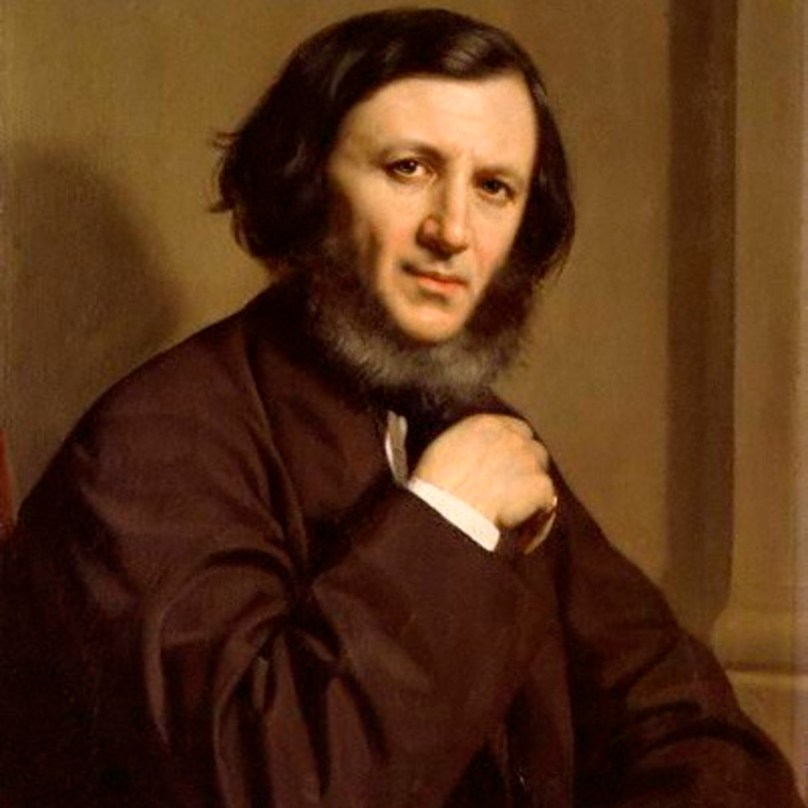
Robert Browning (1812-1889)

It is time for another poem by one of my favorite poets, the late Jorge Francisco Isidoro Luis Borges Acevedo of Argentina.

Robert Browning Decides To Be a Poet

In these red labyrinths of London
I find that I have chosen
the strangest of all callings,
save that, in its way, any calling is strange.
Like the alchemist
who sought the philosopher's stone
in quicksilver,
I shall make everyday words—
the gambler's marked cards, the common coin—
give off the magic that was their
when Thor was both the god and the din,
the thunderclap and the prayer.
In today's dialect
I shall say, in my fashion, eternal things:
I shall try to be worthy
of the great echo of Byron.
This dust that I am will be invulnerable.
If a woman shares my love
my verse will touch the tenth sphere of the concentric heavens;
if a woman turns my love aside
I will make of my sadness a music,
a full river to resound through time.
I shall live by forgetting myself.
I shall be the face I glimpse and forget,
I shall be Judas who takes on
the divine mission of being a betrayer,
I shall be Caliban in his bog,
I shall be a mercenary who dies
without fear and without faith,
I shall be Polycrates, who looks in awe
upon the seal returned by fate.
I will be the friend who hates me.
The persian will give me the nightingale, and Rome the sword.
Masks, agonies, resurrections
will weave and unweave my life,
and in time I shall be Robert Browning.

The line about “if a woman turns my love aside” is particularly poignant. For most of his life, Borges was in love with a fellow writer, Norah Lange, who instead married Oliverio Girondo, whom he hated with a passion.

Argentinean Writer Norah Lange (1905-1972)

Borges did eventually get married in his old age—twice. The first one was a disaster, the second one more of a helpmate.

PC

Political Correctness Has Gone Way Too Far

I have just read a library book in which the entire text was edited for political correctness by some ignorant vandal. The book was Rosario Santos’s The Fat Man from La Paz: Contemporary Fiction from Bolivia. If you’ve read yesterday’s post, you know that I am interested in visiting Bolivia, which is one of two Andean countries I have not seen (the other is Colombia).

The copy I checked out from L.A.’s Central Library is full of ballpoint editings enforcing a rigid code of PC relating to feminism, religion, sexual preference, and aboriginal peoples. The stories ranged from interesting to outstanding, but I was constantly being outraged by the marginal comments.

Below is a table showing some typical examples:

PageOriginal TextPC Corrections and [Notes]
68a prayer of health to the Virgina prayer of health to Mary
104Since Rosemary had her baby[Birth Control!]
134saints with expressions of satisfaction“saints” with expressions of satisfaction
141they went around poisoning the lives of others[Sexist]
143why her grandmother hated menwhy her grandmother hated marriage
235a mestizo born of an Indian womana mestizo born of a native woman
236the spire of the Mother Church[Patriarchal]
239the Indians shifted restlesslythe people shifted restlessly
246his worn out little love of his dreamshis worn out love of his dreams
250making holes for their women to toss in seedsmaking holes for the women to toss in seeds
254the Indians maintained their balancethe workers maintained their balance

I have decided that the only punishment worthy of this vandalism is to locate the individual responsible, strip him or her naked, and tattoo them all around their body with the most politically incorrect terminology possible. Anyone want to join me?

Atacama and Altiplano

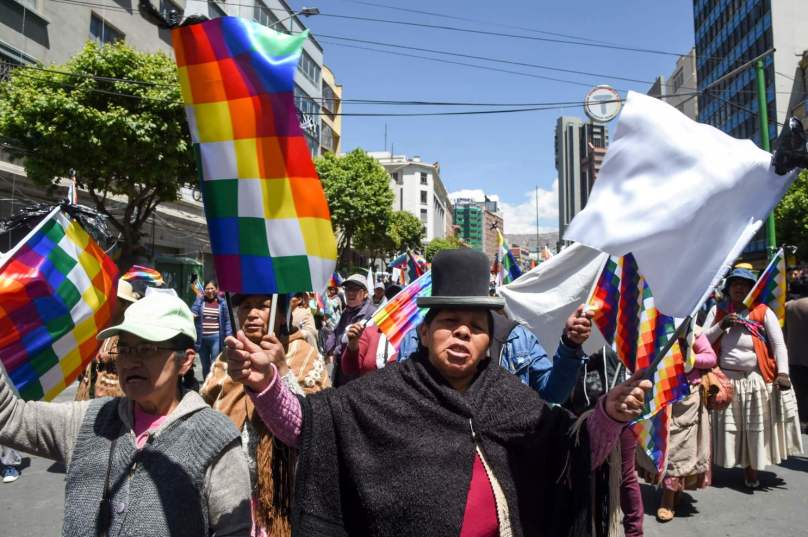
Political Demonstration in La Paz, Bolivia

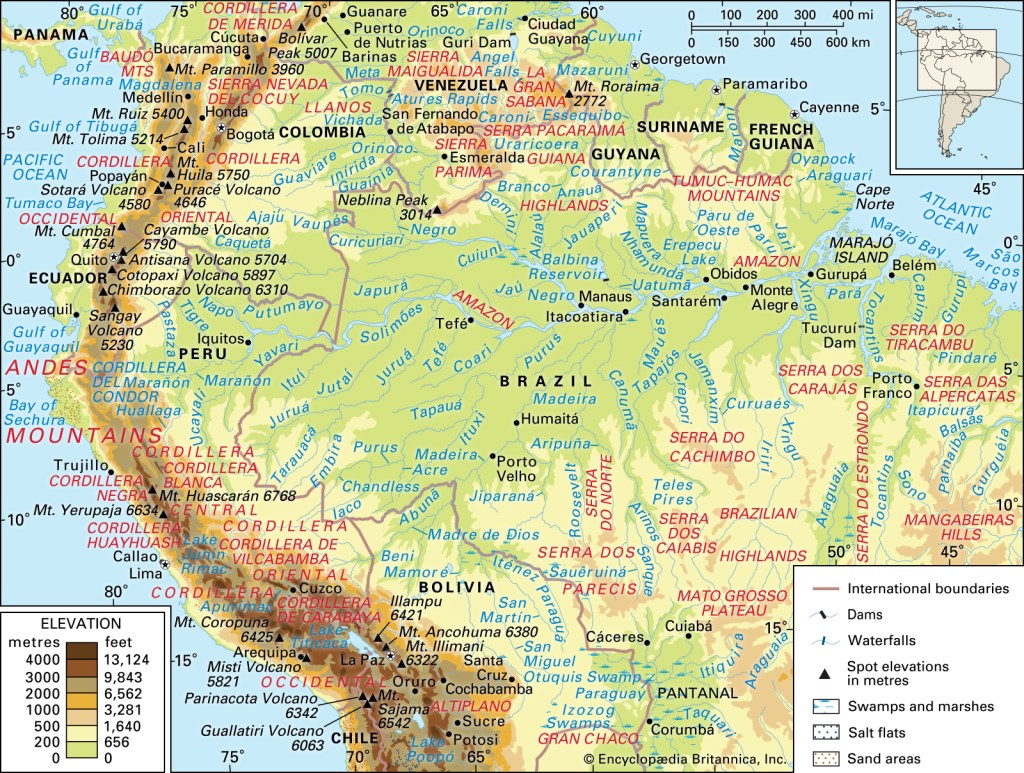
Still on lockdown from the quarantine, I am dreaming of a vacation that includes Peru, the northern tip of Chile, and the Altiplano region of Bolivia. I may be too old for this trip (at age 76), but I continue to collect information. In terms of transportation, it involves a round trip flight from Los Angeles to Lima, Peru.

There are three legs to this trip.

First I head south in two or three stages to Tacna, Peru, which is on the border with Chile and its Atacama Desert, and over the border to Arica. The stages might include Paracas, Huacachina, and (most definitely) Arequipa.

From Arica, I head northeast to the Bolivian border, possibly stopping at Putre and the Parque Nacional Lauca. From this point until the end of the trip, I am at high altitude, from twelve to fifteen thousand feet (between 3600 and 4600 meters). I will be subject to soroche, or altitude sickness. I will have to use coca leaves and an alkaloid to keep me from becoming seriously ill.

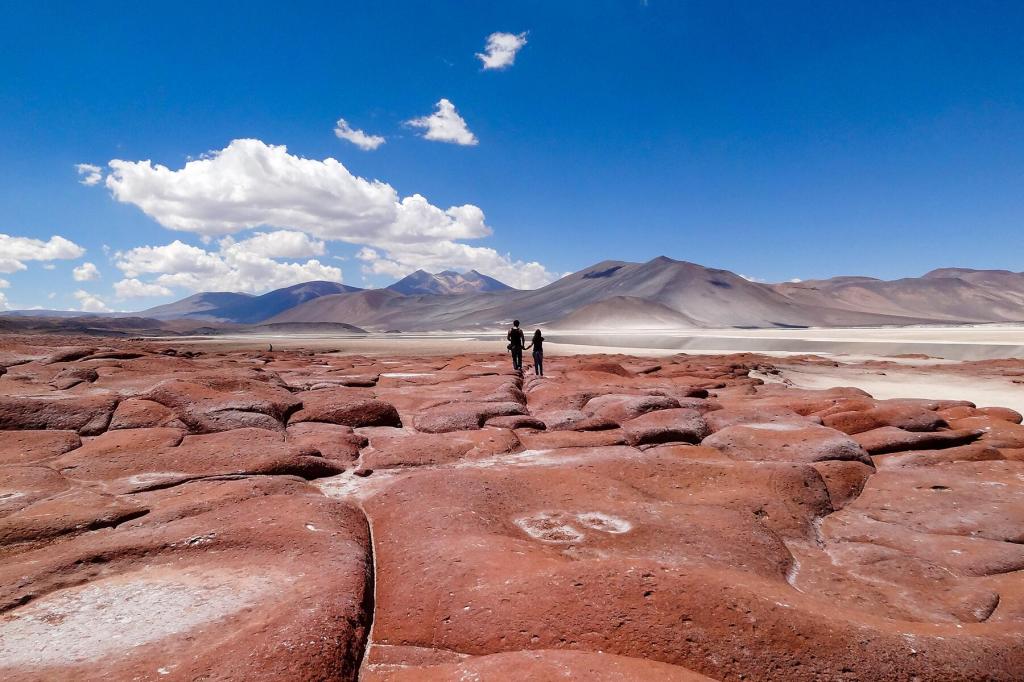
Chile’s Atacama Desert, Which Receives No Rain To Speak Of

From Arica to La Paz, Bolivia is only seven hours by bus, continuing on my northeasterly direction.

I will recover from my bus ride for a few days in La Paz, possibly seeing the ruins at Tiwanaku. Then I head northwest to Copacabana, where I will be on the shores of Lake Titicaca. I will spend a night on the Isla del Sol, and take a bus to Puno in Peru. From Puno, I will take either a bus or train to Cusco, where I will see several local Inca ruins (though not necessarily Macchu Pichu, which I saw in 2015). From Cusco, I fly to Lima and eventually back to Los Angeles.

The Whole Trip Is in the Extreme Southwest of This Map

What interests me in this area are, in addition to the mountains and deserts, the cultures of the mountain peoples living in the area. Originally, I was very interested in the Inca, but then I realized that they were not as advanced as I had thought. One exception: Their stonework is amazing. Also, this is the area from which the Spanish conquistadores extracted most of their wealth, leaving behind some incredible churches full of gold, silver, and incredible paintings.

If it turns out I am too old for this trip, I will reluctantly skip Bolivia and continue to head southward in Chile until I reach Santiago.

The Month of Reading Women

This Month I Am Reading Only Books Written by Women, Such as Virginia Woolf

I read a lot of books, but I feel I have not given women authors their due. So far, I have read Celeste Ng’s Little Fires Everywhere and am within a few pages of finishing Joyce Carol Oates’s The Man Without a Shadow. Ng is new to me, but I have always loved Oates, though I haven’t nearly enough of her prolific works.

Among the books I will be selecting from for the rest of March (in no particular order):

  • Something by Svetlana Alexievich, most likely Secondhand Time [Russia]
  • Rosario Santos’s The Fat Man from La Paz: Contemporary Fiction from Bolivia*
  • Ludmilla Petrushevskaya’s The Time: Night* [Russia]
  • Marilynne Robinson’s Gilead* [USA]
  • Simone de Beauvoir’s The Ethics of Ambiguity [France]
  • Patricia Highsmith’s The Black House [USA]
  • Dorothy B. Hughes’s In a Lonely Place [USA]
  • Selma Lagerlof’s The Saga of Gosta Berling* [Norway]
  • Virginia Woolf’s To the Lighthouse [England]
  • Clarice Lispector’s Hour of the Star [Brazil]
  • Silvia Moreno-Garcia’s Gods of Jade and Shadow* [Mexico/Canada]
  • Marie NDiaye’s Three Strong Women [France]
  • Dawn Powell’s The Locusts Have No King* [USA]
  • Valeria Luiselli’s Lost Children Archive* [Mexico/USA]

Invariably, I will not read some of the above and likely add some other writers, such as Charlotte Brontë, Willa Cather, Madeleine Albright, or Helen Hunt Jackson. It all depends on how I like the books I have selected.

Books marked with an asterisk [*] are by authors I have not yet read.

The Vast Armies of the Benighted

A Scene from the Merchant Ivory Production of A Room with a View (1986)

I have never ceased to marvel how some homosexual authors as Marcel Proust were so brilliant at translating their knowledge of relationships into a more “acceptable” heterosexual context. This is also true of E. M. Forster, whose A Room with a View I have recently read. The following is taken from Chapter Seventeen of that novel:

It did not do to think, nor, for the matter of that, to feel. She gave up trying to understand herself, and joined the vast armies of the benighted, who follow neither the heart nor the brain, and march to their destiny by catch-words. The armies are full of pleasant and pious folk. But they have yielded to the only enemy that matters—the enemy within. They have sinned against passion and truth, and vain will be their strife after virtue. As the years pass, they are censured. Their pleasantry and their piety show cracks, their wit becomes cynicism, their unselfishness hypocrisy; they feel and produce discomfort wherever they go. They have sinned against Eros and against Pallas Athene, and not by any heavenly intervention, but by the ordinary course of nature, those allied deities will be avenged.

Watch But Don’t Touch

Mohave Desert Scene with Joshua Tree in Foreground

Yesterday I did a search for poems about the desert and came up with a winner. “Desert” was written by Josephine Miles way back in 1934, but it has a contemporary feel. One thing for sure: There are no tree huggers in the desert, what with all the spiny plants. Moreover, the ground itself is unfriendly, full of sharp stones. The only thing Miles leaves out is the wind-blown dust.

Desert
When with the skin you do acknowledge drought,
 The dry in the voice, the lightness of feet, the fine
 Flake of the heat at every level line;

 When with the hand you learn to touch without
 Surprise the spine for the leaf, the prickled petal,
 The stone scorched in the shine, and the wood brittle;

 Then where the pipe drips and the fronds sprout
 And the foot-square forest of clover blooms in sand,
 You will lean and watch, but never touch with your hand.

“Cactus Slim”

One of My Favorite Places in the Coachella Valley

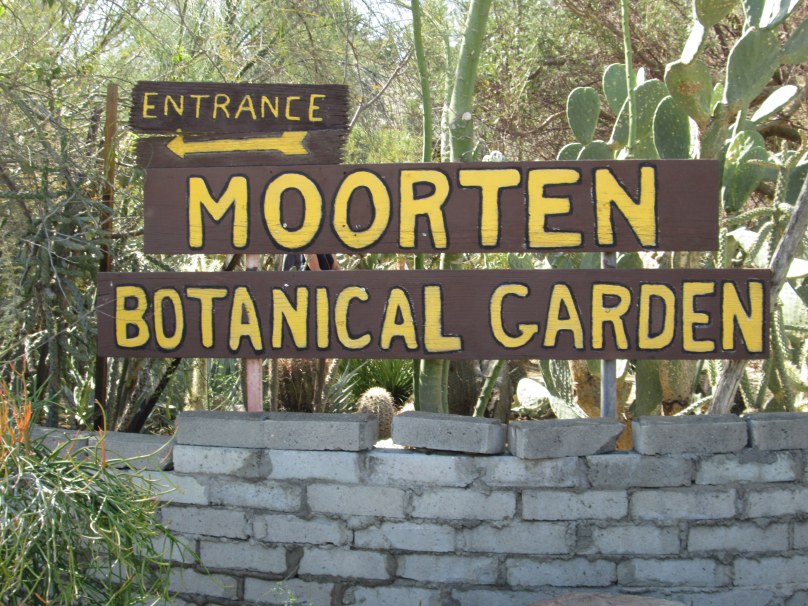
During my weekend in the desert, my brother and I didn’t get much of a chance to go gallivanting around. I did manage to introduce him to one of my favorite places, which, surprisingly, he had never visited. I am referring to the Moorten Botanical Garden on South Palm Drive in Palm Springs.

The garden was founded by Chester “Cactus Slim” Moorten who had come to California during the silent film era and acted in Mack Sennett’s Keystone Cops films. By the 1930s, he had received a diagnosis of tuberculosis and was urged by his doctors to check into a sanitarium. Instead, he moved to the Palm Springs area and opened a cactus nursery. The story is told in Garden Collage magazine in a 2016 article by Molly Beauchemin which you can find here.

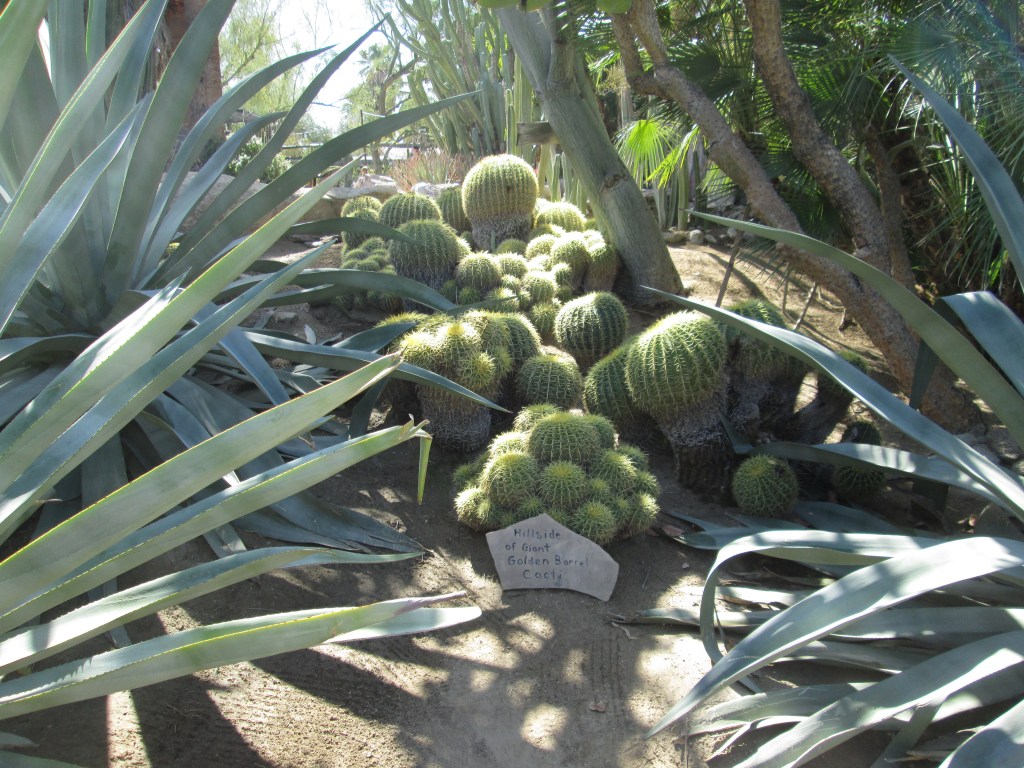
Acres of Incredible Cacti and Other Succulents

Dan and I enjoyed an hour exploring the paths overgrown with thousands of varieties of the desert foliage. The garden also does a land office business selling potted cacti to visitors.

One of the Most Photogenic Places in the Coachella Valley

Chester Moorten’s son Clark now runs the botanical garden. Plant varieties are carefully labelled with the plants’ scientific and popular names. There is even a greenhouse with hundreds of rare varieties which normally wouldn’t otherwise grow in the Palm Springs area.

For more information, you can visit the garden’s website: Moorten Botanical Garden.

Weekend in the Desert

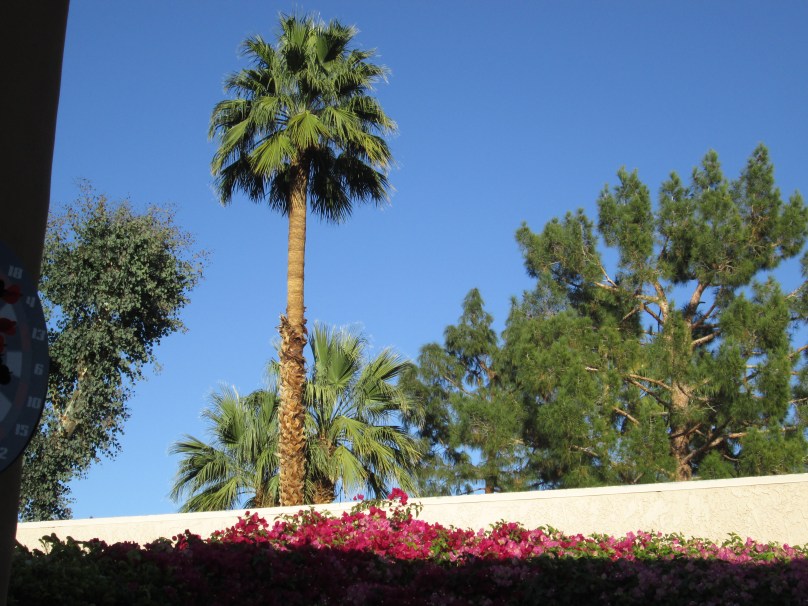
Looking Up from the Book I Was Reading, This Was the View

It was good to see my brother again after four months of quarantining alone with Martine. Because she hates the desert (having lived and work for two years in Twentynine Palms), Martine stayed behind in L.A. and engaged in several cleaning projects which would have been difficult with me tromping about the place.

Dan and my sister-in-law Lori were, as usual, excellent hosts. Dan went out of his way to cook several gourmet meals including a vegetarian lasagna with eggplant and spinach as well as corned beef and cabbage with potatoes and carrots. We didn’t visit many places, because the Coachella Valley is still under a Covid-19 lockdown. But I did manage to read two whole books sitting in Dan’s back yard. The weather was perfect, an even 70° Fahrenheit (21° Celsius) with an occasional cool breeze.

The photo above was taken from the chair in which I was reading Hilaire Belloc’s Selected Essays and Jon Krakauer’s Classic Krakauer: Essays on Wilderness and Risk. (I love reading essays, as I consider myself to be something of an essay writer, but in a small way.)

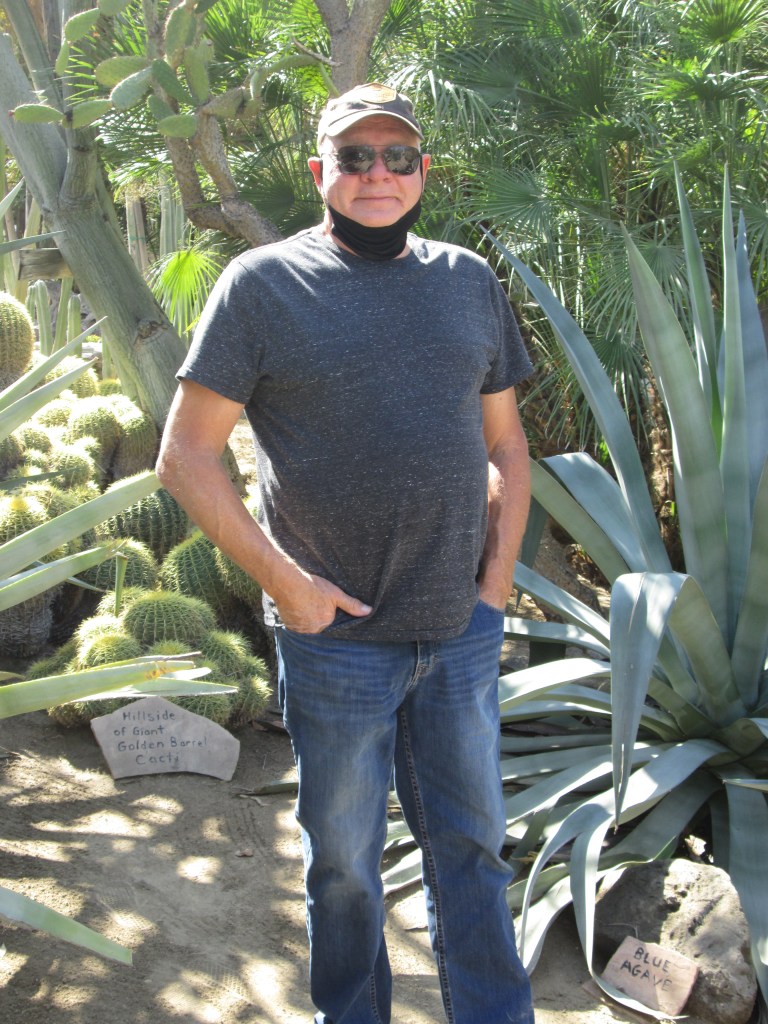
My Brother Dan at the Moorten Cactus Garden in Palm Springs

Because Dan lives in the lower desert of California, I would not venture to visit him during the blazingly hot summer months. I hope that he can make it to L.A., or I will have to wait until the fall to drive out again.