In Cloudy Santa Barbara

Humboldt Penguin at the Santa Barbara Zoo

Today Martine and I set out for the Santa Barbara Zoo, which is open for prepaid admissions. The Spring marine layer was in force, with heavy clouds and some drizzle between Ventura and Santa Barbara. It had stopped by the time we got to the zoo, so we were hopeful. We had a nice time despite the absence of the elephants (which were being replaced by an “Australian Walkabout” of some sort.) Also, the aviaries and some of the indoor exhibits were closed down “because of the virus.” Also, many other animals were either missing or hiding from view.

I suppose I could understand this. If I were in a cage at the zoo, I would not be too terribly interested in gaping at the teams of children and their harried parents. So I would probably present them with my hindquarters, like the above Humboldt Penguin. (Curiously enough, these Penguins come from near the Equator off the coast of Peru—not Antarctica.)

One animal which had no problem facing down the staring zoo visitors was the African lion:

We were done in about an hour, but satisfied by our walk in the cool, cloudy weather. Zoos are never perfect, but the small Santa Barbara Zoo is better than most. The LA Zoo is characterized by massive traffic jams and stroller collisions with adult ankles.

After the zoo, we drove down to the harbor and had lunch at Brophy Brothers, one of our favorite seafood restaurants in Southern California. Their New England clam chowder is to die for, and I also enjoyed the grilled mahi mahi sandwich.

By the time we were headed back home, the sun came out around Ventura and stuck around for the rest of the afternoon. In celebration, we drove home on the relatively uncrowded California 126 and stopped for strawberries the size of clenched fists at Francisco’s Fruit Stand in Fillmore. Also I picked up some yummy dried mangos and Banderita Mexican cocoanut candy.

It was a fun day, probably the most fun we had together since the onset of the plague in March 2020.
Time To Take In Sail

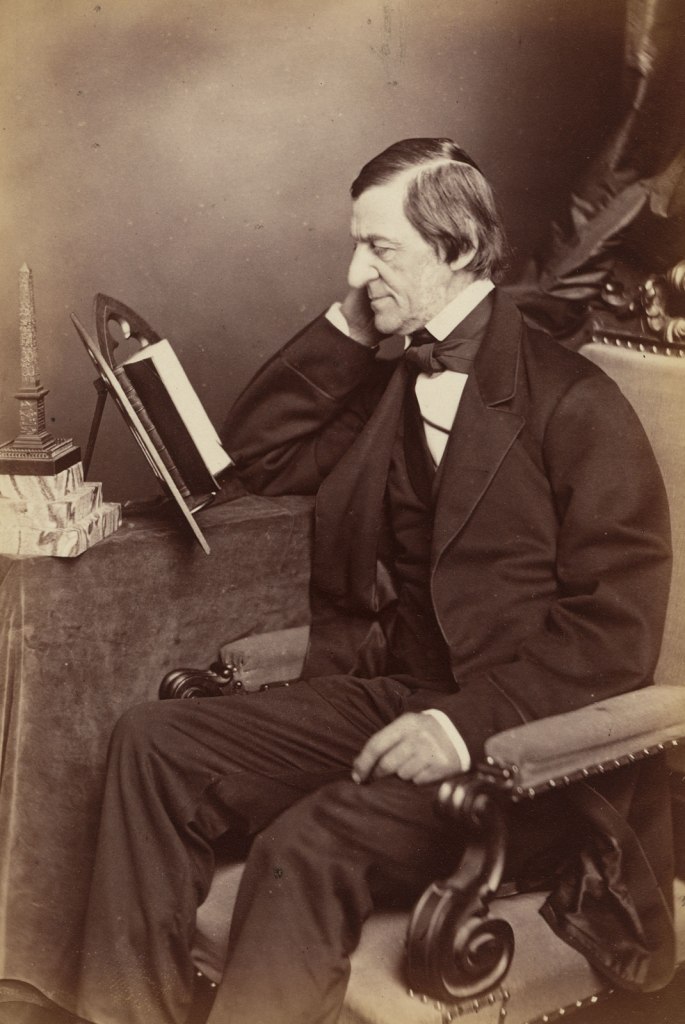
Ralph Waldo Emerson (1803-1882)

Having just finished an absorbing biography of Henry David Thoreau, I thought I should also give some attention to his friend and neighbor, Ralph Waldo Emerson. Here is a poem of his that impressed me entitled “Terminus”:

Terminus
It is time to be old,
To take in sail:—
The god of bounds,
Who sets to seas a shore,
Came to me in his fatal rounds,
And said: “No more!
No farther shoot
Thy broad ambitious branches, and thy root.
Fancy departs: no more invent;
Contract thy firmament
To compass of a tent.
There’s not enough for this and that,
Make thy option which of two;
Economize the failing river,
Not the less revere the Giver,
Leave the many and hold the few.
Timely wise accept the terms,
Soften the fall with wary foot;
A little while
Still plan and smile,
And,—fault of novel germs,—
Mature the unfallen fruit.
Curse, if thou wilt, thy sires,
Bad husbands of their fires,
Who, when they gave thee breath,
Failed to bequeath
The needful sinew stark as once,
The Baresark marrow to thy bones,
But left a legacy of ebbing veins,
Inconstant heat and nerveless reins,—
Amid the Muses, left thee deaf and dumb,
Amid the gladiators, halt and numb.”

As the bird trims her to the gale,
I trim myself to the storm of time,
I man the rudder, reef the sail,
Obey the voice at eve obeyed at prime:
“Lowly faithful, banish fear,
Right onward drive unharmed;
The port, well worth the cruise, is near,
And every wave is charmed.” 

A Little Man With a Big Nose

Henry David Thoreau (1817-1862)

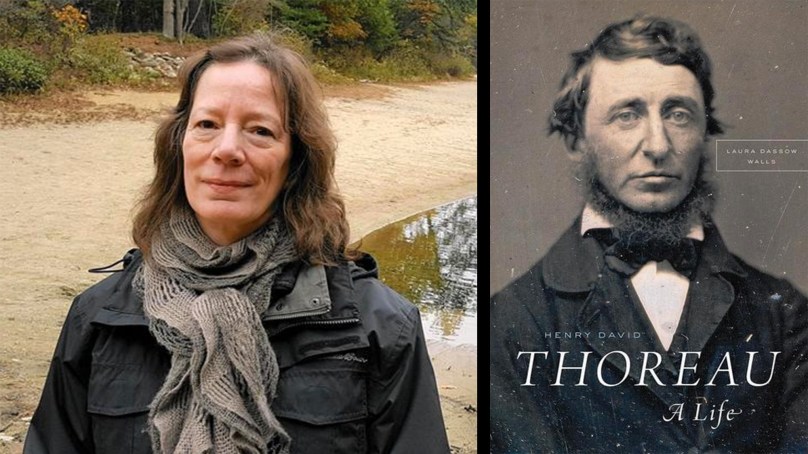
I have just finished reading Laura Dassow Walls’s Henry David Thoreau: A Life. As I have mentioned before, I don’t usually like biographies, because if you admire the person who is the subject of them, you are devastated when he or she dies in the last chapter. Sitting in my little library, I was devastated when the American I most loved and admired succumbed to consumption at the age of forty-four.

Everyone knows a little about Thoreau, most of it wrong. When I first read the book, I was told by friends that when he moved to his cabin by the shores of Walden Pond, Thoreau “cheated.” What kind of a hermit was he when he spent a lot of time in Concord with his friends. The answer is: He was no kind of a hermit. The first chapter of Walden, or Life in the Woods is entitled “Economy,” not some eremitical mumbo-jumbo.

Long after he returned to his house in Concord, Thoreau lived an active life giving speeches, writing thousands of pages of notes on nature, fulminating against slavery (his house was a station on the Underground Railroad), and supporting John Brown and his followers even after Brown was executed for his raid on Harper’s Ferry. He had read and understood Charles Darwin’s The Origin of Species, even while thousands of Americans condemned it as heretical.

I love the above photograph of Thoreau, which also is on the dust jacket of Laura Walls’s biography. Look at those piercing blue eyes. The scraggly beard was to warm his neck to protect him from the ravages of consumption.

This biography is nothing less than spectacular. I was saddened to come to the end of it.

Why do I admire Thoreau so much? I can only say that he was one of the most observant people who ever lived, easily on a par with John Muir and Charles Darwin. It was Thoreau’s notion of land set aside from human occupation as “commons” which led, via Muir, to the creation of the National Park System. Also, I regard Walden as a great book in a century that included such luminaries as Hawthorne, Melville, and Whitman.

Now I’m going to have to read some more Thoreau. Lucky me!

Republicans

What Comes First? The Death of the Republican Party or the Death of Our Democracy?

As much as I hate talking about politics in America, I cannot shut up when I see one of our two political parties attempt to destroy the country even as they destroy their own party. It’s like a race to the bottom—that shit pit of death cults and failed states.

I can hardly believe that over 70 million Americans have drunk the Republicans’ poisoned Kool-Aid. I regret to say that the woman I love is one of them. Martine not only refuses to get the shots protecting against Covid-19, but she keeps trying to show me “evidence” from right-wing websites which the AM talk radio pundits cite for their over-the-air lies. Take a look at Natural Health News for its take Defending Health, Life and Liberty (followed, of course, by the obligatory American flag).

These people are the enemy. Follow their advice, and risk dying. Martine is convinced that the Covid shots are more dangerous than the disease they were formulated to fight. She says that her health is too fragile for the shots. How would she fare, however, if she contracted the coronavirus? Better? I don’t think so.

If Martine doesn’t want to take the vaccine, I’m not going to force her. But I have nothing but contempt for her “news” sources. The Republican cultists have created their own plastic bubble of destructive falsehoods in which they, and perhaps ultimately all of us, are weakening and perhaps failing.

Captain of a Huckleberry Party

Author Laura Dassow Walls and Her Biography of Henry David Thoreau

Today I did not even set foot outside my apartment. It was a nice day, even a bit on the cool side, but I was entranced reading Laura Dassow Walls’s Henry David Thoreau: A Life.

Ever since I first read Walden, I have been entranced by Thoreau. I even liked A Week on the Concord and Merrimack Rivers, which was not exactly received with open arms when it was published. Wikipedia describes him as a Naturalist and indicates his chief interests as being (in no particular order) ethics, poetry, religion, politics, biology, philosophy, and history.

In addition, he was a pencil manufacturer (the family business), handyman, surveyor, builder, and agronomist. His published works represent but a small part of his interests. Perhaps his major work consisted of his notebooks, which were voluminous. His friend Ralph Waldo Emerson promoted him and his work, but lost interest as the friendship wore off and referred to Thoreau as the ideal captain of a huckleberry party.

I am not always fond of reading biographies: As soon as I become interested in the subject, he or she dies at the end of the book. Still, I always wanted to know more about Thoreau, so I’ll have to put up with some grief when I get to that last chapter.

I’ll leave you with this great quote from Walden:

However mean your life is, meet it and live it; do not shun it and call it hard names. It is not so bad as you are. It looks poorest when you are richest. The fault-finder will find faults even in paradise. Love your life, poor as it is. You may perhaps have some pleasant, thrilling, glorious hours, even in a poorhouse. The setting sun is reflected from the windows of the almshouse as brightly as from the rich man’s abode; the snow melts before its door as early in the spring. I do not see but a quiet mind may live as contentedly there, and have as cheering thoughts, as in a palace.

Seeing vs Thinking

Fernando Pessoa (1888-1935) Painted by Almada Negreiros

We tend sometimes to forget that Portugal even exists, yet the tiny country at the left edge of the Iberian Peninsula has a way of grabbing our intention, especially with its literature. Fernando Pessoa was such a rich trove that he split himself into some some seventy-five heteronyms, or authorial entities. The following excerpt from “The Keeper of Sheep” is by one of his most prominent heteronyms, Alberto Caeiro.

My gaze is clear like a sunflower.
It is my custom to walk the roads
Looking right and left
And sometimes looking behind me,
And what I see at each moment
Is what I never saw before,
And I’m very good at noticing things.
I’m incapable of feeling the same wonder
A newborn child would feel
If he noticed that he’d really and truly been born.
I feel at each moment that I’ve just been born
Into a completely new world...

I believe in the world as in a daisy,
Because I see it. But I don’t think about it.
Because to think is not to understand.
The world wasn’t made for us to think about it
(To think is to have eyes that aren’t well)
But to look at it and be in agreement.

I have no philosophy, I have senses...
If I speak of Nature it’s not because I know what it is
But because I love it, and for that very reason,
Because those that love never know what they love
Or why they love, or what love is.
Love is innocence,
And the sum of innocence is not thinking...

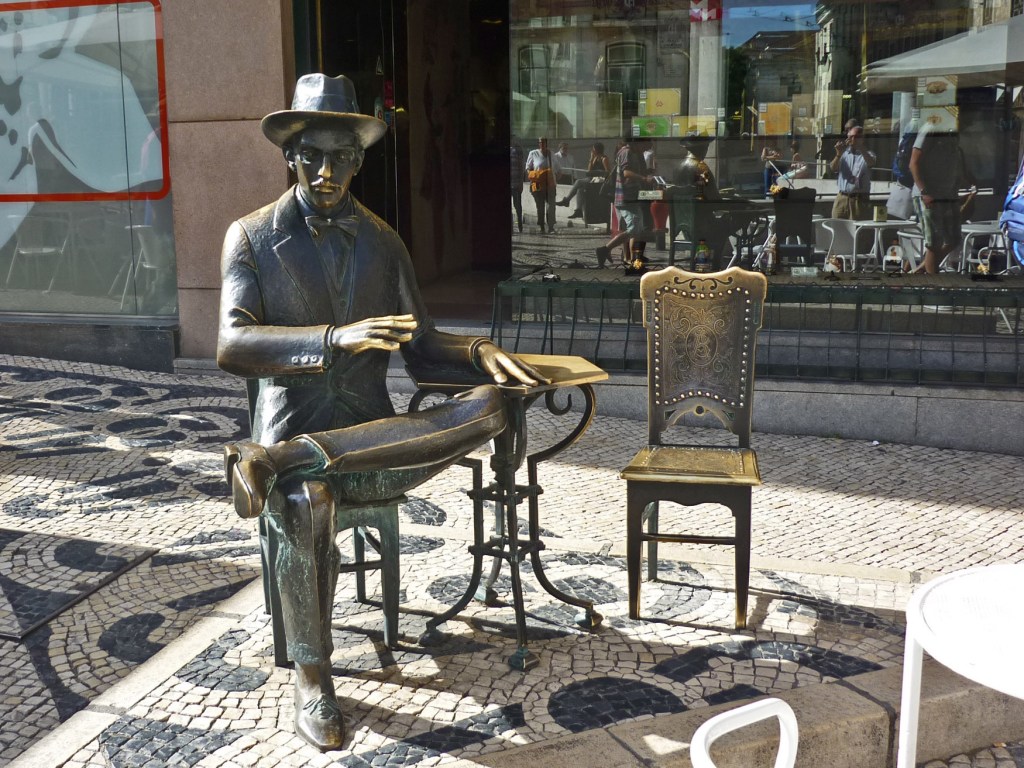
Statue of Fernando Pessoa in Lisbon

In a mock interview with “Alberto Caeiro,” Pessoa wrote:

I’m not a materialist or a deist or anything else. I’m a man who one day opened the window and discovered this crucial thing. Nature exists. I saw that the trees, the rivers and the stones are things that truly exist. No one had ever thought about this.

I don’t pretend to be anything more than the greatest poet in the world. I made the greatest discovery worth making, next to which all other discoveries are games of stupid children. I noticed the Universe. The Greeks, with all their visual acuity, didn’t do as much.

The poem and the quote come from the Pessoa collection entitled A Little Larger Than the Entire Universe: Selected Poems translated by Richard Zenith.