A Little Man With a Big Nose

Henry David Thoreau (1817-1862)

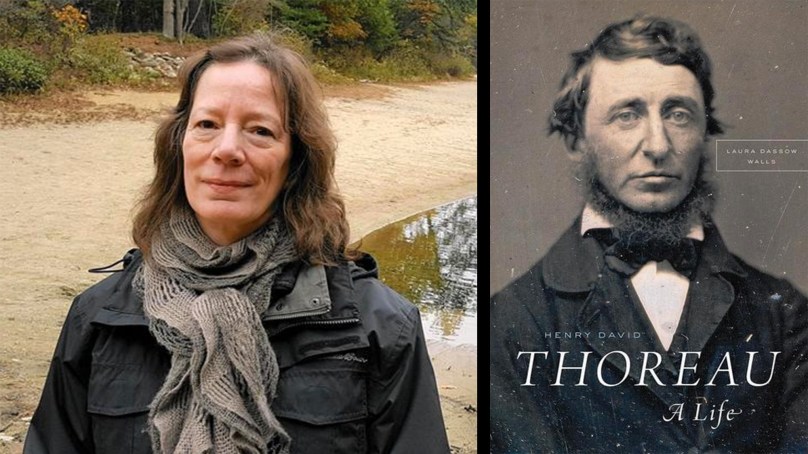
I have just finished reading Laura Dassow Walls’s Henry David Thoreau: A Life. As I have mentioned before, I don’t usually like biographies, because if you admire the person who is the subject of them, you are devastated when he or she dies in the last chapter. Sitting in my little library, I was devastated when the American I most loved and admired succumbed to consumption at the age of forty-four.

Everyone knows a little about Thoreau, most of it wrong. When I first read the book, I was told by friends that when he moved to his cabin by the shores of Walden Pond, Thoreau “cheated.” What kind of a hermit was he when he spent a lot of time in Concord with his friends. The answer is: He was no kind of a hermit. The first chapter of Walden, or Life in the Woods is entitled “Economy,” not some eremitical mumbo-jumbo.

Long after he returned to his house in Concord, Thoreau lived an active life giving speeches, writing thousands of pages of notes on nature, fulminating against slavery (his house was a station on the Underground Railroad), and supporting John Brown and his followers even after Brown was executed for his raid on Harper’s Ferry. He had read and understood Charles Darwin’s The Origin of Species, even while thousands of Americans condemned it as heretical.

I love the above photograph of Thoreau, which also is on the dust jacket of Laura Walls’s biography. Look at those piercing blue eyes. The scraggly beard was to warm his neck to protect him from the ravages of consumption.

This biography is nothing less than spectacular. I was saddened to come to the end of it.

Why do I admire Thoreau so much? I can only say that he was one of the most observant people who ever lived, easily on a par with John Muir and Charles Darwin. It was Thoreau’s notion of land set aside from human occupation as “commons” which led, via Muir, to the creation of the National Park System. Also, I regard Walden as a great book in a century that included such luminaries as Hawthorne, Melville, and Whitman.

Now I’m going to have to read some more Thoreau. Lucky me!

Republicans

What Comes First? The Death of the Republican Party or the Death of Our Democracy?

As much as I hate talking about politics in America, I cannot shut up when I see one of our two political parties attempt to destroy the country even as they destroy their own party. It’s like a race to the bottom—that shit pit of death cults and failed states.

I can hardly believe that over 70 million Americans have drunk the Republicans’ poisoned Kool-Aid. I regret to say that the woman I love is one of them. Martine not only refuses to get the shots protecting against Covid-19, but she keeps trying to show me “evidence” from right-wing websites which the AM talk radio pundits cite for their over-the-air lies. Take a look at Natural Health News for its take Defending Health, Life and Liberty (followed, of course, by the obligatory American flag).

These people are the enemy. Follow their advice, and risk dying. Martine is convinced that the Covid shots are more dangerous than the disease they were formulated to fight. She says that her health is too fragile for the shots. How would she fare, however, if she contracted the coronavirus? Better? I don’t think so.

If Martine doesn’t want to take the vaccine, I’m not going to force her. But I have nothing but contempt for her “news” sources. The Republican cultists have created their own plastic bubble of destructive falsehoods in which they, and perhaps ultimately all of us, are weakening and perhaps failing.

Captain of a Huckleberry Party

Author Laura Dassow Walls and Her Biography of Henry David Thoreau

Today I did not even set foot outside my apartment. It was a nice day, even a bit on the cool side, but I was entranced reading Laura Dassow Walls’s Henry David Thoreau: A Life.

Ever since I first read Walden, I have been entranced by Thoreau. I even liked A Week on the Concord and Merrimack Rivers, which was not exactly received with open arms when it was published. Wikipedia describes him as a Naturalist and indicates his chief interests as being (in no particular order) ethics, poetry, religion, politics, biology, philosophy, and history.

In addition, he was a pencil manufacturer (the family business), handyman, surveyor, builder, and agronomist. His published works represent but a small part of his interests. Perhaps his major work consisted of his notebooks, which were voluminous. His friend Ralph Waldo Emerson promoted him and his work, but lost interest as the friendship wore off and referred to Thoreau as the ideal captain of a huckleberry party.

I am not always fond of reading biographies: As soon as I become interested in the subject, he or she dies at the end of the book. Still, I always wanted to know more about Thoreau, so I’ll have to put up with some grief when I get to that last chapter.

I’ll leave you with this great quote from Walden:

However mean your life is, meet it and live it; do not shun it and call it hard names. It is not so bad as you are. It looks poorest when you are richest. The fault-finder will find faults even in paradise. Love your life, poor as it is. You may perhaps have some pleasant, thrilling, glorious hours, even in a poorhouse. The setting sun is reflected from the windows of the almshouse as brightly as from the rich man’s abode; the snow melts before its door as early in the spring. I do not see but a quiet mind may live as contentedly there, and have as cheering thoughts, as in a palace.

Seeing vs Thinking

Fernando Pessoa (1888-1935) Painted by Almada Negreiros

We tend sometimes to forget that Portugal even exists, yet the tiny country at the left edge of the Iberian Peninsula has a way of grabbing our intention, especially with its literature. Fernando Pessoa was such a rich trove that he split himself into some some seventy-five heteronyms, or authorial entities. The following excerpt from “The Keeper of Sheep” is by one of his most prominent heteronyms, Alberto Caeiro.

My gaze is clear like a sunflower.
It is my custom to walk the roads
Looking right and left
And sometimes looking behind me,
And what I see at each moment
Is what I never saw before,
And I’m very good at noticing things.
I’m incapable of feeling the same wonder
A newborn child would feel
If he noticed that he’d really and truly been born.
I feel at each moment that I’ve just been born
Into a completely new world...

I believe in the world as in a daisy,
Because I see it. But I don’t think about it.
Because to think is not to understand.
The world wasn’t made for us to think about it
(To think is to have eyes that aren’t well)
But to look at it and be in agreement.

I have no philosophy, I have senses...
If I speak of Nature it’s not because I know what it is
But because I love it, and for that very reason,
Because those that love never know what they love
Or why they love, or what love is.
Love is innocence,
And the sum of innocence is not thinking...

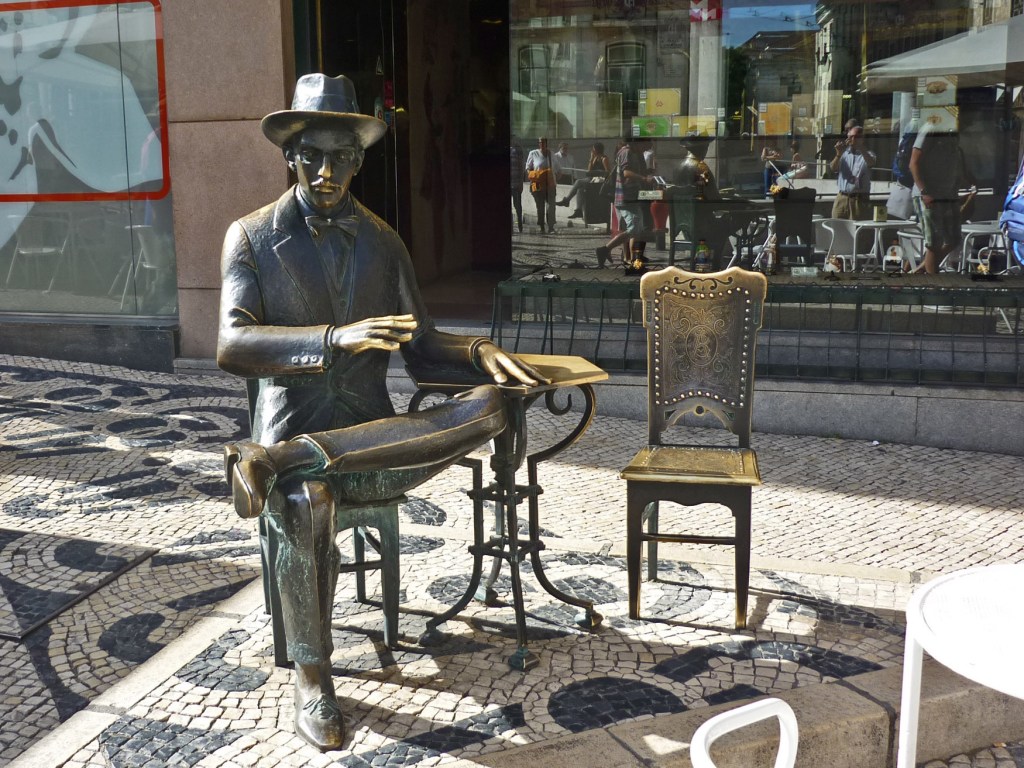
Statue of Fernando Pessoa in Lisbon

In a mock interview with “Alberto Caeiro,” Pessoa wrote:

I’m not a materialist or a deist or anything else. I’m a man who one day opened the window and discovered this crucial thing. Nature exists. I saw that the trees, the rivers and the stones are things that truly exist. No one had ever thought about this.

I don’t pretend to be anything more than the greatest poet in the world. I made the greatest discovery worth making, next to which all other discoveries are games of stupid children. I noticed the Universe. The Greeks, with all their visual acuity, didn’t do as much.

The poem and the quote come from the Pessoa collection entitled A Little Larger Than the Entire Universe: Selected Poems translated by Richard Zenith.

Never the Twain Shall Meet

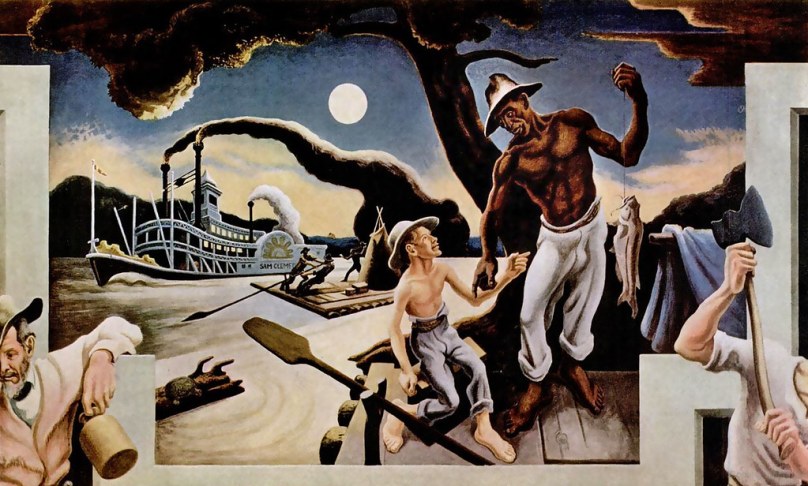
Thomas Hart Benton Mural of Huck with N-Word Jim

This is a re-post from my January 7, 2011 blog for the late unlamented Multiply.Com.

As one who has frequently been accused of speaking in an “inappropriate” way, I am still grateful that no one has attempted to apply a muzzle to my face. (Not that some haven’t been thinking about it.) If someone tried, I would resist—which is more than poor Mark Twain can do a hundred years after his death.

Unless you have spent the last few weeks visiting the moons of Jupiter, you’ve probably heard that some publisher has attempted to bowdlerize Huckleberry Finn by giving the slave Nigger Jim a more respectable name, and I don’t mean Reginald or Percival. It’s the first word of his name—the so-called N-word—that many find objectionable.

So be it! While I would never venture to call a person of color a nigger under any circumstances, I find any attempt to tinker with a great author’s work objectionable on the face of it. If the name “Nigger Jim” is objectionable, I suggest that the offended parties restrict themselves to reading kiddie books written by the oh-so-politically-correct.

You can’t wipe out the sins of the past as if with an eraser on a clean board: People thought and wrote differently then. The past, they say, is a different country.

Yet it has not stopped people from trying. In the Eighteenth Century, Shakespeare’s plays were substantially re-written before being put on the stage—just to make them more acceptable. As soon as the powder fell out from peoples’ wigs, the changes were canned and the original was restored.

So you PC types can get all het up about this nonsense. Me, I’m going to go home and read Joseph Conrad’s The Afro-American of the Narcissus.

The picture above is a detail from a mural by Thomas Hart Benton of Huck Finn and Colored-Person James from the Missouri State Museum.

Southeast

This Is the Part of Los Angeles County That Most People Know

Although I have lived in the Los Angeles area for over half a century, there are parts that are almost totally unfamiliar to me. Today, I had a chance to visit one of them as I drove Martine to a ophthalmologist appointment in Lakewood, which is a place I have whizzed past on the freeway, but never stopped to visit.

The part of LA that is most unfamiliar to me are the so-called “Gateway Cities” in the southeastern part of the county. I am somewhat familiar with Long Beach, which I regard as part of the tierra cognita of my experience.

The City of Los Angeles occupies much of the center of the county. Then there is a narrow corridor of the city that stretches down to San Pedro and the Port of Los Angeles. To the right of that corridor are a number of independent cities that include such names as Bell, Bell Gardens, Bellflower, Cudahy, Downey, Hawaiian Gardens, Lakewood, Lynwood, Maywood, and presumably other -woods.

Here is a map of the Gateway Cities:

Los Angeles’s “Gateway Cities”

When you remove the dark blue of Long Beach, you are left with a bunch of small, tightly squeezed together communities that for all intents and purposes have little of interest for people visiting Southern California. There are a couple of colleges, no major museums, only one ethnic community (the Indian and Pakistani enclave along Pioneer Avenue in Artesia), and a couple of historical places, mostly in Whittier. Other than Long Beach, the only community people outside of California are likely to have heard of is Compton, mostly as a high-crime place to avoid.

Martine is due for another appointment in Lakewood in a couple of weeks, so I should probably learn a little more about this apparent black hole in the city where I dwell.

And where do I live? If you look at the top map for Santa Monica slightly to the left of center, look for the number oval 2, which indicates Santa Monica Boulevard. I live right under that oval 2.

Sir Vidia Takes on Politics

Nobel Prize Laureate V.S. Naipaul

I have just finished reading V.S. Naipaul’s sixth novel, The Mimic Men (1967)—a semi-autobiographical work about what it is like to win fame and renown while coming from a place like the island of Trinidad, which he calls Isabella in the book. About fifty pages in, I came across his musings on politics and politicians, which I excerpt here:

Politicians are people who truly make something out of nothing. They have few concrete gifts to offer. They are not engineers or artists or makers. They are manipulators; they offer themselves as manipulators. Having no gifts to offer, they seldom know what they seek. They might say they seek power. But their definition of power is vague and unreliable. Is power the chauffeured limousine with fine white linen on the seats, the men from Special Branch outside the gates, the skilled and deferential servants? But this is only indulgence, which might be purchased by anyone at any time in a first-class hotel. Is it the power to bully or humiliate or take revenge? But this is the briefest sort of power; it goes as quickly as it comes; and the true politician is by his nature a man who wishes to play the game all his life. The politician is more than a man with a cause, even when this cause is no more than self-advancement. He is driven by some little hurt, some little incompleteness. He is seeking to exercise some skill which even to him is never as concrete as the skill of the engineer; of the true nature of this skill he is not aware until he begins to exercise it. How often we find those who after years of struggle and manipulation come close to the position they crave, sometimes indeed achieving it, and then are failures. They do not deserve pity, for among the aspirants to power they are complete men; it will be found that they have sought and achieved fulfilment elsewhere; it takes a world war to rescue a Churchill from political failure. Whereas the true politician finds his skill and his completeness only in success. His gifts suddenly come to him. He who in other days was mean, intemperate and infirm now reveals unsuspected qualities of generosity, moderation and swift brutality. Power alone proves the politician; it is ingenuous to express surprise at an unexpected failure or an unexpected flowering.

British Colonials

“Richmond, Virginia, USA – June 18th, 2012: Cancelled Stamp From Jamaica Featuring Elizabeth II And The West Indies.”

1958 Jamaican Stamp Honoring the West Indies Federation

As a young lad, I was a devoted collector of stamps. All those countries, colonies, and protectorates fascinated me. And it was around then that the rush to independence began with the Gold Coast becoming Ghana in 1957. But all the newly independent states lacked one thing: The portrait of the young and beautiful monarch of Britain, Queen Elizabeth II.

Oh, I know that the Queen is approaching her 96th birthday, and she looks it, waddled in her neon-colored cloth coats and matching outfits. But at one time, Elizabeth was a real looker, such that I would look for televised broadcasts in which she appeared.

Bechauanaland Protectorate

The Bechuanaland Protectorate morphed into the independent nation of Botswana. When it became independent, it lost not only the queen, but its unpronounceable name.

I regarded Britain as cooler because it had such a cute queen. In contrast, when Germany had several colonies in Africa prior to the First World War, all they could display on their postage stamps was Kaiser Wilhelm’s yacht, the SMY Hohenzollern. B-o-r-i-n-g. I guess that’s why they lost their colonies in the war.

Just to give you an idea of just how cute the young Queen Elizabeth II really was, here is an old Pathé news video from YouTube:

America First?

Dragging Our Flag Down Into the Mire

Sometimes, I think the United States was destroyed by our victory in the Second World War. It seemed that we found ourselves alone at the top of the heap even as we were surrounded by countries in ruins. That’s when the hubris set in. We were free to make mistakes, lots of mistakes, while trumpeting our prowess.

In an article for The New York Review of Books for November 19, 2020, Pankaj Mishra wrote:

In Radical Hope: Ethics in the Face of Cultural Devastation (2006), Jonathan Lear writes of the intellectual trauma of the Crow Indians. Forced to move in the mid-nineteenth century from a nomadic to a settled existence, they catastrophically lost not only their immemorial world but also “the conceptual resources” to understand their past and present. The problem for a Crow Indian, Lear writes, wasn’t just that “my way of life has come to an end.” It was that “I no longer have the concepts with which to understand myself or the world…. I have no idea what is going on.”

It is no exaggeration to say that many in the Anglo-American intelligentsia today resemble the Crow Indians, after being successively blindsided by far-right insurgencies, an uncontainable pandemic, and political revolts by disenfranchised minorities. For nearly three decades after the the end of the cold war, mainstream politicians, journalists, and business people in Britain and the US repeatedly broadcast their conviction that the world was being knit together peaceably by their guidelines for capitalism, democracy, and technology. The United States itself appeared to have entered, with Barack Obama’s election, a “post-racial age,” and Americans seemed set, as President Obama wrote in Wired a month for Donald Trump’s election, to “race for new frontiers” and ”inspire the world.”

Well, that didn’t happen. We had Trump for four years, and suddenly it appeared that we were headed for the dissolution of everything we held dear, while dumbasses from Red States crawled out of their caves and began to shake the foundations of our democracy.

It’s not over yet by a long shot. The one sentence I remember from my high school civics textbook is, “Eternal vigilance is the price of liberty.” So we had best wake up.

Orphans

There are several things I could write about today. For instance, I could celebrate my 40th annual boycott of the Academy Awards Show. Or I could tell you what V. S. Naipaul thought about politics and politicians—well, maybe tomorrow on that one. I think instead I will talk about the Automobile Driving Museum’s Orphan Car Show held yesterday.

By “orphan” was meant all discontinued makes and models. There was a Hudson, a LA Fire Department Hummer, several American Motors and Nash products, several Austin-Healeys, even a weird Fiat that competed with golf carts. And the place was crowded with affable car collectors eager to talk about their prize possessions.

Poster for Yesterday’s “Cruise-In” Car Show

Martine always enjoys the Automobile Driving Museum because of its emphasis on classic American cars and because of its nearness to where we live. On May 1, the museum displays inside will re-open, and Martine will once again be able to sit inside a classic Corvette and dream about the old days when Detroit made some great cars.

The Front End of a Classic Hudson