The Narcoleptic Driver?

I was very late learning to drive. It was not until age 40 that I got my first driver’s license. Around that time, I was on some relatively ineffective blood pressure medications that had all sorts of nasty side-effects. Apresoline attacked my joints and made me averse to any sort of movement. Ismelin (which I called Dismalin) made me impotent. And Catapres turned me into a narcoleptic: Whenever I rode in an automobile or bus for any distance, I would quickly drop off to sleep.

Naturally, I was not taking all three medications at the same time; but I had at the time some major concerns about my health. When in 1985 my doctor took me off Catapres, I decided it was now or never. I contacted the Sears Roebuck Driving School and started learning to drive. My driving instructor, Jerry Kellman, was excellent. After a couple of months of driving under his tutelage, I took the driving test and got an excellent score.

No sooner did I get my license than I ordered a 1984 two-door Mitsubishi Montero. Like the model illustrated above, the color was “Dakar Sand.” I was eager to show my father my newfound driving ability, but unfortunately he died of heart failure around that time.

Way back when, he tried to teach me how to drive. But he was so hot-tempered that he would whack me in the head every time I made a mistake; so I decided I would learn on my own. Alas, shortly after I had my brain tumor operation; and everything was put on hold. For my first twenty years in Los Angeles, I depended on public transportation and the kindness of friends.

My Mitsubishi Montero lasted for ten years. Then I burned out the engine by driving up San Marcos Pass in Santa Barbara in low gear. And after replacing the engine (ouch!), my dealership made a mistake that wrecked my automatic transmission. On a trip to Sacramento to see Martine, I started leaking transmission fluid all over the I-5 midway between L.A. and Sacramento. The last straw was in Los Angeles, when an elderly woman driver who was afraid of being late to see her doctor T-boned my car close to home and sent it turning end over end in heavy traffic.

It was only a four-cylinder vehicle, but I grew fond of it.
Rome in God’s Eye

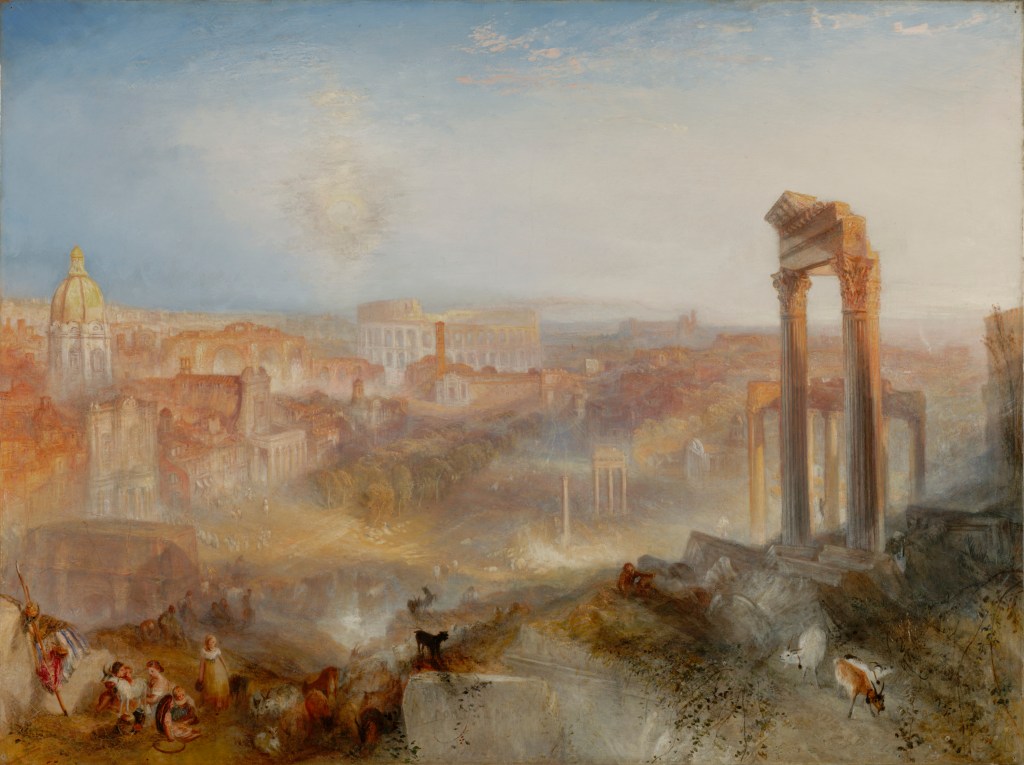
The title of the illustrated painting is “Modern Rome—Campo Vaccino.” It was painted in 1839 by Joseph Mallord William Turner (1775-1851). It is the third of five paintings that moved me during my last visit to the Getty Center in Los Angeles.

There is something about the quality of light in J.M.W. Turner’s work. The painting is described as follows by the Getty’s database:

Ten years after his final journey to Rome, Turner envisioned the Eternal City through a veil of memory. Baroque churches and ancient monuments in and around the Roman Forum seem to dissolve in iridescent light shed by a moon rising at left and a sun setting behind the Capitoline Hill at right. Amidst these splendors, the city’s inhabitants carry on with their daily activities. The picture’s nacreous palette and shimmering light effects exemplify Turner at his most accomplished.

When first exhibited at the Royal Academy in 1839 with its pendant, Ancient Rome; Agrippina Landing with the Ashes of Germanicus, the painting was accompanied by a modified quotation from Lord Byron’s masterpiece, Childe Harold’s Pilgrimage (1818): “The moon is up, and yet it is not night, / The sun as yet divides the day with her.” Like the poem, Turner’s painting evokes the enduring sublimity of Rome, which had been for artists throughout history less a place in the real world than one in the imagination.

Note the characters and livestock in the foreground of the painting. In the background, ancient and contemporary Rome are intermingled as the light at the end of day washes out all the details. It looks almost as if Rome is in flames.

Campo Vaccino literally means cow pasture or cattle field in Italian. For years, the location had been a cattle market. According to the Princeton Art Museum, “Essentially in ruins since the fifth century A.D., by the seventeenth century the still-to-be excavated Roman Forum was popularly known as the Campo Vaccino, or cow field, alluding to its dual role as pasture and cattle market; it was also a popular sketching spot for artists.”

Hitting Rock Bottom

TLOS ANGELES, CA – JANUARY 24: Lisa Rogers, a homeless woman, carries her tent as she relocates her camp on January 24, 2017 in Los Angeles, California. According to a 2016 report by the U.S. Department of Housing and Urban Development, Los Angeles has the highest number of homeless people in the nation with close to 13,000 living on the streets. The annual Greater Los Angeles Homeless Count begins today and will continue through Thursday. (Photo by Justin Sullivan/Getty Images)

To begin with, there are a hell of a lot more than 13,000 homeless living on the streets of Los Angeles. I would put the number at close to 5-10 times that many. I have just finished reading Sam Quinones’s excellent book The Least of Us: True Tales of America and Hope in the Time of Fentanyl and Meth, from which the following paragraph is taken:

We used to believe people needed to hit rock bottom before seeking treatment. That’s another idea made obsolete by our addiction crisis and the current synthetic drug supply. It belongs to an era when drugs of choice were merciful. Nowadays people are living in tents, screaming at unseen demons, raped, pimped, beaten, unshowered, and unfed. That would seem to be rock bottom. Yet it’s not enough to persuade people to get treatment. In Columbus, Ohio, Giti Mayton remembers a meth addict who was hospitalized with frostbitten, gangrenous hands, yet who left the hospital in midwinter to find more dope. San Francisco and Philadelphia, two cities with years of experience with heroin, are seeing users homeless and dying like never before. The dope is different now. Today, rock bottom is death.

The United States of Addiction

Across the street from my apartment is a row of some dozen or more tents usually surrounded by piles of trash and inhabited by people we typically refer to as homeless. (To me, that’s about as useful as referring to my neighbors in this building as “the housed.“) The easternmost tents have the most stable residents, while the ones to the west come and go. Some die of drug overdoses; some are hauled away by the police or ambulance; and, hopefully, some manage to escape life on the streets by happier means. They spend much of the night yelling at one another, particularly if one of the campers is a woman. It’s nobody’s idea of a stable community. Yet Los Angeles has tens of thousands of similar campers, whose numbers seem to be growing every week.

What are the causes of this phenomenon? One could certainly point to economic causes, such as the insanely rising cost of housing. There are also various social causes, such as people released from prison. In my neighborhood, many of the tent dwellers are military veterans as I live two miles from a major Veterans Administration hospital. I suspect, however, that the major causes are a combination of mental illness, alcoholism, and drug addiction.

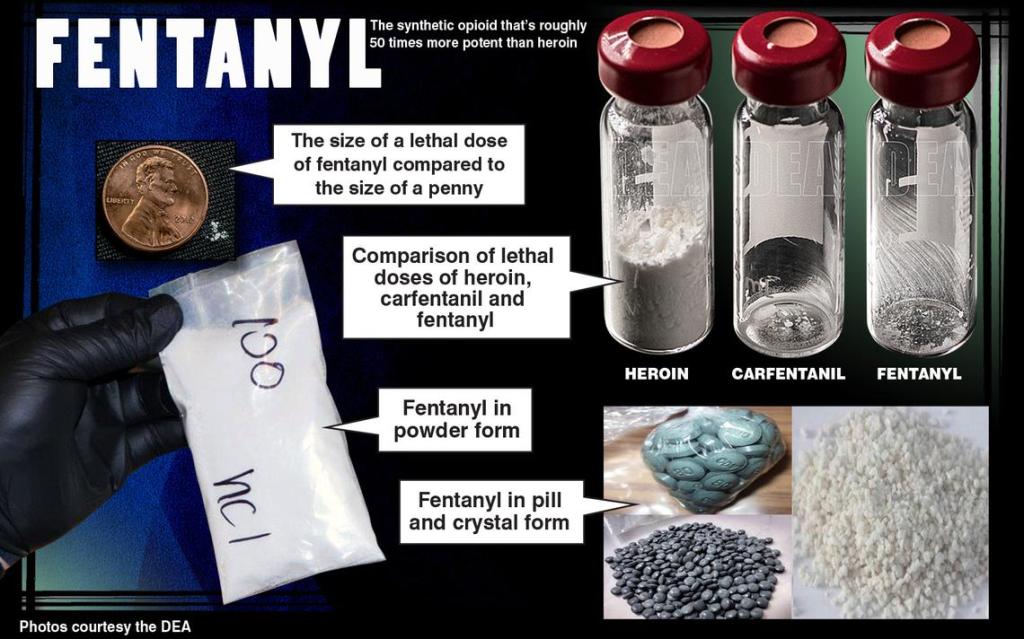
I am currently reading a new book by Sam Quinones entitled The Least of Us: True Tales of America and Hope in the Time of Fentanyl and Meth. Its author talks about how a relatively new drug called Fentanyl has taken America by storm. Not relying on growing and processing a crop, such as cannabis, cocaine, or opiois, fentanyl is produced in the lab from such substances as Benzylfentanyl and 4-Anilinopiperidine. It is now readily available and devastatingly cheap. So cheap that small amounts are frequently mixed in with cocaine and opioids. The result is twofold: .

  • A more satisfying high
  • A vastly increased mortality rate

The above illustration from the Drug Enforcement Administration tells the whole story, comparing the amount required to cause overdose deaths of heroin, carfentanyl (developed to anesthetize rhinoceroses), and fentanyl. As you can see, if a drug dealer gets a pound of fentanyl or carfentanyl, he or she can make thousands of pills with it and still have enough left over to mix with heroin or cocaine. Because so little is needed—beyond which the risk of overdose looms—one can see how a drug dealer can more easily move the drug without being apprehended and also make a killing selling it.

Most fentanyl comes from China. Although the Chinese government has outlawed its sale, drug manufacturers can evade prosecution by making slight changes to the molecular structure of their product.

I have no doubt that most of the tent dwellers across the street from me are users of fentanyl. It’s compact. It’s cheap. And it’s deadly.

Limits

Here is one of my favorite poems by the Argentinian Jorge Luis Borges (1899-1986). Above is a view of a street in the San Telmo neighborhood of Buenos Aires.

 
Limits
Of all the streets that blur in to the sunset,
There must be one (which, I am not sure)
That I by now have walked for the last time
Without guessing it, the pawn of that Someone

Who fixes in advance omnipotent laws,
Sets up a secret and unwavering scale
for all the shadows, dreams, and forms
Woven into the texture of this life.

If there is a limit to all things and a measure
And a last time and nothing more and forgetfulness,
Who will tell us to whom in this house
We without knowing it have said farewell?

Through the dawning window night withdraws
And among the stacked books which throw
Irregular shadows on the dim table,
There must be one which I will never read.

There is in the South more than one worn gate,
With its cement urns and planted cactus,
Which is already forbidden to my entry,
Inaccessible, as in a lithograph.

There is a door you have closed forever
And some mirror is expecting you in vain;
To you the crossroads seem wide open,
Yet watching you, four-faced, is a Janus.

There is among all your memories one
Which has now been lost beyond recall.
You will not be seen going down to that fountain
Neither by white sun nor by yellow moon.

You will never recapture what the Persian
Said in his language woven with birds and roses,
When, in the sunset, before the light disperses,
You wish to give words to unforgettable things.

And the steadily flowing Rhone and the lake,
All that vast yesterday over which today I bend?
They will be as lost as Carthage,
Scourged by the Romans with fire and salt.

At dawn I seem to hear the turbulent
Murmur of crowds milling and fading away;
They are all I have been loved by, forgotten by;
Space, time, and Borges now are leaving me.

Embattled Young Victorian Women

There is something so fragile about young Victorian women. Partially, this was because they could not really own property: If they were married, their husbands had full control. According to Bartleby.Com:

The property rights of women during most of the nineteenth century were dependent upon their marital status. Once women married, their property rights were governed by English common law, which required that the property women took into a marriage, or acquired subsequently, be legally absorbed by their husbands. Furthermore, married women could not make wills or dispose of any property without their husbands’ consent. Marital separation, whether initiated by the husband or wife, usually left the women economically destitute, as the law offered them no rights to marital property.

I have just finished reading J. Sheridan Le Fanu’s Uncle Silas: A Tale of Bartram-Haugh (1864), a brooding mystery about a young English heiress named Maud Ruthyn who is hemmed in by the incompetence of her guardians and the villainy of people trusted by their guardians who strive to take advantage of her.

Looking back on English novels of the Victorian era, I find many novels on this theme. Think of Jane Eyre, Bleak House, The Mysteries of Udolpho, and Agney Grey. It made me realize that it took a long time for society to protect the rights of women. Even today, many existing societies fail in this regard.

In those novels, the only prospect young women could look forward to other than marriage with a loving and rich husband is a dead-end job as a governess, seamstress, laundress, or some other poorly paying “-ess.”

Thou Foster-Child of Silence and Slow Time

Irish Writer J. Sheridan LeFanu (1814-1873)

He is probably most famous for his ghost stories. His Carmilla (1872) was a Lesbian vampire tale that inspired Bram Stoker’s Dracula and was turned into a Roger Vadim film called Blood and Roses (1960). His stories were an unusual mixture of horror, mystery, and historical fiction. After putting it off for decades, I am finally reading his Uncle Silas: A Tale of Bartram-Haugh (1864) and am enjoying immensely.

The title of this post comes from John Keats’s “Ode on a Grecian Urn”:

Thou still unravish'd bride of quietness,
       Thou foster-child of silence and slow time,
Sylvan historian, who canst thus express
       A flowery tale more sweetly than our rhyme:
What leaf-fring'd legend haunts about thy shape
       Of deities or mortals, or of both,
               In Tempe or the dales of Arcady?
       What men or gods are these? What maidens loth?
What mad pursuit? What struggle to escape?
               What pipes and timbrels? What wild ecstasy?

There is something eminently satisfying about reading a long nineteenth century novel. It calls for reserves of patience, but rewards with insights similar to those of the Grecian urn about which Keats writes. That is particularly true of novels from the British Isles, where the prose at times approaches the realm of poetry:

See how a sleepy child will put off the inevitable departure for bed. The little creature’s eyes blink and stare, and it needs constant jogging to prevent his nodding off into the slumber which nature craves. His waking is a pain; he is quite worn out, and peevish, and stupid, and yet he implores a respite, and deprecates repose, and vows he is not sleepy, even to the moment when his mother takes him in her arms, and carries him, in a sweet slumber, to the nursery. So it is with us old children of earth and the great sleep of death, and nature our kind mother. Just so reluctantly we part with consciousness, the picture is, even to the last, so interesting; the bird in the hand, though sick and moulting, so inestimably better than all the brilliant tenants of the bush. We sit up, yawning, and blinking, and stupid, the whole scene swimming before us, and the stories and music humming off into the sound of distant winds and waters. It is not time yet; we are not fatigued; we are good for another hour still, and so protesting against bed, we falter and drop into the dreamless sleep which nature assigns to fatigue and satiety.

I am presently 70% of the way through Uncle Silas and look forward to finishing the book tomorrow, come hell or high water. If you are interested in exploring LeFanu’s work, the following editions were issued by Dover Publications and may still be found from used book dealers (I recommend http://www.abebooks.com):

  • Best Ghost Stories of J. S. LeFanu
  • Green Tea and Other Ghost Stories
  • Ghost Stories and Mysteries
  • Wylder’s Hand
  • Uncle Silas: A Tale of Bartram-Haugh
  • The Wyvern Mystery

It is my opinion that LeFanu is a sadly neglected writer who, over time, will come into his own.

Allhallowtide

If you were to look closely at the word Halloween, you may notice that it means the Eve of All Hallows Day, November 1, which is also called All Saints’ Day. In fact, the period from October 31 through November 2 is sometimes referred to as Allhallowtide. In a way, the period is a kind of liturgical trifecta, in that November 2 is All Souls’ Day, also known as the Day of the Dead.

The idea of All Saints’ Day was primarily to commemorate the nameless martyrs who died for their faith at the hands of certain Roman emperors who persecuted them. Perhaps the largest single group is the Theban Legion, commanded by Saint Maurice, who was ordered by the Emperor Maximian to defeat rebels in what is now Switzerland and, in the process, to make sacrifices to pagan gods. Maurice and his men refused. As punishment, Maximian ordered the legion to be decimated, that is, to have every tenth man executed. After two rounds of decimation, it was decided to execute the entire legion, which consisted of some 6,700 legionaries. Their martyrdom took place in AD 286.

Above is a painting by Fra Angelico of various saints and martyrs, not including the entire Theban Legion. In fact, none of the saints depicted look particularly like Roman legionaries.

All Saints’ Day (November 1) is still considered a Holy Day of Obligation in the Catholic Church, during which all Catholics are required to attend Mass or commit a mortal sin for failure to comply.

Although I continue to hold warm feelings about my Catholic upbringing, I am pretty much a lapsed Catholic and am probably doomed to the fires of Heck.

Flirting With Death

It seems that, as time goes on, Halloween is becoming an ever more popular holiday. It has moved from being a children’s celebration to one that is equally observed by adults. In the Catholic liturgy, it is merely the eve of All Saints Day, which continues to diminish in importance as Christianity slowly recedes. The next day, All Souls Day—November 2—is the Mexican Dia de los Muertos, the Day of the Dead.

What with all the horror films and Stephen King novels and Jack O’Lanterns, Halloween tends to flirt with death without really facing it. As a culture, we tend to stay in the outskirts of death without descending into the center of it. The skulls and skeletons we affect are free of putrefaction and stench.

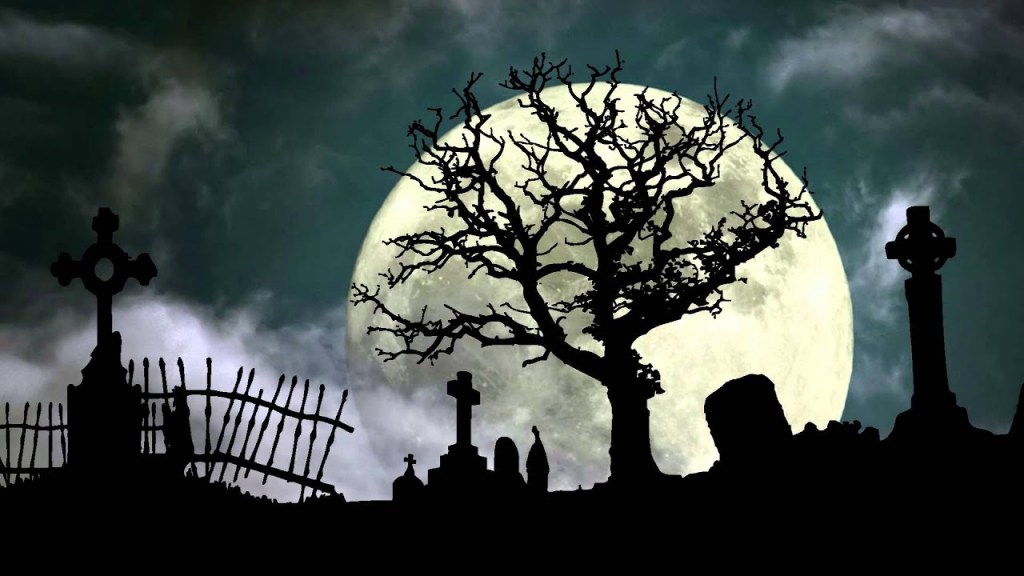
When I was a student at Dartmouth College, I spent four years in the remote Middle Wigwam dormitory (later re-christened McLane Hall). To get to the center of campus, I had to pass along the northern edge of the Hanover, New Hampshire cemetery, which has tombstones dating back to the 18th century, as Dartmouth was founded in 1769. It was an eerie experience, especially when walking home at night after a movie, play, or visit to Baker Library. Yet it looked nothing like the fantasy cemetery pictured above. Even the much older Copps Hill Burying Ground in Boston, where Cotton and Increase Mather are interred, is nowhere near as nasty as a typical horror film cemetery.

We like to keep our cemeteries on the neat side else no one would want to visit them. That’s because we are forced to acknowledge death, but we’d rather not think about it. And when we do, we use typical horror themes to frighten ourselves before returning to normality. Among these are vampires, zombies, Frankenstein monsters, ghosts, hauntings, mummies, shock operas like Hitchcock’s Psycho, demons, goblins, and so on. In fact, most of these themes are wildly fictional and outside the experience of most everyone.

Absent from most of these themes is the real sting of death: a numbing sense of loss of our loved ones and the realization that we will not escape the same fate.

So celebrate Halloween by all means. I certainly do. This month I read Thomas Ligotti’s stories in Grimscribe and Shirley Jackson’s The Haunting of Hill House. And I just started Sheridan LeFanu’s Uncle Silas (1864).

Pharaonic Corporations

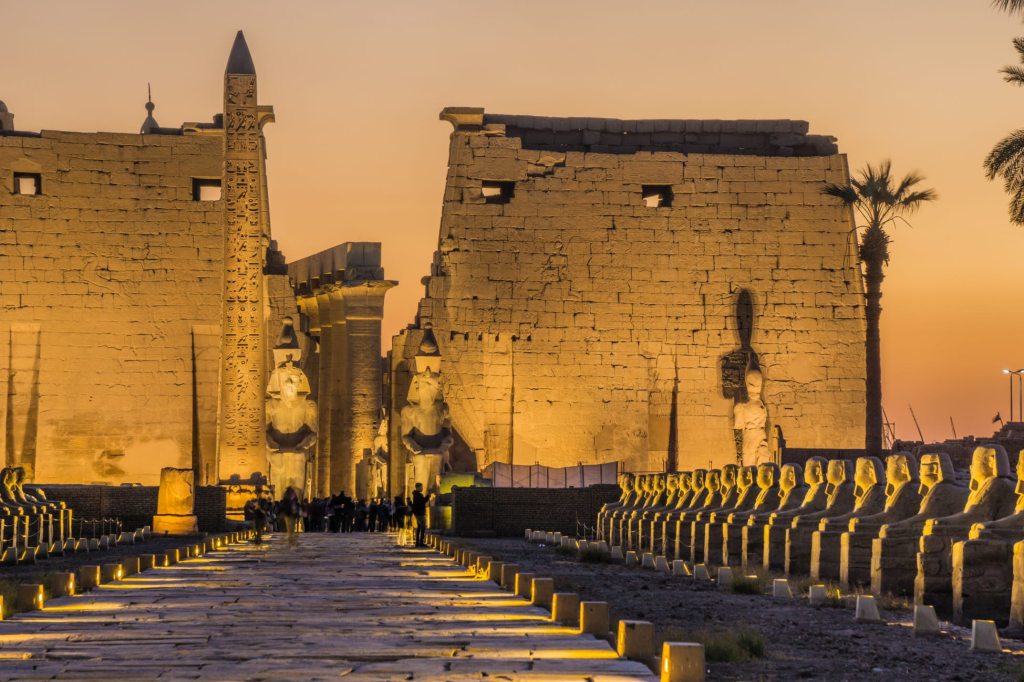
It used to be that American corporations encouraged their customers to call them. But that was way back when. Now, with automated attendant services, the corporations let you talk to their computer—but only if you want to talk about the things about which they want you to talk. And nine times out of ten, those are not the things about which you are calling.

This month, I ran into a nasty bind with a medical lab. My doctor ordered from Question Diagnostics a self-administered test to be sent to me by mail. It never came, but Question Diagnostics e-mailed me to come into their office. Okay, perhaps they were going to hand it to me. So I made an appointment to go in and was asked for my doctor’s order. I told them it was sent from her office by computer. Then a look of comprehension crossed the features of the receptionist: “Oh, I see. Our supplies of that test ran out.” It was suggested that I visit other offices of the lab until I found one that had the test.

Rather than make appointments at multiple offices of the lab, I telephoned the various offices. In none of them was it possible to break through the barrier set up by the automated attendant and speak to a real live human being. Thereupon, I called customer service at the headquarters of Question Diagnostics. Would you believe that the customer service rep duplicated my steps in calling several nearby offices, only to be surprised that I couldn’t find out who had the test available? The rep mentioned that everyone was busy because of Covid-19. (I am willing to bet they’ll be using that excuse for the next five years, whatever happens with the pandemic.)

I made an appointment with the branch in Century City for 11:10 this morning using their Internet appointment software. I was met with a locked door and a sign saying they were gosh-awfully sorry, but the office was closed until November 1. Out of desperation, I returned to my local branch of the lab and, to my delight, found out that the tests had come in. The receptionist handed one to me, and I left with a smile on my face.

Although these corporate automated attendants don’t want to let me through to talk to anyone, many companies have no compunction about using a robocall program to contact me, usually about car repair warranties. Of course, why should I not hang up the moment I detect it’s a robocall?

What gets me is that a company thinks they can sell products and services to the general public without ever getting any direct feedback.