“Alone”

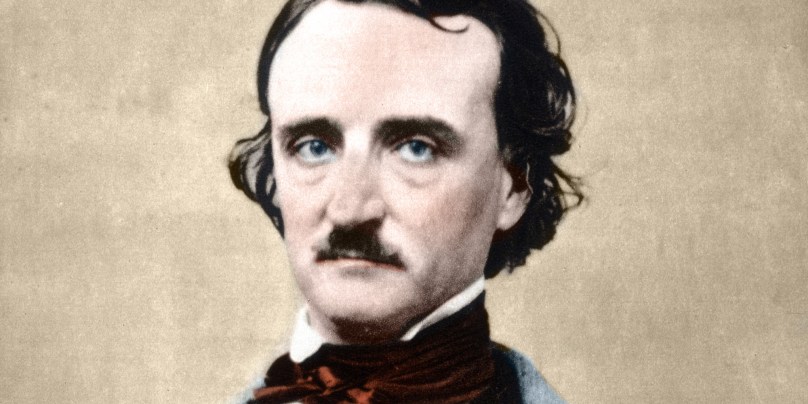
Edgar Allan Poe (1809-1849)

Here’s an early poem by Edgar Allan Poe:

Alone

From childhood’s hour I have not been
As others were—I have not seen
As others saw—I could not bring
My passions from a common spring—
From the same source I have not taken
My sorrow—I could not awaken
My heart to joy at the same tone—
And all I lov’d—I lov’d alone—
Then—in my childhood—in the dawn
Of a most stormy life—was drawn
From ev’ry depth of good and ill
The mystery which binds me still—
From the torrent, or the fountain—
From the red cliff of the mountain—
From the sun that ’round me roll’d
In its autumn tint of gold—
From the lightning in the sky
As it pass’d me flying by—
From the thunder, and the storm—
And the cloud that took the form
(When the rest of Heaven was blue)
Of a demon in my view—

A Cemetery for Halloween

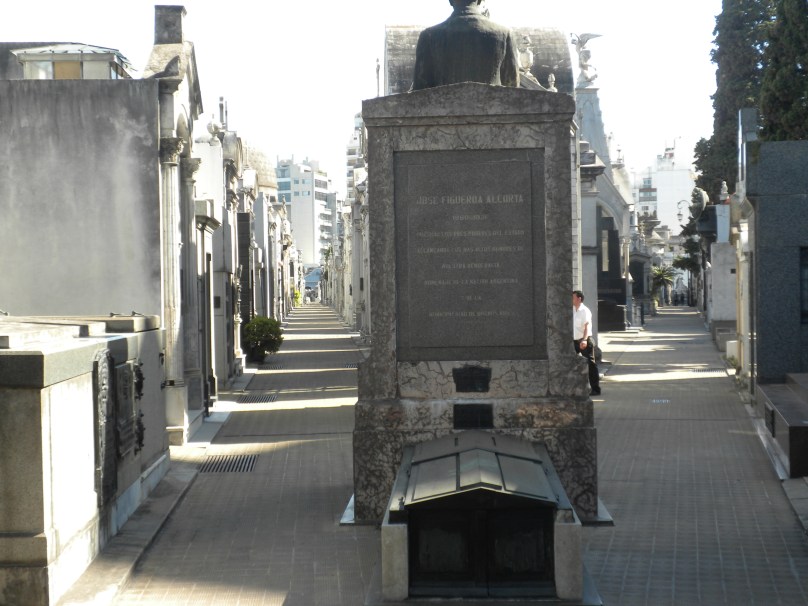
Recoleta Cemetery in Buenos Aires

I have been to some spooky cemeteries, but I think that the spookiest one of all is El Cementario de la Recoleta in Buenos Aires. Curiously, it is also perhaps the city’s main tourist attraction.

Practically everybody who was anybody in Argentina is buried there—with some interesting exceptions. Jorge Luis Borges is interred in Geneva, Switzerland, where he died. Although Evita Perón is buried in Recoleta under her maiden name of Duarte, her husband, former dictator Juan Perón was not allowed in. He is buried on the grounds of his presidential estate at Olivos.

Many of the funerary monuments at Recoleta are spectacular. Some are grim. In a few vaults, one can look through gaps in the gates and see some occupied coffins in bad shape, apparently from families that have died out and not left instruction for their maintenance.

The last time I was in Buenos Aires, I stayed in a hotel that was across Avenida Azcuenaga from the high west wall of the cemetery. It didn’t feel spooky to me at all. It’s only by wandering up and down the rows of funerary monuments that one gets a spooky forechill.

O Canada

Floating Post Office on Vancouver Island

It was 2004. I was on an old packet boat called the Lady Rose that went back and forth on the Alberni Inlet on Vancouver Island between Port Alberni and Bamfield. It was a beautiful day, and I was surrounded by a congenial group of Canadians.

The Lady Rose has since been decommissioned, but my memories of that trip will last a lifetime. The next day, I took another ship to Ucluelet, from which I took a bus to Tofino, where I stayed for several days.

I would love to spend some more time in British Columbia. Andrew Marvell had it right: “Had we but world enough and time ….”

There is something about Canada that Martine and I love—from Nova Scotia and Quebec to Alberta and B.C. Martine loves practicing her French (she was born in Paris) in Quebec; and she loves the fact that Canadian food is generally non-threatening. I know that she would accompany me to Canada in a heartbeat, whereas Latin America is more problematic.

I know our current President (I forget his name) has a grudge against Canada, but that’s his problem.

Notorious

Edgar Allan Poe (1809-1849)

As part of my Halloween reading, I am reading Penguin Books’ The Portable Edgar Allan Poe. After having read numerous popular editions of Poe, I decided to concentrate on an edition that took him seriously as one of the greatest literary figures of the young Republic.

There is little doubt in my mind that Poe is a genius. At the same time, there is little doubt in my mind that Poe was anything but warm and fuzzy as a person. He admitted as much in his story “MS. Found in a Bottle” (1832): “Of my country and of my family I have little to say. Ill usage and length of years have driven me from the one, and estranged me from the other.”

Later in the same paragraph:

I have often been reproached with the aridity of my genius; a deficiency of imagination has been imputed to me as a crime; and the Pyrrhonism of my opinions has at all times rendered me notorious.

Looking back at Poe’s life, one can see him constantly produce brilliant stories and poems, yet struggle to earn a living or find happiness in marriage or family. He was orphaned at the age of two and had a tempestuous relationship with his stepfather John Allan, whose last name he adopted as his middle name.

Over and over again, we find that the characters in life died young of consumption. Poe did not react well: He took to the bottle. In fact, he died of alcohol poisoning at the age of forty, though the newspapers of the time blamed “congestion of the brain” or “cerebral inflammation.”

It requires some extra discipline for me to forget Poe’s unhappy life and concentrate on his works. Let’s face it: some very unhappy people have created works of such vivid imagination that made him ever so much more than the lunatic that critic Rufus Wilmot Griswold described as walking “the streets, in madness or melancholy, with lips moving in indistinct curses, or with eyes upturned in passionate prayers, (never for himself, for he felt, or professed to feel, that he was already damned).”

Poe’s life is a closed book, but his works will live on forever.

The Moral of Dutch Still Life Paintings

Jacob van Hulsdonck’s “Still Life with Lemons, Oranges, and a Pomegranate”

I have always found classical Dutch still life paintings to be interesting. In many of them, one can find insects devouring the fruits and flowers depicted. But even if insects are not present, as in Jacob van Hulsdonck’s fruit bowl above, there is an implied message that the fruits depicted will be only around for a while.

According to the Getty Center’s website description of the painting:

The still life attests to the fragile and fleeting properties of the natural world. The dimpled skin of the lemons and oranges; the juicy, glistening insides of the pomegranate held gently together by the thin white tissue of the pulp; the leaves and blooms still attached to fruit; and the shiny droplets of water in the foreground are all brilliant, short-lived effects captured on panel.

Ever since I first noticed this tendency, I have always spent extra time viewing Dutch still life paintings. Even if it’s not a Rembrandt, it is a message to us from four centuries ago that tempus fugit. The message is underlined by the fact that the fruit sits in a Ming dynasty bowl of the sort that could be found in a prosperous merchant’s house.

The Los Angeles Police Museum

On York Boulevard in the Highland Park neighborhood of Los Angeles sits the Los Angeles Police Museum with three stories of exhibits on the history of policing in the City of Angels (and Bad-Asses).

Originally, we intended to visit the Heritage Square Museum with its Victorian mansions that were moved to a lot alongside the 110 (Pasadena) Freeway. Unfortunately, they were closed for a fund raising event, so we had to find an alternate. We had visited the LAPD Museum a couple years ago, so we decided to drive north and check to see if it was open. Fortunately, we were in luck.

The second floor has three interesting exhibits that are the heart of the museum:

  • The 1963 kidnapping of LAPD officers Ian Campbell and Karl Hettinger by two hoods. Hettinger managed to escape, but Campbell was executed in a Kern County onion field. Joseph Wambaugh wrote a novel about the incident in his novel The Onion Field.
  • The Symbionese Liberation Army (SLA) in May 1974, in which six members of the organization were killed when the LAPD attacked the house they were in.
  • Most interesting to me was the 1997 North Hollywood shootout between two heavily armed bank robbers and several hundred police officers. One of the exhibits was a video of the actual event.

Still from the February 1997 Bank Robbery

Afterwards, Martine and I had lunch and went to one of our favorite stores, the Galco Soda Pop Stop on York Boulevard. They sell an incredible selection of soda pop, beer, and wine from all over the world, in addition to nostalgic candies and toys from the 1950s and 1960s.

A Bowl of Pho

This afternoon’s Mindful Meditation session ended at one p.m., so I made my way to 505 Spring Street for a bowl of Vietnamese soup at Downtown Los Angeles Pho. I was hungry, and lately I craved the filet mignon pho with extra jalapeño pepper slices. To this I added some Sriracha hot sauce and some hot chile oil. Finally, I added just a small dash of soy sauce.

With my chopsticks, I picked up a slice of jalapeño, a piece of filet mignon, and some rice noodles and shoveled it into my mouth. Oh, it was s-o-o-o-o-o good!

I was not always a chile head. Growing up in Cleveland, I could not believe the spiciness when my mother cooked lecsó, a kind of hot pepper ratatouille much beloved by Hungarians. Even my father wouldn’t touch it, and I certainly wouldn’t.

Coming to Los Angeles changed me in many ways, especially when it came to food. In Cleveland, I hated fish; in L.A., I loved sushi. In Cleveland, I preferred my food bland; in L.A., I went way past jalapeño to habanero.

Does all that hot stuff bother me? Nope. In fact, I find each chopstick portion a delight. When people I know of the bland food persuasion are surprised by my food tastes, I tell them that chile peppers are a vegetable, and what do they have against vegetables?

The Tyger

Every time I read this poem by William Blake, I am impressed anew by its greatness. Its very simplicity is deceptive, as it hints at levels of mystery and savagery that underlie our workaday world. I have posted this poem before, but I continue to be mightily impressed by it.

The Tyger

Tyger Tyger, burning bright, 
In the forests of the night; 
What immortal hand or eye, 
Could frame thy fearful symmetry?

In what distant deeps or skies. 
Burnt the fire of thine eyes?
On what wings dare he aspire?
What the hand, dare seize the fire?

And what shoulder, & what art,
Could twist the sinews of thy heart?
And when thy heart began to beat.
What dread hand? & what dread feet?

What the hammer? what the chain,
In what furnace was thy brain?
What the anvil? what dread grasp.
Dare its deadly terrors clasp?

When the stars threw down their spears 
And water’d heaven with their tears:
Did he smile his work to see?
Did he who made the Lamb make thee?

Tyger Tyger burning bright,
In the forests of the night:
What immortal hand or eye,
Dare frame thy fearful symmetry?

Totem

Detail from Totem Pole in Victoria BC

Totem poles are some of the most accessible images of aboriginal spirits. The best I’ve seen were on Vancouver Island in British Columbia, mostly in Victoria and Cowichan. After seeing them, I read Franz Boas’s book Primitive Art (1927). As I wrote in a previous blog, “It’s a difficult read, but like many difficult reads, eminently worthwhile.”

One of the reasons that totem poles are so stunningly impressive is that they are still being made by Indians in the U.S. and First Nations members in British Columbia. Unlike Hopi Kachinas, which are also still being made, they are a public art form; and many old poles have been gathered together and put on display.

I would love to visit the Alaska panhandle to see the Haida totem poles on Prince of Wales Island, and perhaps also the Haida Gwaii archipelago in British Columbia north of Vancouver Island.

Totem Poles at Cowichan in 2004

One could stand in front of a totem pole and try to guess at what the images are signifying. For instance, in the loincloth-clad figure on the right above, he is cradling a fish (probably a salmon) in his left hand while wearing an oversized hat with blue and red strips along the bottom. What does that mean?

If I were to go back to Cowichan for another look, I would be deeply disappointed. When I did go back a few years later, the totem poles were looking uncared for and there was talk of turning the tribal facility into a conference center. I wonder if that ever happened.

AI Gets Stupid

I was doing some research on a film, so I decided to ask Google if there were any movie sequels to City Across the River (1949). At the top of every Google response is what is called the “AI Overview.” What I got in this overview made me guffaw:

There are no direct movie sequels to the 1949 film City Across the River, but other films with similar themes, like the 1956 film Don’t Knock the Rock [Not similar at all], shared some elements or settings with the movie. There is also a more recent film, Across the River and Into the Trees (2022), which may be what you are looking for [It isn’t], although it is not a sequel.

Here are some other movies with “River” in their titles that might be relevant:

Across the River and Into the Trees (2022): a more recent film that might be the one you are thinking of. [No!]
Take Me to the River: New Orleans: The second film in the award-winning series “Take Me to the River” which celebrates the musical history of New Orleans and Louisiana. [NO!!!!!]
The River (1984): A film starring Mel Gibson about a farming couple in the face of economic hardship. [No No No]
Deliverance (1972): A film starring Jon Voight and Burt Reynolds about a canoe trip that goes horribly wrong. [Correct me if I’m wrong, but is “River” in the title?]
The River Wild (1994): A film starring Meryl Streep as a woman whose family is taken hostage during a river rafting trip. [Nope]

All of the titles suggested by Google’s AI are totally off the mark. City Across the River is about a teenage gang in 1940s Brooklyn. The word “River” is in the title, but has no bearing on the film’s story.

As it happens, there was—sort of—a sequel to the film. It was called Cry Tough (1950), though it changed the locale and virtually everything else that was in Irving Shulman’s sequel. Instead of Jewish Brooklyn, the story is set in Spanish Harlem with a Puerto Rican gang.

Now if I had believed Google’s bumbling AI overview, I would have been laughed at. And I would have richly deserved it.