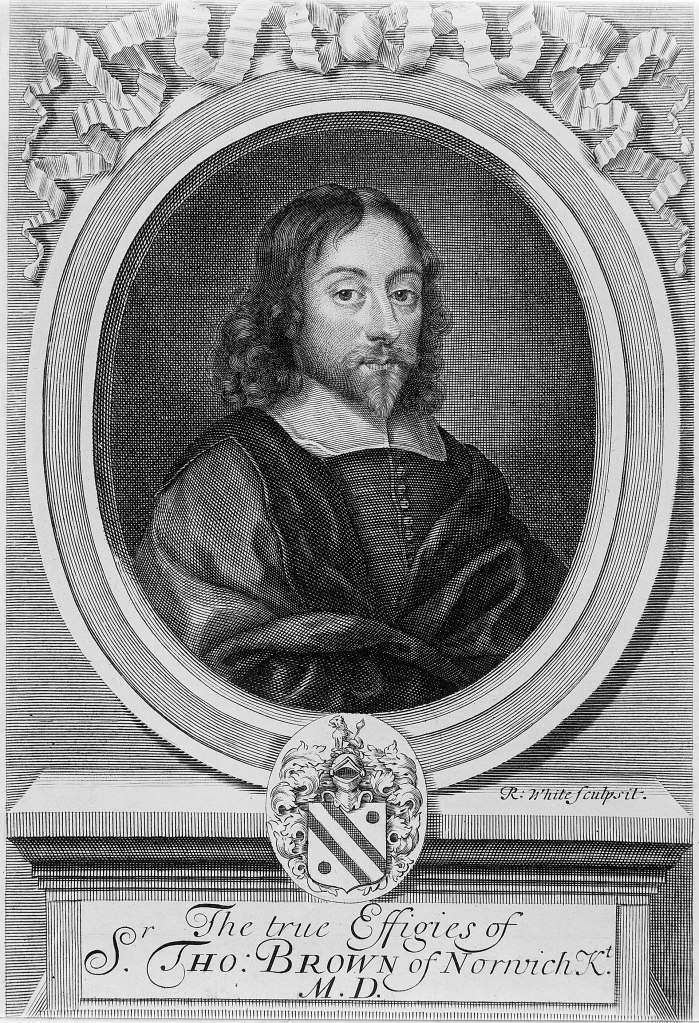
Sir Thomas Browne (1605-1682)
He was one of the greatest writers of prose in the English language. Religio Medici and essay “Hydriotaphia, or Urn Buriall” are my favorites among his works. The following comes from Religio Medici:”:
We term sleep a death; and yet it is waking that kills us, and destroys those spirits that are the house of life. ’Tis indeed a part of life that best expresseth death; for every man truely lives, so long as he acts his nature, or some way makes good the faculties of himself. Themistocles, therefore, that slew his Soldier in his sleep, was a merciful Executioner: ’tis a kind of punishment the mildness of no laws hath invented: I wonder the fancy of Lucan and Seneca did not discover it. It is that death by which we may be literally said to dye daily; a death which Adam dyed before his mortality; a death whereby we live a middle and moderating point between life and death: in fine, so like death, I dare not trust it without my prayers, and an half adieu unto the World, and take my farewell in a Colloquy with GOD.
And here is a devout prayer he wrote:
An Evening Prayer
THOU whose nature cannot sleep,
On my temples sentry keep;
Guard me ’gainst those watchful foes,
Whose eyes are open whilst mine close;
Let no dreams my head infest,
But such as Jacob’s temples blest.
While I do rest, my soul advance;
Make me to sleep a holy trance,
That I may, my rest being wrought,
Awake into some holy thought;
And with as active vigour run
My course, as doth the nimble sun.
Sleep is a death. Oh, make me try
By sleeping, what is it to die!
And as gently lay my head
On my grave, as now my bed.
Howe’er I rest, great God, let me
Awake again at last with Thee!
And thus assured, behold I lie
Securely, or to wake or die.


I believe there is something in Browne which is of particular interest : his way of acknowledging the existence of realities that reason approaches but cannot fully fathom. Across a span of nearly four centuries, and in a world that is obviously vastly different, this curiously echoes the phrase I recently read regarding Rick Bartow , a Native American artist from the Wiyot tribe who lived in Oregon. I have seen about ten years ago an exhibition of his works in Santa Fe entitled “things we know but cannot explain.” Browne would likely have been deeply attuned to this distinction between what we know inwardly and what we are capable of explaining rationally. Thanks for your post.
Jean-Paul Scheidecker, Paris, France
Thank you for your comment. I do think that Browne is almost magical.