I cannot help but see myself in this haiku by the great Japanese poet Matsuo Bashō:
Another year is gone—
A travel hat on my head,
Straw sandals on my feet.
Two weeks from today, I will be in Mérida, Yucatán, reacquainting myself with the world of the Maya. In many ways, Matsuo Bashō is the poet of travel. His book, The Narrow Road to the Deep North, is the ultimate vade mecum for a traveler. The record of a 1,500-mile journey through the main Japanese island of Honshu, it captures with great beauty and subtlety the joys and sorrows of a life on the road.
The sound of a water jar
Cracking on this icy night
As I lie awake.
The extreme conciseness of the haiku form can lead to poetry that is brilliant—or banal. One has to somehow put two ideas together (as the ice and the sleepless traveler) with an absolute minimum of embellishment. Ah, but when it succeeds!
On the withered grass
Shimmering heat waves rise
One or two inches high.
I will, as usual, travel with a blank notebook. I would love to compose haiku relating to my upcoming journey to Mexico. It’s possible, but, alas, not likely. Even though I don’t usually go out evenings (except in Mérida), I will probably find myself too busy reading from my Amazon Kindle, which is fully loaded with hundreds of works of literature and history.
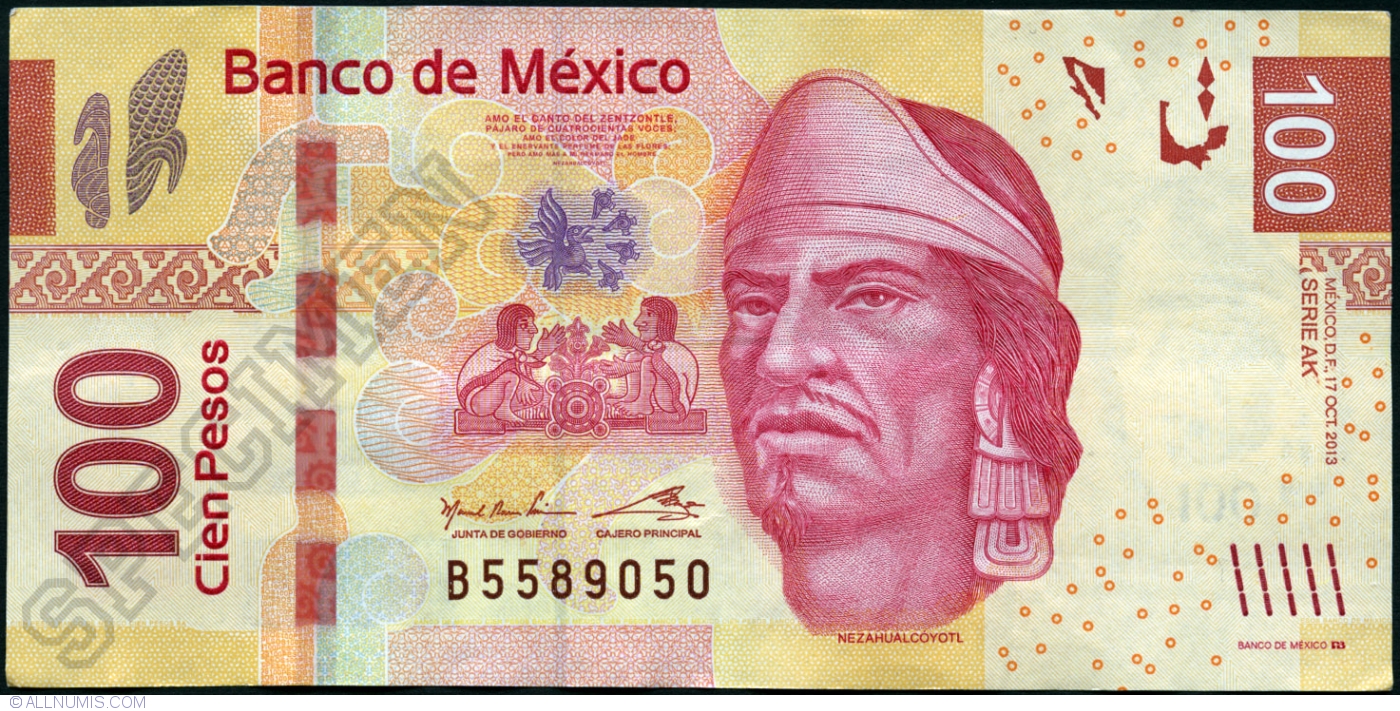
Before visiting any foreign country, I always like to get a supply of banknotes in that country’s currency for the first few days of my trip. So today I headed to Bretton Woods Currency in Brentwood to pick up a couple hundred dollars worth of pesos. The act of handling another country’s currency is always a magical moment for me: I suddenly feel the reality of my impending vacation—in this case, exactly two weeks from today. I got three denominations: 500 Pesos, 200 Pesos, and 100 Pesos.
My favorite is the 500 Peso note, which shows painter Diego Rivera on the front and his wife, the painter Frida Kahlo, on the reverse.
Mexican Patriots Miguel Hidalgo and José Maria Morelos on the 200 Peso Note
Nezahualcoyotl, Pre-Columbian Poety and Ruler of Texcoco
Above are the 200 and 100 Peso bank notes. I was intrigued by the figure shown on the 100 Peso note of Nezahualcoyotl, “Coyote Who Fasts,” who died some fifty years before Hernan Cortés landed at Vera Cruz with a party of conquistadores.
In the article on him in Wikipedia, I read the following interesting description:
Unlike other high-profile Mexican figures from the century preceding Spanish conquest of the Aztec Empire, Nezahualcoyotl was not Mexica; his people were the Acolhua, another Nahuan people settled in the eastern part of the Valley of Mexico, settling on the eastern side of Lake Texcoco.
He is best remembered for his poetry, but according to accounts by his descendants and biographers, Fernando de Alva Cortés Ixtlilxóchitl and Juan Bautita Pomar, he had an experience of an “Unknown, Unknowable Lord of Everywhere” to whom he built an entirely empty temple in which no blood sacrifices of any kind were allowed — not even those of animals. However, he allowed human sacrifices to continue in his other temples.
In general, I am not big on public holidays. And New Years Day is probably my least favorite. In the past, I have tended to answer the usual enthusiastic “Happy New Year” with the off-putting, “Only a fool celebrates the passing of time.” I am no longer invited to New Years parties, but then none of my friends hold them any more.
Here I am, three weeks away from visiting an ancient society which depended heavily on the calendar (the Maya), while I tend to pooh-pooh the whole idea. I do not read any retrospective articles on the year that was or watch any TV programs that fill the same function; and I most certainly do not stay up past midnight to usher the new year in. I rather think the new year can usher itself in: It knows where the door is. I will not drink any cocktails, and I will probably be abed by 10 pm.
I have no particular feelings about 2019. It had its good points, and it had its bad points. Trump is still in charge of the White House and he hasn’t yet canceled the Bill of Rights. (Maybe this coming year….)
Politics has no magic for me. On one hand, elections involve people who make promises, but really want to exercise power and/or accumulate wealth. And even if my candidate wins, I will likely be disenchanted after a few months—because I forgot this simple fact.
If all this sounds deeply cynical, remember that I am a cynical person. I have seen some three quarters of a century pass by my eyes. There has been love, there has been despair, there has been failure, there has been modest success, there has been hope, there have been disasters. I came close to cashing in my chips in 1966, but I am curiously in fairly good health at the present moment—even if I can’t count on it to last.
So I will still wish you all a Happy New Year, but know that years are all ineluctably mixed. I think Spock had the best greeting: Live long and prosper.
The Pico-Union District of Los Angeles is a tough neighborhood with heavy concentrations of Central American immigrants. Yet there on Bonnie Brae Street lies the Grier Musser Museum with its huge collection of antiques and seasonally related memorabilia. During the key holidays of Halloween and Christmas, there are fascinating exhibits of decorations, music boxes, pop-up books, greeting cards, postcards, and other popular culture highlighting the present and past.
Although Martine and I have visited only during those periods, there are also special exhibits for Valentines Day, Chinese New Years, and Independence Day.
Susan Tejada with Christmas Elf
On Saturday, we spent several hours viewing the Christmas exhibits and chatting with Susan and Rey Tejada, the owners (and inhabitants) of the museum. Christmas is now safely in the past, but it was nice to see the constantly growing exhibits that Susan has collected. They represent what we all want the holidays to be like, far from the mayhem in the parking lots and department stores in mega-malls which it has become. Visiting the Grier Musser Museum gives you a picture of what we all want Christmas to be like. It’s actually a nice feeling.
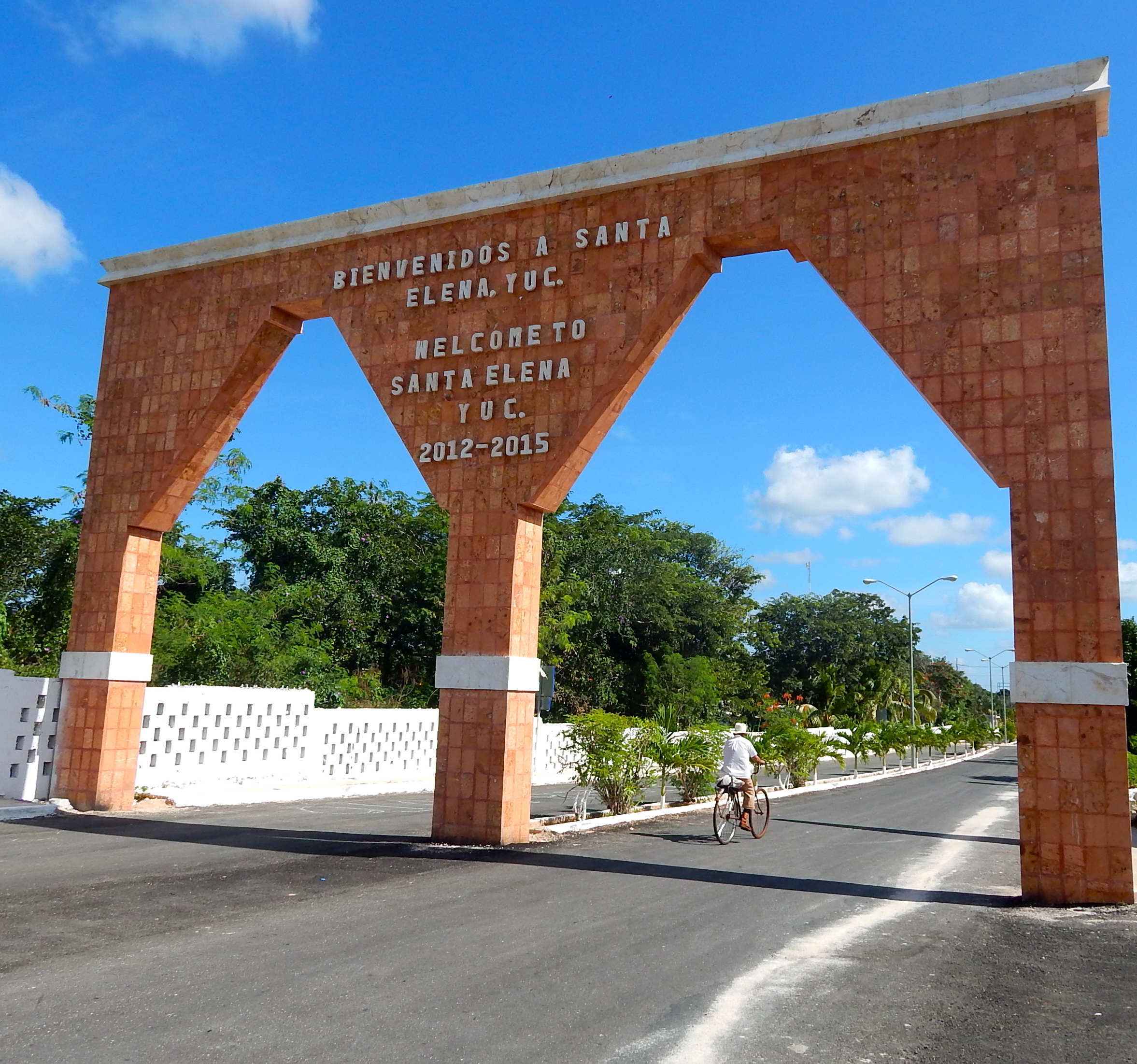
I am frantically trying to get reservations to hotels in Yucatán—much later than I usually would. It is all due to the problem with my left knee. I wanted some assurance that it was not the beginning of a condition that might rapidly get worse. As a result, I am making reservations a month or so later than I usually would. Unfortunately, a lot of the places I wanted to stay have already been booked, even for such a small town as Santa Elena, which is midway between the ruins of Uxmal and Kabah. I may have to spend big money to stay at the Hacienda Uxmal at the ruins, where I stayed twice before in 1975 and 1992—that is, if I can.
No doubt I will find something. It’s just a little more work than usual.
The Luxurious Hacienda Uxmal Across the Street from the Ruins
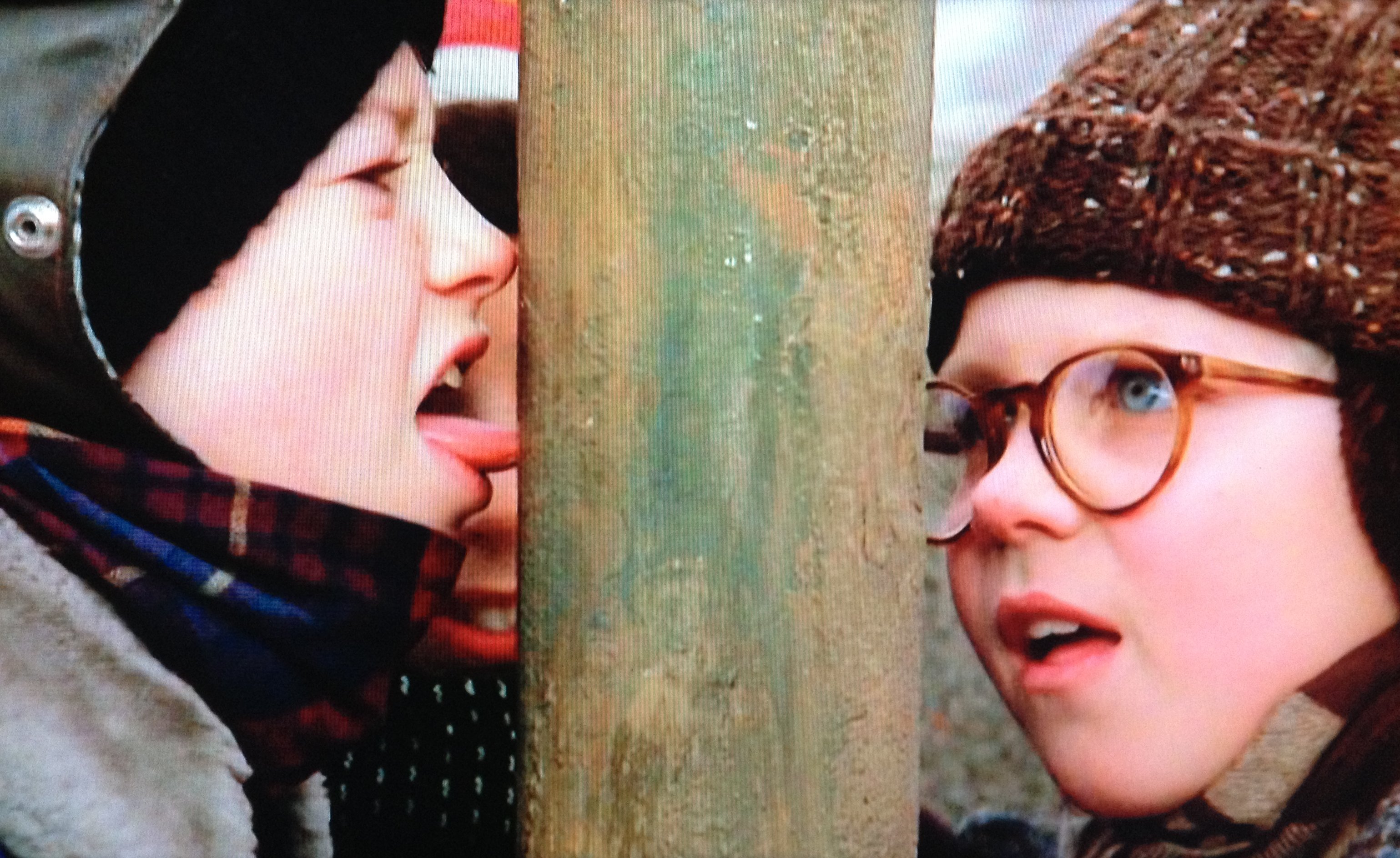
Scott Schwartz as Flick and Peter Billingsley as Ralphie
It’s refreshing that a film produced as late as the 1980s has become a legitimate Christmas classic. Seeing it repeatedly has not diminished its appeal, even when seen in bits and pieces on TV channels that played the film for 24 hours straight.
The director of A Christmas Story, Bob Clark, is a filmmaker who has not produced anything else that comes up to the standard of this, his masterpiece. I have read Jean Shepherd’s In God We Trust: All Others Pay Cash and loved it. As good as the original story was, the film was better. The direction of the actors, particularly the child actors, was as good as anything I have ever seen.
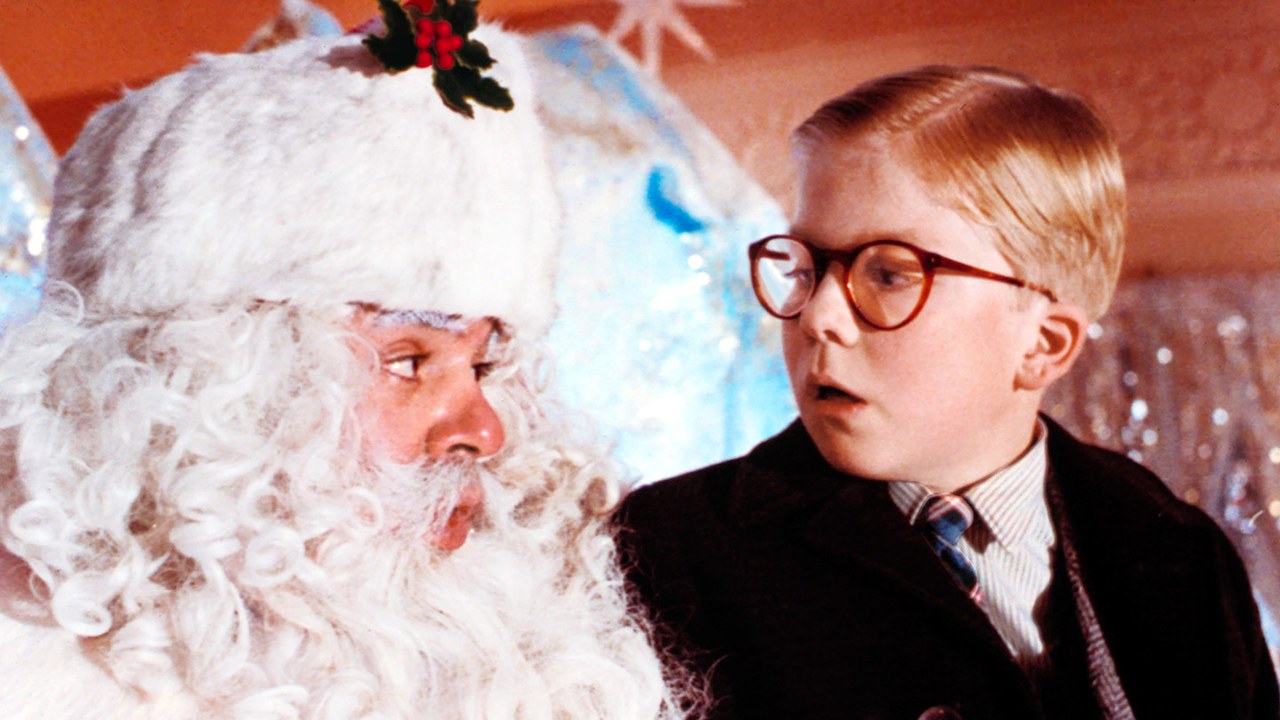
Peter Billingsley Faces Jeff Gillen as Santa
There is another reason I love the film. Although the story is set in Indiana, scenes were set on Public Square in Cleveland, Ohio, where I spent most of my childhood. I remember the Christmas parades there, and particularly the Christmas display windows at Higbee’s Department Store, which is clearly identified in the film. Other scenes may have been shot elsewhere, but most of the exteriors reminded me of Cleveland. Even Ralphie’s school looked exactly like Harvey Rice Elementary School, where I attended kindergarten and half of first grade. (I never finished first grade, but let that be our little secret.)
If I were the one scouting locations for A Christmas Story in such a way as to reflect my own childhood, I would not have done any differently than the producers of the film. That’s why every time I see this film, I am taking a trip down memory lane.
I have seen a lot of Christmases. Like birthdays, they don’t seem to as magical when one is older. I celebrated Christmas Eve by spending five hours putting together a tasty beef stew, served with a crusty artisanal baguette and a bottle of Egri Bikavér (“Bull’s Blood of Eger”) Hungarian red wine. It was the best stew I ever made. I remember sometimes cooking myself a stew (accompanied with red wine) back when I was in my twenties and alone for the holidays. So it is a tradition of sorts for me.
Like my brother—though nowhere as good as him at it—I find cooking to be one of my favorite creative outlets. So I will translate this into a Christmas wish for those of you who come across this post:
May you and your loved ones find joy in what you do and with whom you share it, in the coming year and always.
What may or may not have happened in Bethlehem some two thousand plus years ago has cast a long shadow. I take from it some useful lessons, but not the whole package. I am content with that.
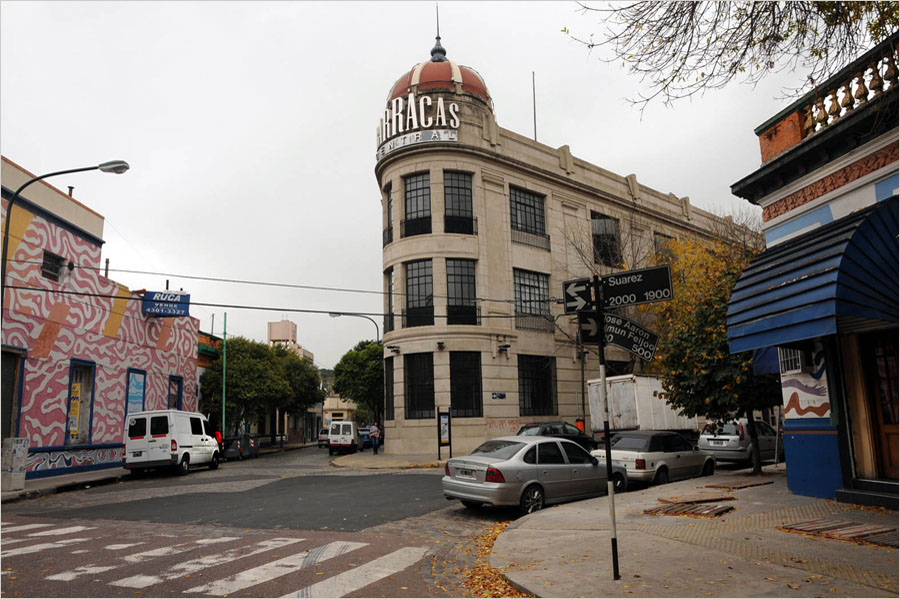
Buenos Aires is a magical city. I have been there three times; and each time, I loved wandering its streets. Is it because of Argentinian poet Jorge Luis Borges, who loved the place and never grew tired of writing about it in his poems and stories? Or did Buenos Aires, in some strange way, create Borges, who merely returned the favor? The following is one of my favorite poems by Borges.
Limits
Of all the streets that blur in to the sunset,
There must be one (which, I am not sure)
That I by now have walked for the last time
Without guessing it, the pawn of that Someone
Who fixes in advance omnipotent laws,
Sets up a secret and unwavering scale
for all the shadows, dreams, and forms
Woven into the texture of this life.
If there is a limit to all things and a measure
And a last time and nothing more and forgetfulness,
Who will tell us to whom in this house
We without knowing it have said farewell?
Through the dawning window night withdraws
And among the stacked books which throw
Irregular shadows on the dim table,
There must be one which I will never read.
There is in the South more than one worn gate,
With its cement urns and planted cactus,
Which is already forbidden to my entry,
Inaccessible, as in a lithograph.
There is a door you have closed forever
And some mirror is expecting you in vain;
To you the crossroads seem wide open,
Yet watching you, four-faced, is a Janus.
I like the line about a “four-faced” Janus. Perhaps, is Borges connecting two-faced Janus with the four directions that are sacred to the Indians of the Americas?
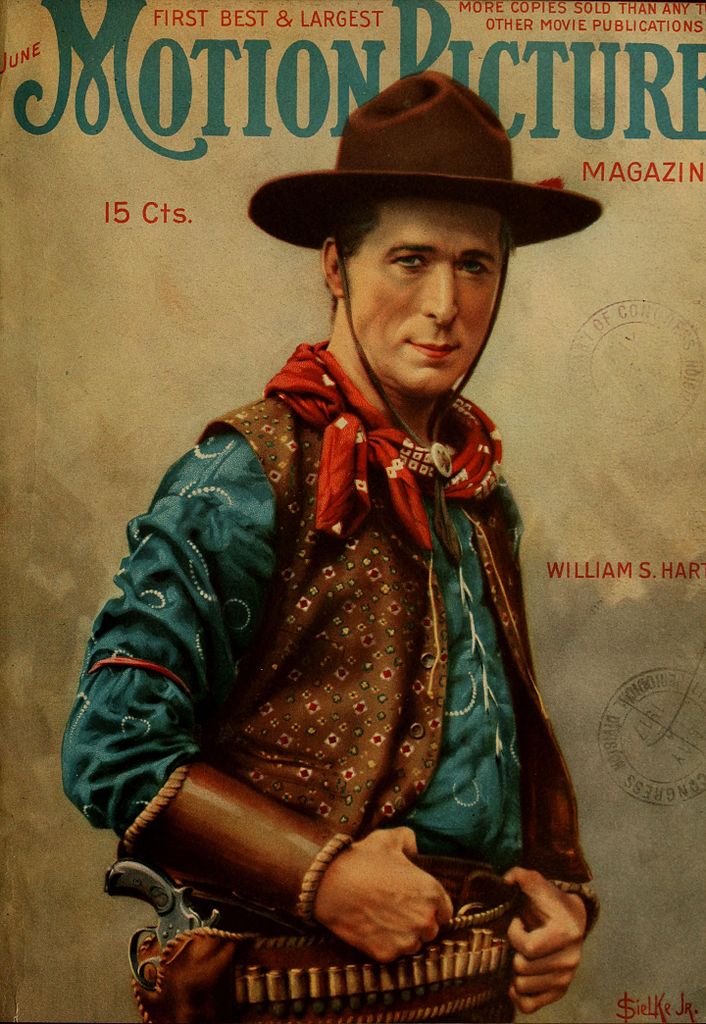
William S. Hart (1864-1946) was one of the great early cowboy stars. A scant year after Cecil B. DeMille traveled to Hollywood to shoot The Squaw Man (1913), Bill Hart teamed up with Thomas H. Ince to shoot a series of Western two-reelers, many of which hold up well today. There was a sense of moral compass about Hart’s roles that registered with silent film audiences—that is, until flashier actors like Tom Mix started eating into his popularity in the 1920s. By the time that happened, Hart was in his sixties and getting a little long in the tooth.
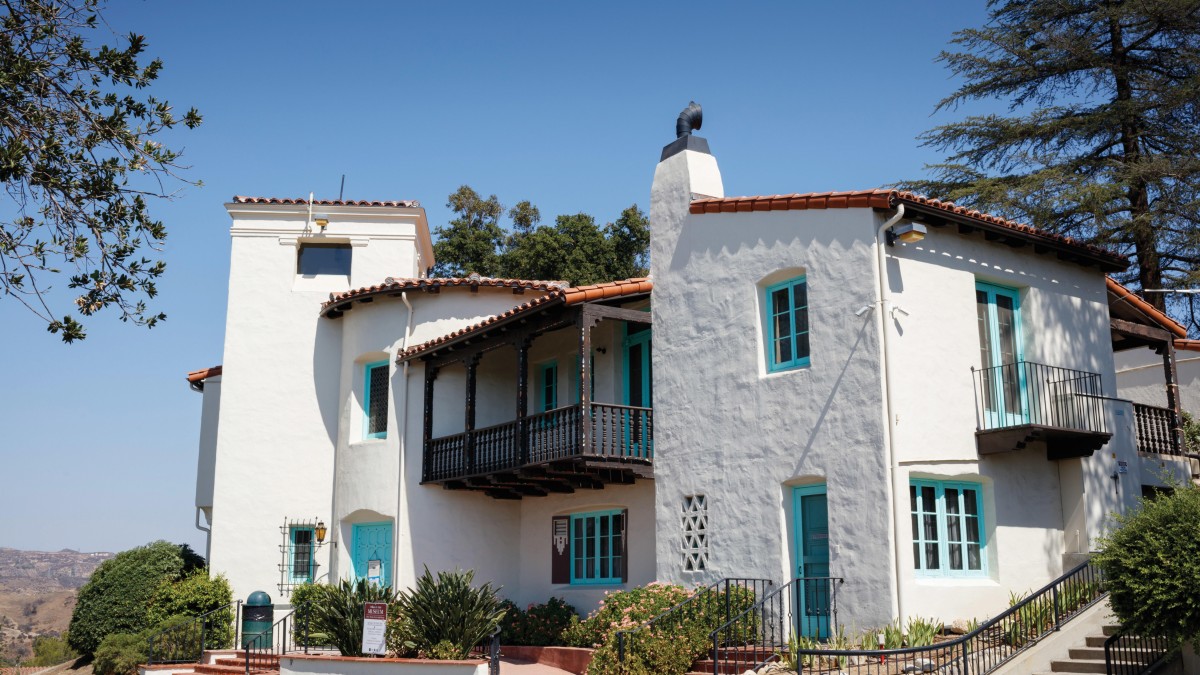
Today, Martine and I made our annual pilgrimage to the William S. Hart Museum in Santa Clarita, which we had been doing for upwards of seventeen years. There is something about La Loma de los Vientos (“The Hill of the Winds”) that has always appealed to us. Part of it is the attraction of Hart himself. Part of it is that I knew William S. Hart, Jr., who used me on several occasions as a guest lecturer in tools for site location in his classes in real estate at California State University at Northridge. And part of it is that the house is a beauty.
Façade of La Loma de los Vientos
Living at his hillside retreat in Santa Clarita, Hart made friends with Western legends like Wyatt Earp and Bat Masterson. He also knew Will Rogers, Amelia Earhart, Charles Marion Russell, and other notables of the day. After his marriage to actress Winifred Westover fizzled after a few short months, Hart lived alone with his sister Mary-Ellen, his son William Jr. being raised by the estranged mother. I got the feeling that, in his last years, Hart lived mostly on the second floor of his comfortable house, where, after his film career, he wrote Western-themed books.
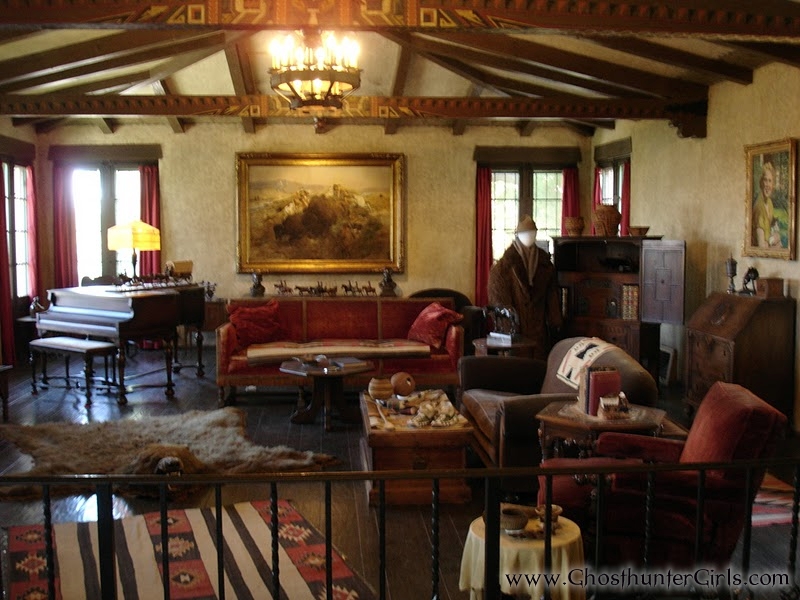
The Second-Floor Living Room of the Hart House
I love the second-floor living room/screening room in the museum. Ther’s a 35mm projection booth in the back, capable of filling a large screen that one one time hung from the horizontal rafter by the two south windows.
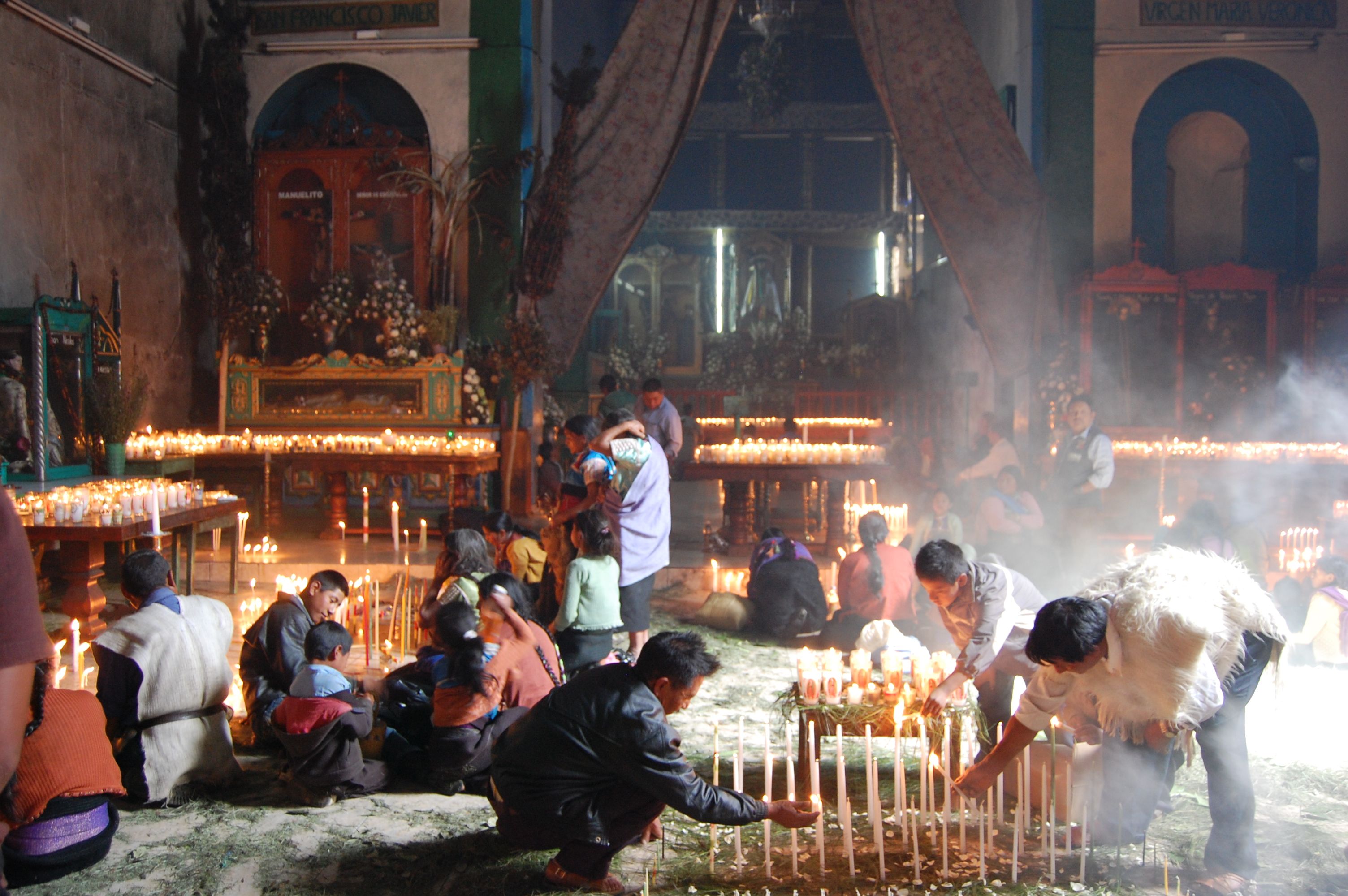
A Rare (and Forbidden) Interior Shot of the Chamula Religious Observances
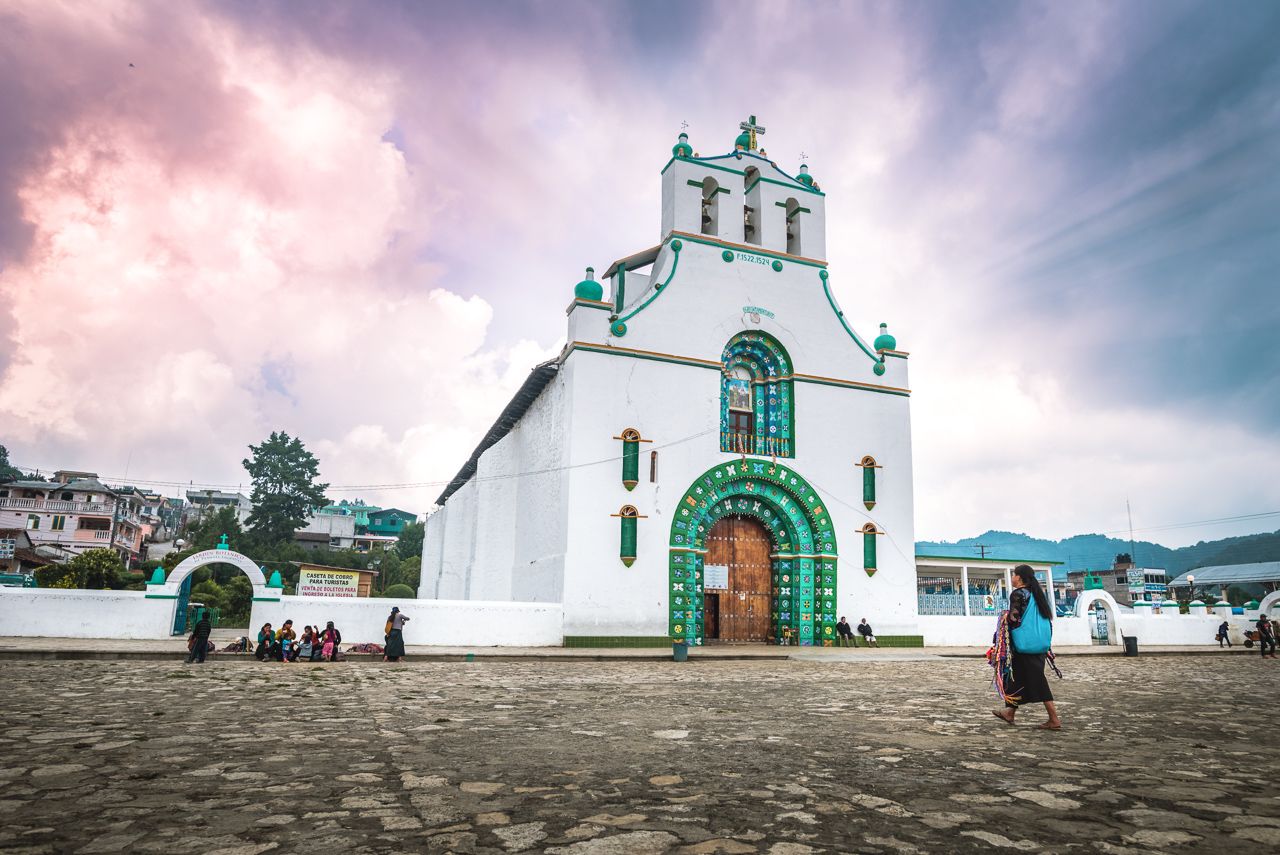
My brother and I visited the Tzotzil village of San Juan Chamula in 1979. We stood in the back of a stake truck from San Cristóbal de las Casas along with dozens of Chamulas. In the village, we requested permission to visit the church, which was at one time Catholic until the Tzotzil threw the priests out and took over the churches for their own syncretic observances. In the alcalde’s office, we had to sign a promise that we would not take any photographs inside under pain of the severest punishment. (During the 1980s, at least European tourist was killed by an angry mob for just such a transgression).
I found the following description in Paul Theroux’s On the Plain of Snakes: A Mexican Journey, which I have just finished reading:
On the way to Oventic I stopped at the town of Chamula, famous for its weird church observances, where the interior of the basilica of San Juan Bautista was ablaze with flames. Worshipers crouched on the floor arranging candles, fifty or a hundred in symmetrical patterns, then lighting them and, in the candlelight, drinking Coca-Cola and ritually burping—eructation believed to be salutary—and splashing libations of Coke on the church floor, which was covered with sand.
The Church at San Juan Chamula
There were no pews, there were no priests, there was no Mass or formal service. It was a gathering of curanderos—medicine men—and those wishing to be cured. Other solemn groups were chanting, passing hens’ eggs around the the faces and bodies of prayerful pilgrims in a limpia—a purification—or holding a squawking chicken near a kneeling devotee, and a moment later the chicken’s neck was wrung, and the softened, drooping carcase placed near the candles.
As I watched, a man approached me holding a bottle and a glass. He said, “Mezcal,” and poured me a slug and offered it. I drank it, blinked away the dazzle in my eyes, thanked him, and kept looking.
It was a fusion of pre-Hispanic traditions and Christian dogma, the result an observance involving a mass of candles, throttled chickens, and soda pop. (But sheep are sacred, never harmed or eaten: the town of Chamula is full of grazing sheep.) Added to these rituals was a chance for retribution, because if the chosen saint did not grant the supplicant’s wish, the deity could be punished, just as the Zapotecs and mayans punished their gods and saints, lashing their images with whips. In this church, the statues of saints, which had been ceremonially draped, with an uttered prayer, could be stripped of their robe if the prayer was not answered.
Check out the above YouTube video, which gives a you a feeling of life in this Tzotzil village.









You must be logged in to post a comment.