I Wipe the Dust of Ohio from My Feet

I Get Pretty Tired of All My Political Contributions Being Spent in Ohio

Unless you live in one of the swing states, such as Ohio, Florida, and Iowa, you’re vote just doesn’t count as much. Now California is the most populous State in the Union. All fifty-five of our electoral college votes for President will go to Obama. That’s almost a dead certain guarantee, however badly the ranchers in the San Joaquin Valley and the Republican troglodytes of Orange County feel about it.

But where is all the effort in the last few weeks of political campaigning going? You guessed it: Ohio, Florida, Iowa, and a handful of other swing states.

Why is it that these are swing states? The answer is simple: Because they are divided approximately fifty-fifty between Democrats and Republicans. Take Ohio. I’m from Cleveland originally, which, like most of Northeastern Ohio, leans to the Democrats. South of Lake Erie is where most of the trogs, recidivists, and Red-State racists live. As a Clevelander, I never visited Columbus, Dayton, or Cincinnati: We also considered the southern half of the State to be south of the Mason-Dixon Line.

Over the decades since I’ve left Ohio, the State has drifted farther and farther to the right. So far, in fact, that I repudiate my origins, at least insofar as the State is concerned. (I still have some feelings for Cleveland, “The Mistake on the Lake.”)

It’s not that I want to see more political advertising in California. I hate political advertising. It’s one of the reasons I don’t watch television at all. But I have donated several hundred dollars to the Obama campaign; and I am mightily pissed that most of that money is probably going to television stations in parts of Ohio that I would just as soon see swamped by a tsunami.

There is a funny short piece on Raw.Com entitled F*ck You Ohio for hogging presidential race. Among the points it brings up is that all kinds of concessions must be made to Southern Ohio regarding the use of coal for energy:

For example, [Andy] Cobb [of Second City] notes that vying for Ohio means that candidates feel the need to promote “clean coal” technologies, “something the rest of the country knows is bullshit.”

“Ohio made them do that,” he observes. “Clean coal doesn’t exist. Coal is dirt. So, clean coal is like clean dog shit.”

Why should we kowtow to Ohio for being so deeply divided? The answer lies in our country’s dysfunctional electoral college voting system, which should be scrapped in favor of direct elections. But that is another matter entirely. It is probably the most glaring weak point of our Constitution and should be scrapped.

I suspect, however, that it will drag on for several more decades, doing incalculable harm to our political process.

Addendum (10/26/12): This cartoon from David Horsey that appeared in today’s Los Angeles Times:

A Picture Is Worth a Thousand Words

Under Brinkie’s Brae

Alfred Street in Stromness

I have been to Stromness in Orkney twice, once in 1976 and again in 1998. It is a strange little town with narrow winding streets—and, oh yes, a great poet and storyteller who lived here until his death in 1996. I am talking about George Mackay Brown (b. 1921), whose work I have been reading since I met him outside the town’s bookstore in 1976 while clutching a copy of his poem collection, Fishermen with Ploughs.

Tongue-tied, I asked him whether he was George Mackay Brown, knowing full well that he was, as his likeness was familiar to me. He smiled and said, “I cannot deny it.” If my heart were not in my throat, I would have invited him out for a pint. As it was, I showed him my book, being even too shy to ask for his autograph. We went our separate ways.

What I hope to accomplish here in my blogging here on WordPress is what Brown accomplished in a weekly column he wrote for The Orcadian, a newspaper published in Kirkwall, some fifteen miles eastward. Just to give you an idea of the flavor of his work, here is one of his essays entitled “Place names”:

I was sitting idly in the sun the other afternoon when seemingly out of the blue, the words “Orkney Islands” came into my mind. A waste of syllables, really: since Orkney itself means Orc islands. The fault is what is called, I think, tautology. (Whether “Orc” means whale, or seal, or boar, I leave to the experts to decide.)

That’s not the only tautology in our list of place names. “Houton Head”—the Hout part itself signifies headland (like Howth promontory outside Dublin).

Another misnomer is Brough of Birsay. Possibly the whole parish derives its name from the tidal island where there was originally a keep or fortification of some kind.

The very south end of Stromness is called the Point of Ness; which is to say, “the point of the point,” Ness meaning a piece of land thrusting into the sea: in this case, into the tiderace of Hoy Sound. That is why Stromness is called what it is. Living in the town itself, this is not so obvious. But coming down the Scorradale Road into Orphir, there it lies, a thrust of hard land into the wide strong waters. (Maybe the Norseman who gave Stromness its name was looking west one day from the Orphir foothills.)

Brown’s little essay goes on and names other places in the archipelago, ending with “Hrossey,” the island of the horse, which was the original name of what is today called the Orkney “mainland,” though it is by no means a mainland, but just the largest of the isles off the north end of Caithness.

I have just finished the second volume of Brown’s columns for The Orcadian, called Under Brinkie’s Brae, after the hillside overlooking the east end of Stromness. The pieces were charming and often quite lyrical, full of northern Scots words such as “haar,” “peedie,” “noust,” “Hogmanay” (that’s New Years), “clapshot” (mashed “tatties” and “neeps” with a liberal infusion of butter).

To get to Orkney, you have to take the slow train from Inverness to Thurso, and thence via a short bus ride to Scrabster, where the roll-on roll-off ferry St. Ola will transport you past the Old Man of Hoy to Stromness. There you will find an austere land almost entirely devoid of trees (the wind is so fierce). On Orkney, you will never be far from the sea, and you will never be far from George Mackay Brown, the poet of Hamnavoe (the old Norse name for Stromness).

The Paradise of Apples

Loaded Branch at Green Mountain Orchard

One of the best things about travel is discovering (or, in our case, re-discovering) some great foods. Although we like the apples from Oak Glen, where we journeyed yesterday, nothing can compare with the tanginess of apples and apple cider from Vermont and New Hampshire. There is something about the granitic soil that does something rich and strange to the flavor. And when you make cider from them—without killing the flavor by pasteurizing—the result is one of the most refreshing drinks on the planet.

The first couple of days of our vacation in September were spent in Vermont. After a brief stop at the Vermont Country Store in Rockingham, we drove to nearby Putney, where Green Mountain Orchard is located. We had heard they sold unpasteurized apple cider, and it was true. Between the two of us, we guzzled a whole quart of the stuff and then spent an hour just driving around the property and seeing their trees (such as the one above) as well as their stands of raspberry and blueberry bushes.

When we crossed over the border into Canada, we hoped to be able to find equivalent quality. We bought a bag from a farm stand just west of Fredericton, New Brunswick, but it wasn’t the same thing. The terrain had changed to fertile flatlands, which are good for most crops, but which result in so-so fruit.

I remember buying apple cider by the gallon from Tanzi’s Grocery (now long gone) in Hanover, New Hampshire, when I was a student at Dartmouth. Because at the time we had no access to refrigerators, the students would hang the gallon jugs by the eyelet from their dorm room windows. Most did this to ferment it into hard cider. I just wanted to drink good, cold cider. (Naturally, it was unpasteurized.)

Northern New England will forever go down in my memory for its apples, its Maine lobster, and a delicious preparation of young cod, haddock, or whitefish called scrod that Martine and I ate in Boston back in 2005.


At The Petting Zoo

Mother Goat With Baby

It has become a tradition for Martine and I to go every October to Oak Glen in San Bernardino County to buy fresh-picked apples, a pumpkin for Halloween, and (for Martine at least) to eat a giant piece of apple pie a la mode at Apple Annie’s Restaurant in Oak Tree Village. Also at Oak Tree Village is a petting zoo that Martine loves to visit.

I had hoped to find some Honey Crisp apples, but they’ve been sold out for a couple of weeks. I had to settle for some Pippins and Fujis from Snow-Line Orchard, my favorite purveyor of pomes.

For starters, I decided to rent a car. My 1994 Nissan Pathfinder needs some maintenance, and Oak Glen is a hundred miles east of where we live. I know it costs money, but the thought of getting into car trouble somewhere in the so-called “Inland Empire” makes it worthwhile. Eventually, I’ll have to get a new car, but I have too many irons in the fire right now to contemplate such a large expenditure.

In all, we spent an hour at the petting zoo, looking at (and feeding) goats, a donkey, Vietnamese pot-bellied pigs, roosters, chickens, a Jersey cow, alpacas, Barbary sheep, and aoudads. I enjoy seeing Martine enjoy herself this way, talking to the animals and trying to tell them where some dropped food is that they can eat. The animals have their own agenda, and are well enough fed without the corn we have to offer them; but watching Martine become a happy little girl before my eyes is a precious experience for me.

The momma and baby goat shown in the above picture were like royalty in the petting zoo. Everyone was trying to feed them, but neither of them were hungry. Nonetheless, they accepted the homage of the crowd. And the baby’s fur was so silky smooth.

“There Is No Path”

Antonio Machado

Wanderer, the road is your
footsteps, nothing else;
wanderer, there is no path,
you lay down a path in walking.

In walking, you lay down a path
and when turning around
you see the road you’ll
never step on again.
Wanderer, path there is none,
only tracks on the ocean foam.—Antonio Machado

The New Yorker Scores Again

A Great New Yorker Cover

I don’t always like The New Yorker, which I slavishly continue to read every week. There are far too many detailed biographies of boring national business figures and other thieves whom I would consign to the lower circles of Dante’s Inferno. (Witness, in particular, the October 8, 2012 issue, which on one hand kisses up to the top 0.001% and on the other attempts to maintain its Liberal editorial policy.)

The September 24 cover, however, which is shown above, is a classic take-off on an America which I no longer profess to understand. It’s not that I’m a Socialist or even necessarily a Liberal. But most certainly I am not a flag-waving motherhood and apple pie type. Whenever I meet some Tea Party type, I usually prefer to think of myself more as a Hungarian-American rather than an American—just to distance myself. (Though, God knows, there are as many if not more horror stories connected with my Magyar antecedents.)

It is always surprising to me to fight Right Wingers in other countries, yet they are there. In fact, they are everywhere.

Will I ever come to terms with them? Probably not. At best, I can co-exist with them, and not always peacefully. I am always amazed by the disconnect by these people, who usually profess to be such good Christians, yet are so hateful toward the unfortunate, in direct opposition to Christ’s teachings. Trying to reconcile one’s beliefs and make sense of them does not appear to be part of the American way.


Tories or Loyalists?

Loyalist Reenactors at Kings Landing, New Brunswick

Back in the days before the Cretaceous Extinction, when I was in high school learning the history of the American Revolution, we heard a lot of nasty things about the so-called Tories. These were American colonists who would have no part of the Revolution and who wanted to remain loyal to King George III.

We did not treat these Americans particularly well. We destroyed their property, threatened their lives, and keyed their carriages. The result was that many, if not most, of them fled to Canada or back to Britain.

When one is in Canada, there is an entirely different point of view. The Tories here are called Loyalists. And the United States is seen, particularly from the point of view of the 18th and 19th centuries, as the enemy. After all, we sent Benedict Arnold to invade Canada during the Revolution; but he failed, as he himself was conflicted over his loyalties. Then, during the War of 1812, we invaded twice and were beaten back twice.

In New Brunswick, one of Canada’s Maritime Provinces, there is an open-air park near Fredericton called Kings Landing Historical Settlement, which honors the Loyalist settlers. When the Saint John River was dammed near Fredericton, many old 19th century buildings were moved to Kings Landing and re-assembled as an outstanding museum, complete with costumed reenactors in the houses and shops who were able to explain the details of farming, cooking, printing, milling grains, sawmills, furniture manufacture, and other typical activities of the time.

Martine and I spent a whole day here, from opening time to closing. We even had an excellent lunch at the King’s Head Inn. I don’t suppose we were disloyal Americans for sympathizing with these Tories who, after all, were for the most part decent people who contributed greatly to Canada’s growth in the early days after the English occupied the country after the French and Indian War (1754-1763).

In general, it was interesting during our vacation to see so many of the populations that make up Eastern Canada, from the Loyalists to the French Canadians of Quebec to the Acadians of the Maritime Provinces (who are very distinct from the Quebecers) to the so-called First Nations tribes.

We Americans joke about the Canadians lacking a national identity. We did not find that to be so. It’s just that most Americans don’t bother to see for themselves, or else they just won’t open their eyes.


Time and Tide

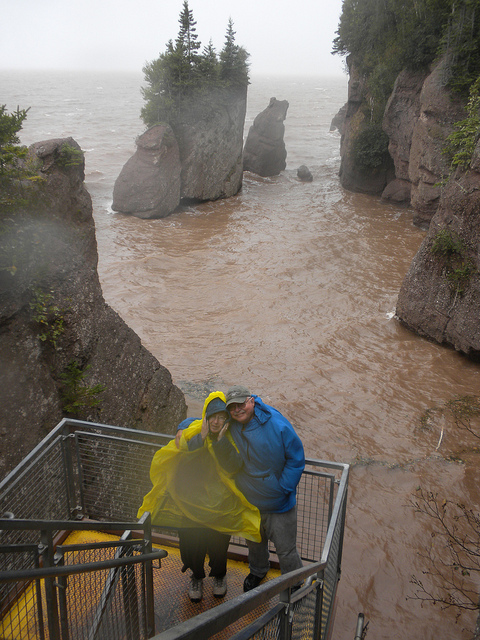
Hopewell Rocks at High Tide, September 19, 2:45 pm

I had always wanted to see the famous high and low tides in Canada’s Bay of Fundy, though I doubted I could do this without some guidance. So Martine and I took the Hopewell Rocks and Bay of Fundy Coastal Tour offered by Roads to Sea of Moncton, New Brunswick. About ten of us crowded into a minibus with Anna-Marie Weir, our capable guide.

We started by going to Hopewell Rocks at low tide, around 8:45 am. We learned that we had by accident picked a day when the difference between high and low tide would be 45.3 feet (13.8 meters). Afterwards, we saw several other sites affected by the tides, including the Harvey Shipyard, the Alma Lookout, the boats in the harbor at Alma, and Cape Enrage. The first three of the above, we saw twice, at intervals that graphically illustrated the striking difference made by the tides.

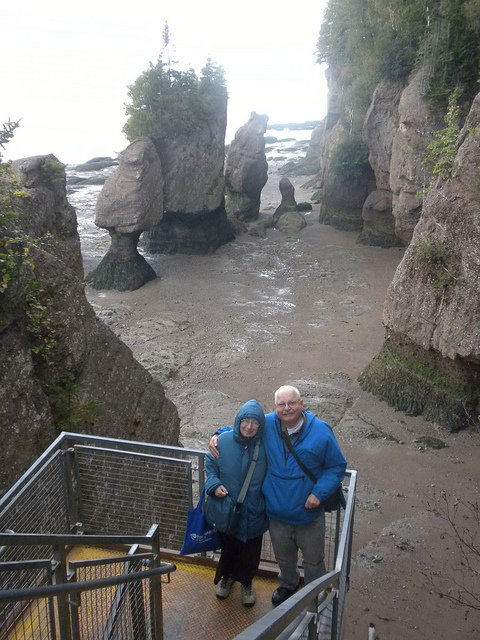
Below is the same location as the above photo in the early morning at low tide:

Hopewell Rocks at Low Tide Earlier the Same Day

We were able to walk among the rocks and take pictures . One can see by the markings along the bottom of the rocks how high the tide normally comes.

That Wednesday we took the tour started with the threat of rain, which, by early afternoon, became a reality—as you can see in the first photo above. Irrespective of the weather, we enjoyed the tour to such an extent that it was one of the highlights of our recent vacation.

Below is a photo of the personable Anna-Maria Weir and the minibus we rode on the tour:

Anna-Marie Weir of Roads to Sea

Martine and I had been in other areas with substantial tidal variation, especially when we visited Normandie in France about fourteen years ago. The high tide at Mont St-Michel reputedly would come in so fast that author Victor Hugo compared it to the speed of a galloping horse. Alas, we never were able to time our visit to see the variation with our own eyes.

Later in the trip, we even crossed the Bay of Fundy in a roll-on roll-off ferry that runs between Digby, Nova Scotia, and St. John, New Brunswick. It was interesting that the ferry docked at both coasts by a steel bridge that moved up and down with the tide. Ours was a surprisingly smooth crossing over its three-hour length. We were even able to eat a delicious supper with the famous Digby scallops, which are particularly huge and succulent.


Is That How He Prefers Them?

A New Romney Meme Is Born

From Debate #2 between Barack Obama and Mitt Romney. The circumstances, according to CNN:

When asked about what he’d do to improve income equality for women, Romney cited his efforts as governor of Massachusetts to include women on a state economic panel, efforts that apparently included poring through “binders full of women” in search of qualified candidates. And with that, a meme was born.

I wonder how the women felt….

Follow the Bouncing Ball

Argentinean Author César Aira

Most traditional literature is somewhat like a series of nested matryoshka dolls: You come back out the way you go in. In the process, all unresolved issues are neatly resolved (one hopes), and one has experienced a real 19th century experience.

Well, that doesn’t seem to be happening any more, except perhaps in some whodunits. It certainly isn’t happening in the slim novels of César Aira, an Argentinean from Coronel Pringles who writes the way a Roomba vacuum cleaner robot cleans: He just moves in a straight line until he encounters a barrier that sends him off in another direction.

In Varamo, we are in the city of Colón in Panama some 20 years after the Panama Canal was built. Varamo is the name of a Chinese-Panamanian who works for one of the government ministries in Colón. The story begins when, as his pay, he is handed 200 counterfeit pesos which he at once recognizes and is afraid to cash. He walks to the cafe one evening and witnesses an accident in which one of the government ministers is severely injured. That makes him late to the cafe, where he runs into three pirate publishers who urge him to write a book, which Varamo gladly does. It turns out to become a Central American poetry classic: The Song of the Virgin Boy.

Along the way, he encounters other adventures, but this will do for now. In the last paragraph, Aira gives a kind of apologia for his own highly individualistic writing style:

The result was Varamo’s famous poem, except that it was less a result in itself than a way of transforming what had preceded it into a result. It produced a kind of automatism or mutual fatality, by which cause and effect changed places and became the same story. Far from diminishing the poem’s initial vigor, this circle intensifies it. Which is, in fact, what always happens. If a work is dazzlingly innovative and opens up unexplored paths, the merit is not to be found in the work itself, but in its transformative effect on the historical moment that engendered it. Novelty makes its causes new, giving birth to them retrospectively. If historical time makes us live in the new, a story that attempts to account for the origin of a work of art, that is, a work of innovation, ceases to be a story; it’s a new reality, and yet a part of reality as it has always been for everyone. Those who don’t believe me can go and see for themselves.

Now there’s a manifesto! Aira’s “new reality” has, with me, fallen on receptive ears. I have read every Aira book that I could get my hands on. They are all relatively short, but always succeed in defying any attempt at speed-reading. This Argentinean knows how to throw curve balls that bounce all over the place. Following their trajectory across space and time is not only great fun, but also profound, in a weird way.

Photo Credit: The above picture—a favorite of mine—comes from the Buenos Aires BAFICI website (dedicated to independent filmmakers).