Sawtelle Days

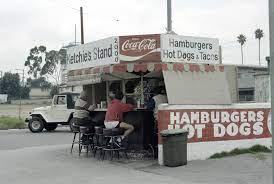
Ketchie’s Stand at Sawtelle and Missouri

The third place I lived in Los Angeles was the first that I had picked out for myself. The apartment on Sunset Boulevard was picked by my roommate and best friend, Peter; and my father picked out the hot-box on Darlington where I sweltered from a total lack of ventilation.

In the fall of 1967, I was diagnosed with idiopathic aseptic necrosis of the left femoral head. My orthopedist at UCLA thought I would be placed in traction for months, so I hightailed it back to Cleveland to stay with my parents. It turned out that the treatment was for me to be on crutches for a couple of years.

Around New Years of 1968, I returned to L.A. and, with the help of my friend Norm, found a studio apartment on Mississippi Avenue a half block west of Sawtelle Boulevard. It was and, to some extent, still is a Japanese neighborhood. And this was at a time that I was gaga over Japanese films and cuisine and culture. I dreamt of meeting some Nisei cutie who looked like Toho film star Mie Hama.

Toho Film Cheesecake Star Mie Hama

Of course, I didn’t—and, besides, what kind of dating scene can a guy on crutches have who doesn’t have either a car or a driver’s license? For me, that was still in the future….

But it was interesting living in a Japanese neighborhood and eating teriyaki and donburi regularly at the O-Sho Restaurant and the Futaba Café, which were right around the corner on Sawtelle. And there was Ketchie’s Stand at Missouri and Sawtelle where the friendly Okie chef cooked up some very creditable hamburgers and tacos.

I was still attending graduate school in film at UCLA and wound up taking two Santa Monica buses to and from classes, unless I just decided to walk the five blocks from Santa Monica Boulevard and Sawtelle.

Around this time, I joined my film friends from UCLA in making regular treks to the Japanese movie theaters in town. At the time, there were five of them: the Toho La Brea, which showed films from Toho; the Kokusai and Sho Tokyo, from Daiei Studio; the Kabuki, from Shochiku; and the Linda Lea, from Tohei. At the time, I think the Japanese film industry was consistently making the best films anywhere. Needless to say, those theaters are no more.

I lived in the Mississippi apartment for about a year before moving to the first of my two Santa Monica apartments on 12th and 11th Streets respectively. But that is a story for another time.
Road Trip

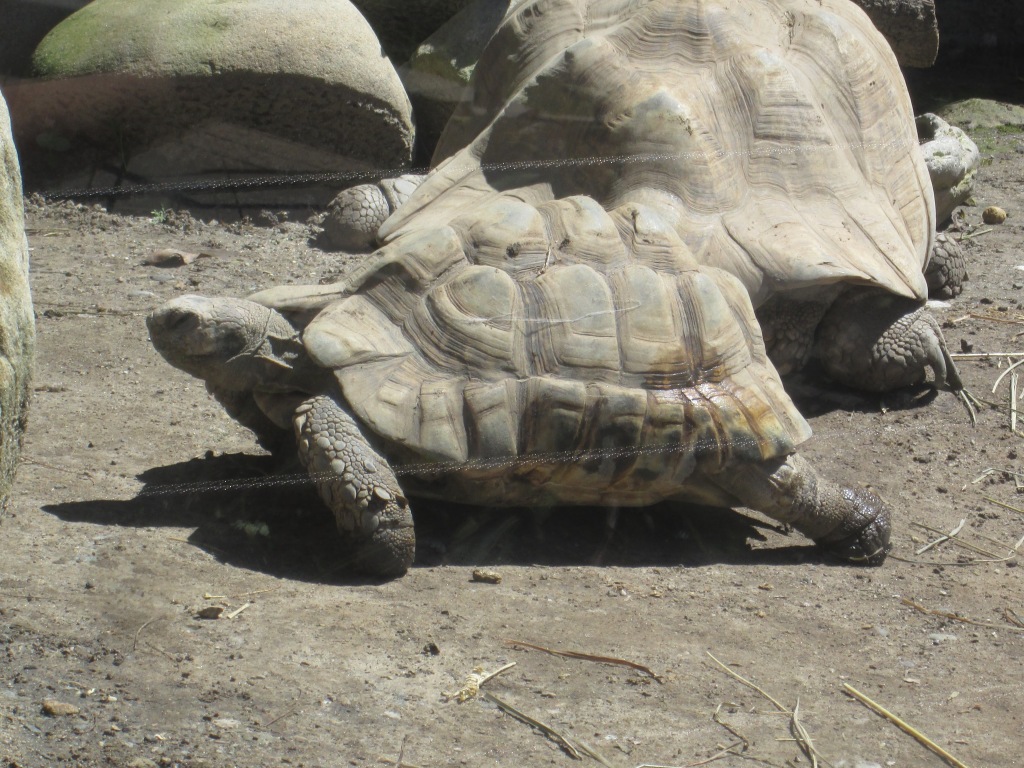
Tortoise at the Santa Barbara Zoo

Because of all the rain we’ve been having, Martine and I haven’t gone on any road trips lately. Today, we drove to Santa Barbara, had a great seafood lunch, and went to the Santa Barbara Zoo. Unlike the Los Angeles Zoo, there are usually fewer than 10,000 visitors present; and consequently there is about 76% less chance of having an infant stroller destroy your ankles.

Mind you, there were many small children in attendance. But that is to be expected at any zoo. It’s one of the few places one can take one’s small progeny and allow them to act like kids without inflicting too much damage to the animals and other visitors.

We’ve been visiting the Santa Barbara Zoo for upwards of twenty years, so we were saddened to hear that the two Asian elephants, Sujatha and Little Mac, died in 2019; and the zoo is not planning to replace them. Instead, their large compound is now an Australian “walkabout.”

On the way back, we took the pleasant and very rural California 126 to avoid the usual traffic jam around Oxnard and Ventura. We stopped at Francisco’s Fruit Stand in Fillmore to buy some honey, strawberries, and mandarins. I was shocked to find that taking 126 and I-405 in Santa Clarita takes no more time and eats up no more miles than taking either the Pacific Coast Highway to U.S. 101 or taking U.S. 101 all the way.

Unfortunately, Martine was in considerable pain from a pinched nerve in the back that has been bothering her for several years and getting progressively worse. Unless she finds a way of ameliorating her condition, we may not be able to go on many more trips together.

A Vanished Legacy

My Old Grade School—Since Renamed

Between September 1951 and June 1958, I attended Saint Henry Catholic School in Cleveland, Ohio. It was taught mostly by Dominican sisters who had a two-story convent on the premises. I started in second grade after having finished only half of first grade at Harvey Rice Elementary School in the old Buckeye Road neighborhood. My persistent nightmare is that someone will find out that a illegally skipped half a grade and force me to go back to Cleveland and sit at one of those tiny desks and spend my days trying to puzzle out phonics.

I suspect that we moved to the Harvard-Lee neighborhood primarily because, when I lived in the old Hungarian neighborhood, I didn’t speak English, which didn’t help my academic standing.

The good sisters at Saint Henry forced me to become more of an American (and less of a Hungarian). With my poor second grade marks, Sister Frances Martin O.P. (short for Ordinis Praedicatorum, or Order of Preachers) would sneak up behind me when I misbehaved, pull my ears and call me “cabbagehead.”

My grades improved, until in fifth grade I was considered less of a wiseacre and more of an “A” student. My seventh grade teacher, Sister Beatrice, was in her eighties when she taught my class. In eighth grade, I had Sister Rose Thomas.

Back at Saint Henry, we typically had an average of 55 students per class. At some point, the Harvard-Lee neighborhood became majority African American and (probably) Baptist. The church (whose entry is the door on the right in the above photo) was closed down; and in 1993 the school was renamed Archbishop Lyke School Saint Henry Campus, with an average of 17 students per class.

While I was in college, my parents joined the “White Flight” to the all-white community of Parma Heights on the West Side of Cleveland, where my brother attended Holy Family School.

When last I was in Cleveland—for my mother’s funeral in 1998—I couldn’t recognize the old Harvard-Lee neighborhood. The trees that were planted when the neighborhood was new right after the Second World War were now massive. We never had anything like that in the way of shade during the 1950s and 1960s.

Ablative Absolute

St Peter Chanel High School in Bedford, Ohio

The year was 1958. I began attending a new Roman Catholic high school which had opened the previous year. At the time, there were only a sophomore and freshman class. I was in the latter.

My most memorable teacher was the Rev. Gerard Hageman for English. He was super strict. Some years earlier, he has put together his own summary of grammatical rules which he distributed copies of to the class. Any violation of the rules, and the student received not only a flunking grade, but a zero. Since the numerical grades were averaged out—without any sort of bell curve adjustment—it was possible to get and stay in deep trouble insofar as your English grade was concerned.

Fortunately, I led the pack with an 89% average. I thrived in Father Hageman’s class. Even though I told everyone I wanted to be a nuclear physicist, at the time I did not know that I had no head for the sciences and only an indifferent head for mathematics.

I remember Father Hageman assigned us to write one page essays (graded either 0 or 100—nothing in between). Being a good Catholic, I wrote a whole series of essays on Jesus Christ standing before Pontius Pilate. My writing style was influenced largely by what I gleaned from William Faulkner after reading only The Sound and the Fury and by my class in Latin I.

The only thing I remember clearly is when I actually used an obscure Latin construction called an Ablative Absolute in one of my English essays. The opening phrase of the sentence in question was “Cold sweat covering his dolorous countenance” followed by what I conceived Pontius Pilate was thinking.

Prett6y fancy for a 14-year-old! I guess I’m still the same kind of writer, though I generally avoid obscure Latin grammar. On the other hand, by now I have read all of Faulkner’s novels; so I can copy him with some degree of confidence.

The Tiger at the Buenos Aires Zoo

The Buenos Aires Zoo that Jorge Luis Borges visited to be inspired by its tigers was closed in 2016, five years after Martine and I visited it. Its former space in Palermo is now occupied by an EcoPark.

Although he became almost totally blind in the 1950s because of an ophthalmic ailment inherited from his father, Borges in his poetry returned again and again to the tigers he heard roaring in the old zoo.

Below is one of my favorites—“The Gold of the Tigers”—translated by Alastair Reid:

The Gold of the Tigers

Up to the moment of the yellow sunset,
how many times will I have cast my eyes on
the sinewy-bodied tiger of Bengal
to-ing and fro-ing on its paced-out path
behind the labyrinthine iron bars,
never suspecting them to be a prison.
Afterwards, other tigers will appear:
the blazing tiger of Blake, burning bright;
and after that will come the other golds—
the amorous gold shower disguising Zeus,
the gold ring which, on every ninth night,
gives light to nine rings more, and these, nine more,
and there is never an end.
All the other overwhelming colors,
in company with the years, kept leaving me,
and now alone remains
the amorphous light, the inextricable shadow
and the gold of the beginning.
O sunsets, O tigers, O wonders
of myth and epic,
O gold more dear to me, gold of your hair
which these hands long to touch.

In this poem, Borges refers to William Blake’s poem “The Tyger”; to the Greek myth of Zeus impregnating Danaë disguised as a shower of gold; and the Norse myth of Draupnir, the self-replicating gold ring. The only color Borges was able to see as his blindness worsened was yellow. Finally, the golden-haired beauty referred to at the end was probably Norah Lange, the Norwegian-Argentinian writer whom Borges loved but who chose to marry rival poet Oliverio Girondo instead.

Oops! I’m Running for President!

The Residence of the President of Iceland (Center)

I read an amusing story in the current edition of the Reykjavík Grapevine. It appears that it is so easy to run for the presidency of Iceland using a handy website that a number of people accidentally put their names in for nomination. According to the Grapevine article:

As the upcoming presidential elections draw near, more and more viable candidates are entering the race. Potential contenders need to collect at least 1500 signatures before April 26 to be eligible for election. This is the first time the entire process is conducted online, leading some people to unintentionally run for president on island.is with the push of a button.

On March 24, approximately 80 people had put their names forward, formally entering the presidential race. RÚV [the Icelandic English-language news service] reports that 40 candidates subsequently removed their submissions, with at least six individuals unknowingly entering the 2024 presidential race. The National Election Board has remedied the technical glitch.

53 candidates are currently in the process of collecting signatures, with voters choosing the next President of Iceland on June 1.

South and West

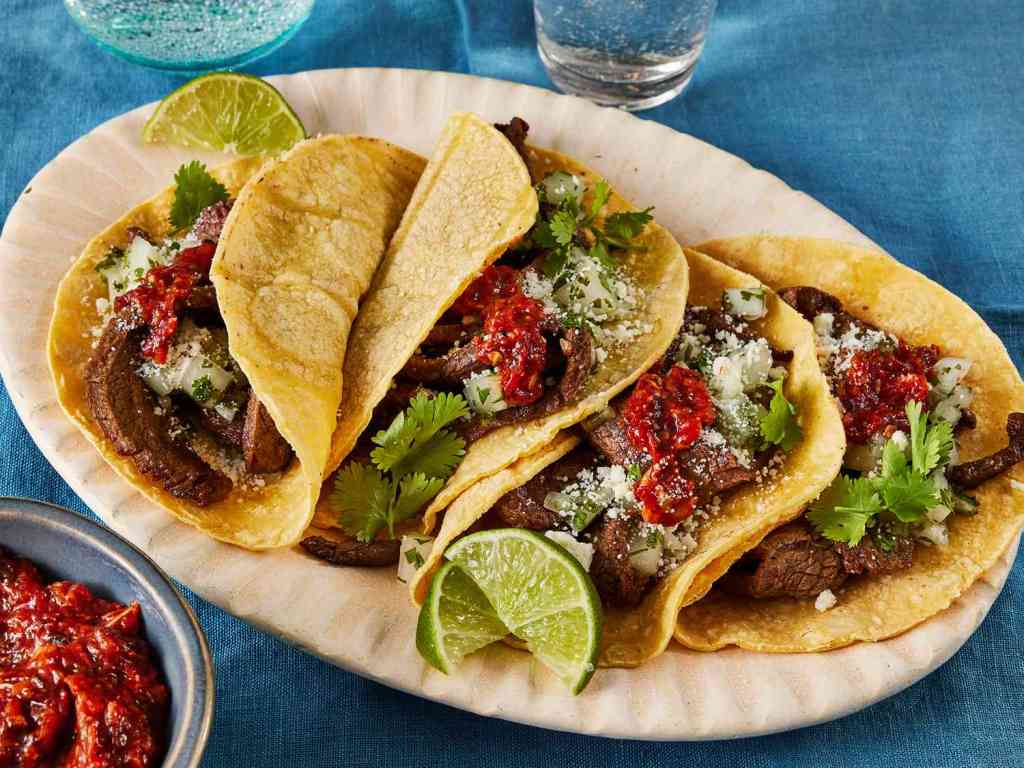
Plate of Tacos

Believe it or not, I first tasted Mexican food at the Mexico Pavilion of the 1964-1965 New York World’s Fair. The whole family had come to the Big Apple from Cleveland to help me decide where to go for graduate school. I was examining two possibilities: New York University (NYU) in Manhattan and UCLA in Los Angeles.

NYU turned out to be a complete washout. I talked to Professor Haig P. Manoogian of the NYU Film Department who did his best to convince me not to apply. Later, when I found that Martin Scorsese dedicated his film Raging Bull to Manoogian, all I could do was shrug my shoulders and blow a raspberry.

The taco that I ate at the World’s Fair was more of an indicator of where I was headed. From a childhood in Cleveland and four years of college in New Hampshire, I was headed south and west to UCLA. During the summer before my start at UCLA, I experimented with Mexican frozen food meals that were incredibly mediocre and inauthentic.

It did not take long for me to eat the real autentico item. When I was living in Santa Monica, I would have many a dinner at Castillo’s, a Mexican steam table deli on Wilshire Boulevard with a very cute server.

My tastes in food continues to go south and west: south to Mexico, and west to China, Japan, and India. Even today, I do not go much for Euro/American chow with its neatly separated meat, potato, and cooked vegetable (the exception being the Hungarian food of my youth, which I still love).

Today, I ate lunch after an early afternoon doctor appointment. I went to Kalaveras in Marina Del Rey and had a couple of carnita tacos and a bottle of draft Modelo beer. It was just what I needed, and it set me to thinking of my history with Mexican food.

Snæfellsnes: Iceland in Miniature

Twice I have had my toes touching the Snæfellsnes Peninsula of Iceland, but got no further than Stykkishólmur each time. The first time, in 2001, I was on a day trip from Reykjavík; the second time, in 2013, I took a ferry to Flatey and Brjánslækur in the Westfjords and returned to Reykjavík by land via Hólmavík.

I would dearly love to go to Iceland again and see some of the sights I have missed. These include:

  • Most of the Snæfellsnes Peninsula west of Stykkishólmur
  • The area along the Ring Road (Route 1) between Borgarnes and Akureyri
  • The Tröllaskagi Peninsula
  • The Sprengisandur Route through the center of Iceland

As I understand, there is no longer any public transportation on the Sprengisandur Route; and it requires an oversized 4×4 vehicle that can ford glacial rivers.

Map of the Snæfellsnes Peninsula

What interests me about the Snæfellsnes Peninsula is that, within little more than a hundred miles (or 160 kilometers), it includes just about everything that Iceland has to offer, including mountains, waterfalls, a famous glacier (which inspired Jules Verne’s Journey to the Center of the Earth), attractive fjords, puffins, black sand beaches, postcard pretty fishing villages, and even the site of a famous medieval saga: The Eyrbbygja Saga.

I know there are a lot of long, complicated Icelandic names in this post. It is only because I love Iceland so much I want to make it easy for anyone who reads this to find out what I am talking about. A few minutes on Google Images would show you what I mean.

Ten Tens

Over the last quarter of a century, I have read over three thousand books. Ever since I was a sickly child unable to compete in physical sports with my age group, I have used books to feel good about myself and to ready myself to compete in a dog-eat-dog world. Now that I am retired, I find that reading still has huge benefits, particularly when it comes to keeping on an even keel as I enter my eighth decade.

If you want to see the last two thousand or so books I have read and written reviews for, look me up on Goodreads.Com using as your Google search field: Goodreads Tarnmoor.

In the meantime, here are ten of the best books I have read in the last year and a half presented in alphabetical order by the last name of the author:

  1. Ivan Bunin: Collected Stories. Although he is virtually forgotten today, Bunin has written some of the greatest short stories ever penned by a Russian author.
  2. Alejo Carpentier: Explosion in a Cathedral. If you think that a book about the influence of the French Enlightenment on the Caribbean couldn’t be fascinating, guess again!
  3. Geoff Dyer: Last Days of Roger Federer and Other Endings. Superb essays on the theme of the special quality of an artist’s last works.
  4. Tove Jansson: The Summer Book. A gentle and truly lovely book written by a Finnish author in Swedish, of course. If the name sounds familiar, remember the Moomintrolls.
  5. Clarice Lispector: Too Much of Life: The Complete Crônicas. This bizarrely beautiful Ukrainian/Brazilian writer wrote short journalistic essays that are a classic for our times.
  6. Lucretius: The Nature of Things. A long philosophical poem by an ancient Roman that, even today, is worth mining for the author’s unique insights.
  7. John Cowper Powys: Wolf Solent. Another great work by an author who is almost forgotten today. Read this and you will think differently about living in a rural English town.
  8. Juan Rulfo: Plain in Flames. This Mexican writer did not publish much, but these short stories will make you sit upright. Like John Webster, Rulfo could “see the skull beneath the skin.”
  9. Georges Simenon: Strangers in the House. He wrote hundreds of mysteries, but writers like William Faulkner Patricia Highsmith, and John LeCarré recognized his greatness.
  10. Olga Tokarczuk: House of Day, House of Night. This Polish Nobelist describes life in rural Silesia. As one reviewer wrote: “What emerges is the message that the history of any place–no matter how humble–is limitless, that by describing or digging at the roots of a life, a house, or a neighborhood, one can see all the connections, not only with one’s self and one’s dreams but also with all of the universe.”

Probably what all these works have in common is that they are not as well known as most books. Sometimes, the surprise of reading an author like Dyer or Lispector or Tokarczuk can take you to more interesting places simply because you have not heard of them before.

Mérida Noviembre 1975

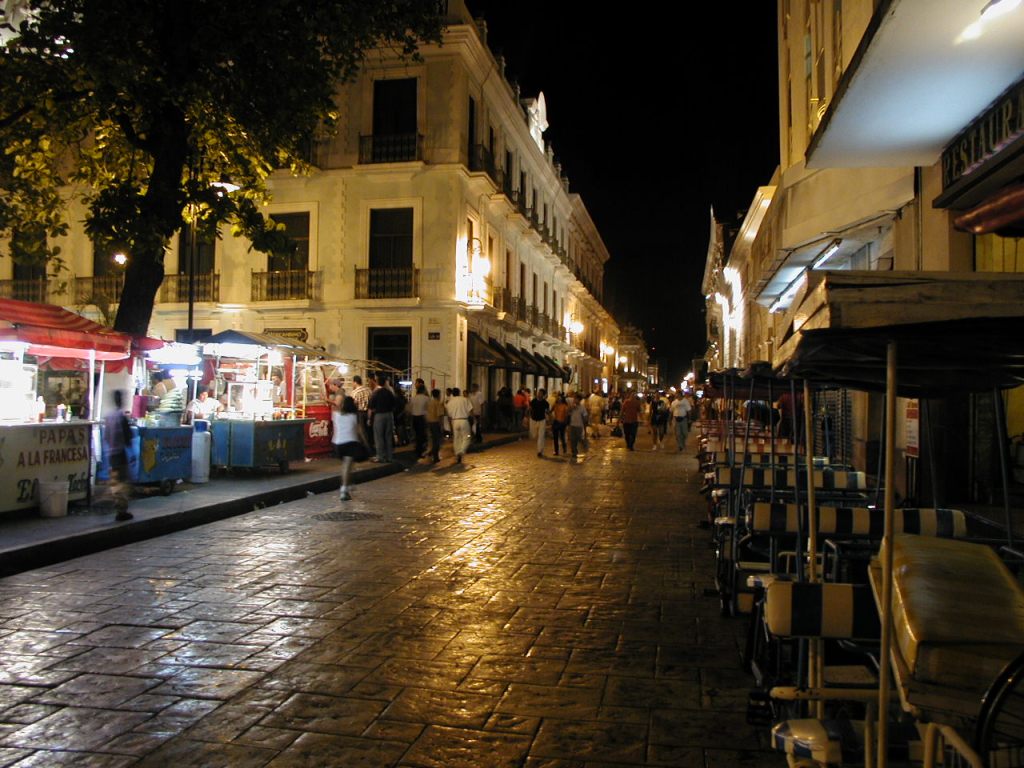
Street Scene at Night in Mérida, Yucatán

I had just landed on a Mexicana de Aviación direct flight from Los Angeles. I was thirty years old, yet this was my first trip alone that did not involve going “home” to Cleveland or going back and forth from Cleveland to college. The night was much darker than in a U.S. city, and the humid heat told me I was in the tropics. As the taxi sped to the center of town, we passed houses where I saw families seated at dinner in the dim light.

We passed a huge Coca Cola bottling plant that I later learned was the largest employer in the city.

The taxi pulled up to the Hotel Mérida on Calle 60 and I checked in. As soon as I dropped off my luggage, I took a walk down to the Plaza Grande and stopped in at several of the shops. I had a delicious meal at the Restaurant Express of Cochinita Pibil with a Cervéza Carta Clara.

Returning to my room, I finally bedded down for the night; but I couldn’t sleep. Several times, I rose from bed and looked out at the street from my ninth floor room at the Optica Rejón and other shops across the street, and a very different kind of foot traffic than I ever experienced in the States. Several times, I would stare at a Maya pedestrian dressed in the typical whites; and, knowing he was being watched, he would look up at me directly. How did he do that?

Eventually, I was able to calm down and get to sleep. Nonetheless I was up early the next morning, eager to acquaint myself with the city before branching out and visiting the Maya ruins on my schedule. I showed up at a local travel agency called Turistica Yucateca which was run by a helpful woman who didn’t know a word of English. Somehow I managed to book two trips with her using the same guide (Manuel Quinónes Moréno) who drove his own car.

The first trip was to the ruins of Dzibilchaltun just north of Mérida. The second was to the ruins of Acanceh and Mayapán, On my own, I managed to get to Uxmal and Chichén Itzá.

I was in seventh heaven. Almost nothing in this life had given me as much pleasure as that first trip on my own. As much as I have enjoyed all my journeys, that one was always special to me. It was the start of my travels. And now, as I approach the age of eighty, I still have the travel bug.