Greene with Envy

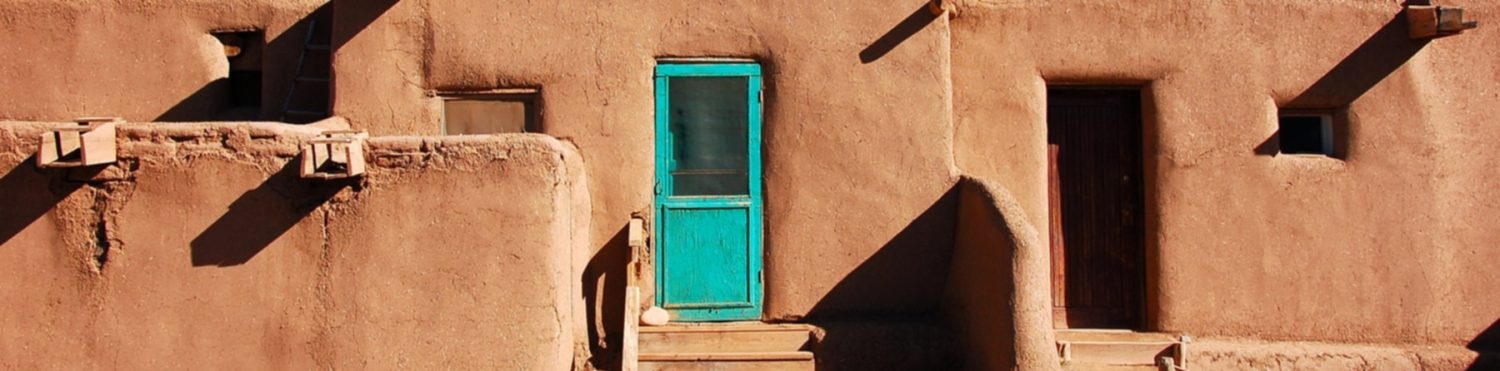
Front Entrance to the Gamble House

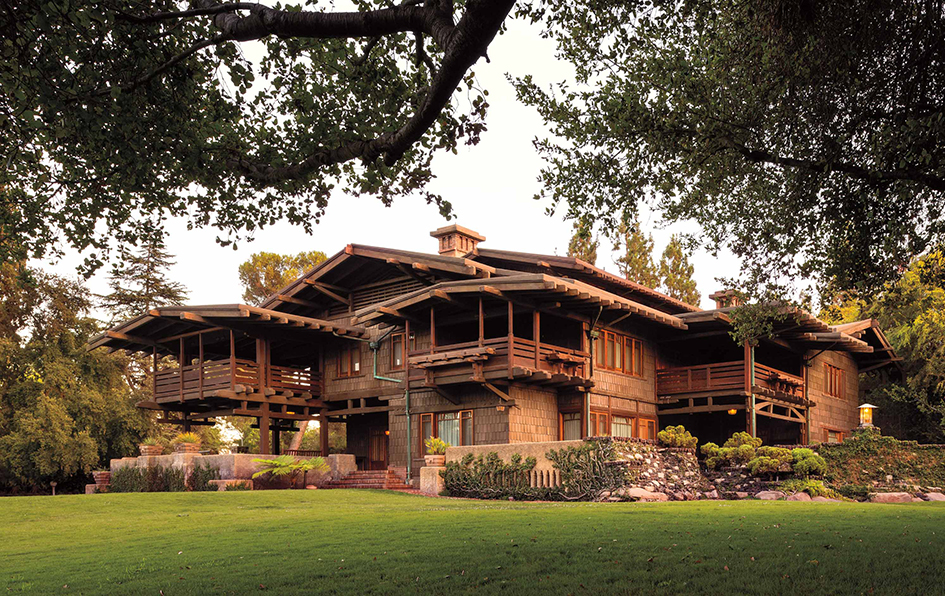
Yesterday, Martine and I drove to Pasadena to visit the Gamble House. No, it’s not a casino. It was the home of the Gambles of the Procter & Gamble fame. Situated on Orange Grove near where the Tournament of Roses Parade makes the turn onto Colorado, the area is a turn of the century (19th to 20th, that is) millionaires’ row. We had visited the house before, years ago, but it’s a good thing to renew one’s acquaintance with great works of art from time to time.

the house is the work of the architectural firm of Greene & Greene. While their works are usually characterized as “arts and crafts bungalows,” what we have here is a sizeable mansion.

Gamble House Exterior

There is something infinitely pleasing and subtle about the works of Greene & Greene when they are at the top of their game, and the Gamble house was definitely at the top of their game. The architects decided not only the exterior feature of the building, the room layouts, and the grounds—but even the furniture in many cases. In one room, everything is made to resemble a vase on the dresser.

Although the architects had never been to the Orient, they did stop at the World’s Columbian Exposition in Chicago on their way to California, where they saw a number of examples of Japanese architecture. That glimpse was sufficient to get them thinking about how to use wood not only for weight-bearing, but also for decorative purposes.

Gamble House Sample Interior

Note the way all the features in the above room blend in with one another. The pottery, the lighting fixture, the table and chairs seem all of a piece. At one point where the servants would injure their hip by banging into a sharp counter corner, the architects made the counter trapezoidal, eliminating the sharp corner. At another point, the very short Aunt Julia Gamble had a special chair made for her to work with the fastenings on her high-button shoes. (Also note Aunt Julia’s little step stool in the above photo for her comfort.) In the boys’ bedroom, there is a low, wide drawer for storing their shoes. In the kitchen, there is a super-wide drawer for storing tablecloths without wrinkling them along the folds.

Everything is on a human scale. And strikingly beautiful.


The Architectural Muse

Visitor at a Homage to Roberto Aizenberg’s Paintings

He started out as a student of architecture and ended up being a surrealist painter whose work has an architectural quality. Roberto Aizenberg (1928-1996) is the subject of this post, part of a desultory series on Argentinian painters. In general, I dislike abstract expressionists and love realists and surrealists. A student of Antonio Berni, about whom I have written before, Aizenberg’s work is reminiscent of Xul Solar, another surrealist from the Rio de la Plata.

“Biography of the Author” by Aizenberg

The above painting ties the artist’s love of architecture to the soil of Argentina, with the buildings appearing to be a range of buttes and mesas built atop red earth riddles with caves. This one particularly reminds me of Xul Solar’s surrealist humor.

“Harlequin” by Aizenberg

Harlequins typically wear costumes broken into a design of alternating black and white diamonds. Here, Aizenberg suggests the costume and brackets it with architectural elements. Instead of a human figure, the painter’s harlequin is topped with a doughnut-shaped ring and supported by three spheres of descending size—almost as if it were a decorative finial for a staff or scepter of sorts.

I have not seen many original canvasses by Argentinian painters, with the exception of Xul Solar, whose dedicated museum I have visited in Buenos Aires. The next time I go to South America—and I hope there is a next time—I will have to visit MALBA, the Museo de Arte Latinoamericano de Buenos Aires.


The Joys of Pre-Columbian Art

Moche Portrait Vessels at Lima’s Museo Larco

Not everyone is an aficionado of primitive art—particularly the Pre-Columbian art of the Americas. Children are not taught in schools about the early civilizations of the Americas. On the contrary, I suspect most kids think that, since the ancient civilizations fell so quickly to the conquistadores,  they didn’t have anything to offer to us.

Even one of my literary heroes, Aldous Huxley, came a cropper in his 1934 travel classic, Beyond the Mexique Bay: “Frankly, try how I may, I cannot very much like primitive people. They make me feel uncomfortable. ‘La bêtise n’est pas mon fort.’”

I strongly suspect that among Europeans of some eighty years ago, that was a common opinion. After all, the Olmecs, Maya, Aztecs, Moche, and Inca do not in any way resemble the ancient Greeks and Romans—except that the Inca, like the Romans, were also great road-builders. They didn’t have much of a literature that has survived the Spanish conquest, except perhaps for the Maya Popol Vuh of the 16th century. As for philosophy, drama, novels, poetry… you can pretty much forget about it.

There was a period of tens of thousands of years during which the peoples of the Americas were isolated from any possible contact with European civilization. In consequence, they developed along different lines. Again and again in his book on Guatemala and Mexico, Huxley shows himself to be unwilling to consider that the Maya are very different. Not inferior, just different.

The Moche figures in the above photograph are all highly individualized. They remind me of the terra-cotta Chinese warriors discovered in Xian: Each of the 8,000 soldiers was different from all the others.

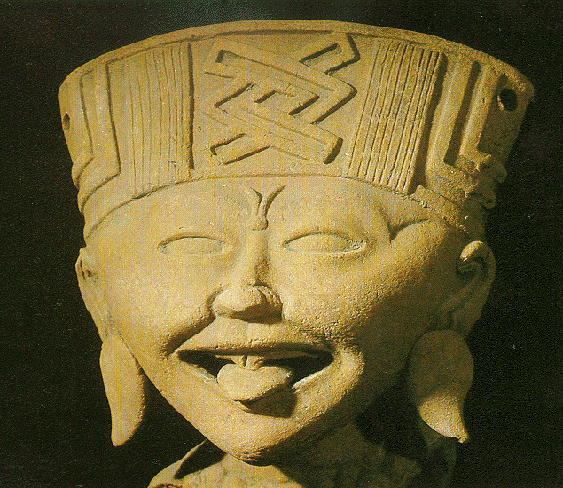
Totonac Figure from Mexico

Take the Totonac figure from the State of Veracruz in Mexico. This is a typical subject for Totonac art. Do we know what it means? The sloping forehead (does it show a deliberately deformed skull such as many Maya subjects?), the humorous expression: It is as if the distant past were laughing at us. And, in a way, it is. Many Pre-Columbian figures of animals from Mexico are downright hilarious. I don’t remember that type of humor from Greece or Rome, and certainly nothing similar from the Christian era.

Look at the Diego Rivera mural below, depicting a scene from El Tajin, the ancient ceremonial center of the Totonacs:

Scene from Diego Rivera Mural of El Tajin, Ancient Totonac Center

Let’s face it. We don’t quite understand what is going on here. We probably never will. I myself have been to El Tajin and saw Totonac youths rotating around elevated poles as voladores. Was there any convincing explanation of what was going on here? No, of course not. What intrigues me about this period is that the subjects are incredibly fascinating, but it is all a great mystery. Like life in general.


Tarsila do Amaral

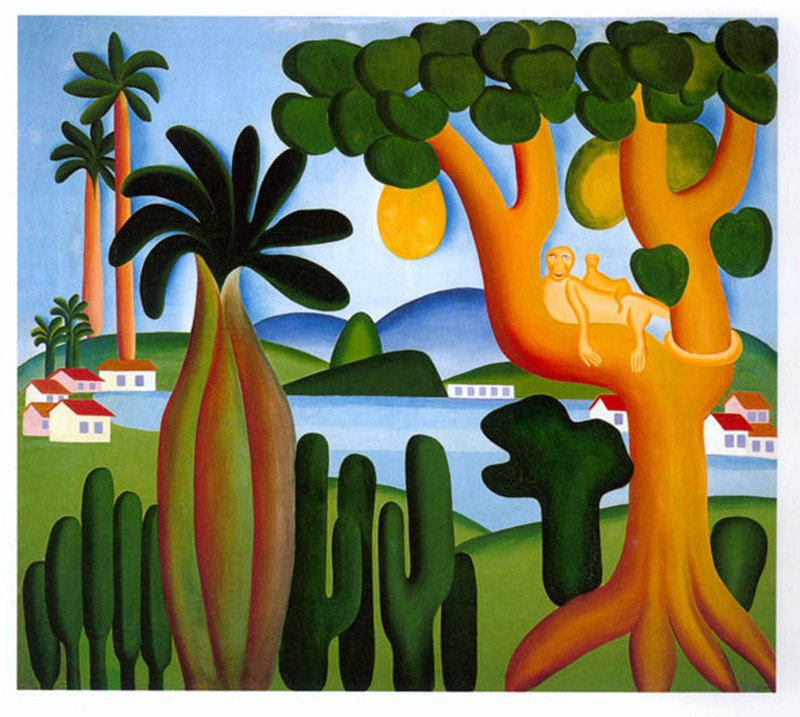
Postcard View with Brazilian Scenery by Tarsila do Amarol (1886-1973)

As you may or may not know, I am fundamentally opposed to non-representational painting. Abstract expressionism leaves me cold and even slightly hostile. I don’t even like Pablo Picasso. When I was in Paris last time, I deliberately decided not to visit the Picasso Museum even though I was in the neighborhood between Les Halles and the Bastille, where it is located.

So when I heard of a Brazilian painter who has been called the Picasso of Brazil, I was less than impressed—until I saw some of her works. I was suddenly reminded of Xul Solar, the Argentinean painter whose work was much loved by Jorge Luis Borges (before he became blind, of course). Tarsila de Amaral calls herself simply Tarsila. There is a n exhibit of her works opening at the Museum of Modern Art (MOMA) in New York City.

“Brazilian Religion” (1927)

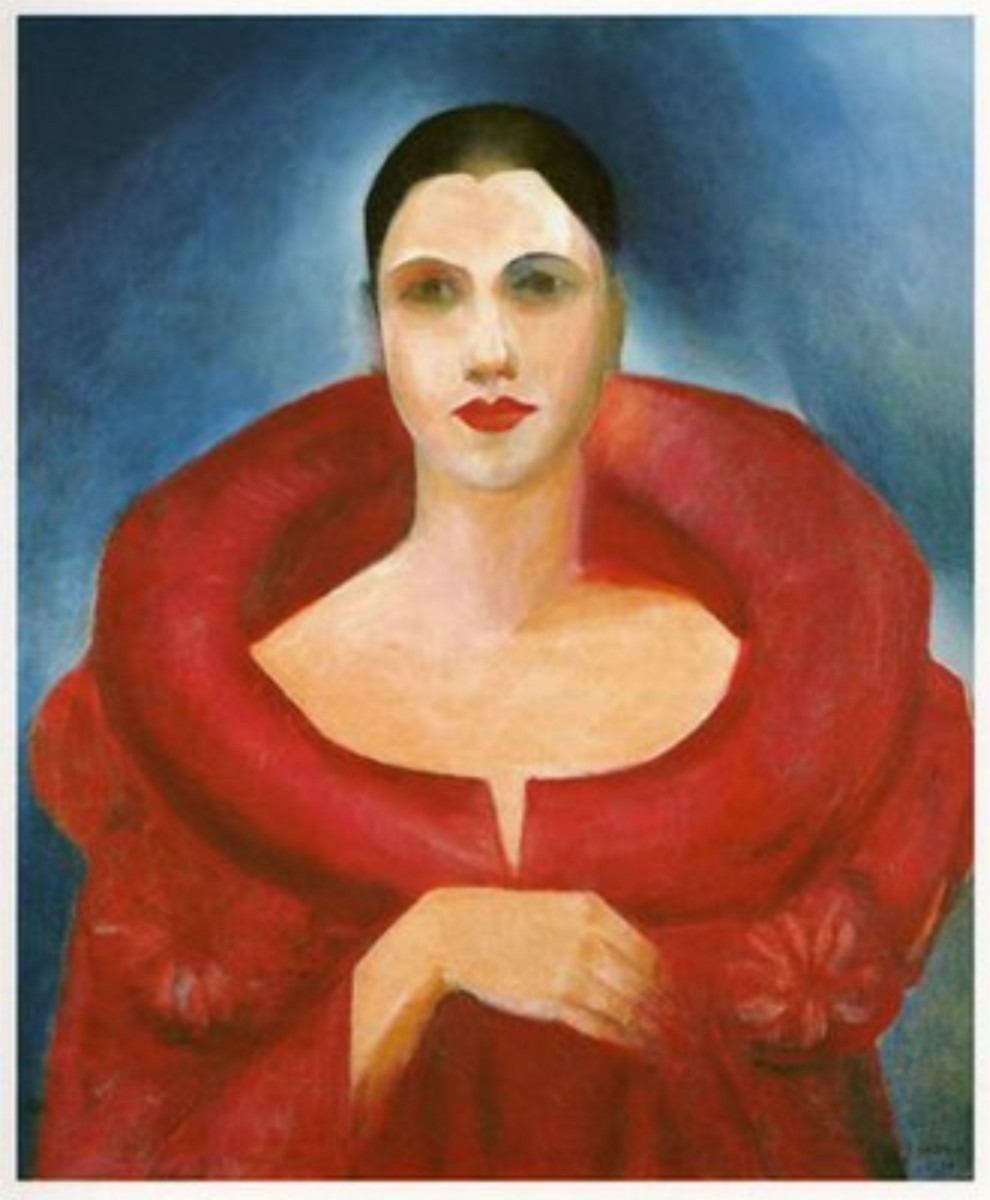
If you want to see a representative selection of her paintings, click on WikiArt’s website about her. Included there is her self-portrait (see below). Tarsila becomes one of a select group of Latin American artists of the 20th century whose work I think ranks with the best of American painting during that period, and in many cases surpasses it: Fernando Botero of Colombia; Benito Quinquela Martin and Xul Solar of Argentina; and Frida Kahlo, José Clemente Orozco, Diego Rivera, and David Alfaro Siqueiros of Mexico.

“Self Portrait” (n.d.)


Valentino’s Voisin et al

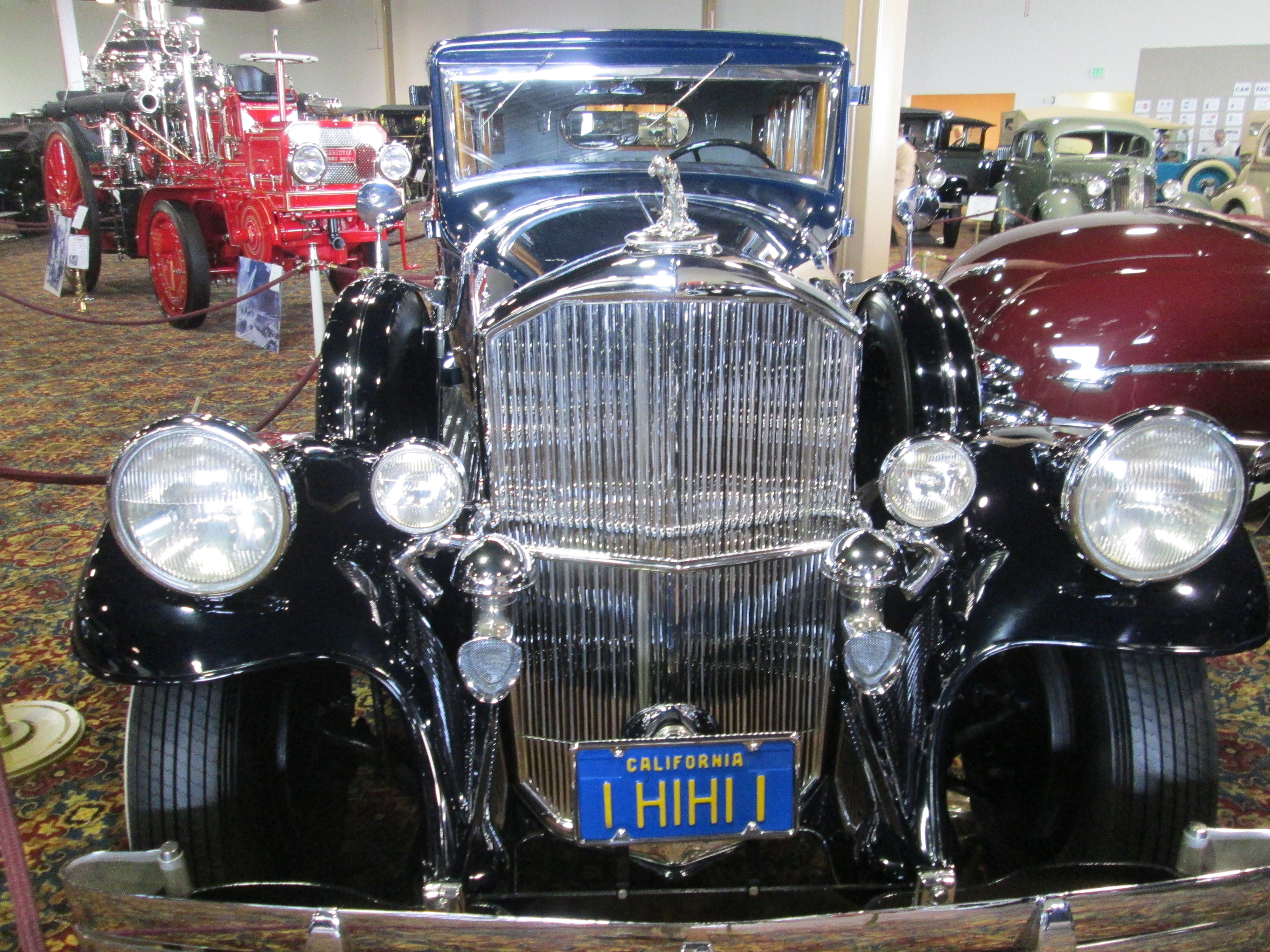
1932 Pierce-Arrow V12 Model 52 Sedan

On this cool and cloudy Saturday, Martine and I paid another visit to the Nethercutt Collection in Sylmar. We saw many of the same cars as on previous visits, but were newly impressed with the variety and beauty of automobiles manufactured in the 1920s and 1930s. The 1932 Pierce-Arrow practically called me by name as I walked by it. Like all the cars at the Nethercutt, it shone like a jewel. Even the tires look bran new. And yes, that is an old fire engine in the left background.

When I compare today’s cars with what was available a hundred years ago, we have lost individuality. (It looks like all the car bodies today were tested in the same wind tunnel, whether from Mercedes, Range Rover, or BMW.) Do you think the Toyota Prius is a new concept? Not so, there were hybrids a hundred years ago—and they looked better, too.

Rudolph Valentino’s 1923 Voisin

Many of the automobiles on display have fascinating histories. For instance, there were only eighteen Rolls-Royce Silver Phantom IVs manufactured, and they were all sold tom heads of state. The Nethercutt has one of the two that belonged to the Sheikh of Kuwait. At the time he owned them, there were only twenty miles of paved road in the whole country.

And then there is the gray 1923 Voisin that belonged to Rudolph Valentino. He purchased three of them, and brought one of them back with him to Hollywood. The hood ornament is a custom-made cobra head which was given him by fellow actor Douglas Fairbanks Sr.

There is even a Duesenberg Twenty Grand that cost … twenty grand. It was the only one manufactured, a special order made for the 1933-34 Century of Progress World’s Fair in Chicago.

Will I ever get tired of seeing these beauties? Not bloody likely.


The City in Woodcuts

The Early 20th Century City in All Its Glory

For some reason, I had always thought that Frans Masereel (1889-1972) was German, because his subject matter seemed to coincide so exactly with German Expressionism’s view of the city, usually Berlin. Actually, he was Flemish, and although he spent time in Germany, he also spent time in France and Belgium. I know him primarily for two wordless graphic novels composed entirely of woodcuts: Passionate Journey (1919) and The City (1925). I have both in my book collection.

I wonder if these woodcut books were created to appeal to those who couldn’t read. In any case, I admire them for their view of life in the city circa 1920.

Symbolic Image of Loneliness in the City

Both wordless novels are (or at least have been) available in reasonably priced paperback editions from Dover Publications.

I have always liked woodcuts as a medium of artistic expression. Masereel is able to convey a story and an overwhelming feeling of being crushed by the multitudes in modern urban life.

Busy Restaurant

After Masereel, the American Lynd Ward (1905-1985) carried on the medium of the wordless novel. There is a two-volume collection of his graphic novels available from Library of America.


Dürer’s Melancholia I

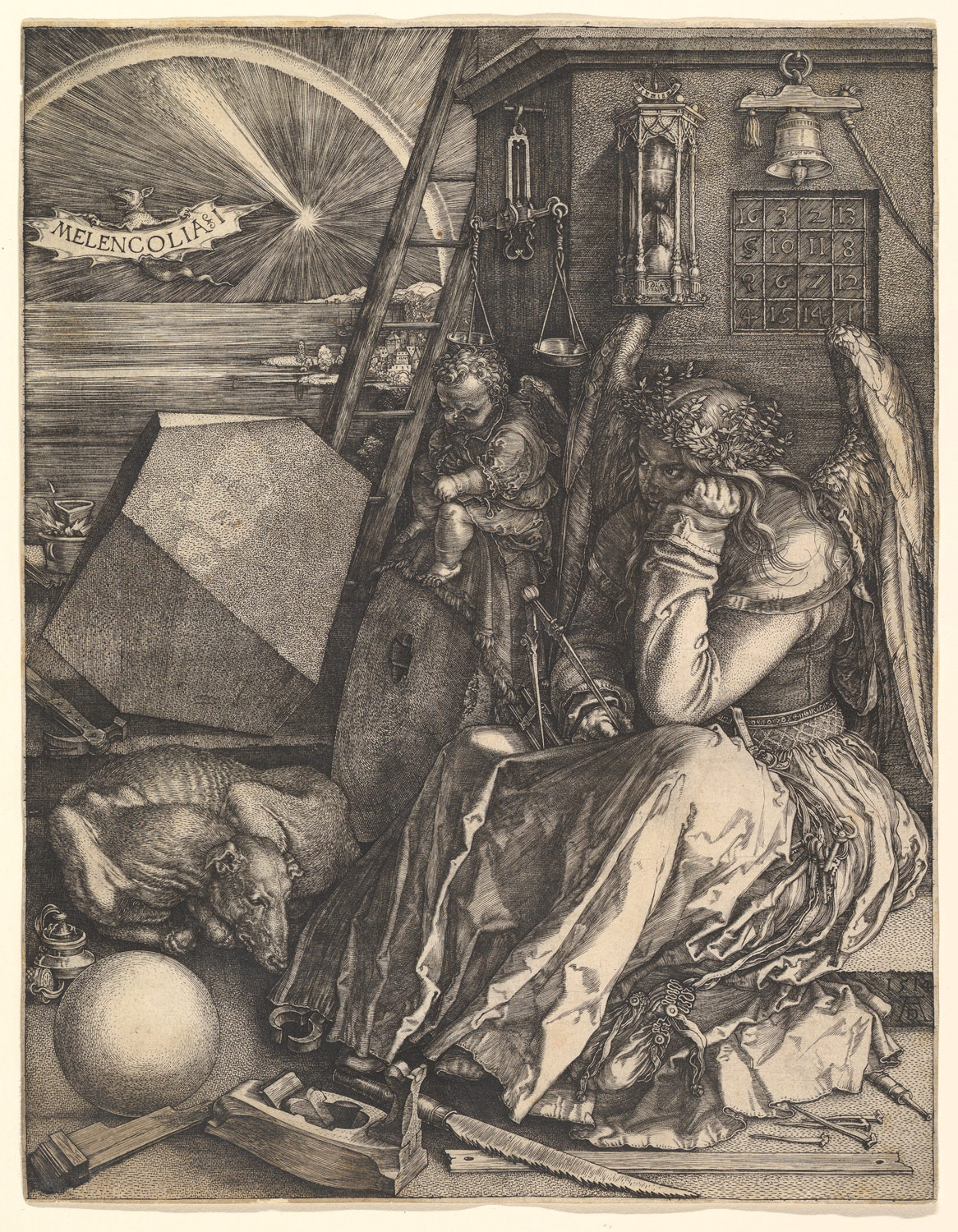
Albrecht Dürer’s Engraving “Melancholia I”

I have written before of my admiration for Albrecht Dürer (1471-1528), probably Germany’s greatest artist. Now I am even more certain of my admiration, since I discovered that he is of Hungarian descent—his father was a goldsmith named Albrecht Ajtósi.

Slowly poring through Will Durant’s The Reformation: A History of European Civilization from Wyclif to Calvin 1300-1564, I hunted up Dürer’s engraving after reading what the author had to say about it:

Finally the engraving that Dürer entitled Melancholia I reveals an angel seated amid the chaos of an unfinished building, with a medley of tools and scientific instruments at her feet; a purse and keys attached to her girdle as emblems of wealth and power; her head resting pensively on one hand, her eyes gazing half in wonder, half in terror, about her. Is she asking to what end all this labor, this building and demolition and building, this pursuit of wealth and power and the mirage called truth, this glory of science and Babel of intellect vainly fighting inevitable death? Can it be that Dürer, at the very outset of the modern age, understood the problem faced by triumphant science, of progressive means abused by unchanging ends?

It is by far the greatest work of art on the theme of being stumped. I find it interesting that the angel is female, no doubt wondering what men have come up with this time.


“An Instant of Artistic Grace”

Van Cliburn on the Cover of Time Magazine on May 19, 1958

Some artistic careers blaze brightly like meteors before being snuffed out, leaving nothing behind but a crater. Such was the short but brilliant musical career of Van Cliburn who went to Russia at the height of the Cold War, and performed in the Great Hall of the Moscow Conservatory during the first Tchaikovsky International Competition, which he won handily. After getting an eight-minute standing ovation, Van Cliburn reminded Russian pianist Andrei Gavrilov o “som kind of angel.” In The Ivory Trade (1990), Joseph Horowitz wrote:

His lanky six feet four inches, his blue eyes and mop of frizzy blond hair, were recognized everywhere. People hugged and kissed him on the street, calling him “Vanya” and “Vanyushka.” He was showered with flowers and personal mementos. Women wept when he played, and students shouted “First prize!” Outside the conservatory, militiamen were used to maintain order. His pandemonious victory, announced April 14, confirmed the popular verdict of days before. The Cliburn furor was of unprecedented, unrepeatable, incomprehensible proportions.

Van Cliburn in Moscow. Note the Roses Strewn Across the Stage.

And then what? Cliburn went back to Texas to live with his mother, performing occasionally—but with considerably less éclat. After the ticker-tape parade through Manhattan, and a few concerts with diminishing returns, that was just about it.

What his fans did not, could not know at that time, was that Cliburn was gay. Had that become publicly known, he would have been reviled by the same public that seemingly adored him. It is such a pity. Today, his sexual preference would be met with a shrug (though perhaps not in Russia). In 1998, he suffered the indignity of being sued by his long-time domestic partner, mortician Thomas Zaremba, for palimony. The case was thrown out of court as palimony is not recognized by the State of Texas, He died in 2013 in Texas at the age of 78, years after his last successful concert.

Stuart Isacoff, in his book When the World Stopped to Listen: Van Cliburn’s Cold War Triumph and Its Aftermath calls his Moscow concert “perhaps the best concert of his life … an instant of artistic grace.”

Facing South

Skeletoid Academics?

Dartmouth College was the beginning of many things in my life. One of the most influential was the Reserve Room on the ground floor of Dartmouth’s Baker Library. On three sides was a magnificent sequence of frescoes by José Clemente Orozco (1883-1949) which began with the invasion of Mexico by the Conquistadores and ended up with the mess that Mexico was in during the 1930s. One of the most shocking images was the one above of the skeletoid academics giving birth to a baby skeleton.

These frescoes influenced me so much that I would study or even just hang out in the Reserve Room just to imbibe the atmosphere of Orozco’s powerful political murals. It was no accident that the first vacation I took on my own, nine years after my graduation, was a visit to Mayan ruins in Yucatán. Over the next seventeen years, I was to go to Mexico eight times, spending as much as a month on each visit.

José Clemente Orozco

During those visits, my eyes turned further south. I would have loved to go from Yucatán to Belize and on to the Mayan ruins at Tikal in the Petén region of Guatemala. At that time, however, the man in charge was Efraín Ríos Montt, a murderous dog who was responsible for the massacre, rape, and torture of thousands of indigenous people; and the U.S. State Department did not recommend that Americans vacation in Guatemala during his presidency.

Around then, Paul Theroux published The Old Patagonian Express (1979), about taking trains from Boston as far south in the Americas as one could go. I vowed that I would eventually make it to South America, and I did. Since 2006, I visited Argentina (three times!), Uruguay, Chile, Peru, and Ecuador. An despite Mexico’s continuing problem with narcotraficantes, I would not mind going to Yucatán and Chiapas again.


Of Billionaires and Fashion Models

Orazio Gentileschi (Italian, 1563 – 1639)
Danaë and the Shower of Gold, 1621 to 1623, Oil on canvas
161.5 × 227.1 cm (63 9/16 × 89 7/16 in.)
The J. Paul Getty Museum, Los Angeles

You may have heard about how Zeus would fall in love with mortal women and transform himself into various disguises to have his way with them. In all, there were approximately twenty, ranging from Alcmene to Thyia. The one I found most interesting was Danaë, daughter and onlyc hild of the King of Argos, Acrisius. The story is as follows, according to Wikipedia:

Disappointed by his lack of male heirs, King Acrisius asked the oracle of Delphi if this would change. The oracle announced to him that he would never have a son, but his daughter would, and that he would be killed by his daughter’s son. At the time, Danae was childless and, meaning to keep her so, King Acrisius shut her up in a bronze chamber to be constructed under the court of his palace (other versions say she was imprisoned in a tall brass tower with a single richly adorned chamber, but with no doors or windows, just a sky-light as the source of light and air). She was buried in this tomb, never to see the light again. However, Zeus, the king of the gods, desired her, and came to her in the form of golden rain which streamed in through the roof of the subterranean chamber and down into her womb. Soon after, their child Perseus was born.

But then, isn’t that the way that all ugly billionaires woo fashion models (including our current President)?

The painting by Orazio Gentileschi is a recent acquisition of the Getty Center which I saw a couple of weeks ago. I like the way that the gold is shown as a shower of gold coins, which appears to be quite acceptable to the young lady.