“The Pinnacle of 20th Century Art and Design”

A Museum Dedicated to the Art of the French Automobile 1900-1940

A Museum Dedicated to the Art of the French Automobile 1900-1939

Oxnard, California, is blessed with two world-class automobile museums less than a mile from each other. Martine and I had visited the Murphy Auto Museum twice so far this year. It was a little more difficult to visit the Mullin Automotive Museum, mainly because it is open for tours only twice a month by reservation only.

The Mullin Automotive Museum was founded by Peter W. Mullin, an American businessman and philanthropist, who, early on, fell in love with French autos, particularly the Bugatti (which was 100% French despite the Bugatti family’s Italian origins).

Bugatti Hood Ornament

Bugatti Hood Ornament and Grill

The cars at the museum were a revelation. According to the museum’s founder:

For me the French automobiles of the 1920s and 1930s represent the pinnacle of 20th century art and design—the artistic realization in steel, leather, and glass of a modern idea created at a moment when hand craftsmanship embraced the machine, and a spirit of optimism fueled an explosion in artistic and technical development. As an avid collector, the preservation of these rolling sculptures for the enjoyment of future generations is both a responsibility and a pleasure. I relish the stewardship and preservation of their exciting histories.

Surrounding the automobiles along the outer walls is a world class exhibit of art nouveau and art deco works, including paintings, sculptures, and furniture—to to mention some of the neatest hood ornaments I’ve ever seen.

Flying Hood Ornament

Flying Hood Ornament

I was so impressed not only with the cars and the artwork that I plan on doing one or more follow-up blogs. Martine and I showed up at opening time (10 AM) and had to be ushered out at closing time (3 PM). We plan on returning in a number of months, when they have changed their exhibits.

Below is view of the exhibit floor, which is designed to resemble the original Paris automobile salons of the early 20th century, complete with signs indicating the major “exhibitors.”

The Exhibit Floor

The Exhibit Floor


To avoid getting stuck in beach traffic, we returned home via California 126, stopping at Cornejo Produce in Fillmore for some fresh locally-gown produce.


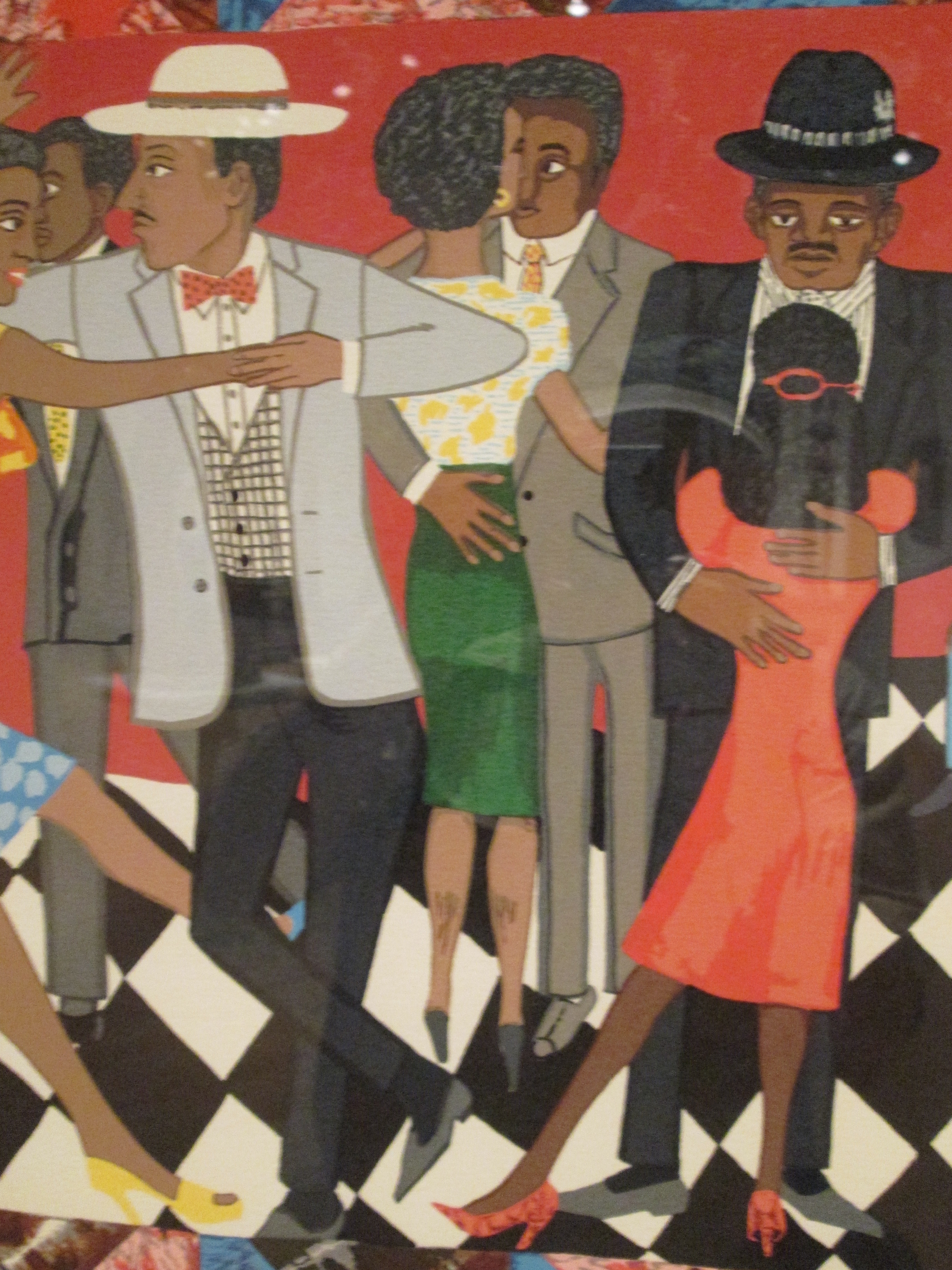
Groovin’ at CAAM

Detail from Faith Ringgold’s Groovin’

Detail from Faith Ringgold’s “Groovin’”

The opening of the Expo Line from Santa Monica to Downtown Los Angeles has opened up a whole new world for me. Once or twice a week, I take the train downtown and explore the ethnic richness of the city center. Today, I went to the California African American Museum (CAAM) in Exposition Park.

I have always felt that African Americans have made an outsize contribution to our culture, especially in music, entertainment, and literature. CAAM gave me the opportunity to see a number of highly original artworks that are not “normally” seen by white people.

There are four galleries at CAAM, two large ones for the permanent collection and two smaller ones for rotating exhibits.

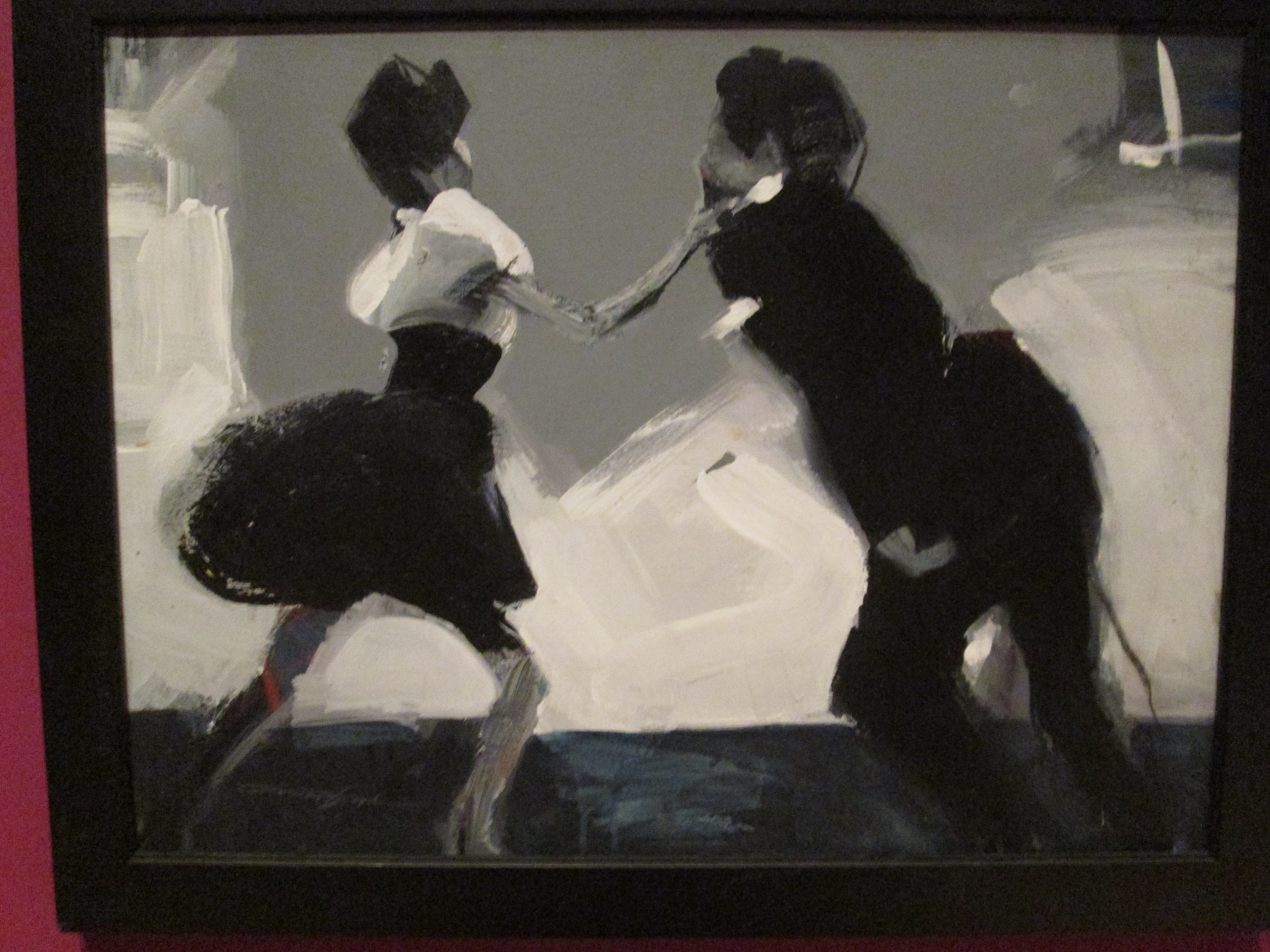
Dancers by Overton Loyd

Dancers by Overton Loyd

The rotating exhibits on view at present in the two smaller galleries are a retrospective of the works of Overton Loyd and an exhibition of hip hop photography by various artists.

Why did I choose two works showing dancers? It’s not that the exhibit was slanted toward them, but that I was drawn to them. Both paintings are intense, with the Ringgold’s slow rhythms and the abstract dynamism of the Loyd.

Although I profess not to live most modern art, there is something about the black artists who have struggled in obscurity to create beauty and meaning that appeals to me. I hope to check in at CAAM every once in a while to see what’s on exhibit.

Frida Kahlo: “A Ribbon Around a Bomb”

Frida Kahlo Self Portrait

Frida Kahlo Self Portrait

In all of the New World, there was never so beguiling and striking a painter as Frida Kahlo. Today is her birthday. If she were alive today, she would be 109 years old. But, alas, she died in pain at the age of 47.

At the age of 6, Frida came down with polio. For the rest of her life, her right leg would be thinner than her left—a fact she disguised by wearing only pants or long dresses. At the age of 18, she was in a bus accident in which she suffered, according to Wikipedia, “a broken spinal column, a broken collarbone, broken ribs, eleven fractures in her right leg, a crushed and dislocated right foot, and a dislocated shoulder.” Also she was able to walk again, she suffered excruciating pain, had multiple surgeries, and became a world-famous painter.

She married the painter Diego Rivera, had numerous affairs, including with Leon Trotsky, and was, despite her health issues, beautiful and proud. Of her, André Breton said of her art that it was “a ribbon around a bomb.”

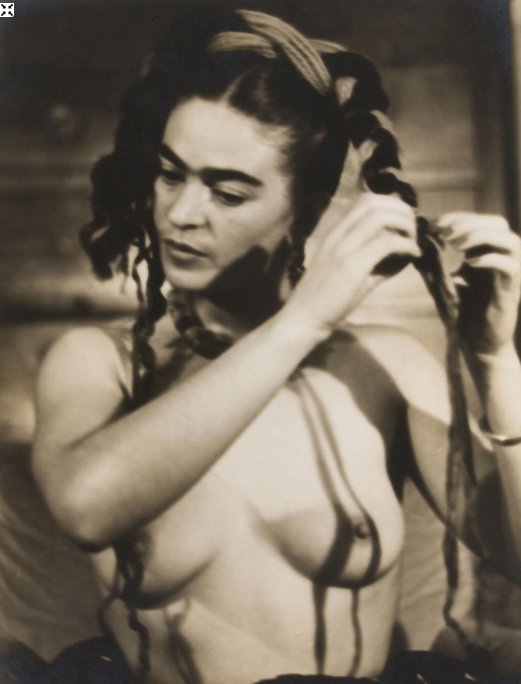
Nude Portrait of Frida Kahlo by Julien Levy

Nude Portrait of Frida Kahlo by Julian Levy

In the end, after she died, Frida’s fame only grew, such that her work is more recognized today than that of any of her contemporaries. If ever I should return to Mexico City, I would like to visit the Casa Azul, the Blue House, in Coyoacán, where she was born and where she died. Today it is a museum dedicated to her life and work.

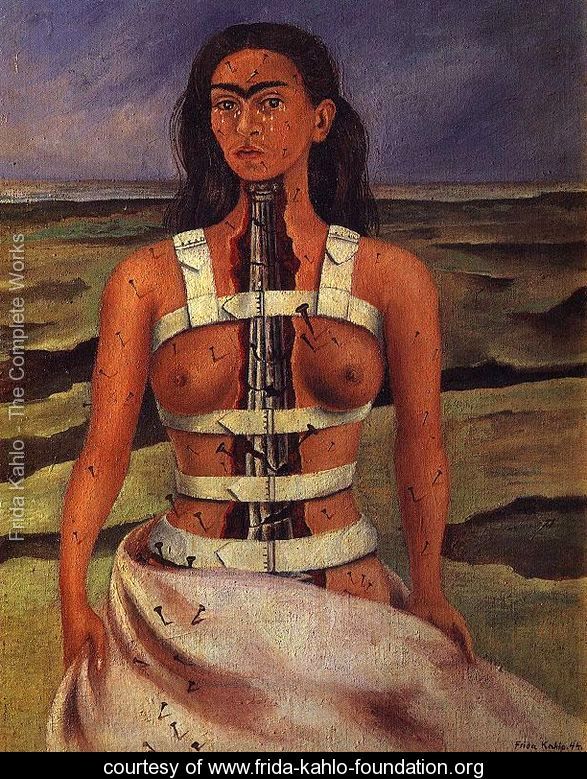
Frida’s Self Portrait with Broken Column

Frida’s Self Portrait with Broken Column and Nails


Asked why she appears as the subject of so many of her paintings, the artist said “I paint myself because I am so often alone and because I am the subject I know best.”

Lions and Bulls, Oh My!

A Frequent Theme in Roman Mosaic Art?

A Frequent Theme in Roman Mosaic Art?

At our visit to the Getty Villa on Wednesday, I was surprised to see so many works depicting lions eating other large, powerful beasts. There was a special exhibit entitled “Roman Mosaics Across the Empire.” (Follow the link and you will see a lion biting into a surprisingly nonchalant horse.) The image that caught my eye, however, was the one above, in which a lion is chasing what looks like a Brahma bull.

Roman mosaics can be stunningly beautiful. I remember a show at the Los Angeles County Museum of Art years ago which included various objects retrieved from the ruins at Pompeii and Herculaneum. The mosaics in this exhibit, taken from the Naples Museum of Archaeology, were particularly beautiful—probably because the Romans during that period were more advanced in their art than those of the later Empire, from which most of the works in this special exhibit were drawn.

There were numerous lions, particularly in funerary monuments. Although I do not recall reading anything about lions during Roman times, I am surprised that they appear prominently in so many mosaics and pieces of statuary.

A Pot To Piss In

Greek Reveler Draining His Lizard

Just because they wore togas and spoke Classical Greek, that doesn’t mean that the ancient Greeks were all that high and mighty. One of the more amusing exhibits at the Getty Villa that Martine and I saw yesterday afternoon illustrated a different and more down to earth use for an amphora.

A bibulous reveler is shown urinating into the amphora (or, more technically, a chous) held up by his slave boy while continuing to declaim his sodden oration.

The closer one gets to the ancient Greeks and Romans, the more we see people very much like ourselves. The conditions of their lives were radically different, but they were recognizably human in he same way we are. Read the letters of Cicero or Pliny the Younger and you will enter a whole new world peopled with recognizable characters.


Ocean Park

In His Case, I’ll Make an Exception

In His Case, I’ll Make an Exception

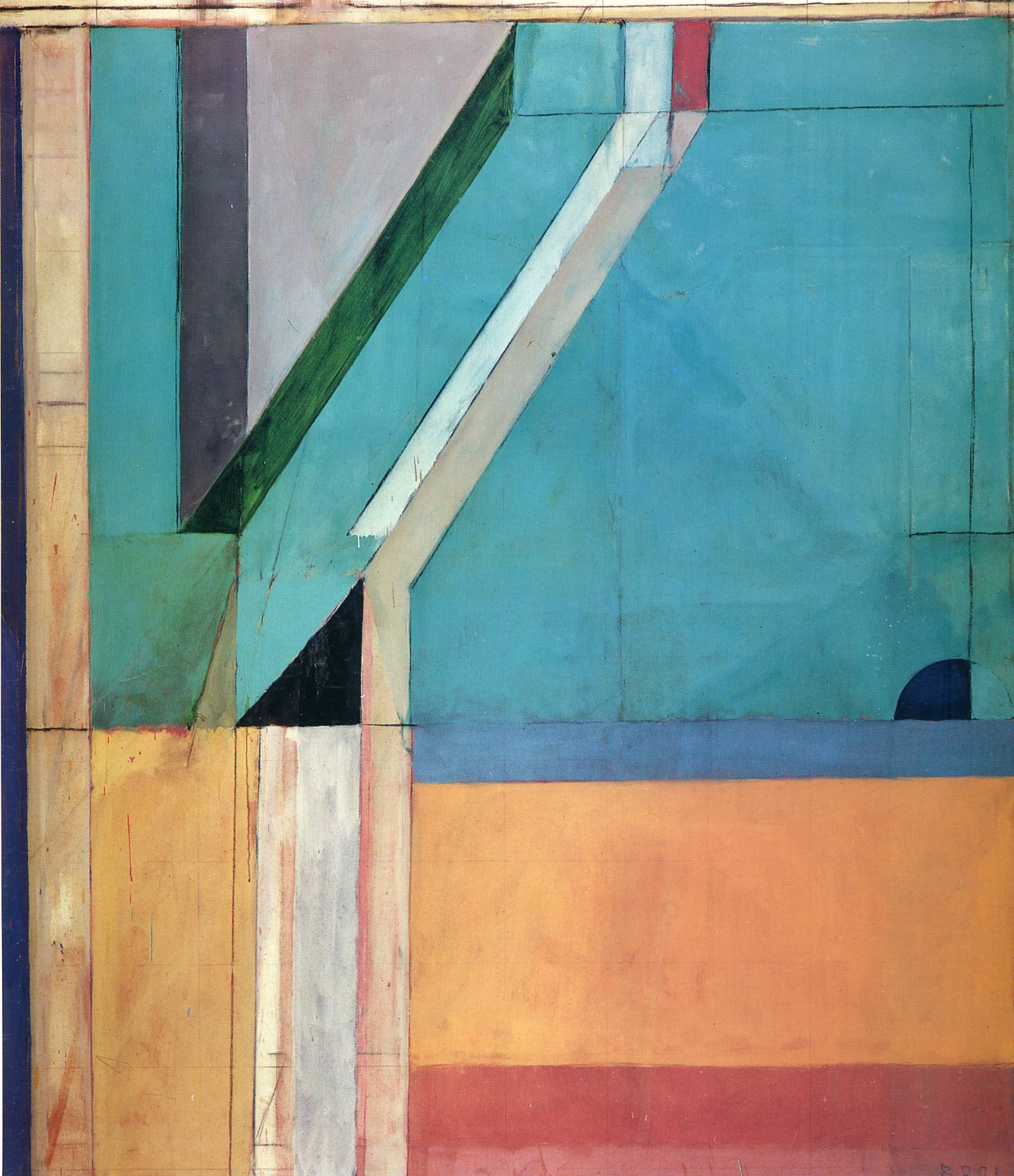
It was my friend Lynette who opened my eyes to the “Ocean Park” series of abstract paintings by Richard Diebenkorn (1922-1993). Ordinarily, I dislike nonrepresentational art; but in Diebenkorn’s case, I’ll make an exception. He moved in Los Angeles around the same time I did, and I found his choice of colors reminded me of the Santa Monica neighborhood after which this series is named.

Usually, colors alone do not mean much to me. In the case of Mark Rothko, for example, they mean less than nothing. In “Ocean Park #40” above, I could probably find something like that particular pattern somewhere along Ocean Park Boulevard.


Ocean Park #105

Ocean Park #105

The same goes for “Ocean Park #105” above.

I wonder, if the color scheme of an abstract painting suggests something to me, can it really be said to be abstract at all?

Thomas Bewick and His Tail Pieces

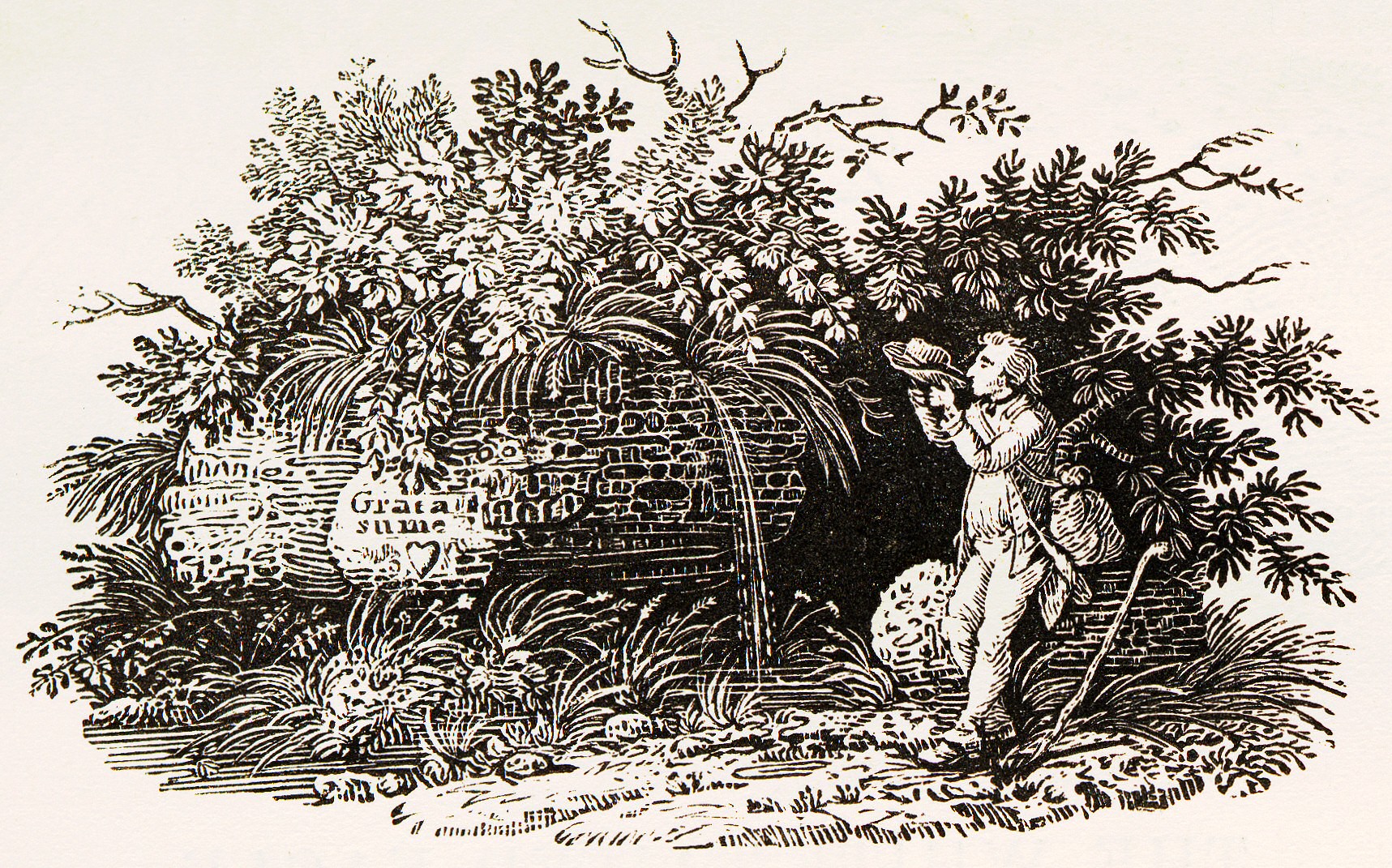
Bewick Depicting Himself as a Traveler Drinking Water from His Hat

Bewick Depicting Himself as a Traveler Drinking Water from His Hat

Thomas Bewick (1753-1828) was one of Britain’s great unsung artists. Known as an engraver and a naturalist (he authored A History of British Birds), he won the admiration of no less than John James Audubon, who visited him in 1827:

As length we reached the dwelling of the Engraver, and I was at once shewn his workshop. There I met the old man, who, coming towards me, welcomed me with a hearty shake of the hand, and for a moment took off a cotton night-cap, somewhat soiled by the smoke of the place. He was a tall stout man, with a large head, and with eyes placed farther apart than those of any man I have evr seen: a perfect old Englishman, full of life, although seventy-four years of age, active and prompt in his labors. Presently, he proposed shewing me the work he was at, and went on with his tools. It was a small vignette, cut on a block of boxwood not more than than three by two inches in surface, and represented a dog frightened at night by what he fancied to be living objects, but were actually roots and branches of trees, rocks, and other objects bearing the semblance of men. This curious piece of art, like all his works, was exquisite.

The illustration described by Audubon is shown below and constitutes one of the artist’s famous tail-pieces, which were dashed off to fill blank space at the end of a chapter.


The Tail Piece Described by Audubon

The Tail Piece Described by Audubon

This is not to detract from Bewick’s carefully observed engravings of birds and mammals of his native Northumberland. It’s merely to admit that I am not as acute an observer of nature as Bewick was and could not appreciate them as much as other naturalists such as Audubon and Sir Joseph Banks.

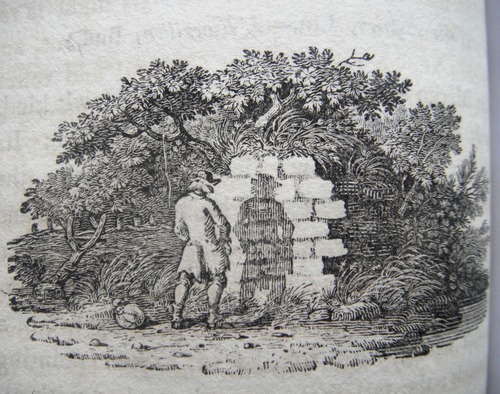
One image that afforded me some amusement was of a traveler urinating on the wall of a Roman ruin:

How Not to Appreciate a Roman Ruin

How Not to Appreciate a Roman Ruin

Note the shadow of the traveler cast on the wall, something one doesn’t usually see on a casual illustration of this sort. But Bewick was always meticulous in his observations.


Serendipity: Documents of the Ultra-Terrain World

“Blue Harbor” by Xul Solar

“Blue Harbor” by Xul Solar

While in Buenos Aires last month, I visited the museum of painter Xul Solar, friend of Jorge Luis Borges. It was Borges who wrote the prologue to the museum’s catalog, which is reproduced here in its entirety:

Man versed in all disciplines, curious of all enigmas, father of writings, languages, utopias, mythologies, guest of hell and heavens, chessplayer author and astrologist, perfect in indulgent irony and friendly generosity, Xul Solar is one of the most outstanding events of our epoch. There are minds which profess the truth, others indiscriminate abundance: the large creativity of Xul Solar does not exclude the strict honesty. His paintings are documents of ultra-terrain world, of metaphysical world in which gods take the form of the imagination of the ones dreaming. The passionate architecture, the happy colours, the many circumstantial details, the labyrinths, the dwarves and angels unforgettably define this delicate and monumental art.

The taste of our time vacillates between the more lineal preference, the emotive transcription and the realism of wall painters: Xul Solar renews, in his ambitious way of being modest, the mystic painting of the ones who do not see with physical eyes in the sacred world of Blake, Swedenborg, yogis and bards.


Posada’s Mexico

Posada’s Assault of the Zapatistas

Posada’s Attack of the Zapatistas

José Guadalupe Posada was born in Aguascalientes, Mexico, in 1852.During the Mexican Revolution. By the time of the Mexican Revolution, of which the above engraving shows a scene, he was poor despite his immense talent as a folk artist. He died in 1913, but not before having influenced the great muralist José Clemente Orozco. It was Orozco’s frescoes in the Reserve Room of Dartmouth College’s Baker Library that influenced me in my own visual tastes.

Posada’s Cyclists

Posada’s Cyclists

Posada is probably best known for his calaveras, images of skeletons savagely satirizing life under Mexican dictator Porfirio Diaz. Not surprisingly, most of these cavorting skeletons have become associated with the Mexican Day of the Dead, or All Souls’ Day, on November 2. On this day, families have picnics by the graves of their loved ones who have passed on.

I thought Posada would be a good artist for Halloween as well.


The New Realism

Carmen Miranda

Carmen Miranda

This is a continuation of my occasional series on Argentinian painters. Today, I am presenting three paintings by Delesio Antonio Berni (1905-1981), who is known for his Nuevo Realismo, or new realism. This is usually taken to mean a Latin American form of social realism.

Below are two paintings dealing with poverty and the effects of industrialization in Argentina. Juan Perón came into power in the 1940s largely because of his appeal to workers. He was greatly aided in this by his then wife Evita Perón.

Public Demonstration

Manifestacion (Public Demonstration) (1934)

Note the sign at the upper right of this haunting image that reads “Pan y Trabajo,” which translates as “Bread and Work.” The faces in the foreground are particularly interesting.

There was a time when Argentina and Uruguay were two of the richest countries in the world. Much of this had to do with the invention of canned meat, followed soon after by the First World War, when there was a huge demand for meat to provision the troops of both sides. Sadly, boom times do not always last.

Desocupados

Desocupados (The Unemployed) (1934)

The above painting shows unemployed workers either asleep or staring into the middle distance.

When I go to Buenos Aires next month, I hope to find some of his original paintings, perhaps at MALBA (Museo d’Arte Latinoamericano de Buenos Aires).