Desert X 2025

Sculpture “The Living Pyramid” by Dénes Ágnes

I returned today from a long weekend visiting my brother Dan in the Coachella Valley. Saturday began on a dubious note: We visited an installation of the Desert X 2025 art show at Summerlands in Rancho Mirage. Since the artist was the Hungarian-born Dénes Ágnes, we expected great things, being self-professed Hungarians ourselves.

What we saw was a plywood pyramid painted white, planted with native desert plants, that is on view at Summerlands until May 11, 2025. Ah, well, I guess not all Hungarian art works are great.

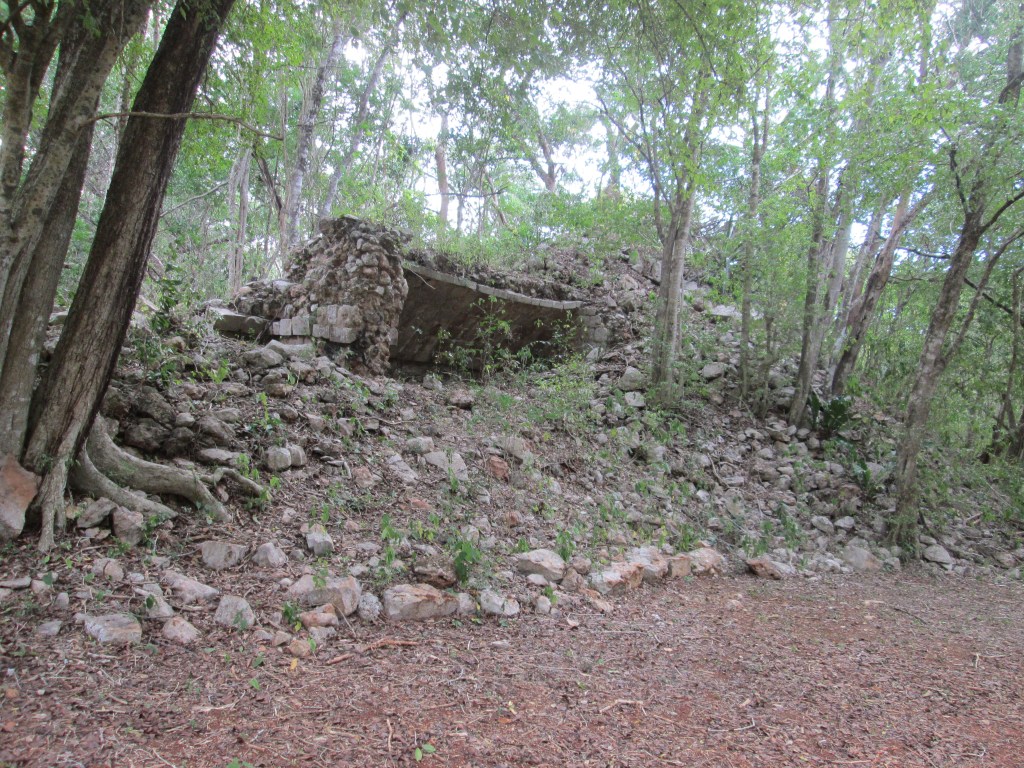
I was reminded of Maya pyramids in Yucatán that were not rebuilt by archeologists, such as this pyramid I photographed at Sayil in the Puuc Highlands in January 2020:

Maya Pyramid at Sayil

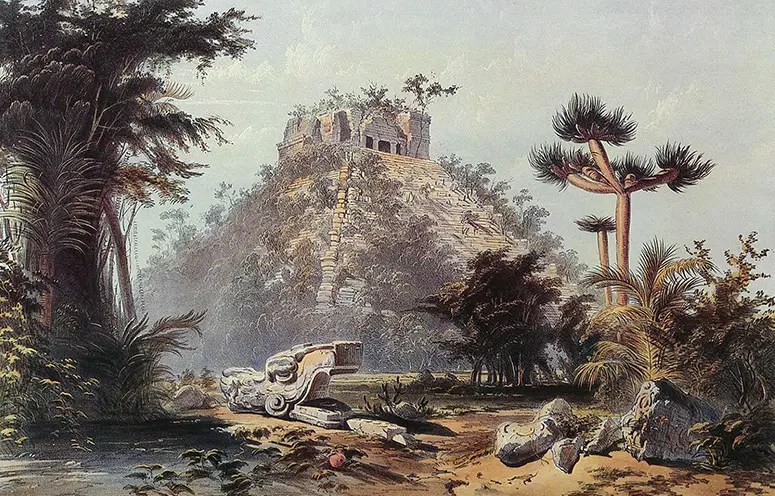
Another point of comparison is one of English artist Frederick Catherwood’s engravings in the 1841 classic by John Lloyd Stephens, Incidents of Travel in Central America, Chiapas and Yucatán:

The Castillo at Chichén Itzá Engraved by Frederick Catherwood

I guess I’m too much in love with the impressive Maya ruins in Mexico and Central America to accept Dénes’s “The Living Pyramid” with anything other than a shrug. Nice try, but no cigar.

Picturesque

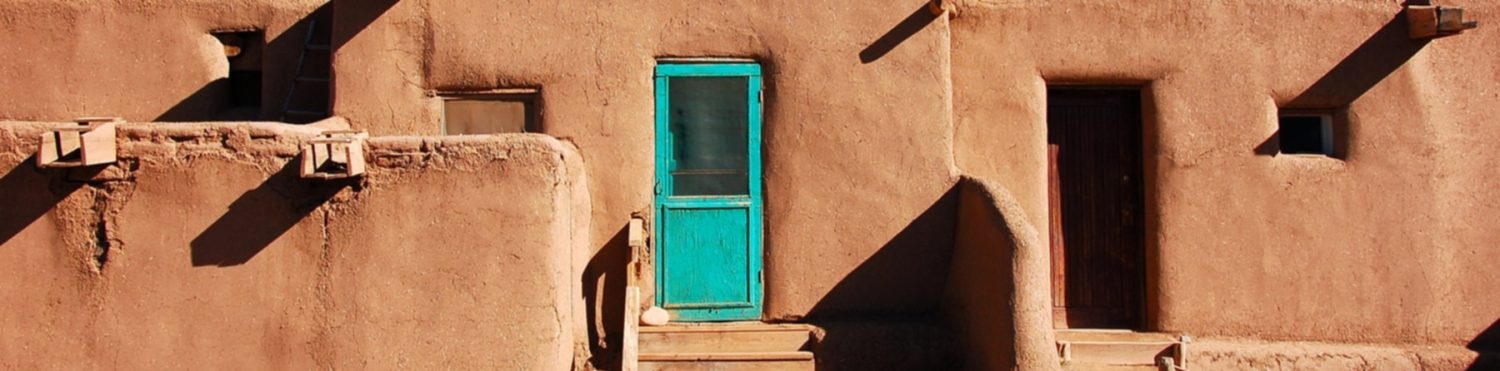
Porcelain Tiles Decorate the Outer Wall of a Hungarian Building

In 1853, a Hungarian businessman named Miklós Zsolnay founded the Zsolnay (ZHOAL-nah-ee) Porcelánmanufaktúra Zrt (Zsolnay Porcelain Manufactory Private Limited) in the town of Pécs near the border with what is now Croatia.

Before long, the products of his factory started turning up in the most interesting places, such as the roof of the Matthias Church in Budapest’s Castle District:

Not to mention interestingly designed and wildly colored porcelain vases and figurines:

In a way, one can’t go to Hungary without encountering the works of the Zsolnay Manufactory. Their work has become one of the most characteristic looks in Hungarian architecture, furnishings, and knickknacks.

The Art of Mihaly Munkácsy

Mihály Munkácsy’s “The Cell of the Condemned”

This is the first of several posts I will write about famous Hungarian painters. IO begin with Mihály Munkácsy (1844-1900), known primarily for his genre paintings and Biblical scenes. Although of Bavarian origin, he changed his name to reflect the town of his birth: Munkács. He traveled extensively in Europe and worked with a number of well-known artists of the time.

According to Andrienn Szentesi, writing in The Essential Guide to Being Hungarian, edited by István Bori:

Mihály Munkácsy’s first masterpiece was Siralomház (Cell of the Condemned). Fifteen human figures can be seen in this painting, people to whom, it is safe to presume, something terrible has just happened. Dark hues, not least various shades of brown and black, have the run of this painting, too; and of course this serves to reinforce the work’s depressing theme. Also discernible, however, is just ba bit of white and red; for example, a little girl calls attention to herself as she stands in a corner in a red skirt. What has she just been through? What fate awaits her?

Mihály Munkácsy’s “Paris Interior”

Somewhat lighter is Munkácsy’s Paris Interior (above). A young woman sits reading while a small child plays on the floor behind her.

Mihály Munkácsy’s “Christ Before Pilate” (1882)

Above is one of three Biblical subjects painted in a series that also included Golgotha and Ecce Homo.

Munkácsy dies in a Bonn mental hospital in 1900. As the Wikipedia article on him says, “Neither 19th century visual art nor the historical developments of Hungarian art can be discussed without considering Munkácsy’s contributions. His works are considered the apogee of national painting. He was a standard-setter, an oeuvre of reference value.”

Kigumi

The Art and Tradition of Japanese Carpentry

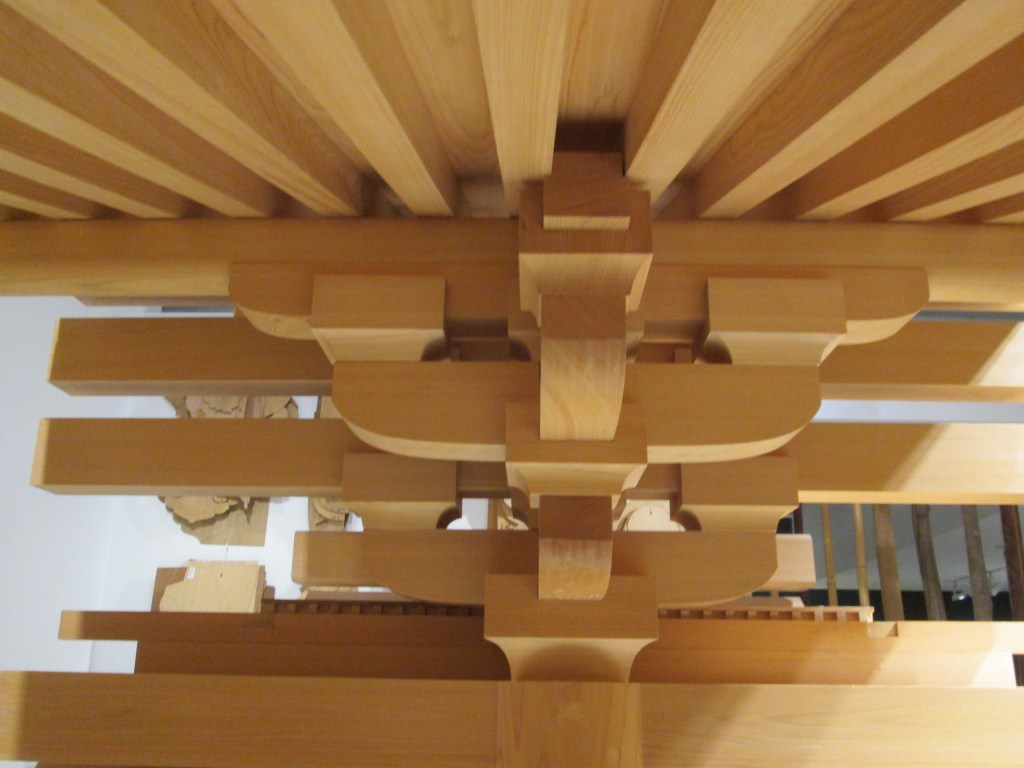
Today, I met my brother at the Japan House in Hollywood. He drove in from Palm Desert, where he is a builder whose specialty over the years has been working with wood. On display at the Japan House through January 22, 2025 is an exhibit entitled “Masters of Carpentry: Melding Forest, Skill and Spirit.” It was an awesome display of the beauty and intricate detail that is the art of Japanese carpentry.

According to the handout describing the exhibit:

The exhibit is structured around 5 pillars of daiku [Japanese woodworking masters] culture: a reverence for nature and the Japanese forest, the master carpenters’ refined tools, the practice of dōmiya daiku—the temple and shrine carpenters, kigumi— the strength and beauty of Japanese joinery, and the work of the sukiya daiku—the skillful carpenters employing natural materials to detail and finish teahouses.

What impressed me the most were the exhibits of the intricate joinery linking the boards, posts, and beams using careful measurement and relying as little as possible on nails and other iron and steel fasteners. The result is aesthetically pleasing and built to last. And because it is carefully selected from a large variety of native woods, it even smells beautiful.

According to the exhibit, the islands that constitute Japan are 67% forested. Even such exotic woods as persimmon fruit trees are used because of the striated grain of the wood.

Intricate and Ultimately Pleasing

Although, unlike my brother, I have no skill in woodworking, I quickly became aware that this was high art and a labor of love. This is an exhibit with broad appeal to anyone with an artistic frame of mind. The two hours we spent at the Japan House Masters of Carpentry Exhibit was well worth it.

Japan House Los Angeles
Gallery Level 2
6801 Hollywood Blvd
Los Angeles, CA 90028

https://www.japanhousela.com/

The Etruscan Smile

A Smile That Shines Across Millennia

Here’s a post from ten years ago this month. I’ve always meant to read up on the Etruscans, as I admire what I know of their view of life—even though I’m not known for smiling.

The whole world of the smiling girl in he above photo is long gone, but her smile still speaks to us. It tells us that, even in Ancient Rome, there was something to laugh about. When I took the picture on Friday, I did not note the provenance of the figurine, but I wonder if it was Etruscan. This ancient people is the only one that has allowed itself to be depicted as wreathed in smiles—very contrary to the picture we have of the dour Romans.

Below is a hollow funerary urn from the Banditaccia Necropolis showing a married couple, whose ashes are presumably commingled therein:

I guess my little figurine is not Etruscan.Their images always show them as having sharp features and almond eyes. The girl above is definitely Roman.

Not to change the subject, but it reminds me somewhat of the following poem by Robert Browning:

My Last Duchess

That’s my last Duchess painted on the wall,
Looking as if she were alive. I call
That piece a wonder, now: Frà Pandolf’s hands
Worked busily a day, and there she stands.
Will ‘t please you sit and look at her? I said
‘Frà Pandolf’ by design, for never read
Strangers like you that pictured countenance,
The depth and passion of its earnest glance,
But to myself they turned (since none puts by
The curtain I have drawn for you, but I)
And seemed as they would ask me, if they durst,
How such a glance came there; so, not the first
Are you to turn and ask thus. Sir, ‘t was not
Her husband’s presence only, called that spot
Of joy into the Duchess’ cheek: perhaps
Frà Pandolf chanced to say, ‘Her mantle laps
Over my lady’s wrist too much,’ or ‘Paint
Must never hope to reproduce the faint
Half-flush that dies along her throat:’ such stuff
Was courtesy, she thought, and cause enough
For calling up that spot of joy. She had
A heart—how shall I say?—too soon made glad,
Too easily impressed; she liked whate’er
She looked on, and her looks went everywhere.
Sir, ‘t was all one! My favour at her breast,
The dropping of the daylight in the West,
The bough of cherries some officious fool
Broke in the orchard for her, the white mule
She rode with round the terrace—all and each
Would draw from her alike the approving speech,
Or blush, at least. She thanked men,—good! but thanked
Somehow—I know not how—as if she ranked
My gift of a nine-hundred-years-old name
With anybody’s gift. Who’d stoop to blame
This sort of trifling? Even had you skill
In speech—(which I have not)—to make your will
Quite clear to such an one, and say, ‘Just this
Or that in you disgusts me; here you miss,
Or there exceed the mark’—and if she let
Herself be lessened so, nor plainly set
Her wits to yours, forsooth, and made excuse,
—E’en then would be some stooping; and I choose
Never to stoop. Oh, sir, she smiled, no doubt,
Whene’er I passed her; but who passed without
Much the same smile? This grew; I gave commands;
Then all smiles stopped together. There she stands
As if alive. Will ‘t please you rise? We’ll meet
The company below then. I repeat,
The Count your master’s known munificence
Is ample warrant that no just pretence
Of mine for dowry will be disallowed;
Though his fair daughter’s self, as I avowed
At starting, is my object. Nay, we’ll go
Together down, sir. Notice Neptune, though,
Taming a sea-horse, thought a rarity,
Which Claus of Innsbruck cast in bronze for me!

That line about “all smiles stopped together” is grimly humorous.

Assemblée dans un parc

Watteau de Lille (Louis-Joseph Watteau, dit). “Assemblée dans un parc”. Huile sur toile, vers 1785. Paris, musée Cognacq-Jay.

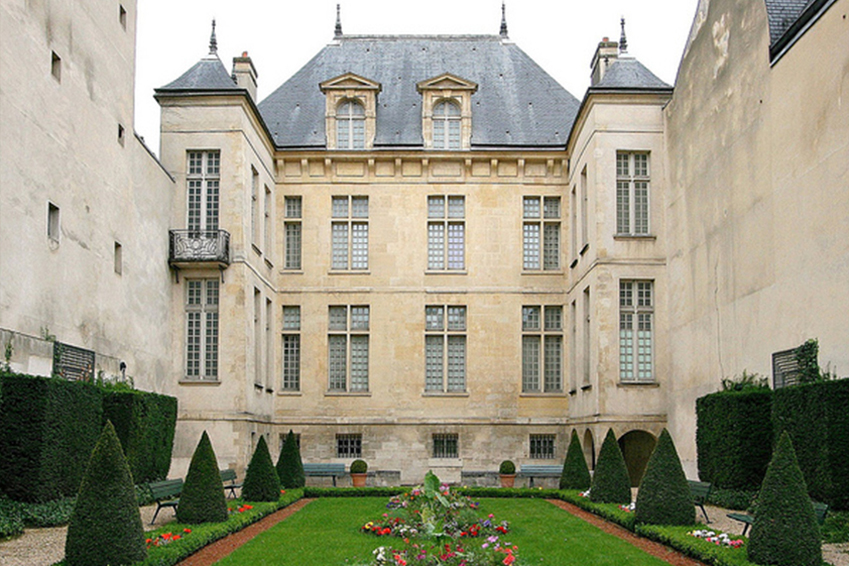
I have always loved the paintings of Jean-Antoine Watteau (aka Watteau de Lille and Louis-Joseph Watteau). There is a kind of sad elegance in them, frequently in a beautiful natural setting. I saw the above painting at a small art museum in Paris that is little visited. The Musée Cognacq-Jay is dedicated to the art of the 18th Century and features, besides Watteau, such painters as Boucher, Fragonard, Greuze, Chardin, Tiepolo, and Robert.

Most of the works therein were acquired between 1900 and 1927 by Ernest Cognacq, founder of the Samaritaine department store, and his wife Marie-Louise Jay. The building the collection sits in is an elegant structure redolent of the 18th century. Situated at 8 rue Elzévir, it is close to the Marais District of Paris.

Musée Cognacq-Jay

If you love art, I have no doubt you would find the Cognacq-Jay more interesting than the nearby Picasso Museum or the Pompidou Center. Unless, of course, you are a big fan of modern art, which I am not.

Beyond the Master Forger’s Ability

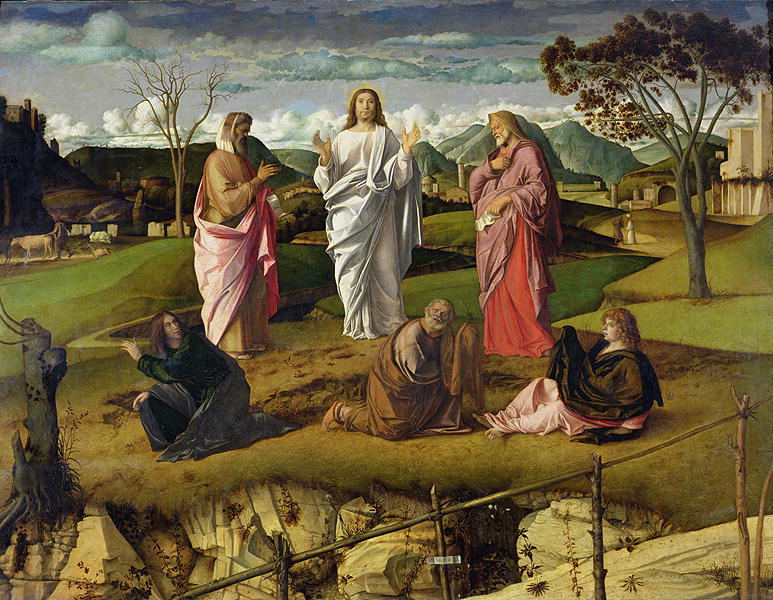
Giovanni Bellini’s “The Transfiguration” (1480)

This is a repost from ten years ago today: August 4, 2014.

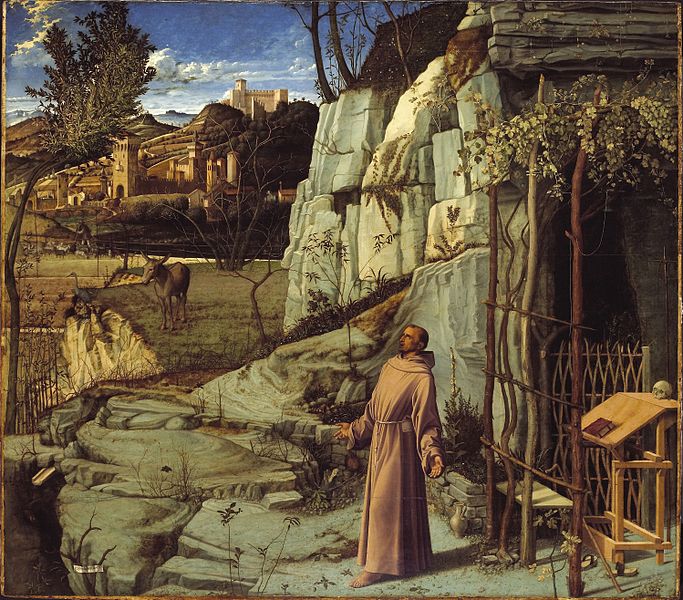
Yesterday, I was drawn to the television by a segment on “Sixty Minutes” about the noted German art forger, Wolfgang Beltracchi. When Bob Simon of CBS asked him what painters he couldn’t forge, Beltracchi, without hesitation, answered Bellini. I took him to mean Giovanni Bellini (1430-1516) and not his brother Gentile (they were both brothers-in-law of the great Andrea Mantegna). The only time I remember ever seeing or original Giovanni Bellini was at the Frick Collection in New York City, which has a superb “St. Francis in Ecstasy” also painted in 1480. I have included an image below.

There is such an incredible sense of detail in a Bellini oil that I feel as if I could pick a background segment (say 1/64th of the total) and enlarge it to full size without losing anything. And the detail would be almost as fascinating as the foreground. Look at that fence following the upward path in “The Transfiguration” (above), and note the minor variations from post to post. Look at that dead tree at the lower left, or that couple meeting in the upper right near the tree.

I can almost imagine Bellini in an ecstasy such as St. Francis in the painting below.

St. Francis in Ecstasy (1480) at the Frick Collection

An Embarrassment of Riches

Is This the Attic of Western Civilization?

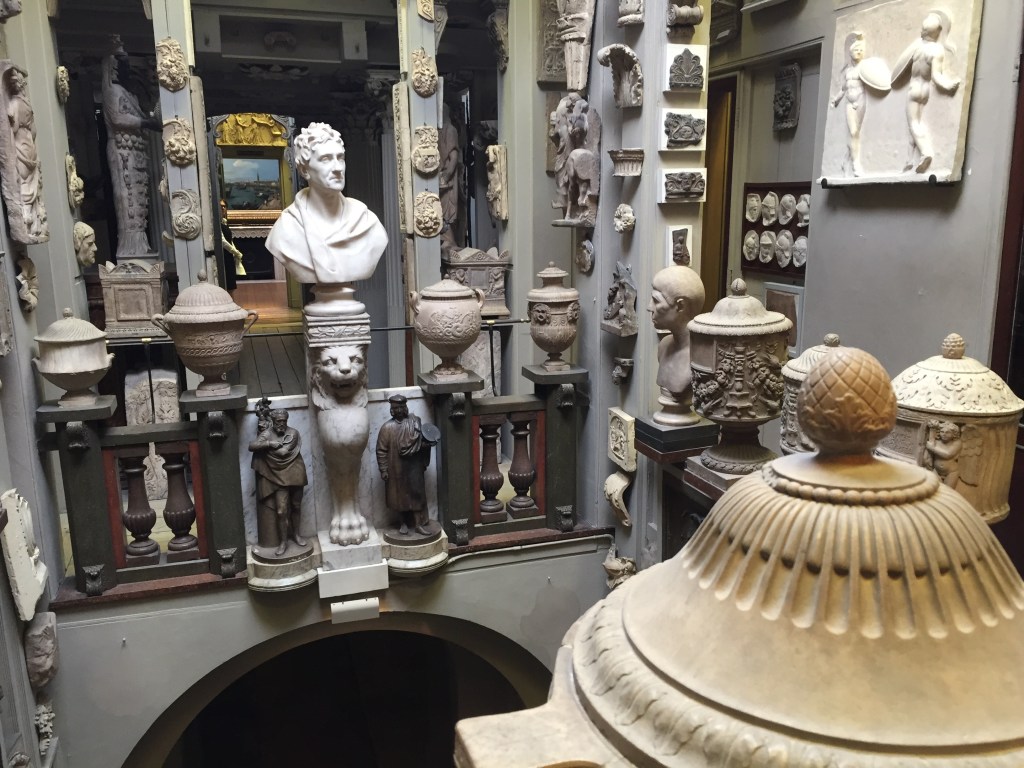
If I were asked to pick my favorite museum, I would have a hard time deciding; but I might very well end up by picking Sir John Soane’s Museum by Lincoln’s Inn Fields in London. Each time I have visited London, I have spent time marveling at the collections represented, whether of Egyptian, Greek, or Roman antiquities or 18th century paintings.

The original Sir John Soane (1753-1837) was the architect who designed the Bank of England, Not the present one, but the old one that was demolished in the 1920s. While I cannot comment on Soane’s skills as an architect, I am nothing short of amazed by Soane the art collector.

Walk through the museum, and it’s as if you were carefully edging your way through an overcrowded attic—except that Soane was no mere hoarder. He is, as it were, at the very pinnacle of a cultivated English artist circa 1800.

Paintings and Sketches Line the Walls from Floor to Ceiling

And I mean English with a vengeance. You would not find anything like this in France. The story of how the museum came to be is archetypally English (quoted from Wikipedia):

The museum was established during Soane’s own lifetime by a private Act of Parliament … in 1833, which took effect on Soane’s death in 1837. The act required that No. 13 [Lincoln’s Inn Fields] be maintained “as nearly as possible” as it was left at the time of Soane’s death, and that has largely been done. The act was necessary because Sir John had a living direct male heir, his son George, with whom he had had a “lifelong feud” due to George’s debts, refusal to engage in a trade, and his marriage, of which Sir John disapproved. He also wrote an “anonymous, defamatory piece for the Sunday papers about Sir John, calling him a cheat, a charlatan and a copyist.”

Oh, you can view the changing of the guards at Buckingham Palace, ride in giant Ferris Wheel in Greenwich, visit the British Museum, but nowhere else could you see the odd genius of a single human being—one who left us a Pisgah view of the 18th century.

Check out the museum’s website if you have a few minutes.

The Little Ice Age in Holland

Skating on the Ice in Holland

One of the exhibits I saw at the Getty Center last week was a collection of drawings depicting cold weather in Holland during the 17th century. According to the Getty website:

In the 17th century, frigid winters and unusually cool summers blanketed northern Europe in what became known as the Little Ice Age. Dutch artists depicted this persistent global cooling in scenes of daily activities like ice skating and fishing. Highlighting human vulnerability and resilience in the face of a changing climate, these works offer opportunities to reflect on our current environmental crises. This exhibition features works by Hendrick Avercamp and other Dutch artists of the 1600s.

It was during this Little Ice Age that the Greenland colony of Scandinavian and Icelandic colonists was abandoned at some point between 1350 and 1400.

Dutchmen Playing Ice Hockey

I have always been fond of Dutch art, and that was only reinforced when Martine and I visited Amsterdam more than twenty years ago. Uniquely, it seems, Dutch painting elevated the humdrum to the level of high art in the works of Vermeer, Rembrandt, Hals, Bosch, and Bruegel.

As I looked at all the drawings of the Dutch enjoying themselves in what looked like wickedly cold weather, I wondered if the global warming that the news media talks about is a permanent feature, or just another of earth’s mysterious centuries-long cycles that we don’t understand. Not that we shouldn’t do everything in our power from making it worse than it is, but it does make one think.

In the Shadow of (Male) Genius

French Sculptor Camille Claudel (1864-1943)

The 19th century was not a good time for a female artist of genius to enter the orbit of an older male genius. Can one ever escape that orbit? The above photo was taken of Camille Claudel at the age of nineteen, when she started working in Auguste Rodin’s sculpture studio.

Now there is no doubt that Rodin was one of the greatest sculptors who ever lived. I visited his museum on the Left Bank of the Seine in Paris over twenty years ago. In fact, there was a whole room dedicated to the work of his young protegée.

But she deserved more. Today, I visited the Getty Center, where there was a traveling exhibit of Camille Claudel’s sculpture. Seen by itself, it was nothing short of amazing.

“The Age of Maturity” (1902)

There is something particularly poignant about Claudel’s female nudes. I was particularly struck by the pleading figures such as the nude in “The Age of Maturity” (above). Another impressive nude appears below:

“Wounded Niobid” (1907)

There was also something wounded about poor Camille. Around the time of the above sculpture, she appeared to be suffering from mental illness. In fact, in 1913, her younger brother, the famous French author Paul Claudel, had her committed to an insane asylum, where she lived out the last thirty years of her life. Was she in fact mentally ill? Some say yes and some say no. In any case, it is a tragedy considering what a great artist she was.

In 1988, a film of her life called Camille Claudel was made in France by Bruno Nuytten, starring the lovely Isabelle Adjani as Camille. When I first saw it years ago, that was the first time I had heard of her. Now, with this exhibit at the Getty Center, I think she is one of the all time greatest sculptors whose work I have ever seen.