Monsters: American vs. Japanese

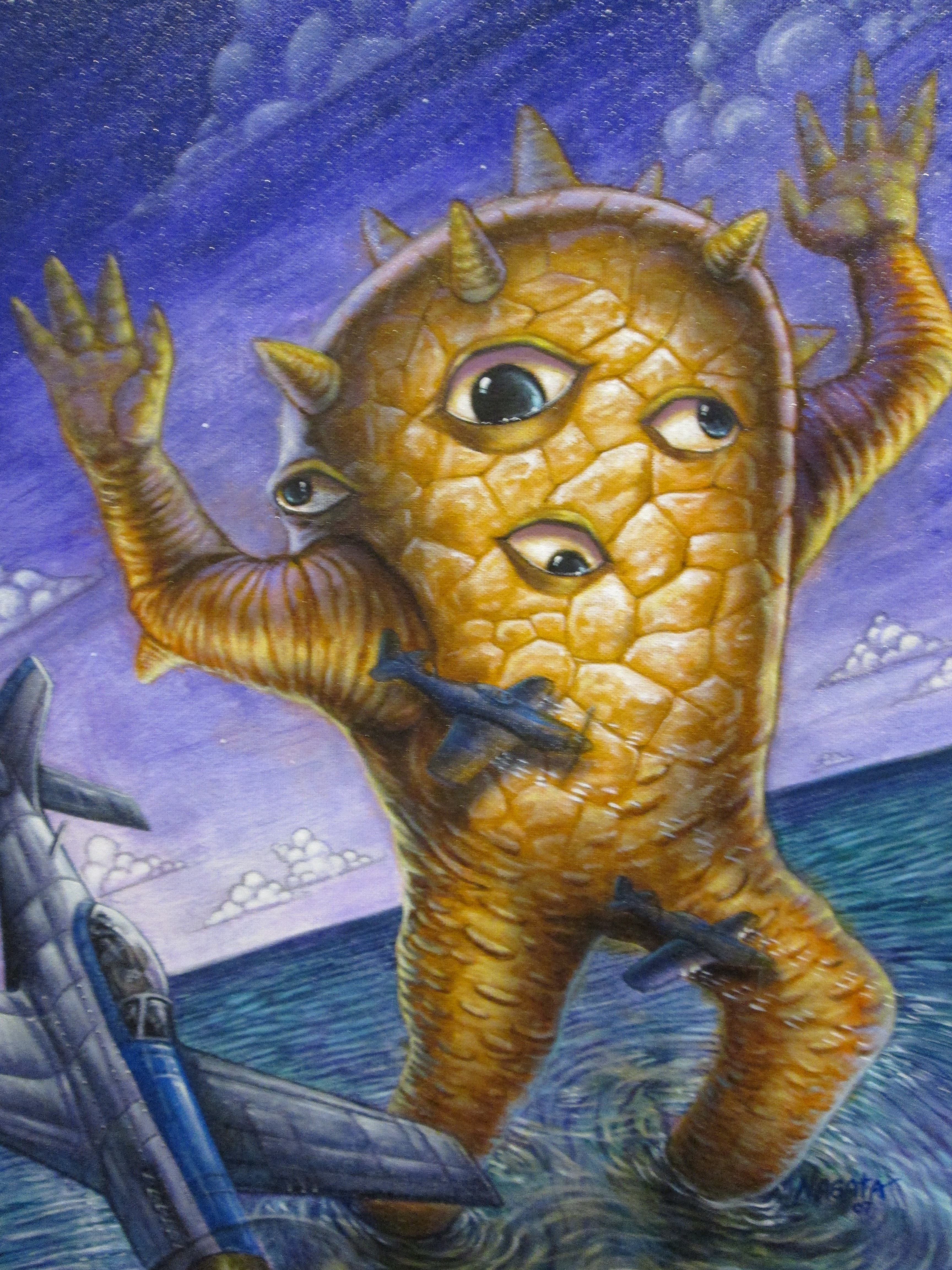
Mark Nagata’s Kaiju Eyezon

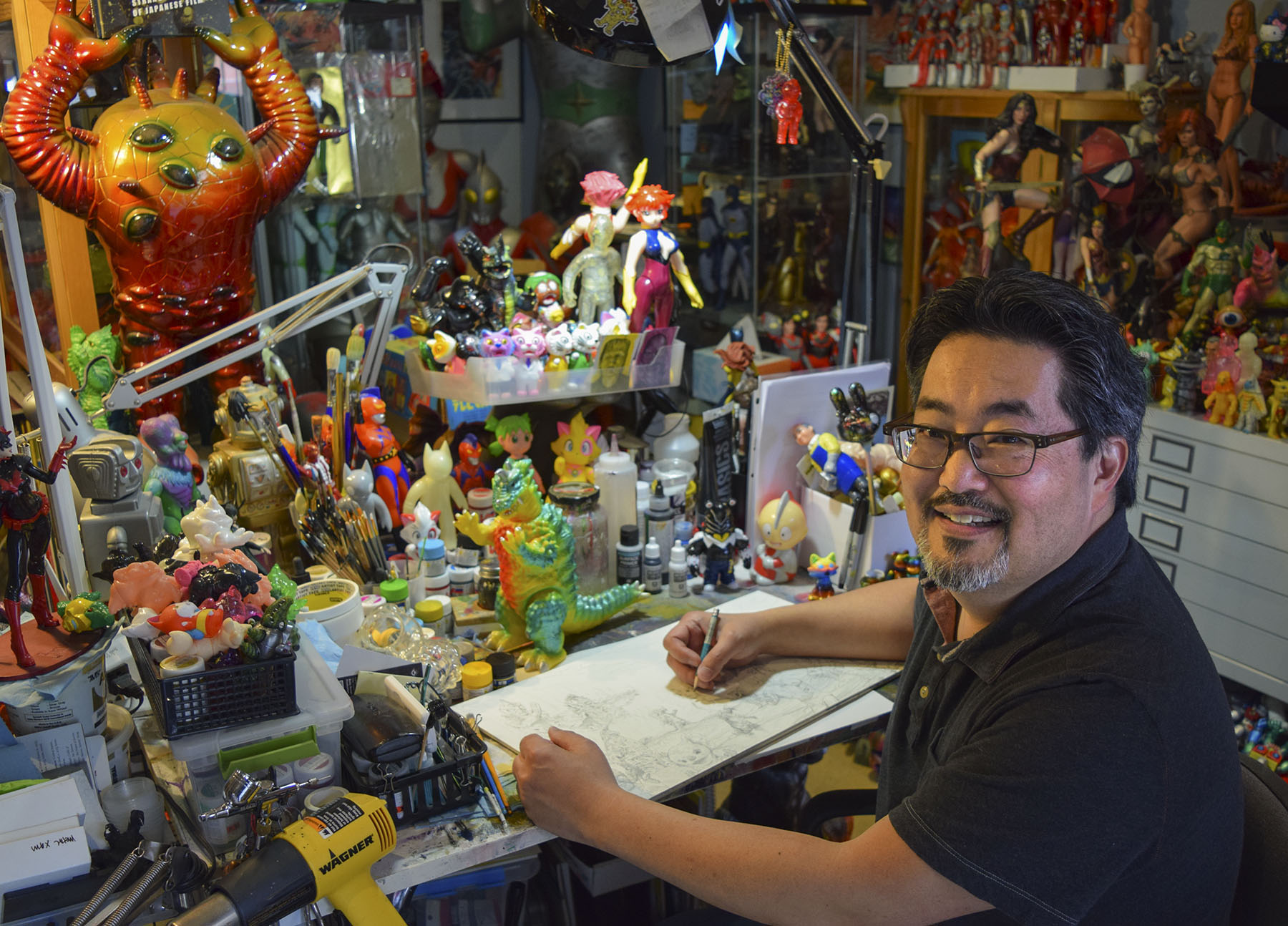
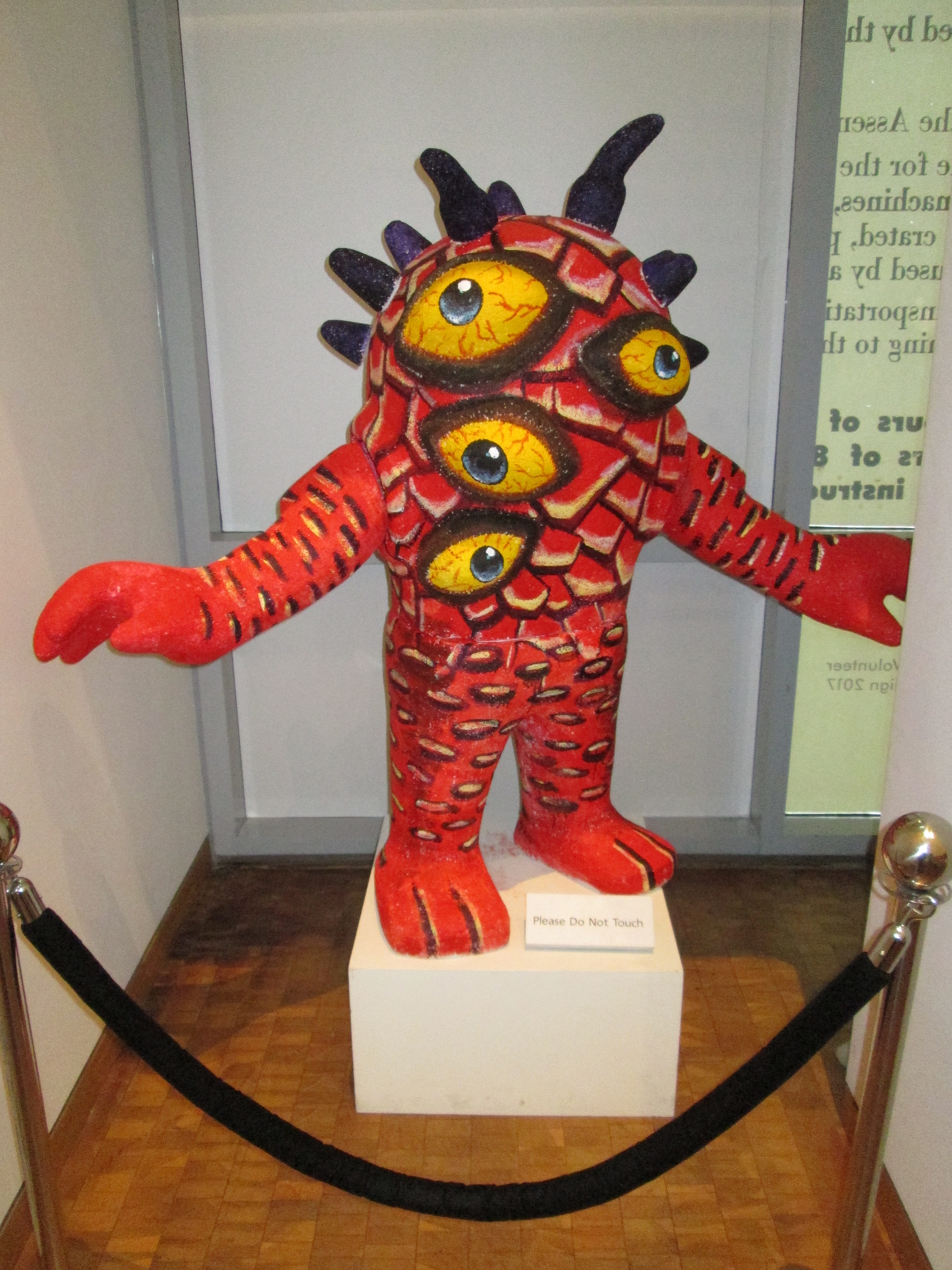
As I promised, I stopped in again at the Japanese American National Museum (JANM) in downtown L.A. to take a second look at the “Kaiju vs Heroes: Mark Nagata’s Journey Through the World of Japanese Toys” exhibit. (To refresh your memory, the term kaiju refers to Japanese monsters, like Godzilla, Mothra, and Rodan.) Looking at the kaiju in the exhibition, I noticed that the Japanese monsters were picturesque, bordering on the cute. Even Eyezon in the above illustration, dangerous as he appears, would probably arouse as much amazement as terror.

Another of Nagata’s Kaiju, an Iridescent Giant Lizard

I keep thinking back to the Ishiro Honda’s Toho horror films of the 1950s and 1960s. There was an element of wonder, which was emphasized by the presence of child actors. Look, for instance, at the cute figurines in the above photo below the giant lizard.

What came to mind as I saw these kaiju was the role of the wrathful deities in The Tibetan Book of the Dead. By being frightened of the wrathful deities in the bardo state following death, the decedent is reborn. Only by not being afraid can the soul attain Nirvana.

Contrast the kaiju with American monsters, whose goal is to frighten the bejeezus out of you, like Boris Karloff in The Mummy below:

Boris Karloff in The Mummy (1932)

The aim of American and Western European horror films is to scare you to the maximum extent possible. If you don’t grasp the arms of your theater seatmate, the film is reckoned a failure.

Now maybe if Boris Karloff were iridescent, and children were brought into the picture, we would have something resembling the kaiju figurines I saw at the JANM.
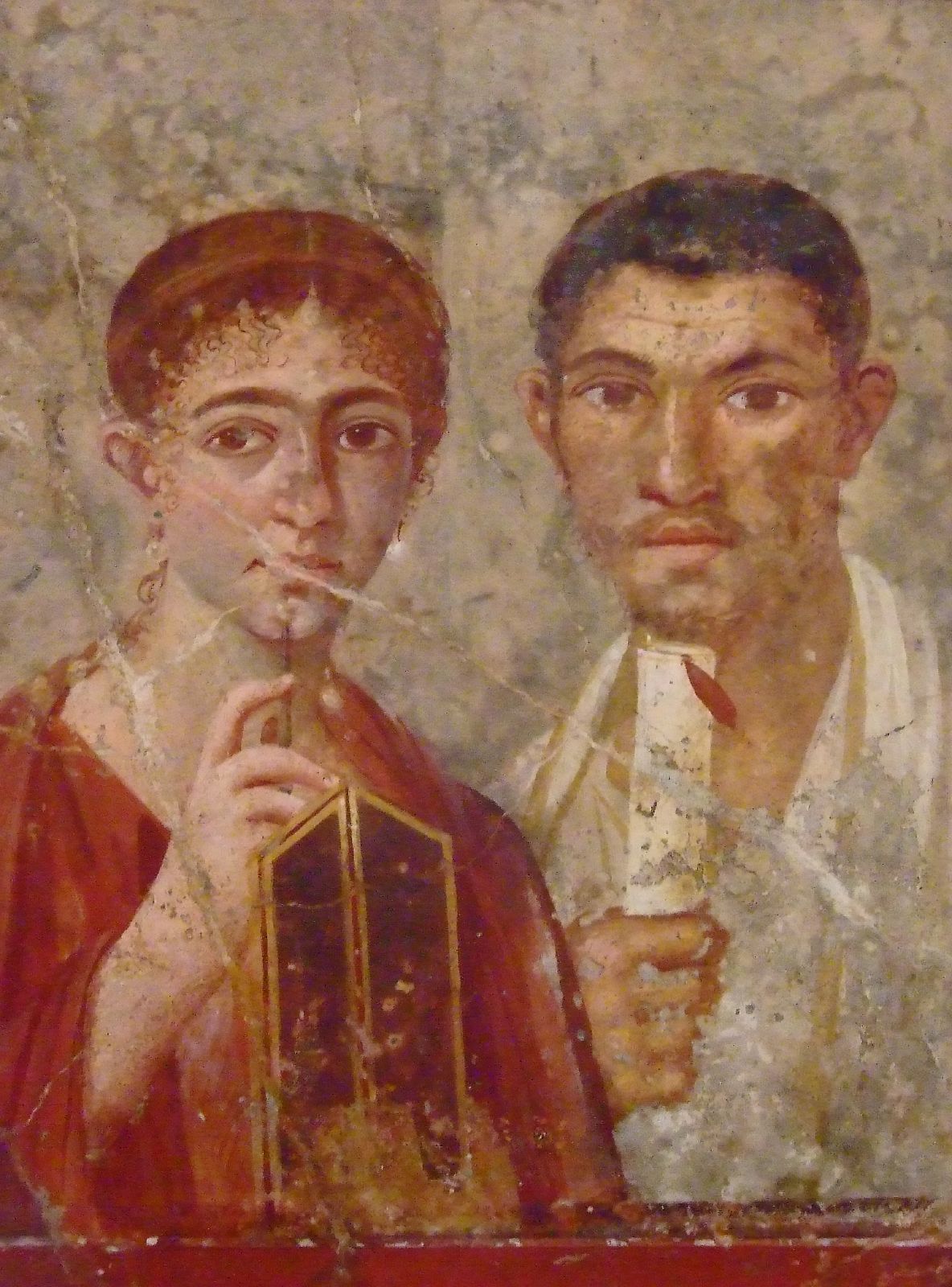
 

Opus Tesellatum

Well-To-Do Young Couple from Pompeii

Many years ago there was an exhibit at the Los Angeles County Museum of Art (LACMA) of various objects found at Pompeii that had been covered by the ash from Mount Vesuvius. I remember seeing the original of the above mosaic in the exhibit, which looked much better than the illustration above.

According to an article by Mark Cartwright published in 2013:

Mosaics, otherwise known as opus tesellatum, were made with small black, white and coloured squares typically measuring between 0.5 and 1.5 cm but fine details were often rendered using even smaller pieces as little as 1mm in size. These squares (tesserae or tessellae) were cut from materials such as marble, tile, glass, smalto (glass paste), pottery, stone and even shells. A base was first prepared with fresh mortar and the tesserae positioned as close together as possible with any gaps then filled with liquid mortar in a process known as grouting. The whole was then cleaned and polished.

In addition, there were wall paintings from Pompeii, but these dis not impress me greatly. It was as if painting was a kind of poor man’s version of mosaics. What surprised me was that, in so many instances, there were paintings of statues.

Mosaic of Fish and Ducks

There were even some historical mosaics, such as this badly damaged view of Alexander the Great and his army:

Mosaic of Alexander the Great with His Army


In almost every case I have seen, the Roman mosaics were superior to the paintings of the period that I have seen. When one sees the original of one of these mosaics, one is impressed by the vividness of the image and the superiority of the medium. When I see a Pompeii exhibit or attend the Getty Villa, I always end up feeling that, with the end of the Roman Empire, we have lost a great art form.

Tarnmoor in Toyland

Mark Nagata Surrounded by His Collection

On Sunday, Martine and I drove downtown to visit a museum that was closed because of the Memorial Day Holiday. So instead, we headed for the Japanese American National Museum (JANM) in Little Tokyo. There was the standard (permanent) exhibit about the forced relocation of Japanese-Americans to concentration camps in the desert; but there was also something diferent.

I am not a toy collector, but I have always been impressed by the Japanese superheroes and monsters (known as kaiju). However powerful the kaiju were, there was something almost appealing about them. American toy villains are somehow more evil. The Japanese ones are almost cuddly.

At JANM,there was an exhibit entitled “Kaiju vs Heroes: Mark Nagata’s Journey Through the World of Japanese Toys.” It was scheduled to end in March, but was held over through July 7, 2019. I was enthralled.

The Kaiju Eyezon, Created by Mark Nagata

Mark started as a collector, then became an illustrator and a creator of Japanese toys. The exhibit was so interesting that I resolved to visit it again on Thursday so that my thoughts on the nature of his art would somehow jell. I( thought back to my response to Ishiro Honda’s horror films for Toho of the 1960s, such as Godzilla (1954), Rodan (1956), Mothra (1961), and all the other Japanese monster films that were to follow. There was a definite difference in these monsters compared to the ultimate evil that is Dracula or Frankenstein or the Nightmare on Elm Street.

Poster for the JANM Exhibition

I am still thinking over in my mind what I will ultimately conclude about this exhibit and Nagata’s artistry, other than that I am strongly drawn to it. Stay tuned to this space for further developments.

.

The Muralist

Quetzalcoatl Mural at Dartmouth College’s Baker Library

During the four years I was at Dartmouth College in Hanover, New Hampshire, I spent many hours studying in the reserve room of Baker Library where, between 1932 and 1934, José Clemente Orozco painted a striking series of murals named “The Epic of American Civilization.” One of the images (above) was of the god Quetzalcoatl (or Plumed Serpent) crossing the Gulf of Mexico to Yucatán. It was largely due to Quetzalcoatl’s yellow beard in Aztec iconography that misled Moctezuma to believe that Hernán Cortés was Quetzalcoatl returned to the Aztecs. We all know how that turned out….

Orozco also did other murals at a dining hall at Dartmouth, but they were removed because they were thought to be Communist, and the Patricians in control at Dartmouth were aghast that the Mexican visitor would abuse their hospitality. (A similar thing happened in Los Angelist, where Mexican muralist David Alfaro Siqueiros painted a mural called “América Tropical” that was painted over for similar reasons.)

I love Orozco’s work. At one point, I even journeyed to Guadalajara to see more of his work, such as the image of Miguel Hidalgo below:

Mural by Jose Clemente Orozco featuring Miguel Hidalgo (leader of the Mexican War of Independence), Palacio de Gobierno (Government Palace), in the historic Center of Guadalajara, Jalisco, Mexico

Censorship of a great work of art because one does not believe in the political philosophy espoused by the artist is, to my mind, barbaric. Only in the United States is there a simultaneous attraction/repulsion response to Orozco’s emphatic mural style. Any attempt to paint over his work in Mexico would cause a bloody riot. But then, Mexico does not swing as far to the right as our country does.


Faces from Ancient Rome

Bust of a Byzantine Emperor

I am still thinking of my visit to the Getty Villa yesterday. One thing the ancient Romans knew how to do was sculpt faces. In sculpture, in the images on coins, the goal was to create a recognizable image, even if it was uncomplimentary. And some of the later Roman emperors were nothing to look at. In a previous post, I showed the museum’s statue of Caligula, with his inverted triangle of a face radiating pure evil. I can’t imagine our current emperor—I mean president—accepting such uncomplimentary honesty.

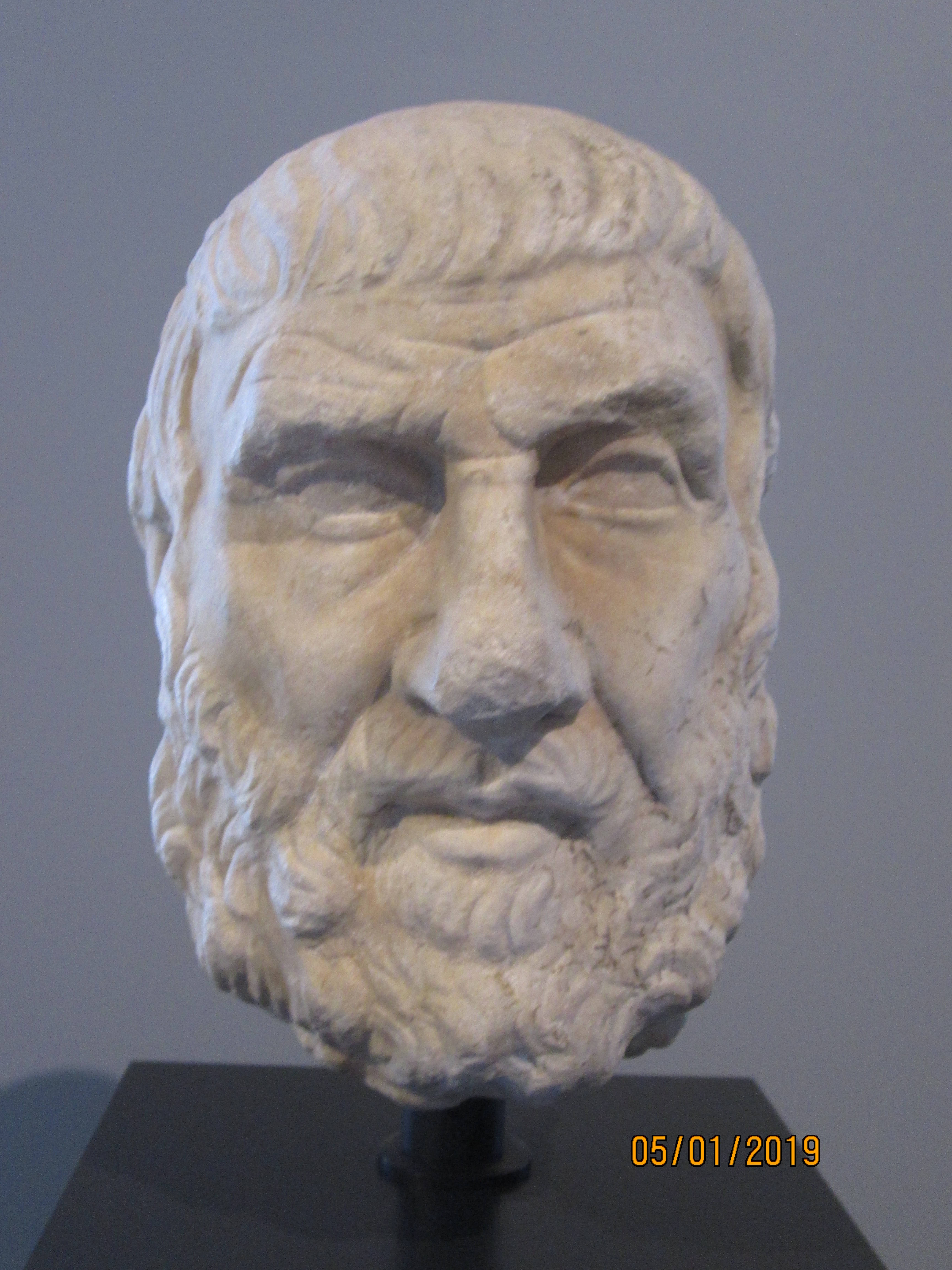
Unidentified Poet or Philosopher

Take a look at this face. The original is unidentified, but the museum thinks he must be a poet or philosopher. In any case, he is old and he has the facial expression of a man who is constitutionally set in his ways. The lines on his face, the slight lopsidedness of his features, the sneer on his lips—this is a man beholden to nobody.

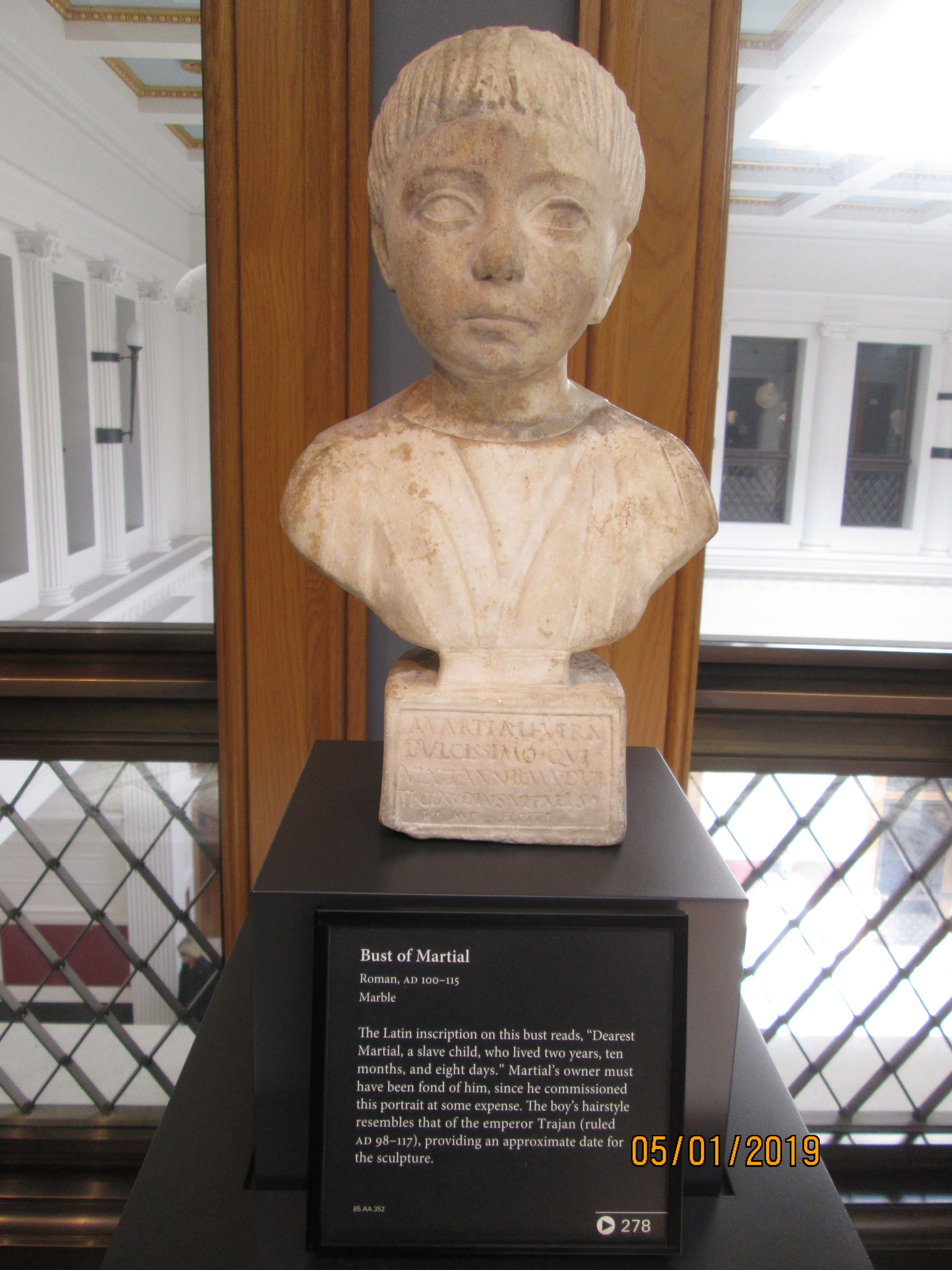
The Slave Boy Martial—Deceased

Finally there is a bust of the slave boy Martial, dead before his third birthday sometime in the second or third century AD. The boy must have been cherished by his owner, because he or she went to the trouble of commissioning this bust for a funerary monument.

Three faces—all very different—all very alive. Walking through the rooms of the Getty Villa, I was acutely conscious that these three individuals were real people. No attempt was made to idealize them. Some two thousand years ago, more or less, they walked the earth looking very much like the busts that commemorated them.


Palmyra

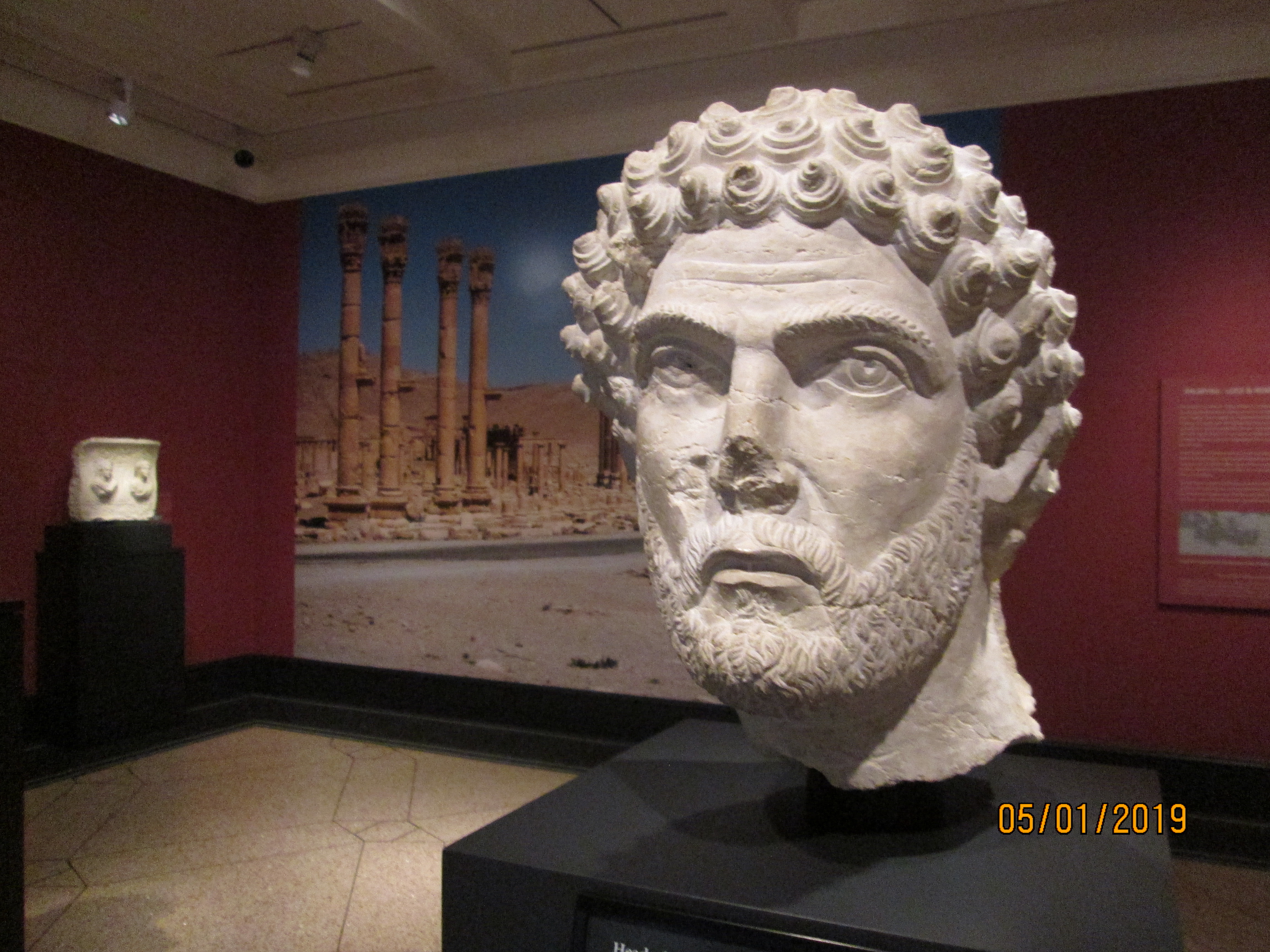
Bust from the Ruins of Palmyra in Syria

In 2015, ISIS seized the ruins of the ancient city of Palmyra in Syria. They proceeded to destroy many of the standing columns, temples, and tombs while gloating over their “accomplishments.” To make matters worse, they captured and beheaded the Khalel al-Asaad, a Syrian archeologist.

This morning, I visited the Getty Villa in Pacific Palisades and was delighted to find an exhibit on loan of mostly funerary statuary from Palmyra, most of which comes from the Ny Carlsberg Glyptotek in Copenhagen. It was titled “Palmyra: Loss and Remembrance.”

It was a revelation to me. Palmyra was neither Roman nor Greek. Their language was a dialect of Aramaic, which was the language of the Holy Land during the life of Christ and for some time after. Most of the items on display were funerary busts and reliefs from the tower tombs that dotted the landscape. The facial expressions were surprisingly realistic, though with larger, more pronounced eyes than found in Greek and Roman sculpture.

“The Beauty of Palmyra”: Obviously a Rich and Powerful Woman

Most women depicted in these sculptures were depicted holding a distaff and spindle in their hands. The statue above displays no such housewifely virtues. Instead she is bedecked with jewels on her headdress as well as her costume. The circles were once filled with precious and semi-precious stones which have disappeared in the course of time.

ISIS Gloating Over the Destruction by Explosives of the Temple of Baal Shamin on One of Their Websites

Naturally, I think ISIS’s actions in Palmyra and elsewhere show a total disregard for the antecedents of their own civilization. They will undoubtedly commit other barbaric crimes until this awful Jihadist movement is brought to account for their crimes against humanity.


Calaveras

One of Posada’s Calaveras: Street Cleaners

John Webster was a Jacobean dramatist known for the grimness of his plays. According to the first stanzas of a poem by T. S. Eliot called “Whispers of Immortality”:

Webster was much possessed by death
And saw the skull beneath the skin;
And breastless creatures under ground
Leaned backward with a lipless grin.

Daffodil bulbs instead of balls
Stared from the sockets of the eyes!
He knew that thought clings round dead limbs
Tightening its lusts and luxuries.

Donne, I suppose, was such another
Who found no substitute for sense,
To seize and clutch and penetrate;
Expert beyond experience,

He knew the anguish of the marrow
The ague of the skeleton;
No contact possible to flesh
Allayed the fever of the bone.

I cannot think of these lines without think of José Guadalupe Posada (1852-1913), who is famous for his depictions of cavorting skeletons.

Posada’s “The Day of the Dead”

As I am thinking once again of going to Mexico this next winter, I am thinking of the country’s great artists, including José Clemente Orozco, Diego Rivera and Frida Kahlo, David Siqueiros, and Rufino Tamayo, to name just a few. And Posada belongs on that list, though perhaps in a more minor key.

Unlike most Americans, the people of Mexico do not sweep the idea of death under a carpet. In fact, November 2, called All Souls Day in the Catholic Church, is the Dia de los Muertos, the Day of the Dead, throughout Mexico. Families visit their dead in the cemeteries with a picnic lunch and with all their children in tow. I remember a long intercity bus ride back in the 1980s on this day on which most of the passengers were joyfully looking forward to their Day of the Dead festivities. The children had white sugar calaveras, or skulls, which are a special treat available throughout the country.

This feeling about death goes back to the Maya and the Aztecs, who fought wars just to get prisoners to serve as sacrificial victims, whose hearts were cut out still steaming from their bodies with an obsidian knife and dedicated to the gods.

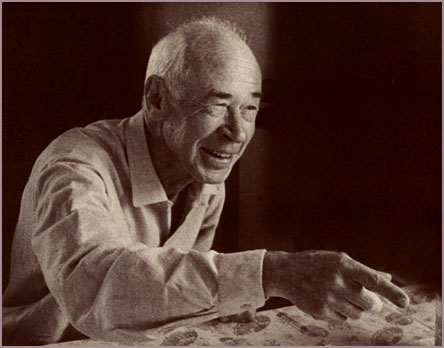
Henry Miller in My Life

American Writer Henry Miller (1891-1980)

I started out with Henry Miller the (forbidden) writer of erotica. There were the Tropics, Black Spring, Sous Les Toits de Paris, and The Rosy Crucifixion trilogy. Then I started reading his nonfiction, and I began to think more of him, especially with The Colossus of Maroussi (1941), his travel classic about Greece; The Air-Conditioned Nightmare (1945), on his pessimism about America after the War; The Time of the Assassins (1946), an essay on Arthur Rimbaud;  and Big Sur and the Oranges of Hieronymous Bosch (1957), about his life in Big Sur. I have just finished reading Remember to Remember (1947), a sequel to The Air-Conditioned Nightmare, which is mostly about artists he has met.

Henry Miller is very much a Jekyll-and-Hyde type of author. He can run off at the mouth for dozens of pages—but then he can zero in a key point in some Buddhist burst of contemplation. And, what I like about him, his instincts are right. His pacifist essay in this book, “Murder the Murderer,” spends some ninety pages telling us that he is against war and killing. All well and good. No burst of contemplation there, though it took balls to be a pacifist in the final days of the Second World War. But then he impales Hollywood poseurs in a brilliant spoof entitled “Astrological Fricasse,” which may be the best short work of fiction he ever wrote.

The artists Miller recommends—painters Beauford DeLaney and Abe Rattner and sculptor Beniamino Bufano—are worth closer study. It seems that public opinion has caught up with them, though they were controversial when Miller wrote his book.

I will continue to mine Miller for the occasional rich vein that one comes across with no advance warning, particularly in his nonfiction.


Two Friends of Henry Miller

Abe Rattner’s “Darkness Fell Over the Land” (1942)

I have been reading Henry Miller’s Remember to Remember (1947), his sequel to The Air-Conditioned Nightmare (1945). Miller has always been interesting to me, even when he descends into rant, as he not infrequently does. Where the earlier book talked about places, the sequel deals mostly with people. Two painters appearing in that book are Abe Rattner (1896-1978) and Beauford Delaney (1901-1979).

As you may know, I reject the tendency of much of 20th century painting, whether here or in Europe, to go in for abstract expressionism. That might well be of interest to interior decorators, but the result of that tendency is a body of work that, of itself, strikes me as empty. Colorful, perhaps, but not so much as inviting a second glance. Art has to represent something other than mere color and form. The literary equivalent might be a selection of adverbs or prepositions without any human context.

In “A Bodhisattva Artist,” Henry Miller expresses his unbounded admiration for Rattner as a person and for his work. such as the above illustrated “Darkness Fell Over the Land,” referring to the aftermath of the crucifixion. Rattner is an artist of the sacred, somewhat like Georges Rouault, but with both a Christian and a Jewish perspective.

Beauford Delaney’s “Jazz Club” (1950)

Beauford Delaney is an African-American artist who was born in Knoxville, Tennessee and died in Paris, France. Miller got to know him in New York, and wrote an essay about the painter and his work in “The Amazing and Invariable Beauford DeLaney.” He is considered to be a representative artist of the Harlem Renaissance, though when he moved to France, he converted (alas) to abstract expressionism.

According to the Wikipedia entry on him:

Delaney felt an immediate affinity with [New York’s] “multitude of people of all races – spending every night of their lives in parks and cafes” surviving on next to nothing. Their courage and shared camaraderie inspired him to feel that “somehow, someway there was something I could manage if only with some stronger force of will I could find the courage to surmount the terror and fear of this immense city and accept everything insofar as possible with some calm and determination.”

I am always interested in finding outliers to the predominant currents of art. Henry Miller, being no mean painter himself, did at times exhibit exquisite tastes.


Giorgio di Chirico, Surrealist Painter

His Surrealist Landscapes Are Endlessly Fascinating

The scene is a port somewhere. You can see the unfurled sails of a ship just over the wall while two muffled figures hover around the entrance of a building. There is a tower just over the wall that could be a lighthouse, but maybe not. Note the conflicting shadows: The building on the left is casting its shadow in the 4 o’clock position, while the unseen structures on the right have shadows that are closer to the 10 o’clock position, I love these strange Mediterranean landscapes which seem to suggest so much but say nothing clearly.

Giorgio di Chirico (1888-1978) was, to my mind, the greatest of the surrealist painters. Although I prefer the landscapes, he painted other subjects as well:

Miscellaneous Objects Suggesting Strange Geometries

In one of his writings, the painter states, “What is especially needed is great sensitivity: to look upon everything in the world as enigma….To live in the world as in an immense museum of strange things.” The above image certainly qualifies.

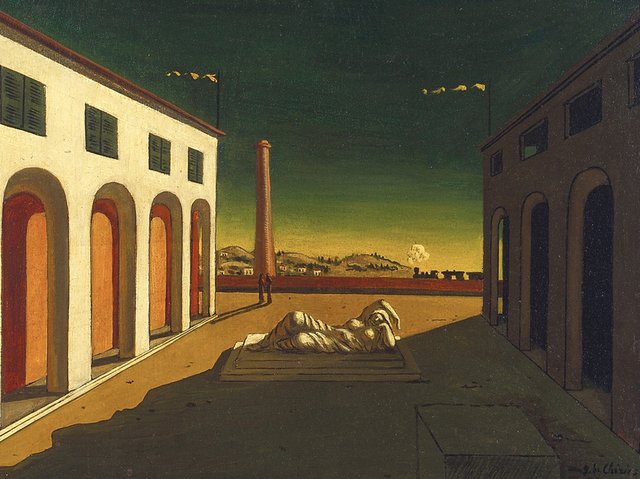
Another Chirico Landscape

The flags atop the facing buildings show a strong wind blowing from right to left. The steam from the locomotive beyond the wall in the background, on the other hand, is going straight up. Again, we have two muffled figures in the middle distance and a strange statue of a reclining male in the middle of the square. Again—not unusual with Chirico—the shadows are a little inconsistent. Where, for instance, is the shadow of the tall phallic tower.