A Plethora of New Words

Whom Do You Think Is Going to Win This Conversation?

Mansplaining: Whom Do You Think Is Going to Win This Argument?

The Oxford Dictionaries have released a list of new words that will start appearing in its online dictionaries and—who knows?—eventually the printed editions. I have indicated some of the more interesting ones below in alphabetical order:

  • amazeballs, adj.: (informal) very enjoyable, impressive or attractive. I can’t imagine anyone but a salesman using this one.
  • bro hug, n.: (U.S. informal) friendly embrace between two men. No tongues involved!
  • clickbait, n.: (informal) (on the Internet) content whose main purpose is to attract attention and draw visitors to a particular web page. I am excessively familiar with this phenomenon.
  • cord cutting, n.: (informal) practice of cancelling a pay television subscription or landline phone connection in favor of an alternative Internet-based or wireless service. Unrelated to childbirth.
  • cray, adj. (also cray cray): (US informal) crazy. I wonder if there is any tie-in with Cray Supercomputers.
  • dox, v.: (informal) search for and publish private data about (an individual) on the Internet, typically with malicious intent. Look as you will, you will probably not discover anything about my incontinence.
  • FML, abbrev.: (vulgar slang) f*ck my life! (used to express dismay at a frustrating personal situation).
  • hate-watch, v.: (informal) watch (a television program) for the sake of the enjoyment derived from mocking or criticizing it. Just about everything that’s televised falls into this category for me.
  • humblebrag, n. & v.: (informal) (make) an ostensibly modest or self-deprecating statement whose actual purpose is to draw attention to something of which one is proud. I would never call attention to myself this way. Honest!
  • hyperconnected, adj.: characterized by the widespread or habitual use of devices that have Internet connectivity. In future, people will look at this as one of the dominant cultural features of our time.
  • listicle, n.: an Internet article presented in the form of a numbered or bullet-pointed list. I guess this post would qualify as a listicle.
  • mansplain, v.: (informal) (of a man) explain something to someone, typically a woman, in a manner regarded as condescending or patronizing. This is my favorite. I’ve never heard of it before, but it’s going to become part of my vocabulary henceforth.
  • side-eye, n.: (informal , chiefly US): a sidelong glance expressing disapproval or contempt. Oops, this is something I do a lot.
  • throw shade, phrase: (US informal) publicly criticize or express contempt for someone. This is the main activity at Faux News.
  • YOLO, abbrev.: (informal) you only live once (expressing the view that one should make the most of the present moment)… And here I thought it was just a county in Northern California.

To see the complete list as published by Salon.Com, click here. WDYT? (What Do You Think?)


Now You, Too, Can Be a Smurf!

Colorful Footwear => Smurfware

Colorful Footwear => Smurfware

Not that I have anything against the Smurfs, except, maybe, that there’s only one female Smurf, namely Smurfette. Now, whether you’re a guy or a gal, you, too, can look like a Smurf. Just wear shoes in neon colors that clash violently with the rest of your outfit. (One hopes that your entire wardrobe is not in matching neon colors: That would go beyond Smurfdom into outright Twee.)

Today, as I walked along the Santa Monica Promenade, I felt curiously muted—even invisible. First of all, my age makes me invisible. Then, too, I was dressed in muted shades of blue and buff with a straw hat to shade against the fierce sun. I guess you’d have to walk right into me to notice my existence at all. Do you suppose it’s because my shoes aren’t bright enough? Hmmmmm.


No Nuclear Weapons for Ferguson PD!

Also: No Drones or Bombers Have Been Approved

Also: No Drones or Bombers Have Been Approved

President Obama today declared in an impromptu press conference that no drones, bombers, or nuclear warheads would be approved for the Ferguson, Missouri Police Department for riot control.

National Rifle Association (NRA) Executive Vice President Wayne La Pierre protested the President’s decision, followed quickly by Senator Lindsay Graham (R-SC), who stated, “The Second Amendment gives us full authority to pulverize any nigras who threaten public order—by any means possible.” House Speaker John Boehner could not be reached for comment, though it is suspected he was either being briefed by Tea Party representatives or putting a new coat of orange paint on his face.

In the meantime, Vladimir Putin has authorized two hundred white trucks to cross the Mississippi River to give humanitarian aid to the white population of the Saint Louis area. It is suspected, however, that these trucks may contain RPGs and automatic weapons to assist the Robocops of the Ferguson Police Department.


A Week of Very Very Bad News

Omigosh, Where Do I Begin?

Omigosh, Where Do I Begin?

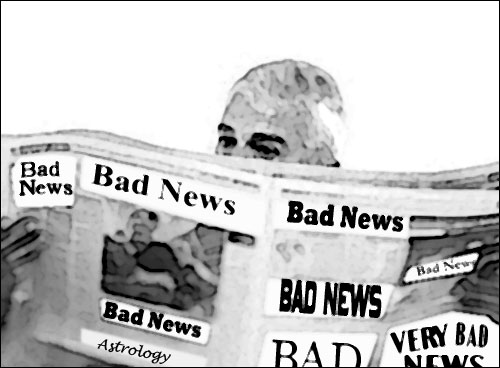
Every once in a while, all the bad news seems to clump up at one time. If you spend a lot of time following this news, you will feel very very bad and have to take some pharmaceutical products that are unlikely to do you any good. For those of you who have been consulting a sage on some remote mountaintop over the last seven days, here’s a brief summary of what has been clogging the pipes:

  • That Malaysian plane that was shot down by the Russkis or their BFFs is still in the middle of a battle zone, and investigators have been told the area is now mined. How’s that for hiding evidence?
  • Somebody did something to some Israelis or Hamas members, so the Israelis went and killed a couple thousand Arabs while Hamas still lobs cherry bombs and hammerheads into Israel.
  • Ebola is spreading like wildfire. For the sake of justice, we are bringing some afflicted Americans back to the States, where Donald Trump will be emptying their bedpans and giving them sponge baths.
  • Immigration? Congress does a bunk and gives Boehner another reason for a very public faceplant. Wait a sec, we’re paying those clowns to take apart the Legislative Branch of the U.S. Gummint?
  • Drought-stricken California is in even worse shape, now that the UCLA campus was flooded by several million gallons of water after a water main break. Is there any certainty that USC was not involved?
  • The stock market has taken a giant dump while we still consider investing in such ad-driven media as Facebook, Twitter, and SnapChat. Wait, don’t advertising budgets suffer first when the economy goes south?

You can laugh at anything—provided that you concentrate on cultivating your garden rather than bearing the world’s unsolvable ills on your back.


The Way We See Ourselves

Reagan Popularized This Concept

Reagan Popularized This Concept

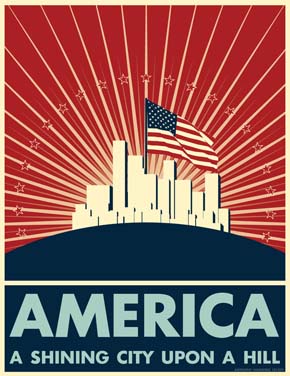
The text originally comes from the Bible, from the Sermon on the Mount in Matthew 5:14: “You are the light of the world. A city that is set on a hill cannot be hidden.” The phrase had been used by several Americans since to describe the way we as a people wanted to be seen. While still aboard his ship en route to the New World, John Winthrop delivered a sermon in 1630 that contained the following phrase:

For we must consider that we shall be a city upon a hill. The eyes of all people are on us. So that if we shall deal falsely with our God in this work we have undertaken, and so cause Him to withdraw His present help from us, we shall be made a story and a by-word through the world. We shall open the mouths of enemies to speak evil of the ways of God, and all professors for God’s sake. We shall shame the faces of many of God’s worthy servants, and cause their prayers to be turned into curses upon us till we be consumed out of the good land where we are going.

In 1961, John F. Kennedy used the phrase in one of his speeches. More famous, however, was Ronald Reagan in 1984 when he said:

…I’ve spoken of the shining city all my political life, but I don’t know if I ever quite communicated what I saw when I said it. But in my mind it was a tall proud city built on rocks stronger than oceans, wind-swept, God-blessed, and teeming with people of all kinds living in harmony and peace, a city with free ports that hummed with commerce and creativity, and if there had to be city walls, the walls had doors and the doors were open to anyone with the will and the heart to get here. That’s how I saw it and see it still…

In the course of the passing years, after Vietnam, Grenada, Iraq, Afghanistan and various other global hotspots, we have developed another image. In a short story entitled “Absence,” a Peruvian-born writer named Daniel Alarcón painted a very different picture of what the United States had become: “Americans always feel bad. They wander the globe carrying this opulent burden. They take digital photographs and buy folk art, feeling a dull disappointment in themselves, and in the world. They bulldoze forests with tears in their eyes.”

Tenniel’s Walrus and the Carpenter

John Tenniel’s Illustration for Walrus and the Carpenter

Now what this reminds me of are the Walrus and the Carpenter from Lewis Carroll’s Through the Looking Glass. You might remember from the accompanying poem that the Walrus and his Carpenter friend talk some oysters into joining them for dinner. Of course, they eat all the oysters, and begin to cry. The following conversation then takes place between Alice, Tweedledee, and Tweedledum:

‘I like the Walrus best,’ said Alice: ‘because you see he was a LITTLE sorry for the poor oysters.’

’He ate more than the Carpenter, though,’ said Tweedledee. ‘You see he held his handkerchief in front, so that the Carpenter couldn’t count how many he took: contrariwise.’

‘That was mean!’ Alice said indignantly. ‘Then I like the Carpenter best—if he didn’t eat so many as the Walrus.’

‘But he ate as many as he could get,’ said Tweedledum.

This was a puzzler. After a pause, Alice began, ‘Well! They were BOTH very unpleasant characters—’

It’s a long way between the City on a Hill and Lewis Carroll’s the Walrus and the Carpenter, but I do believe that over the centuries, the U.S. seems to have arrived at that point with surpassing ease—while at the same time with all our illusions intact.


Bad Karma

Both Israel and Hamas Are Asking for a Miserable Future

Both Israel and Hamas Are Asking for a Miserable Future

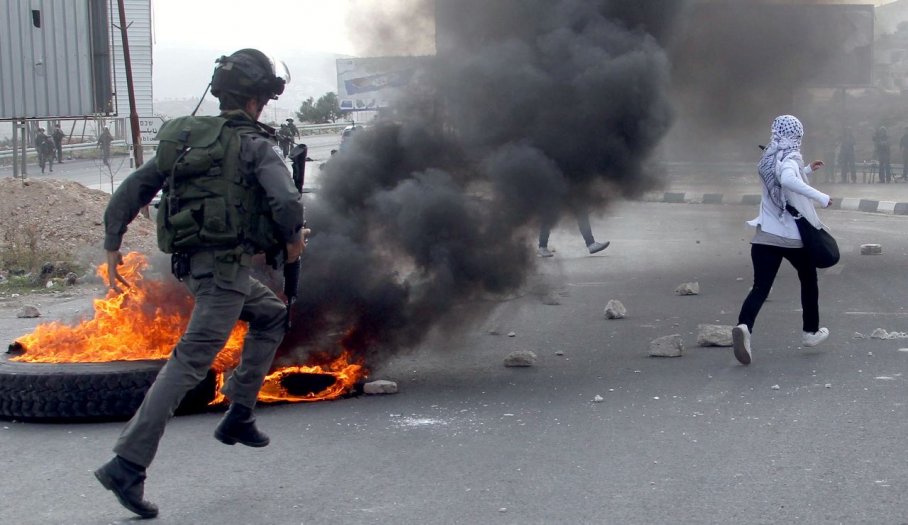
I do not intend to say who is right and who is wrong. But I think that both Israel and Hamas will suffer in years to come for their mutual intransigence. Both sides have negotiated in bad faith, especially when Benjamin Netanyahu was on one of the sides. Unfortunately, it is the innocent who—as always—suffer the most. The images of wounded Palestinian children are everywhere in the news. And certainly, the casualties are grotesquely one-sided.

The question I ask is: When does Israel’s right to defend itself cross the line over into war crimes? Although their rocket attacks have been one-hundredth the intensity of Israel’s air and land barrage, one might also ask of Hamas why, considering what they know of Israel’s tendency to over-respond, do they continue acting in such a way as to deserve punishment by Israel? But will Hamas be punished, or the Palestinians who just want to survive with their families and property intact?

So much of the news today is about irreconcilable conflicts between people who should be brothers: Ukraine and Russia, Syria and the Syrians, Iraq and ISIS … the list goes on. And the casualties continue to mount.

When the U.S. Downed a Commercial Jet

Not One of Our Great Moments in Military History

Not One of Our Great Moments in Military History

The date was July 3, 1988. The United States Navy was engaged in the Persian Gulf protecting oil shipping lanes. Around that time, there had been several hostile engagements with both the Iraqi and Iranian forces. Shipping through the Straits of Hormuz had to cross into territory claimed as Iranian waters in order to avoid running aground.

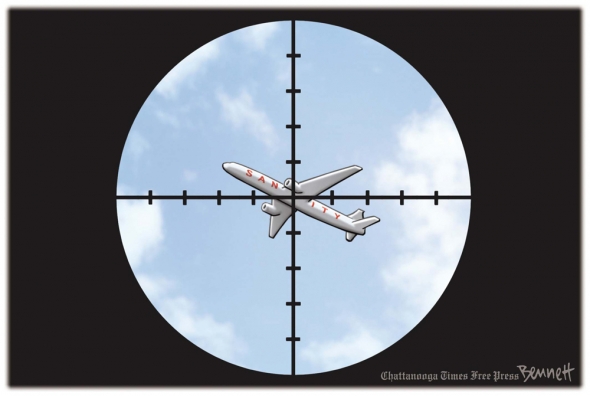
The USS Vincennes, a guided missile cruiser patrolling the Straits, picked up a signal from an aircraft that it misidentified as coming from an F-14 Tomcat, of which there were several in Iran’s air force. It let fly an SM-2MR surface-to-air missile. Instead of an F-14 Tomcat, the missile brought down an Airbus 300B2-200 flying a commercial flight as Iran Air 655 between Bandar Abbas, Iran and Dubai. On board were 290 persons, including 66 children and 16 crew. All persons on board died.

Did the United States apologize to Iran? According to Wikipedia:

In 1996, the United States and Iran reached “an agreement in full and final settlement of all disputes, differences, claims, counterclaims” relating to the incident at the International Court of Justice. As part of the settlement, the United States did not admit legal liability but agreed to pay US $61.8 million ($92.9 million today), amounting to $213,103.45 ($320,446 today) per passenger, in compensation to the families of the Iranian victims.

Iran Stamp Commemorating the Incident

Iran Stamp Commemorating the Incident

Although flight numbers are usually retired after a prominent airline disaster, Iran Air still has a flight 655. I guess they want to keep the villainy of the Great Satan fresh in their minds.

As to the Malaysian Airliner Flight MH17 shot down over Eastern Ukraine, I highly recommend that you read Patrick Smith’s posting on the subject in his Ask the Pilot blog in preference to listening to the mainstream media pundits bloviating about unsupportable conspiracy theories.


Red Sunset Mother

It All Goes Back to Aesop

It All Goes Back to Aesop

The three words of the title of this post were separately suppressed by Myanmar’s ruling junta: “red” because of its association with Communism; “sunset” because General Ne Win’s name meant “sunrise”; and “mother” because that was the nickname of Burmese dissident Aung San Suu Kyi.

That brings back to mind another draconian instance of censorship. In Costa-Gavras’s film (1969), the rightist Greek colonels in charge forbid the use of the letter Z (Zeta) in the Greek alphabet because of the protestors’ use of the Greek phrase “Ζει,” meaning “He lives.” The pronoun refers to the democratic politician Grigoris Lambrakis, who was assassinated in 1963.

What does one do when the powers that be forbid the use of certain words? Russian and Eastern European writers under Communist rule came up with the solution: use other words in their place. This is referred to as the use of Aesopian, or Aesopic, language. Just as the ancient Greek teller of fables used stories to mask political realities, writers would use metaphorical language to stand in for the proscribed language. In an article entitled “The Rhetoric of Subversion: Strategies of ‘Aesopian Language’ in Romanian Literary Criticism Under Late Communism,” Andrei Terian describes the procedure used:

Since organized dissent was absent, the ‘resistance through culture’ represented in Romania the main form of assertion of the writers’ independence from the Communist regime. Civically, it materialized through the refusal to enroll in the party’s propaganda machine, while artistically, it took place through the defense of the priority of the ‘aesthetic’ criterion in the production and reception of literary works, which generated a literature relatively autonomous from the political sphere. Nevertheless, from the perspective of maximalist ethics, the ‘resistance through culture’ is a deeply duplicitous phenomenon, which fits perfectly in the Ketman paradigm described by Czeslaw Milosz. In the Polish writer’s opinion, ‘Ketman means self-realization against something’ (The Captive Mind ….), which, in the case of totalitarian societies, is translated in a profound divergence between an individual’s private thoughts and their public expression.

I thought Milosz expressed it better in The Captive Mind—a book I urge everyone to read—but I can’t quote it because, alas, I can’t lay my hand on it at the moment.

Terian is a bit abstruse, so let me think of an example. Let us say that the Tea Party rules America as a rightist junta and bans the use of the word “abortion.” A hated Liberal writer can use another term, such as “ablution” in such a way that a censor would let it pass, despite the fact that its meaning would be clear from its context, as in “they were able to limit the size of their family with the discreet use of ablution.” Writers can and did develop an entire language of such circumlocutions under the noses of the Communist censors.

Even words as basic as “red,” “sunset,” and “mother” can find Aesopian equivalents, such as, perhaps, “rubicund,” “gloaming,” or “progenitrix” respectively—though a poet can play with the concept much as Viking poets used kennings such as “wave’s steed” for “ship” or “Freyja’s tears” for “gold.” And the Viking’s did this not because of censorship, but to help the meter of their compositions.

Iraq in Tres Partes Divisa Est

ISIS Executing Prisoners

ISIS Executing Prisoners

The following post was written on Yahoo360 back in March 2006. Even with the U.S. forces having been withdrawn, the basic situation has not changed much:

Looking beyond the daily news, the explosions, the body bags, and the turmoil in both Baghdad and Washington, what is likely to happen to Iraq in the years to come? I think that Iraq’s future is closely tied to Iraq’s recent past, starting when it was part of the Ottoman Empire until the end of World War I. As Constantinople had made the wrong choice of allies in the war—namely Germany and Austria—the British and French parlayed after the war to decide how the land would be divvied up.

Many of the Foreign Office clerks in London had only an Old Testament background in the history of the area. So they proceeded to create new countries based on maps printed in old Bibles and distant recollections of empires long faded into dust. There was also a debt that had to be paid: Hussein ibn Ali, Sharif of Mecca, had provided critical aid to the British in their war against the Turks (you may know him as Omar Sharif from the film version of Lawrence of Arabia), and the British promised to make his three sons kings. To accomplish this, they created three countries—Syria, Transjordan, and Iraq—for Hussein’s sons to rule. Syria was placed under French administration; and Transjordan and Iraq, under British.

The tale of how this happened is contained in a book that should be required reading for everyone interested in the subject: David Fromkin’s A Peace to End All Peace: The Fall of the Ottoman Empire and the Creation of the Modern Middle East, which is available from Amazon.Com. You may be interested to know that one of the prime movers behind this remapping of the Middle East was none other than the young Winston Churchill.

Iraq’s monarchy didn’t last very long, but its borders are more or less the same as stipulated by the Sykes-Picot Agreement of 1916 and several subsequent treaties. Ignored by the Foreign Office clerks was the fact that the Iraq they created was split along major cultural fault lines: (1) the north was Kurdish; (2) the area around Baghdad extending west to Jordan was largely classical Sunni Arab with an intermingling of Shi’ites; and (3) the South, centered around Basra, was almost exclusively Shi’ite.

Why don’t we just break Iraq into three countries? (1) The Turks would go ballistic if the Kurds had their own state and destabilized the Kurdish regions of Turkey; (2) There would be wholesale genocide between Sunnis and Shi’ites in the center; and (3) A Shi’ite state in the south would eventually fall under the sway of Iran, even though the Iranians speak a different language.

What can we do? I think we should declare our adventure in Iraq to be a stunning victory and bring our troops home. They have no role to play in a civil war except as targets in a shooting match between all parties concerned.

I wouldn’t change a word of what I wrote back then. I still think that Iraq will be subdivided into two or three states, one of which will be an independent Kurdistan. As for the Sunnis and the Shi’ites, only Allah knows what will happen.

Hold That Line!

There Has Been Relatively Little Change Since WWI

There Has Been Relatively Little Change Since After WWI

Take a quick look at this map. Given that the Middle East is such a volatile and combative part of the world, it is amazing that so little has changed since the pacts after the First World War. At that time, there were quite a few changes: Several countries that formerly belonged to the Ottoman Empire were carved out of desert because the British and French wanted it so. The British and French are long gone, but the lines they drew still hold (as of 1:30 p.m. today anyway).

The biggest change on the map was the creation of all the independent “-stans” after the Soviet Union fell apart around 1992. Other changes include the creation of Pakistan in 1946 (though its eastern part is now Bangladesh) and the union of the former British colony of Aden with Yemen. Also Cyprus is now independent (but divided into Greek and Turkish halves).

Probably the only country whose boundary was not drawn by the European powers is Pakistan. Far from stable, however, the Islamabad government is currently facing three insurgencies: the Taliban, the Belochis, and in Karachi (from several ethnic groups). They also risk war with Iran because of the Belochi insurgency and with China over helping to radicalize in Uighurs in China’s Xinjiang province.

Islamic populations in general seem to be divided into two groups:

  1. Apprehensive, politically ineffectual people who just want to get on with their lives, and
  2. Jihadists who want to conquer the world and introduce Sharia law everywhere.

In the near future, it seems that the Jihadists will be in the ascendant. That tendency will be reversed eventually because radicals who want to blow themselves up are generally not effective in creating a strong country. I suspect that soon the map boundaries will change until they are unrecognizable from the above illustration. Also, I suspect that there will be a lot more countries: several in Iraq, Pakistan, and Syria. Even tiny Lebanon is split between Sunni, Shi’ite, Druze, and Maronite Christian enclaves. Talk about Balkanization!

I think the best thing for the United States to do is to disengage from any military activity in the region: We always end up arming the wrong people. (It would have helped if someone in the Pentagon knew Arabic.) Although extraction of oil through fracking is dangerous, it would be nice if we were independent of the Middle East for our oil needs. Then we could just let them kill one another and go tsk-tsk while shaking our heads.

One exception: Look at what’s sitting right in the center of that map. The most stable country of the group is Iran. I think we should be friends with them and let bygones be bygones. But no military intervention, please!