An Afternoon in Garmonbozia

Laura Palmer Played by Sheryl Lee

Twice a year, Barnes & Noble has a 50% off sale on Criterion Collection DVDs and Blue-Rays. Today, I bought one of my favorite films from the 1990s, David Lynch’s Twin Peaks: Fire Walk with Me (1992), a prequel based on his two-part television series, Twin Peaks for ABC. The term “garmonbozia” is a nightmarish Black Lodge term meaning pain and suffering. In the movie, the pain and suffering relates primarily to two young women who are killed, and one who is presumably scarred for life: Laura Palmer, Theresa Banks, and Ronette Pulaski.

The so-called Black Lodge is a strange room with no windows, full-length floor-to-ceiling red velvet drapes, and a zig-zag pattern in black and white on the floor. Its permanent inhabitant is Michael J. Anderson (below) as The Man from Another Place. He speaks in a strange, barely understandable dialect which was filmed speaking backwards deliberately, and then reversing the sound track. He eats garmonbozia, which looks very like creamed corn.

Michael J. Anderson as The Man from Another Place and Kyle MacLahlan as FBI Agent Dale Cooper

Twin Peaks: Fire Walk with Me was not a popular film when released. No matter, it and the ABC TV series were at least a decade ahead of their time and are just now coming into their own. (Though, truth to tell, I loved the film when it was first released; and only now am I watching the TV series.) Both the film and the TV series are postmodern to the max and greatly influenced the development of films to follow. In an article from the June 2017 issue of The Atlantic Monthly, James Parker wrote:

Stylistically, the most immediate posthumous effect of all this might have been the gnostic, everything-signifies vibe of The X-Files, but there are glimmering splinters of Twin Peaks in Breaking Bad’s trippy desert-sizzle; in the irruptive, disabling dreamtime of Bran Stark on Game of Thrones; and in the absurdist plot spirals, the gizmos and MacGuffins, of Lost. The Sopranos paid homage with Agent Cooper–esque fugue states and shots of trees blowing in the wind, rippling in their fullness and strangeness. And how is it finally communicated to Tony Soprano, after years of repressed suspicion, that Big Pussy—one of his most trusted sidekicks—is ratting him out to the FBI? By a talking fish, in a delirium, after some bad chicken vindaloo. It doesn’t get more Twin Peaks than that.

I have only a few more episodes of Twin Peaks to watch on DVD and then … and then … I just may pay a visit to the area. I have friends and family in the area.



Favorite Films: Stalker (Сталкер, 1979)

Dunes Near the Room That Is the Goal of Stalker

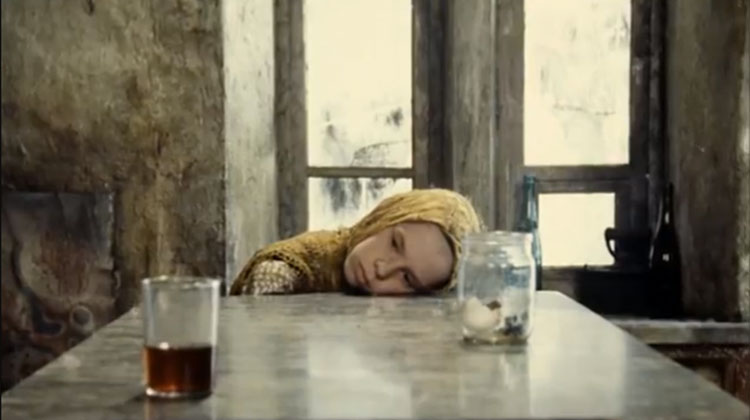
While I was visiting my bother in Palm Desert, we saw Andrei Tarkovsky’s Stalker, a film based on Arkady and Boris Strugatsky’s classic SF novel, Roadside Picnic. He did not like the film, which took 161 minutes to traverse a field and enter a building in search of a room.When one entered the room, one supposedly got all one’s wishes satisfied. Dan was bored by the film’s length, whereas I felt the film zipped by at light speed.

There is something about slow films, such as Carl Dreyer’s Day of Wrath and Ordet, Robert Bresson’s The Trial of Joan of Arc, and Yasujiro Ozu’s Tokyo Monogatari. The main characteristic of these films is a movement of spirit. If you follow this development, the film’s perceived slowness is imaginary.

In Stalker, one cannot just walk across the field and into the room. The interstellar aliens that landed in what is called “The Zone” change things around such that the stalker and the men who hired him to guide them must throw steel nuts bound in rags to check out the path ahead—and under no circumstances must they return the way they came. Several times, they pass a wall of old ceramic tiles, but in each case, the terrain around it is completely different.

The Stalker’s Daughter, Called “Monkey”

I am not saying you will love the film. I certainly do. But my brother, who shares so many film tastes with me, did not.If you demand fast action, you had best stick with CGI and Marvel Comics adaptations. But if you let yourself be guided by one of the greatest directors who ever lived, and follow the story line carefully, you will become one of Stalker’s fans.

Koizumi Yakumo

Lafcadio Hearn (1850-1904)

Martine is gone, and the terrible heat of the last ten days is slowly beginning to abate. I find that I am reading more than ever. (How much more can I read than I’m reading now, I do not know. So far eighteen books this month.) The most recent is by an American who became a Japanese. I refer to Lafcadio Hearn, who went under the Japanese name of Koizumi Yakumo. He married a Japanese wife, raised four children with her. It appears that I have many of Hearn’s books about Japan, which were published by Charles E. Tuttle & Company of Rutland, Vermont and Tokyo, Japan in paperback editions during the 1970s.

When I was traveling to and from Dartmouth College, I took a White River Coach from Hanover to White River Junction, and from hence another White River Coach to Rutland. At Rutland, I would wait for the Vermont Transit bus that would take me to Albany, New York, where I would board the New York Central night train to Chicago, which let me off in Cleveland. There, my parents waited for me.

Because of Tuttle’s proximity, while at Dartmouth I grew interested in Japanese culture. I attended an exhibit of Sesshu Toyo’s “Long Scroll” at Hopkins Center, and saw all the Japanese films that came my way. One of the best of them is Masaki Kobayashi’s Kwaidan (1965), made the year before I graduated.

Scene from Masaki Kobayashi’s Kwaidan (1965)

It is only now, more than fifty years after I graduated, that I picked up my copy of Hearn’s Kwaidan: Stories and Studies of Strange Things (1904) and began reading it with increasing enjoyment. The Kobayashi film took four stories from Hearn’s works, two of them from the book entitled Kwaidan. I was enthralled by Hearn’s stories, such that I can see myself picking the other Hearns off the shelf (I have almost ten of them) and reading them with intense pleasure. The book is not all ghost stories: At the end are three delightful essays about butterflies, mosquitoes, and ants as seen in Chinese and Japanese cultures.  Here is a brief excerpt from his essay on ants:

The work daily performed by these female [ant] laborers comprises road-making, bridge-building, timber-cutting, architectural construction of numberless kinds, horticulture and agriculture, the feeding and sheltering of a hundred varieties of domestic animals, the manufacture of sundry chemical products, the storage and conservation of countless food-stuffs, and the care of the children of the race. All this labor is done for the commonwealth—no citizen of which is capable even of thinking about “property,” except as a res publica;—and the sole object of the commonwealth is the nurture and training of its young,—nearly all of whom are girls. The period of infancy is long: the children remain for a great while, not only helpless, but shapeless, and withal so delicate that they must be very carefully guarded against the least change of temperature. Fortunately their nurses understand the laws of health: each thoroughly knows all that she ought to know in regard to ventilation, disinfection, drainage, moisture, and the danger of germs,—germs being as visible, perhaps, to her myopic sight as they become to our own eyes under the microscope. Indeed, all matters of hygiene are so well comprehended that no nurse ever makes a mistake about the sanitary conditions of her neighborhood.

In spite of this perpetual labor no worker remains unkempt: each is scrupulously neat, making her toilet many times a day. But as every worker is born with the most beautiful of combs and brushes attached to her wrists, no time is wasted in the toilet-room. Besides keeping themselves strictly clean, the workers must also keep their houses and gardens in faultless order, for the sake of the children. Nothing less than an earthquake, an eruption, an inundation, or a desperate war, is allowed to interrupt the daily routine of dusting, sweeping, scrubbing, and disinfecting.

For many years, much of what the West knew about Japan came from Hearn’s pen. I cannot imagine a more delightful introduction to any culture.

Are You Real?

Ana de Armas and Ryan Gosling in Blade Runner 2049

I am not used to saying nice things about sequels and remakes. The original Blade Runner (1982) was directed by Ridley Scott. In this sequel done thirty-five years later, Ridley Scott is listed as an Executive Producer. Could that be the reason that this sequel fits perfectly with the older film, and even shares several characters, most notably Harrison Ford as Rick Deckard.

If you are interested in seeing this film, I recommend that you not only see the original 1982 film, but read Philip K. Dick’s Do Androids Dream of Electric Sheep? Even though I have done both, I plan to re-read the Dick novel and see the Ridley Scott original within the next week or so.

Poster for the New Blade Runner 2049

What I love about this film is the philosophical question, “Is it real or is it a replicant?” (Replicants are robots, and a Blade Runner is a policeman who “retires” certain kinds of replicants who may be troublesome by assassinating them.) For most of the film, I kept asking myself whether Gosling as “K” is himself a replicant, as he seems to have some superhuman powers in a fight. The question is finally answered at the end, but I won’t spoil the ending for you.

Speaking as a Hungarian, I was pleasantly surprised to see that the film was shot in Hungary and that most of the crew and some of the cast were my fellow countrymen. This was the second film I saw this year that was shot in Hungary, and I’ve only seen a handful of new films. I wonder how much of a tendency this is getting to be.

There are images in this film that will stick with me, such as the ruins of Las Vegas and San Diego, the lovely female replicants who are available for monkey business (see illustration below), and the impassive face of Ryan Gosling.

Highly recommended!

A Projection of a Highly Available Replicant Tries to Persuade K

Twin Peaks

My Latest Discovery, 27 Years After the Fact

I have never been a big fan of television series—making time to watch them on a regular basis was too much of a drag on my time—but I have always been a big fan of David Lynch.I have loved all his films I have seen, even the strange Eraserhead (1977). Dune (1984) was something of a disappointment, but then came Blue Velvet (1986), Wild at Heart (1990), and all his subsequent work.

Over the last several weeks, I have slowly been going over the Twin Peaks (1990-1991) TV series. Even when it does not appear to make any sense, it is brilliant. The people of that strange little Northwestern town beggar all attempts at pat descriptions and then there is FBI Special Agent Dale Cooper, who has fallen in love with the town, its people, its coffee, donuts, and cherry pie. Not to mention Tibetan mysticism and dreams that provide answers to the crimes that have plagued the town.

In this country of ours, very little makes sense in a God-is-in-His-Heaven-and-all’s-right-with-the-world 19th century way. Does Trumpf make sense? Does our Senate and Congress make any sense? Very little, in fact.

The Log Lady of Twin Peaks

To date, I have seen the first thirteen of the thirty episodes that make up the show as it was in 1990-1991. (I am not into binge watching, because I tend to miss too much that way.) Whether I find out, definitively, who killed Laura Palmer does not matter to me. I am not looking for answers. What I am looking for are interesting questions, and the series delivers on this scorebig time!

Favorite Films: The Salvation Hunters (1925)

The Pimp, The Girl, The Child, and The Boy

The first film that director Josef von Sternberg made in the U.S. cost only $5,000 and had only eight characters, none of whom bore anything but descriptive names. We meet the three main characters—The Boy, The Girl, and The Child—at the docks in San Pedro, California, where the center of attraction is a huge dredge sucking up mud from he harbor to deposit into a barge. The Boy (George K. Arthur) makes several attempts to get a job, but to no avail. The Girl (Georgia Hale) hangs around the docks and is hit upon by an oafish character called, simply, the Brute. The Child (Bruce Guerin) is a young boy who is beaten by the Brute until the Boy saves him from his clutches. The three drift together, a kind of centripetal relationship in which they care for and defend one another, but do not have a dime.

When a black cat suddenly jumps out of a closed chest full of harbor mud, the three decide to leave for the city, which presents no improvement. It is full of smoke, telephone wires, and broken-down slums. Here they attract the attention of a pimp (called in the credits simply The Man) who offers them a seedy apartment next to one of his women. He then hangs around trying to figure how how to draw The Girl into the trade.

Georgia Hale as The Girl

Georgia Hale was cast by Charley Chaplin as the leading lady in his next film, The Gold Rush (also 1925). In The Salvation Hunters, she is remarkably beautiful without any make-up whatsoever. When she thinks of hooking for The Man, she uses a burnt-out match the accentuate her eyebrows and borrows a dab of lipstick from her neighbor.

This is the second time I saw The Salvation Hunters. The first time was at UCLA in the period 1968-1972. I was initially so impressed by von Sternberg that I wanted to do my master’s thesis on him. In fact, I visited the director at his house in Westwood around 1969 (the year in which he died)  and asked if he had access to any prints of his films which I could screen. He was actually very kind as a host, though his reputation is as something of an ogre. My friend Joe Adamson, who introduced the film at Cinecon 53 today, told of his answering questions of his painterly vision in film when he had taught at UCLA by saying, simply, “I did it because I am an artiste.” He wrote a book about his career entitled Fun in a Chinese Laundry, in which he takes a couple of hundred pages before mentioning, in a subordinate clause, that he was married.

Josef von Sternberg (1894-1969)

Von Sternberg is best known today for the films he made with his protegeé, Marlene Dietrich. Some of these are among the greatest films ever made. Included among them are:

  • The Blue Angel (1930)
  • Morocco (1930)
  • Dishonored (1931)
  • Shanghai Express (1932)
  • Blonde Venus (1932)
  • The Scarlet Empress (1934), my favorite of his films
  • The Devil Is a Woman (1935)

That said, I think all his films are worth seeing. Even if you may not like them, they will change the way you experience film.

I cannot but think that The Salvation Hunter was something of a flop in 1920s America: It depicted a European sense of allegory and universality (a la Murnau’s Sunrise) and poverty. It is not a film that is presented purely for your entertainment. But it is one of the best films made in that decade, along with several other von Sternberg offerings such as Underworld (1927), The Last Command (1928), and The Docks of New York (1928).

Anything Goes

Poster for Anything Goes

Today was my second day at Cinecon 53 (I skipped Saturday) and came with Martine this time. Today’s highlights were two zany musicals. The first was Anything Goes (1936) with music by Cole Porter and starring Bing Crosby, Ethel Merman, Charlie Ruggles, and Ida Lupino (as a blonde no less!). The action takes place on an ocean liner on which Bing is stowing away, because he thinks the lovely Miss Lupino is in danger. Notable is the role of Arthur Treacher as Lord Oakleigh, who is escorting Lupino for what Bing suspects are nefarious purposes. I could describe the plot in more detail, but then it was never intended to make sense. It is merely a rack onto which a number of great Cole Porter tunes are (dis)played to advantage.

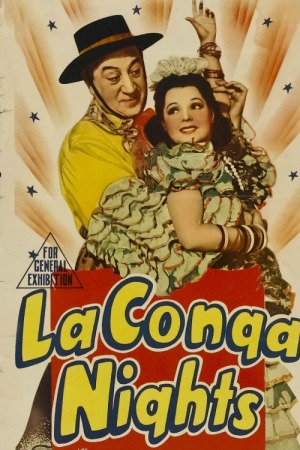
Universal’s La Conga Nights (1940)

The other loony movie was a 1940 quickie from Universal called La Conga Nights, with an even more improbable plot. First of all, the star is Hugh Herbert, who plays no less than six roles. Then there’s this boarding house which is laboring under an evacuation order for nonpayment of mortgage. The tenants, a musical set led by Dennis O’Keefe and Constance Moore, decide to turn the place into a nightclub called the Conga Room.

Neither of these films was slated for fame. They came out when Americans attended movie theaters in droves to see the hundreds of films that Hollywood cranked out year after year. Americans felt in their bones that there would be another war: Spain was already a demo zone for weapons from Germany, Italy, and Russia. But we had just survived a terrible depression, and people didn’t mind being a little silly. I wonder if the tendency will return with our having elected a president that is trying, under the rubric of “Make America Great Again,” to turn us into a Third World Country. So let’s laugh while we can!

An Unregenerate Auteurist

Film Critic Andrew Sarris (1928-2012)

Although I never met the man, he has made a lasting impression on my taste in films. It all started around 1964, when I was a student at Dartmouth College in Hanover, New Hampshire. I ran across the Spring 1963 issue of Film Culture magazine. Most of the contents was a 68 page article by Andrew Sarris, then movie reviewer for The Village Voice.  I remember photocopying the entire article while several other students fumed at the time I took to set up every page perfectly. In the end, I had the best survey of the work of American filmmakers then available.

My Original Encounter with the Auteur Theory

By the time I came out to Southern California, Sarris was working the same material into a book to be called The American Cinema: Directors and Directions, 1929-1968. The book became my bible, a guide to the real artists of the American cinema, the directors. In both the book and the Film Culture article, Sarris was adapting the work of critics at Cahiers du Cinéma and other French film magazines who were reacting to the French classical cinema and rediscovering American film.

I and my fellow auteurists at the UCLA Film Department ran into heavy opposition from the faculty, especially from my thesis adviser, one Howard Suber, whose idea of film criticism was to do a shot-by-shot analysis of Orson Welles’s Citizen Kane. I quickly discovered that the people who were most opposed to the auteur theory were not terribly interested in seeing films. In fact, they did not know very much about film. Where my friends and I were viewing upwards of fifteen films a week, I doubt that most of the UCLA professors saw that many in a year.

The Book Version of the 1963 Film Culture Article

Although over the years, my take on films has changed somewhat, I still love the great auteurs such as John Ford, Howard Hawks, Charley Chaplin, Josef Von Sternberg, Nicholas Ray, Orson Welles, Raoul Walsh, and Budd Boetticher. Now I am willing to admit that, in certain rare cases, the producer could be the main artist of the film. The only example I can think of offhand is Val Lewton, who as producer, created his own style that overrode such excellent directors as Jacques Tourneur, Mark Robson, and Robert Wise.

Yesterday, I attended the Cinecon 53 Classic Film Festival in Hollywood. The very best films were auteur classics: John Ford’s The Brat (1931), George Stevens’s Boys Will Be Boys (1932), and William S. Hart’s Shark Monroe (1918). But where I diverge from the auteurists is my enjoyment of some films by relative nobodies,. most particularly John Blystone’s Woman Chases Man (1937)—which ended up involving three directors and five writers—and Alfred S. Rogell’s No More Women (1934), itself a sequel to auteur director Raoul Walsh’s What Price Glory? (1926), starring the same leading actors.

There are indeed many terrible filmmakers whose work I would think nothing of walking out on. But at shows like Cinecon, there are some wonderful films by people I have never heard of.

Favorite Films: Paris Belongs to Us (1961)

Production Shot from Jacques Rivette’s Film with Françoise Prevost and Giani Esposito

They called it “The New Wave” as if half a century more would not pass and make a mockery of the term. It’s like those terms such as modernism and post-modernism. What’s next? Postpostmodernism? YetAgainModernism? It was definitely a new movement, breaking away from the stagy studio and going off into the streets of Paris. There were a whole slew of great directors, such as Jean-Luc Godard, François Truffaut, Claude Chabrol, Alain Resnais, Eric Rohmer, Agnes Varda, Louis Malle, and let us not forget Jacques Rivette.

Rivette spent three years in making Paris Belongs to Us (Paris nous appartient). I saw it several times in the 1960s and early 1970s, and I loved the film anew with each viewing. Then the film dropped out of sight. Today, I watched the Criterion Collection version and once again fell for it. Except, now I think I understand the film whereas before I was merely dumbly enthralled by it.

This is the ultimate conspiracy film. Betty Schneider (Anne) goes to a cocktail party where the suicide of a talented musician named Juan is discussed. The people we meet at this party will continue to play a part in the film. Anne next attends a rehearsal of a production of Shakespeare’s Pericles, Prince of Tyre directed by Giani Esposito (Gérard). She is offered the part of Marina, the daughter of Pericles; and Gérard begins to fall for her. Gérard’s girlfriend is the Sphinxlike Terry, who seems to ward off everyone. Anne goes in search of a tape that Juan had recorded for Pericles, and runs into several people who knew Juan. One of them is played by director Jean-Luc Godard (below).

Betty Schneider and Jean-Luc Godard at a Café

Other people begin to die mysteriously, including Gérard and even Anne’s brother Pierre. There is talk of a worldwide Fascist conspiracy, a theory fomented especially by Daniel Crohem as Philip Kaufman, an American fleeing the McCarthy hearings in the United States. How did Gérard die? Was it suicide, or was he murdered. It appears that Pierre was gunned down by Terry. Why? There are no clear-cut answers. There is only the persistent Betty, making the rounds of people who might know of Juan’s tape in the labyrinth that is Paris.

In the opening credits sequence of Paris Belongs to Us, there is a quote from the poet Charles Péguy: “Paris belongs to no one.” Now, as I write about this film, I want to see it again.


Musashi and the Flies

You Don’t Have to Draw a Sword to Prove Your Swordsmanship

I had forgotten the movie in which this scene took place until I viewed the DVD this morning. The great masterless samurai, Musashi Miyamoto (played by the redoubtable Toshiro Mifune), is holed up in a cheap inn in which a loud group of gamblers was partying. When Musashi’s disciple, Jotaro, goes out and tells them to shut up, they decide to teach Musashi a lesson. They charge up he stairs to his room, where Musashi is calmly eating a dish of noodles with his chopsticks. He is not much bothered by the gamblers, but he is irritated by the flies buzzing around him and his meal. Without sparing a glance elsewhere, he reaches out with his chopsticks and kills several flies, one after the other. The gamblers are awestruck at Musashi’s demonstration of icy control and quietly back out of his room. In fact, their ringleader, Kumogoro, insists on becoming Musashi’s disciple.

The film is Duel at Ganryu Island (1956), the third film in Hiroshi Inagaki’s Samurai trilogy.

Although the Inagaki trilogy is by no means the greatest of samurai films, I have so many happy memories of seeing the films that I have invested them with perhaps more merit than they deserve. They are, in fact, quite good—particularly at influencing a 21-year-old who had just arrived in Los Angeles and found the whole genre congenial to him.