The Approach to J. L. Borges

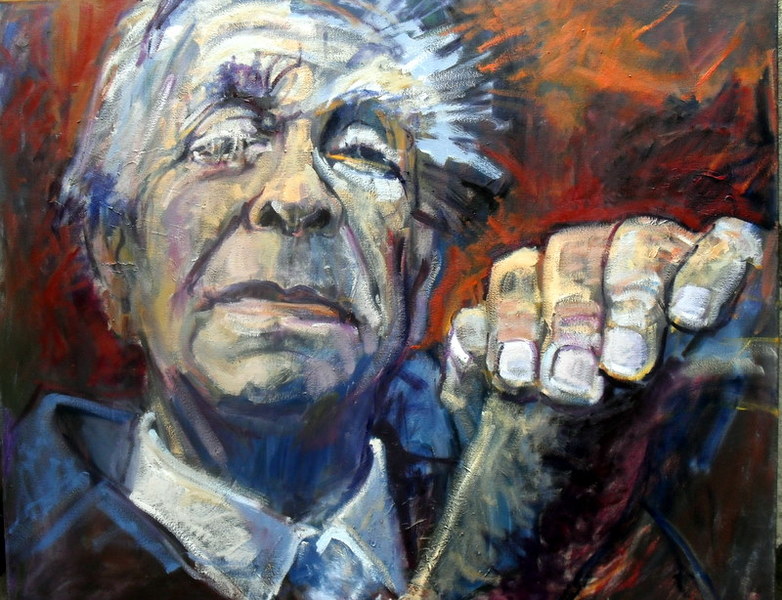
Argentinian Author and Poet Jorge Luis Borges

Argentinian Author and Poet Jorge Luis Borges

In 1935, Jorge Luis Borges wrote a story entitled “The Approach to al-Mu’tasim.” In it, he writes of a man who, after a religious riot between Hindus and Muslims, “becomes aware of a brief and sudden change in that world of ruthlessness—a certain tenderness, a moment of happiness, a forgiving silence in one of his loathsome companions.” He concludes that “somewhere on the face of the earth is a man from whom this light has emanated; somewhere on the face of the earth there exists a man who is equal to this light.”

For me, the source of that light—at least in the world of 20th Century literature—is Jorge Luis Borges himself. I have read all his works that have been translated into English, and even the many interviews he conducted toward the end of his life. I am now on the lookout for ever more obscure works … and I think I have found a good candidate.

The book is by Argentinian author and filmmaker Edgardo Cozarinsky, and its title is Borges In/And/On Film (New York: Lumen Books, 1988). Its three parts consist of:

  1. Reviews of films written by Borges before his blindness became total in the 1950s.
  2. The influence of Borges on film critics and filmmakers (mostly French).
  3. A survey of films based on Borges’s stories or scripts.

The parts become decreasingly interesting from one part to the next. He had a curious liking for the films of Josef von Sternberg—before that director had discovered Marlene Dietrich. Afterwards he regards him as “a devotee of the inexorable Muse of Bric-à-Brac.” Reviewing an Argentinian film, Borges writes it “is unquestionably one of the best Argentine films I have seen, which is to say, one of the worst films in the world.”

Of Citizen Kane, he writes that it “suffers from gigantism, from pedantry, from tediousness. It is not intelligent, it is a work of genius—in the most nocturnal and Germanic sense of that bad word.”

Of Victor Fleming’s version of Doctor Jekyll and Mr. Hyde, Borges complains that he “avoids all surprise and mystery; in the early scenes of the film, Spencer Tracy fearlessly drinks the versatile potion and transforms himself into Spencer Tracy, with a different wig and Negroid features.”

Although Borges did no write many film reviews, many of his observations are interesting. He also has made one notable howler: Recalling Sergei Eisenstein’s Battleship Potemkin (1925), he writes:

Thus, in one of the noblest Soviet films, a battleship bombards the overloaded port of Odessa at close range, with no casualties except for some marble lions. The markmanship is harmless because it comes from a virtuous, maximalist battleship.

It is not the Potemkin that bombards Odessa, but the Czarist Black Sea Fleet, whose shooting results in a massacre.

The above painting is the work of Beti Alonso.

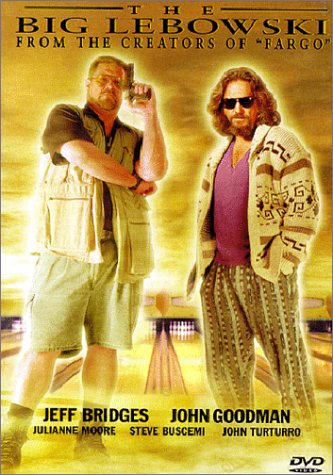
Favorite Films: The Big Lebowski (1998)

The Dude Abides

The Dude Abides

There are few films that have been produced in the last twenty years that do for me what The Big Lebowski by the Coen Brothers does. In the last thirty days, I have seen it twice; and Im still drawn in by it.

This is a film about mistaken identities and incorrect snap judgments. “The Dude” is Jeff Lebowski (played by Jeff Bridges), an unemployed layabout who loves to bowl. He is confused for a more wealthy Jeff Lebowski, whose young trophy wife has supposedly been kidnapped. One of the Dude’s bowling partners is Walter Sobchak (John Goodman), a harebrained security consultant who is a poster boy for making bad decisions. The two get drawn into the kidnap plot, but things go from bad to worse—until Donny (Steve Buscemi), also on the Dude’s bowling team, dies when the Dude and Walter and confronted by the kidnappers.

Along the way are such great bit parts as Jesus Quintana (John Turturro), a egomaniacal bowler; Maude Lebowski (Julianne Moore), the other Lebowski’s daughter; Bunny Lebowski (Tara Reid), the trophy wife; and the Stranger (Sam Elliott), who runs into the Dude at the bowling lanes.

A Poster for the DVD Release of the Film

A Poster for the DVD Release of the Film

What is it about the film which has such a strong appeal for me? Probably it is because The Big Lebowski captures the whole Southern California lifestyle with accuracy and feeling. There are bowlers, millionaires, porno film producers, twisted cops, nihilists, wacko artists, and even a detective who seems to have lost his way. Oddly, Joel and Ethan Coen are New Yorkers who do not look down on L.A. as the land of mashed yeast and right turns at red lights: It looks as if they had actually spent some time here profitably.

I don’t guarantee that the Dude will do for you what he has done for me, but I think he just might.

Playhouse 90

Rod Serling with Playhouse 90 Logo

Rod Serling with Playhouse 90 Logo

Almost sixty years ago to the day—on October 4, 1956—CBS presented its first Playhouse 90. It was called “Forbidden Area,” written by Rod Serling, directed by John Frankenheimer, and starring the likes of Charlton Heston, Tab Hunter, Diana Lynn, Vincent Price, Victor Jory, and Charles Bickford.

As he did later with Twilight Zone, Serling takes us to the heart of the Cold War and a projected Christmas Eve nuclear attack by the Soviet Union on major cities across the United States. Charlton Heston is trying to discover why eight B-99s of the Strategic Air Command suddenly disappeared without a trace from radar screens.

Playhouse 90 was live television: There were no rehearsals. While American viewers were watching, the actors were acting. As difficult as it was, this was the Golden Age of Television. Now there are hundreds more channels, dozens of content providers, and tens of millions more viewers, what they are watching is nowhere near as good as during those heady days of the 1950s and the early 1960s.

I love television as it used to be. As it is today, I would rather leave the remote to Martine and go read a good book.

Tonight, the UCLA Film & Television Archive put on a double bill of Playhouse 90 episodes written by Serling. It was introduced by Matthew Weiner, creator of Mad Men, who gave an excellent speech about why those days were the artistic pinnacle of television as an art medium.

Favorite Films: La Belle et la Bête

Jean Marais as the Beast and Josette Day as Beauty

Jean Marais as the Beast and Josette Day as Beauty

Today was probably the tenth or fifteenth time I have ever viewed Jean Cocteau’s La belle et la bête (1946). Each time, I was enthralled by the magic; and, today, for the first time I introduced Martine to the film, fearing that she wouldn’t like it. She loved it! So much so that she asked about Cocteau’s other films.

The version Cocteau used was written by Jeanne-Marie Leprince de Beaumont and published in 1757 along with other fairy tales. Cocteau seems to have set the story in the 17th century. Riding horseback to town through the forest to inquire about his merchant ships, which were overdue in port. On his way back, he stops at a magical castle, from whose gardens he cuts a rose to give to his daughter Belle. At once, he is confronted by the beast, who demands either his life or that of one of his daughters.

Here the story seems almost to merge with the Cinderella fairy tale, in that Belle’s two sisters  are vain and selfish. But Belle returns (via a magic horse called La Magnifique) to the Beast’s castle. The Beast falls for her and tells her that he requests to have dinner with him once a day at seven o’clock, whereupon he would ask if she would become his wife.

In the end, she falls for the Beast. Once she pledges her troth to him, he is transformed into a resplendent prince who flies away with her through the air.

The strength of the film is Cocteau’s devotion to the magic of the story. In the film prologue, he writes:

Children believe what we tell them. They have complete faith in us. They believe that a rose plucked from a garden can bring drama to a family. They believe that the hands of a human beast will smoke when he kills a victim, and that this beast will be shamed when confronted by a young girl. They believe in a thousand other simple things. I ask of you a little of this childlike simplicity, and to bring us luck, let me speak four truly magic words, Childhood’s Open Sesame: “Once upon a time…”

Over the last fifty-odd years, this film has become a perennial favorite of mine. The nobility of Jean Marais in the role of the Beast and the loveliness of Josette Day as Belle have become hard-wired in my brain.

I highly recommend seeing this film either on the big screen or the Criterion DVD version (which I saw today). It is one of the evergreen masterpieces of the cinema.


Walk Like an Egyptian

Part of the Painted Facade of Grauman’s Egyptian Theater in Hollywood

Part of the Painted Facade of Grauman’s Egyptian Theater in Hollywood

If it’s Labor Day weekend, it’s also time for the 52nd Annual Cinecon Classic Film Festival. So Martine and I invaded Hollywood, parked our chariot at Loew’s Hollywood Hotel, and proceeded to view several newly restored films at Grauman’s Egyptian Theater. These included:

  • An episode of a hokey old serial called Jungle Mystery.
  • Three Laurel & Hardy rareties, including Berth Marks and Come Clean.
  • A silent comedy called More Pay—Less Work from 1926.
  • A Columbia film released during World War Two which uniquely accuses the Nazis of atrocities against the Jews: None Shall Escape (1944) starring a radiant Marsha Hunt and directed by Andre de Toth.

Cinecon has thinned out a bit since last year. President Robert S. Birchard, having served in that capacity since 1998, died of a heart attack in May. Many such as my late friends Norman Witty and Lee Sanders had also passed on. Every year, there are more canes and more geriatric ailments in evidence. The pity of it is that Cinecon has difficulties recruiting younger members, who would consider the restored 1920s and 1930s films as ancient history. The organization would have to move more into the 1950s-1970s to get the attention of Generation Xers, not to mention Millennials.

The Hollywood Walk of Fame

The Hollywood Walk of Fame

Hollywood itself was filled with young tourists of the tattooed and pierced variety who sashayed up and down the street shooting pictures of the commemorative stars on the sidewalk with their cell phones. On holiday weekends, the Boulevard is a big-time crowd scene, with scores of tour buses taking them to see homes of the rich and famous—or whatever it is they show them. Whenever they accost me for a tour, I offer to give it myself, saying “Hey, I live in this dump!”


Licenced to Die in Droves

Moonraker’s Hugo Drax (Michel Lonsdale) and Minions

Moonraker’s Hugo Drax (Michel Lonsdale) and Minions

I have been slogging through Ian Fleming’s James Bond novels—for the first time since my college years. (Instead of studying for my English Comprehensive Exams at Dartmouth, I was picturing myself as an ultra-suave British spy licensed to kill.)

But what about all those uniformed minions in yellow or orange that were to be found working for such supervillains as Dr. No or Hugo Drax or Auric Goldfinger or Ernst Stavro Blofeld. I wonder how they advertised for them:

“Work for destruction of earth for Bond supervillain. Must be willing to be shot dead or blown up in the last reel. Snazzy yellow (or orange) uniform and sexy short dresses for the babes. Absolute loyalty to lost causes and total lack of moral compass required. GOP registration a plus. Apply Box GX-1234.”

In the end, these minions almost always went down with the ship or secret laboratory or supervillain’s hideout. There wasn’t enough screen time to show how each and every uniformed minion met his or her violent end, but the corridors were sure to be running with blood.


The Black Finger Cult

Indulging in Past Favorites

Indulging in Past Favorites

Not two weeks ago, I wrote a post about one of my favorite Japanese actors, Raizo Ichikawa, particularly as he appeared in a 1960s series called variouslythe Kyoshiro Nemuri films and “The Sleepy Eyes of Death.” Since then, I checked out eBay and found that the whole series of twelve films was available for just over a hundred dollars in Zone 1 DVD format. Naturally, I wasted little time in buying the set.

Tonight, I watched my favorite title, Trail of Traps (1967) directed by the underrated Kazuo Ikehiro. I sat entranced as Kyoshiro walked his way between Tokyo (called Edo in those days) and Kyoto, carrying a statue of the Virgin Mary for safekeeping. Along the way, he is seduced several times—Kyoshiro is, after all, an anti-hero—and attacked by a group of devil worshiping baddies who call themselves the Black Finger Cult.

It’s nice to feel the same way after almost half a century about a film one loved to distraction back in the day. Raizo Ichikawa was indeed an excellent actor, and the Daiei Studio people did a great job putting the series together.

Too bad Raizo had to die so young. I think he was even more promising than James Dean.


Favorite Actors: Raizo Ichikawa

Raizo Ichikawa in His Role of Kyoshiro Nemuri

Raizo Ichikawa in His Role of Kyoshiro Nemuri

The most famous Japanese actors appearing in samurai pictures are Toshiro Mifune and Tatsuya Nakadai. There is also a third name, far less familiar to American audiences: I am thinking of the late Raizo Ichikawa (1931-1969), star of jidai-geki productions from the Daiei Studio.

My favorite character he played was that of Kyoshiro Nemuri, a.k.a. “The Sleepy Eyes of Death,” a Japanese born of a Christian father during a black mass, He is also referred to as a Son of the Black Mass. In his films, he regards the Christians baptized by the Portuguese as hypocrites.

His signature sword move was the Half-Moon Cut, against which his opponents were all but powerless. Note the strange cross symbol on his costume.

Raizo as Kyoshiro Nemuri

Raizo as Kyoshiro Nemuri

Now that I am semi-retired, I would like to pick up as many of the Kyosiro Nemuri films as I can find. It wouldn’t be too difficult, but I would definitely need English subtitles.

During the 1960s and 1970s when I went downtown with friends to the Sho Tokyo and Kokusai theaters (which played nothing but Daiei films) on an almost weekly basis, I always considered myself lucky to see Ichikawa in any role, but especially as Kyoshiro Nemuri. The directors of the series included such names as Kazuo Ikehiro (the best), Kenji Misumi, and Issei Mori.

Unfortunately, Daiei and most of the other Japanese studios disappeared during the obscene run-up in real estate values from 1986 to 1991. More’s the pity. During the 1960s, I believe that the best films that were being made anywhere were the Japanese samurai pictures. And Raizo Ichikawa was, to my mind, the best of the actors.

My Japanese Years

Mifune Toshiro in Hiroshi Inagaki’s Duel at Ichijoji Temple

Toshiro Mifune in Hiroshi Inagaki’s Duel at Ichijoji Temple

It all came back to me while I had a Japanese meal with Martine at the Aki Restaurant in West Los Angeles. When I first came to Los Angeles in late 1966 I quickly became a Nipponophile. I lived for a while on Mississippi Avenue in the middle of the Sawtelle neighborhood, the old Japanese plant nursery district. Even before I started my explorations of Mexican food, I started becoming a Japanese foodie. I even thought the little tofu cubes in my miso soup were shark’s fin. (I marveled at my sophistication in eating “shark’s fin” soup.)

Since i was a graduate student in film at UCLA, I made a point of seeing as many Japanese films as I could. I remember taking the MTA #81 bus down Wilshire Boulevard to La Brea and walking a couple blocks south to the old Toho La Brea theater. The first films I saw there were Hiroshi Inagaki’s Miyamato Musashi (based on Eiji Yoshikawa’s novel) trilogy: Samurai (1954), Duel at Ichijoji Temple (1955), and Duel at Ganryu Island (1956). I fancied myself falling love with the sweet Kaoru Yachigusa, who played the part of Otsu; and of course I hero-worshipped Toshiro Mifune as the hero of he saga.

The Toho La Brea theater had a clock over the left emergency exit that was illuminated with the words Sumitomo Bank. All features were preceded by an Asahi Shimbun newsreel in Japanese without subtitles. Although I couldn’t understand a word, I looked forward to the newsreels.

A few years later, I joined with my film freak friends in visiting the other Japanese theaters in town: the Kokusai and Sho Tokyo (both Daiei studio), Kabuki (Shochiku), and the Linda Lea (Tohei). Today all five Japanese theaters are gone.

By the way, ever wonder why I call this website Tarnmoor? That was a pseudonym I used along with two of my friends in a UCLA Daily Bruin column entitled “The Exotic Filmgoer,” which was mostly about these Japanese theaters.

99¢ Triple Features—All Night

The Palace Theater on Broadway

The Palace Theater on Broadway

During the late 1960s, when I was a film student at UCLA, I felt I had to catch up fast in my knowledge of American films. After all, it was foreign films like Carl Dreyer’s Day of Wrath (1948) and Akira Kurosawa’s Seven Samurai (1957) that introduced me to what the film medium could do.

So I went with my late friend Norm Witty to see the 99¢ triple features at the remaining movie theaters on Broadway downtown. Most of these theaters are no longer showing films, though at one time it represented the highest concentration of movie theaters in the U.S.; it was called the Broadway Theater District. It included the Cameo, the Tower, the Palace, the Los Angeles, the Arcade, the Roxie, and the Olympic theaters (though the last one was located on West 8th Street). Most of them ran movies all day and all night, usually as triple features.

Even back then, most of the patrons were just intent on getting a good night’s sleep in a theater seat that wasn’t too sticky or dirty. The rest rooms were something of a horror, and the refreshments were pretty disgusting. The worst of all was the Arcade, which we went to only once.

Poster for Universal’s The War Lord (1965)

Poster for Universal’s The War Lord (1965)

Probably the best film I saw on these all-night excursions was a Universal picture starring Charlton Heston, Richard Boone, and a radiant Rosemary Forsyth called The War Lord (1965). Heston and Boone are two Norman knights who take control of a Saxon village. Heston falls in love with Rosemary Forsyth, a Saxon maiden who is betrothed to another villager. When he exercises the jus primae noctis (“the right of the first night”) and demands the right to bed her before her betrothed, the Saxons begin to mutter. But then Heston decides to keep her, and war breaks out. Franklin Schaeffner directed the film, which is still worth seeing when it comes around.