The Story of Will Rogers

Lobby Card from the Film The Story of Will Rogers

Lobby Card from the Film The Story of Will Rogers (1952)

It has become a tradition for Martine and me to attend the annual outdoor screening each August to mark the anniversary of the star’s death in a 1935 Alaska airplane accident. This year, it was held last Friday. The event is co-sponsored by the Will Rogers Ranch Foundation, to which we belong, and the Will Rogers Motion Picture Pioneers Foundation. This year, instead of screening a film starring Will Rogers, we got a film about Will, starring Will’s son, Will Jr., who is a dead-ringer for his father.

The Story of Will Rogers is an A-list film starring not only Will Jr., but Jane Wyman as Betty Rogers and a great cast of supporting actors, including James Gleason, Slim Pickens, Noah Beery Jr, and Mary Wickes.

As usual, the film was screened outdoors as soon as the sky darkened (around 8 pm). The audience sat around on either blankets or (like us) chairs that we brought from home with us.

I have always thought that Will Rogers was, in many ways, the ideal American. Not only did he have Cherokee blood from both his parents, but his sense of humor was completely non-partisan. Everyone got gored—and fairly, too!

Just to leave you with one of his thoughts: “Too many people spend money they haven’t earned, to buy things they don’t want, to impress people they don’t like.”

The Endless Trek

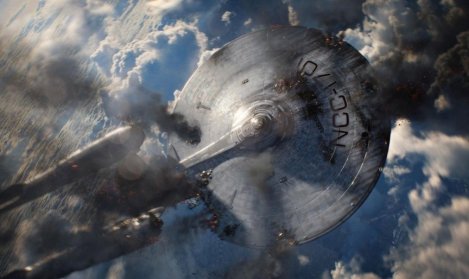
The Immortal NCC-1701

The Immortal NCC-1701

Today I saw Star Trek Into Darkness—by myself because Martine refuses to see any film that’s over ninety minutes long. I had wanted to see the film because, well, I’m sort of a Trekkie. No costumes or anything like that. Perhaps I just have a hankering for green women.

While I enjoyed the film for the most part, all the CGI work bored me. I have no doubt that most of the production money was spent on scenes that meant nothing to me. Ever since the original Star Wars, space ships have been at least as big as the Burj Kalifa (the world’s tallest building, these particular fifteen minutes) and have featured leagues of heavy metal whose mining would have reduced Planet Earth to the size of an inconsequential cinder. What I want to know is: Who did all the dusting and mopping?

On the plus side, the acting was pretty good, with Chris Pine as a believable, super-insubordinate James T. Kirk; Zachary Quinto as the son of the Leonard Nimoy Spock (that seems to go against the chronology, as this takes place before the Shatner/Nimoy original); John Cho as a fearsome Sulu; and Alice Eve (below) as an exceptionally cute addition to the Enterprise.

Alice Eve in a Gratuitous but Welcome Cheesecake Shot

Alice Eve in a Gratuitous but Not Unwelcome Cheesecake Shot

What worked best were when Director J. J. Abrams paid homage to the original series. Referred to in this version were The Wrath of Khan and the TV episode on which it was based (“Space Seed”), and also the TV episode entitled “The Trouble with Tribbles.”

In the end, I think Star Trek Into Darkness was a good addition to the franchise, but no masterpiece.

Favorite Films: Pickpocket (1959)

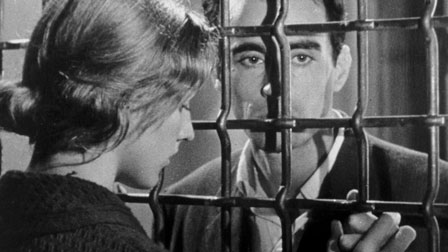
A Still from Robert Bresson’s Pickpocket

A Still from Robert Bresson’s Pickpocket with Martin LaSalle

One film I will never tire of watching is Robert Bresson’s Pickpocket (1959). At a time when the French New Wave was in full flower, it was a resolutely old-fashioned film that was—in my opinion—better than any of the New Wave films. It starred two unknowns, the Uruguayan Martin LaSalle and Marika Green, and shows how a young man (who looks startlingly like a young Henry Fonda) falls in with a pickpocketing gang, and with a young woman who loves him.

Bresson only made a handful of films, but fully half of them are among the greatest films ever made. As I say this, I have to interject that you may or may not think as highly of him as I do: His films may seem preternaturally slow, but there is an unmistakeable development of character that seems missing altogether in the films of today. Pickpocket’s Michel and Jeanne are deeply, even tragically, in love with each other, in a world where crime seems to be the only way to get ahead.

If you are interested in seeing some of Bresson’s films, I highly recommend the following titles:

  • Diary of a Country Priest (1951)
  • A Man Escaped (1956)
  • The Trial of Joan of Arc (1962), based on the original trial records
  • Au Hasard Balthazar (1966)
  • Mouchette (1967)
  • Lancelot of the Lake (1974)

Bresson died in 1999, but his films will never die.

William of Lugos

BelaLugosiHeadstone

Headstone of Bela Lugosi at Holy Cross Cemetery in Culver City

His real name was Béla Ferenc Dezsö Blaskó, but that didn’t sound cool enough for the title role in Universal Pictures’ new film Dracula (1931). Béla, or William as it’s translated into English, was born in Lugos in then Austro-Hungarian Empire. Now it is known as Lugoj and is located in Rumania. And, just so you know, in Transylvania, near Timisoara, known by the Hungarians as Temesvár. So Béla Lugosi is none other than William of Lugos.

By the way, his name is really pronounced BAY-lah LOO-gauche-ee, with the accent on the first syllable of first and last name.

Martine has always loved Lugosi’s acting. In fact, on her favorite sweater, she wears a metal pin of a 32¢ stamp issued in his honor, as shown below:

1997 USPS Stamp Commemorating Famous Monsters of Hollywood

1997 USPS Stamp Commemorating Famous Film Monsters of Hollywood

Martine has a set of DVDs for Lugosi’s films; and when we visit Holy Cross Cemetery, we always check out his grave on a hillside near a grotto.

It always surprises me how many famous people don’t have any flowers or other marks of family or fan affection by their graves. Note, however, that there is a little votive candle by the bottom right of Béla’s headstone.

Triptych

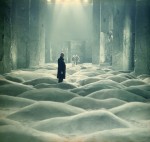
Last Scene from Andrei Tarkovsky’s Film Stalker

Last Scene from Andrei Tarkovsky’s Film Stalker

The following is adapted from my review of Geoff Dyer’s Zona: A Book About a Film About a Journey to a Room as posted to Goodreads.Com.

What we have here is a triptych: three linked works of art, one loosely based on the other. First there was Boris and Arkady Strugatsky’s Roadside Picnic (1972), perhaps the most memorable of the Russian brothers’ science fiction novels. Then came Andrei Tarkovsky’s film Stalker (1979), ostensibly based on it and, in fact, employing the Strugatsky brothers as screenwriters. Now there is Geoff Dyer’s long essay entitled Zona: A Book About a Film About a Journey to a Room. This last is in a genre by itself, an extended commentary retelling the story of the film with lengthy footnoted riffs about how the film has impacted Dyer’s life and imagination.

All three works are masterpieces in their own right. I have now read both books as well as seen the film, and I yearn to reacquaint myself with all three of them.

Is there something perhaps a little perverse about writing a ruminative essay about something that comes from something else. Have we somehow put ourselves too many removes from the original work by the Strugatsky brothers? Or does it matter, inasmuch as both Stalker and Zona are totally absorbing, as was Roadside Picnic.

Perhaps I should draw back a little and give you some idea of the world of the composite work of art I think of as “The Roadside Stalker Zone.” We are some time in the future, in a grimy post-industrial wasteland in a small country near an area once visited by extraterrestrials who just happened, for whatever reason, to leave strange inexplicable things behind—including a room in a deserted building which, if you enter it, grants all your innermost desires. (Never mind that the only known person to have visited it, a man code-named Porcupine, hanged himself shortly thereafter.)

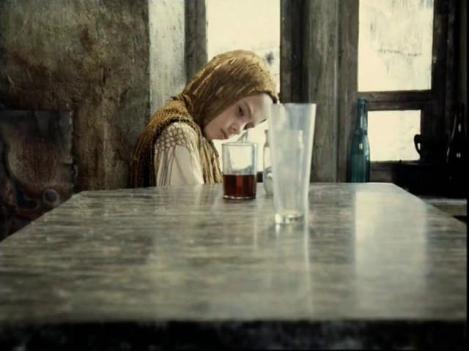
These zones formerly visited by the extraterrestrials (who have all moved on without getting their visas stamped) have been sealed off by the authorities. But there is an active group of individuals called stalkers who, in contravention of the law, take people to visit the zones and perhaps bring some things back—things which are marvelous and inexplicable. The children of these stalkers are themselves strange, like Monkey, the film’s Stalker’s daughter (shown above), who has the power of telekinesis, which we do not learn until the very end of the film.

Stalker takes two individuals, referred to in the film only as Professor and Writer, into the zone. Their journey is a journey of self-discovery. Do they enter the room? I do not wish to spoil the story for you, so I urge you to consume the entire triptych, in order of publication or release, to come to the same realization that I have arrived at: That Geoff Dyer is a phenomenal writer whose work I am going to enjoy reading in the months and years to come.

Feature Attractions

4.2.3

Tarkovsky’s Stalker

This long tracking sequence, following the trolley as it clanks and clangs along, is the most straightforward journey imaginable—horizontal, flat, right to left, in a straight line—and full of all the promised wonders of cinema. That’s what we are being sold in the trailers that precede what used to be called the “feature presentation”. Unfortunately, this has become the most debased wonder in the history of the earth. It means explosions, historical epics in which the outcome of the Battle of Hastings is reversed by the arcane CGI prowess of Merlin the Magician, it means five-year-old children turning suddenly into snarling devils, it means wrecking cars and reckless driving, it means a lot of noise, it means I have to time my arrival carefully (twenty minutes at least) after the advertised programme time if I am to avoid all this stuff which, if one were exposed to it for the full hour and a half, would cause one’s capacity for discernment to drop by fifty percent (or, conversely, one’s ability to tolerate stuff like this to increase a hundredfold). It means sitting there shaking one’s middle-aged head; it means that one is wary about going to the cinema. It means that there are more and more things on the street, in shops, on-screen and on telly from which one has to avert one’s ears and eyes.—Geoff Dyer, Zona

Les Mis(sables)

The Good, the bad, and the Ugly

The Good, the bad, and the Ugly

To begin with, I never saw the Broadway musical upon which this movie is based, so my discussion of it is based solely on the movie, with some surviving memories of Victor Hugo’s novel.

The movie had some problems which detracted from my enjoyment. Most particularly, it is startling to have a film shot almost entirely in close-up. I know the scene is, for the most part, fairly gritty; but I am more familiar with the dermatological issues of some rather well-known cast members as Hugh Jackman (Jean Valjean), Russell Crowe (Javert), Anne Hathaway (Fantine), and Amanda Seyfried (the grown-up Cosette) than I ever wanted to be. Gad, I would hate to see my face plastered across eighty feet of screen at a cinema.

A second issue I had with Les Misérables was that it was 100% sung. Now I don’t mind that with a great opera, but with a musical—especially one that runs almost three hours—I would appreciate some plain spoken lines. Especially when most of the people in the cast would scarcely last more than thirty seconds in a grand opera audition.

Finally, most of the film consists of night scenes. There is something about a color film that demands more light: Otherwise everything begins to look brown after a while.

Some of the supporting roles were excellent, especially Sacha Baron Cohen (?!) and Helena Bonham Carter as the thieving Thénardiers. In the Revolution of 1832 scenes, there was a superb child actor, Daniel Huttlestone, playing the part of the urchin Gavroche. And the ending actually brought some tears to my eyes, as sentimental and overblown as it was.

All in all, Les Misérables is a mixed bag. You may enjoy it, or you can just as easily mis [sic] it.

Best American Films By Year, Part Three

Poster for The Wild Bunch (1969)

Poster for The Wild Bunch (1969)

This is the final installment of my series on The Best American Films By Year series, from 1915 to 1980. Why do I stop with 1980? Essentially, I think that by then, most of the great American directors were either not working or had passed on. As in the other postings, I begin with the choice of my friend Lee Sanders, who has seen far more films than I have.

Lee’s list stops at 1977. The choices for 1978-1980 are all my own.

When there is a second choice, it’s my selection when I have either not seen Lee’s choice or have my own preference. My choices are shown in red.

1961 – Two Rode Together (John Ford)
1962 – The Man Who Shot Liberty Valance (John Ford)
1963 – The Birds (Alfred Hitchcock)
1964 – Marnie (Alfred Hitchcock)
1965 – Red Line 7000 (Howard Hawks); Inside Daisy Clover (Robert Mulligan)
1966 – Seven Women (John Ford)
1967 – El Dorado (Howard Hawks)
1968 – The Legend of Lylah Clare (Robert Aldrich)
1969 – Once Upon a Time in the West (Sergio Leone); The Wild Bunch (Sam Peckinpah)
1970 – On a Clear Day You Can See Forever (Vincente Minnelli); Patton (Franklin Schaeffner)

1971 – The Grissom Gang (Robert Aldrich); They Might Be Giants (Anthony Harvey)
1972 – Travels With My Aunt (George Cukor); The Godfather (Francis Ford Coppola)
1973 – American Graffiti (George Lucas)
1974 – The Tamarind Seed (Blake Edwards); Godfather II (Francis Ford Coppola)
1975 – Night Moves (Arthur Penn); The Man Who Would Be King (John Huston)
1976 – A Matter of Time (Vincente Minnelli); Taxi Driver (Martin Scorsese)
1977 – Twilight’s Last Gleaming (Robert Aldrich); 3 Women (Robert Altman)
1978 – Days of Heaven (Terrence Malick)
1979 – Apocalypse Now (Francis Ford Coppola)
1980 – Popeye (Robert Altman)

And that’s how the American Cinema ended, not with a bang but a whimper….

Sunday Movie Interlude

Ben Affleck, Star and Director of ARGO

It’s so rare for me now to see a film that is currently playing—and by the look of it, it’s nearing the end of its run—that I thought I would write about it. What makes it doubly rare is that both Martine and I liked the film.

When I asked her as we walked out of the theater whether she liked the film, Martine answered that she thought it was all made up. Then she mentioned she knew one of the six people who worked at the embassy who escaped imprisonment by the Ayatollah Khomeini’s Revolutionary Guard because her real name was used in the film: It was Cora Lijek, one of Martine’s algebra classmates from her high-school days in West Long Branch, New Jersey.

When we got home from the theater, we looked up the story of the Teheran embassy hostage crisis: Sure enough, Martine saw that the story of the six who hid out at the Canadian ambassador’s residence really happened. You can see for yourself by clicking on Wikipedia. The article there actually names names and gives details of which embassy employees were captured, which released early by the Ayatollah, and which escaped by hiding out as guests of the Canadian government.

As for the film itself, it was strictly an edge-of-the-seat tale, with a liberal admixture of humor, especially in the scenes with John Goodman and Alan Arkin as filmmakers. Ben Affleck plays the role of Tony Mendez, a CIA specialist in getting people across borders. He concocts a seemingly far-fetched idea of pretending to be a Canadian film crew filming a sci-fi fantasy epic in Iran and providing the six escapees with fake Canadian passports and new identities as members of the film crew scouting out locations for the upcoming production of a film to be called Argo.

The actual film called Argo is definitely worth seeing. If Affleck has any more films like this in his plans, he may well become one of our more interesting directors, of which there are so few in Hollywood.


Best American Films By Year, Part Two

John Wayne in The Searchers

In this posting, I continue my list of “The Best American Films By Year” covering the period 1915 to 1977. What I am going from is a list produced by my friend Lee Sanders, with whom I am in substantial agreement. When there are two films for a particular year and the second one is in red, the second one is because I disagree with Lee’s choice (which you will find is not too often). Below is the continuation of the list from 1941 to 1960:

1941 – How Green Was My Valley (John Ford)
1942 – The Magnificent Ambersons (Orson Welles); Casablanca (Michael Curtiz) – Lee actually had both films tied; I prefer the second
1943 – Air Force (Howard Hawks)
1944 – Meet Me in St. Louis (Vincente Minnelli)
1945 – They Were Expendable (John Ford)
1946 – My Darling Clementine (John Ford); The Big Sleep (Howard Hawks) – Lee had both films tied, a decision with which I agree.
1947 – Pursued (Raoul Walsh); Out of the Past (Jacques Tourneur)
1948 – Letter from an Unknown Woman (Max Ophuls)
1949 – Caught (Max Ophuls); She Wore a Yellow Ribbon (John Ford)
1950 – Rio Grande (John Ford)

1951 – On Dangerous Ground (Nicholas Ray); Strangers on a Train (Alfred Hitchcock)
1952 – The Quiet Man (John Ford)
1953 – The Bandwagon (Vincente Minnelli)
1954 – The Sun Shines Bright (John Ford)
1955 – Rebel Without a Cause (Nicholas Ray)
1956 – The Searchers (John Ford)
1957 – Written on the Wind (Douglas Sirk)
1958 – Vertigo (Alfred Hitchcock)
1959 – Rio Bravo (Howard Hawks)
1960 – Home from the Hill (Vincente Minnelli); Psycho (Alfred Hitchcock)

When I conclude this list, we will look at American films of the 1960s and 1970s (up to 1977, and I will bring the list up to 1980 with my own choices).