Tarnmoor’s ABCs: Film

Mack Sennett Bathing Beauties

Mack Sennett Bathing Beauties

I was very impressed by Czeslaw Milosz’s book Milosz’s ABC’s. There, in the form of a brief and alphabetically-ordered personal encyclopedia, was the story of the life of a Nobel Prize winning poet, of the people, places, and things that meant the most to him. Because his origins were so far away (Lithuania and Poland) and so long ago (1920s and 1930s), there were relatively few entries that resonated personally with me. Except it was sad to see so many fascinating people who, unknown today, died during the war under unknown circumstances.

This blog entry is my own humble attempt to imitate a writer whom I have read on and off for thirty years without having sated my curiosity. Consequently, over the next few months, you will see a number of postings under the rubric “Tarnmoor’s ABCs” that will attempt to do for my life what Milosz accomplished for his. I don’t guarantee that I will use up all 26 letters of the alphabet, but I’ll do my best.

These Mack Sennett Bathing Beauties are not what you usually think of when you think of the movies, but that was about a hundred years ago. Film has been around for more than a century, and I have been  a film freak for almost half that time. It all started at Dartmouth College, where there were frequent free screenings at Fairbanks Hall. One afternoon in my freshman year, I saw Carl Theodor Dreyer’s Day of Wrath (1943), about witchcraft in seventeenth century Denmark. I was hooked.

Although my original intention was to become a professor of English, somewhere during my second or third year at college, I decided to switch to film. The Hopkins Center had just opened, and there was a large beautiful theater for screening films. The Dartmouth Film Society put on an ambitious year-long Alfred Hitchcock Retrospective, and my career choice began to waver. When, finally, Arthur L. Mayer, the author of Merely Colossal, came to teach a class in film history, my mind was made up.

Dartmouth had a long history of ties with the film industry. Its Baker Library was the home of the Irving Thalberg collection of Hollywood scripts. Graduates included such film luminaries as Joseph Losey, Robert Ryan, Budd Schulberg, David Picker, and Max Youngstein. Even before my senior year, I had decided to do my graduate work in film history and criticism. During the summer of 1965, I went with my parents to New York, mainly to see Haig P. Manoogian, who ran the film department at New York University. Mr. Manoogian was kind enough to see me, but not kind enough to encourage me—although he was a favorite of Martin Scorsese, who went to school there. I guess he was more interested in film production. (That summer, I also saw the New York World’s Fair of 1964-1965.)

That left the University of Southern California (USC) and UCLA. One of my Dartmouth classmates from the Class of 1965 had attended UCLA. When he came up to Dartmouth to visit, he discouraged me about USC, which he said was a slum and Smog Central.

So I came out to Southern California, where I still live. I attended graduate school at UCLA for several years until Professor Howard Suber put the kibosh on my budding career as a film professor. He was a lackadaisical academic who supposedly was working on a shot-by-shot analysis of Citizen Kane and who didn’t much like movies. I was about to write a thesis about the Westerns of John Ford with Robert Epstein as head of my thesis committee, but then Suber replaced him with himself. At that point, I knew I was finished, as there was little love lost between us. Years later, I joined a letter-writing campaign to have his tenure denied, calling him a cross between Mr. Pickwick and Caligula.

Although I’ve always loved film, I had by this time taught myself how to operate and program computers, and I got a job at System Development Corporation in Santa Monica. Curiously, the person I replaced at SDC was a young woman who had been murdered by a UCLA film student. So here I am today, a computer expert at a Westwood accounting firm, still in love with film, though greatly disappointed because all the great filmmakers I idolized are dead, and the quality of films now being produced has fallen markedly.

Of Celtic Cats and Consonants

What Do They Do With All Those Consonants?

What Do They Do With All Those Consonants?

The other day, I was browsing through Compton Mackenzie’s classic novel Whisky Galore when I ran into a passage that confused me mightily:

I remember my mother once sat down on the cat, because you’ll understand the plinds were pulled down in our house every Sabbath and she didn’t chust see where she was sitting. The cat let out a great sgiamh and I let out a huge laugh, and did my father take the skin off me next day? Man, I was sitting down on proken glass for a week afterwards. [No words have been misspelled: The novel is in Hebridean Scottish dialect]

What made me sit up is that cat cry: sgiamh. Can someone please pronounce that for me? I have never heard any creature, human or otherwise, make a sound like that; and, not being of the Celtic persuasion, I have not the slightest idea how that is sounded.

Incidentally, Mackenzie’s book was turned into a delightful film variously called Whisky Galore or Tight Little Island by Alexander Mackendrick in 1949. Starring were Basil Radford and the delightful Joan Greenwood. No cats were harmed in the making of that film, and none were coached into crying sgiamh!

Back to Bedlam

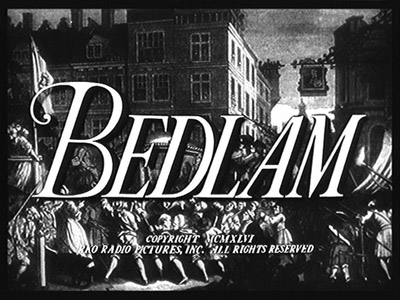
Title Shot of Val Lewton’s Bedlam (1946)

Title Shot of Val Lewton’s Bedlam (1946)

Originally, it was called Bethlem Royal Hospital or St. Mary Bethlehem. Over the years, the British mental hospital has moved from Bishopsgate to Moorfields to Southwark, where it is now, a reputable institution associated with Kings College London. From its period of notoriety in the 18th century, where the glitterati paid admission to see loonies chained to the wall, it was better known as Bedlam.

There is a wonderful Val Lewton film of the same name, starring Boris Karloff, that was released by RKO in 1946 (see above). In it, a sane young woman is forcibly admitted to the insane asylum when she refuses to odious attentions of a powerful rake. Like almost of all of the Lewton films I have seen, it is a delight. It includes a rebellion of the inmates against the infamous Boris Karloff, who plays the head physician at Bedlam.

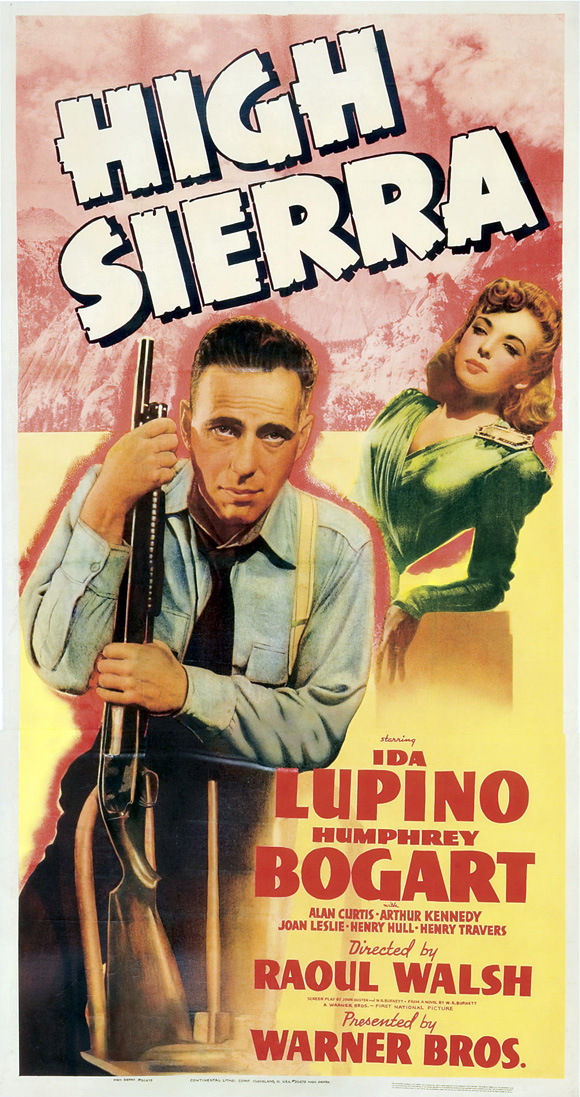
Poster for Val Lewton’s Bedlam

Lobby Card for Val Lewton’s Bedlam

The reason that Bedlam the movie comes to mind is my realization that we have little progressed from those bad old eighteenth century days when the mentally ill were mistreated for the amusement of visitors. Now, things are almost worse. Ever since the 1980s, the mentally ill have been on their own.When they receive any attention at all, it is usually by the police and prison guards. Instead of getting the medication that helps keep them on an even keel, the mentally ill are mistreated by guards who punish them for their non-normative behavior.

Recently, several Orange County, California police beat up and killed a mental patient named Kelly Thomas who was living on the street. In their various police academies, the police are trained to deal with malefactors, and not with persons who have a tenuous grip on reality. The police were tried and acquitted by an Orange County jury.

The outlook for the mentally ill who are loose on the streets is not a good one. Perhaps even the old Bedlam would have been an improvement.

The Wizard, the Beast, and the Beauty

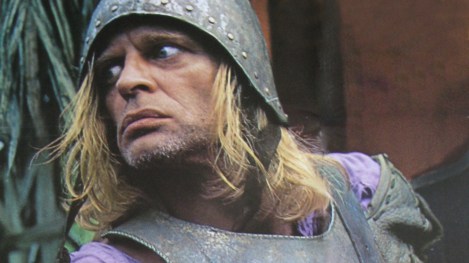
Klaus Kinski in Aguirre, Wrath of God (1972)

Klaus Kinski in Aguirre, Wrath of God (1972)

For the last few weeks, I have been thinking about one of the strangest actor/director partnerships in the history of the cinema. There have been many famous ones, such as Marlene Dietrich and Josef von Sternberg, Greta Garbo and Clarence Brown, Toshiro Mifune and Akira Kurosawa, and Randolph Scott and Budd Boetticher; but the strangest of all was between Klaus Kinski and Werner Herzog.

I say “strangest” because Kinski was that most unusual combination: A brilliant actor and a raving maniac. According to his friend and mentor Werner Herzog, Kinski was a complete egomaniac. When he felt that attention was being diverted away from him, Kinski went off the rails. He would start screaming with his eyes at the maximum bug-eyed setting, with his face at times two inches away from whomever he was directing his rant, During the filming of Fitzcarraldo (1982), the chief of the Amazonian Indians in the cast asked Herzog’s permission to kill him. This story is recounted in Herzog’s book about the making of the film, The Conquest of the Useless.

And yet, there have been few actors quite as outstanding and natural as Kinski. He knew how to make an impression onscreen. At times he could be loving and tender, as he was with Claudia Cardinale in Fitzcarraldo and Eva Mattes in Woyzeck (1979).At worst, he was a disruptive force that could destroy a film production and leave it a gutted ruin.

Why, considering this reputation, did Herzog decided to make five films with Kinski? These films were Aguirre, Wrath of God (1972); Nosferatu the Vampire (1979); Woyzeck (1979); Fitzcarraldo (1982); and Cobra Verde (1987). Three or four of these would be considered in any list of Herzog’s best films—and Kinski’s, as well!

After Kinski died of a heart attack in 1991, Herzog directed a documentary about his contentious, and yet rewarding relationship, with the actor which he called My Best Fiend (1999). To see an excerpt from this documentary, click here.

Klaus Kinski’s Daughter, Nastassja Kinski

Klaus Kinski’s Daughter, Nastassja Kinski

And now we come to the strangest part of the story. The bug-eyed demon, Klaus Kinski, was the father of one of the most beautiful actresses who ever lived, Nastassja Kinski. The daughter did not have an easy relationship with her father:

“He was no father. 99 percent of the time I was terrified of him. He was so unpredictable that the family lived in constant terror.” When asked what she would say to him now, if she had the chance, she replied: “I would do anything to put him behind bars for life. I am glad he is no longer alive.”

She managed to escape being sexually abused by Kinski, but just barely.

I find it surpassingly odd that someone so out of it as Klaus Kinski could work successfully with a director like Herzog and give birth to a woman with such unearthly beauty as Nastassja.

Noir

"William Irish" Was a Pen Name Used by Cornell Woolrich

“William Irish” Was a Pen Name Used by Cornell Woolrich

Over the past several months, I have been reading the large Library of America omnibus volume entitled Crime Novels: American Noir of the 1930s and 40s. Included were the following titles:

  • James M. Cain’s The Postman Always Rings Twice (filmed by Tay Garnett starring John Garfield and Lana Turner)
  • Horace McCoy’s They Shoot Horses, Don’t They? (Sidney Pollack’s 1969 film of this starred Jane Fonda)
  • Edward Anderson’s Thieves Like Us (made into a great Nicholas Ray film called They Live by Night)
  • Kenneth Fearing’s The Big Clock (made into a great John Farrow film with Ray Milland and Charles Laughton)
  • William Lindsay Gresham’s Nightmare Alley (another great John Farrow film, this time with Tyrone Power)
  • Cornell Woolrich’s I Married a Dead Man (published under the pen name William Irish)

So many of the noir novels of the period were turned into classic films that I begin to think the whole genre is a mirror in which we as Americans see ourselves. Although the British are just as famous with their detective novels, it was an American who invented the genre with Edgar Allan Poe’s stories such as “The Gold Bug,” “The Purloined Letter,” and “The Murders in the Rue Morgue.” And while Arthur Conan Doyle, Agatha Christie, Josephine Tey, and countless others were practicing their craft in Britain, their American counterparts created works that were more urban, more mean, and more essentially American.

Frankly, I came to the novels by way of the films. I was a collaborator (though in a minor way) with my friends Alain J. Silver and James Ursini in their genre-defining book Film Noir: The Encyclopedia published by Overlook Press. Other great resources are the same authors’ The Noir Style (also Overlook) and the Taschen Book entitled Film Noir.

Both the novels and the films generally tend to be excellent and well worth your time.

The Curse of the Cat People

Simone Simon and Anne Carter in Curse of the Cat People (1944)

Simone Simon and Ann Carter in The Curse of the Cat People (1944)

All the ingredients for horror are there: Tarrytown, New York, with its legend of the headless horseman; a seemingly haunted house; a woman come back from the dead; and a lonely little girl who will do anything for a friend. Except that this is a Val Lewton film. The horrors are all there in the background, waiting to pounce. That they never do makes the film more profound in a way, as if all the darkness we imagine in life were really just the result of looking at things the wrong way.

The headless horseman never shows up, although at one point we think we will. The haunted house isn’t really haunted: It’s inhabited by an unhappy mother who doesn’t acknowledge the daughter who loves her. The woman come back from the dead (above) is a loving and friendly ghost who wants nothing but good for Amy, the lonely little girl who keeps getting in trouble for being lost in her dreams.

Lobby Card for Curse of the Cat People

Lobby Card for Curse of the Cat People

Oh, and by the way, there is no menacing black cat as shown on the lobby card above. There is a black cat who appears on a tree branch briefly at the beginning, but jumps away to avoid a mischievous boy.

There is one beautiful little French Christmas carol sung by the ghost Irena, played by Simone Simon, that runs through the film—a song without menace of any kind. Here is a link to the carol—“Il Est Né le Divin Enfant”—as sung by Edith Piaf:

So, The Curse of the Cat People is either a total failure, or it’s not quite what it’s advertised to be. My vote is for the latter.

That is so typical of Val Lewton, who produced a series of films in the 1940s that are still being seen and loved. Thousands have been seduced by the prospect of horror that never quite emerges. It is suggested, but is rarely what it seems. There is a death in The Leopard Man, but it happens off screen. There is plague on The Isle of the Dead; grave-robbing in The Body Snatcher; devil worship in The 7th Victim; a real zombie (though not the brain-eating variety) in I Walked with a Zombie; and a menacing panther at a swimming pool in The Cat People. We are brought close to the edge of our seats, but in the end are protected from any direct contact with anything vile: Instead what at first promised to have a terrifying dimension winds up with more of a psychological dimension.

One interesting fact about Lewton is that he never directed any of these films: He produced them. Yet his stamp on these pictures—which are directed by excellent directors such as Jacques Tourneur, Mark Robson, and Robert Wise—is as decisive as the stamp of an Alfred Hitchcock or a John Ford.

I had purchased a collection of Val Lewton films on DVD from Turner Classic Movies (TCM). It arrived yesterday, so I decided to watch The Curse of the Cat People this afternoon. I look forward to re-acquainting myself with the other eight titles in the series as well.

Thirteen Horrors

Scene from Ingmar Bergman’s Hour of the Wolf

Scene from Ingmar Bergman’s Hour of the Wolf

This being the start of Halloween Season, I thought I’d recommend thirteen horror films that have, over the years, continued to scare me. (Let me begin, however, by saying that nothing has scared me more than seeing Ted Cruz try to do Dr. Seuss’s Green Eggs and Ham.)

It was difficult to limit the list down to thirteen. In the process, I had to omit some real classics, such as the original Universal Frankenstein and Dracula, plus some more recent films such as Dracula Prince of Darkness and Roman Polanski’s Repulsion. But I guess that is in the nature of things when trying to narrow down such a large field.

The films below are listed in alphabetical order:

The Black Cat (1934), directed by Edgar G. Ulmer, starring both Boris Karloff and Bela Lugosi. Frightening and very weird.

Black Sunday (1960), directed by Mario Bava, starring Barbara Steele. One of the very best of all the vampire films.

Carnival of Souls (1962), directed by Herk Harvey, starring Candace Hilligoss. A superb film made by a bunch of nobodies in the Midwest, but curiously affecting. See it if you can.

The Cat People (1942), produced by Val Lewton and directed by Jacques Tourneur. One of Lewton’s atmospheric horror films that are among my favorites.

Curse of the Demon (1957), also called Night of the Demon, directed by Jacques Tourneur and starring Dana Andrews. Probably the scariest film on this list. After multiple viewings, it still works!

The Hour of the Wolf (1968), directed by Ingmar Bergman. Another take on the vampire myth, this time from Sweden.

Kwaidan (1964), directed by Masaki Kobayashi, an anthology film based on stories compiled by Lafcadio Hearn in the 19th century. In wide screen and gorgeous Technicolor.

The Leopard Man (1943), produced by Val Lewton and directed by Jacques Tourneur. (I was torn between this and the same duo’s I Walked with a Zombie).

Nosferatu (1922), directed by F. W. Murnau and starring Max Schreck (“Terror”). The original Bram Stoker Dracula plot, set on the Continent. Probably the best of the silent horror films.

Scene from Rosemary’s Baby

Scene from Rosemary’s Baby

Rosemary’s Baby (1968), directed by Roman Polanski and starring Mia Farrow. Polanski had a gift for making great horror films.

The Shining (1980), directed by Stanley Kubrick and starring Jack Nicholson. Find out why all work and no play makes Jack a dull boy.

Ugetsu Monogatari (1952), directed by Kenji Mizoguchi. A classic and lyrical Japanese ghost story that just happens to be one of the greatest films ever made.

Vampyr (1932), directed by Carl Theodor Dreyer. This is probably the scariest vampire film ever made. There are a lot of bad prints of this Danish film, so it’s worth getting your copy from a good source, like Kino-Lorber.

Are there any horror classics you’d like to add to this list? Use the comments for your suggestions.

In the Land of the Tattooed Monkeys

Labor Day Weekend in Hollyweird

Labor Day Weekend in Hollyweird

All the tourists who (1) watch too much television; (2) don’t know much about Southern California; and (3) are decorated all over with piercings and tattoos usually end up on Hollywood Boulevard. Labor Day Weekend is particularly crowded, as crowds stop and take pictures of “tweakers” dressed up as Darth Vader, Spider Man, Wonder Woman and other superheroes and superheroines. Or they take pictures of the thousands of star-shaped plaques embedded into the sidewalks honoring key entertainment figures. Or they just take pictures of each other. (The star commemorating Marilyn Monroe in front of Ripley’s “Believe-It-Or-Not” museum is always a mob scene.)

Yesterday evening, Martine and I found a short cut to get us around the crowd pressing around what was once Grauman’s Chinese Theater (and now called the TCL Chinese Theater). Out of the Loew’s Hollywood Hotel (formerly called the Hollywood Renaissance Hotel), we walked past the entrance to the Dolby Theater (formerly the Eastman Kodak Theater) to a tour bus station on Orange Avenue. That saved us at least 15 minutes on the way to Roubo’s Russian and Armenian Restaurant. Of course, all the re-branding made my head spin.

Especially on holiday weekends such as this, it is impossible to go more than a hundred feet without being solicited by tour bus operators. I always tell them that, as a long-time resident, I am better qualified to offer them a tour.

In fact, at any given time around Labor Day, about 30-40% of all vehicles on the boulevard are tour buses.

The movies at Cinecon made it all worthwhile, though it is something of a gauntlet going between the Egyptian Theater, where the films are screened, to the Loew’s Hollywood Hotel, where the dealers’s booths are set up, or to any restaurant serving halfway decent food.


More Morose Delectation

Bessie Love (1898-1986)

Bessie Love (1898-1986)

Once again it is Labor Day Weekend in the United States, and Martine and I have celebrated by seeing loads of films and seeing old friends at Cinecon 49 in Hollywood. Among the pictures we saw were:

  • The Holy Terror (1937) with Jane Withers
  • A Blonde’s Revenge (1926) with Ruth Taylor
  • The Good Bad Man (1926) with Douglas Fairbanks Sr and Bessie Love, directed by Allan Dwan
  • Transient Lady (1935) with Frances Drake
  • Their First Execution (1913) by Mack Sennett
  • Suddenly It’s Spring (1947) with Paulette Goddard and Fred MacMurray

Once again, I was impressed how beautiful many of the young actresses were almost a hundred years ago. Bessie Love in The Good Bad Man wasn’t much of an actress, but her beauty was heartbreaking.

Ruth Taylor (1905-1984)

Ruth Taylor (1905-1984)

Then there was Ruth Taylor with a small role in the Ben Turpin two-reeler A Blonde’s Revenge. It’s difficult to believe that she was the mother of Buck Henry.

Tomorrow, I’ll have to go in to work to help our computer consultant set up a new file server and seven workstations. But then, on Monday, Martine and I return to Hollywood and Cinecon for more movies.


Favorite Films: Gettysburg (1993)

Probably the Greatest Ever Movie Made for Television

Probably the Greatest Ever Movie Made for Television

Since reading the second volume of Shelby Foote’s magnificent The Civil War: A Narrative, I have decided to read some more histories during the heat of the summer. But first, I thought it was a good time to see the Turner movie of Gettysburg directed by Ronald F. Maxwell.

The film is a real labor of love, with excellent performances by Martin Sheen as Robert E. Lee (he was too short for the role, but was most convincing), Tom Berenger as General James Longstreet, Sam Elliott as General John Buford, and Jeff Daniels as Colonel Joshua Chamberlain. What is so remarkable is that so many of the minor roles were acted with so much passion that they stick in the mind even after twenty years. I am thinking particularly of Richard Jordan as General “Lo” Armistead; Patrick Gorman as General John Bell Hood; and Brian Mallon as General Winfield Scott Hancock.

The use of Civil War re-enactors on both sides made a big difference. This was literally a cast of thousands—thousands of enthusiastic volunteers who had their own uniforms and were accoutered with all the authentic accessories. The only disadvantage to using re-enactors is that so many of them are stout and in late middle age, but one can overlook that.

Also significant was that the script was based on Michael Shaara’s novel The Killer Angels, which focussed on several key parts of the battle, namely the charge on Little Round Top and Pickett’s suicidal charge on the center of the Union line on Cemetery Ridge. There were other actions that never quite make it to the forefront in histories, not to speak of this movie: I am thinking of Ewell’s assaults on Cemetery Hill (not to be confused with the Ridge) and Culp’s Hill. Without that focus, the battle, like many Civil War battles, tends to be too diffuse. (The classic example of a diffuse battle was Chickamauga fought near Chattanooga later that year.)

As good as Gettysburg the movie is, the same director tried to make a prequel ten years later: Gods and Generals (2003) was a rather flaccid failure. Jeff Daniels plays the same role, but he had gained quite a few pounds while he was at Chancellorsville a scant few months earlier.