The Curse of the Cat People

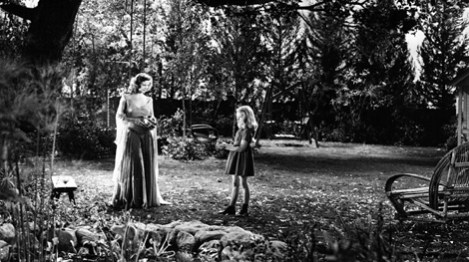
Simone Simon and Anne Carter in Curse of the Cat People (1944)

Simone Simon and Ann Carter in The Curse of the Cat People (1944)

All the ingredients for horror are there: Tarrytown, New York, with its legend of the headless horseman; a seemingly haunted house; a woman come back from the dead; and a lonely little girl who will do anything for a friend. Except that this is a Val Lewton film. The horrors are all there in the background, waiting to pounce. That they never do makes the film more profound in a way, as if all the darkness we imagine in life were really just the result of looking at things the wrong way.

The headless horseman never shows up, although at one point we think we will. The haunted house isn’t really haunted: It’s inhabited by an unhappy mother who doesn’t acknowledge the daughter who loves her. The woman come back from the dead (above) is a loving and friendly ghost who wants nothing but good for Amy, the lonely little girl who keeps getting in trouble for being lost in her dreams.

Lobby Card for Curse of the Cat People

Lobby Card for Curse of the Cat People

Oh, and by the way, there is no menacing black cat as shown on the lobby card above. There is a black cat who appears on a tree branch briefly at the beginning, but jumps away to avoid a mischievous boy.

There is one beautiful little French Christmas carol sung by the ghost Irena, played by Simone Simon, that runs through the film—a song without menace of any kind. Here is a link to the carol—“Il Est Né le Divin Enfant”—as sung by Edith Piaf:

So, The Curse of the Cat People is either a total failure, or it’s not quite what it’s advertised to be. My vote is for the latter.

That is so typical of Val Lewton, who produced a series of films in the 1940s that are still being seen and loved. Thousands have been seduced by the prospect of horror that never quite emerges. It is suggested, but is rarely what it seems. There is a death in The Leopard Man, but it happens off screen. There is plague on The Isle of the Dead; grave-robbing in The Body Snatcher; devil worship in The 7th Victim; a real zombie (though not the brain-eating variety) in I Walked with a Zombie; and a menacing panther at a swimming pool in The Cat People. We are brought close to the edge of our seats, but in the end are protected from any direct contact with anything vile: Instead what at first promised to have a terrifying dimension winds up with more of a psychological dimension.

One interesting fact about Lewton is that he never directed any of these films: He produced them. Yet his stamp on these pictures—which are directed by excellent directors such as Jacques Tourneur, Mark Robson, and Robert Wise—is as decisive as the stamp of an Alfred Hitchcock or a John Ford.

I had purchased a collection of Val Lewton films on DVD from Turner Classic Movies (TCM). It arrived yesterday, so I decided to watch The Curse of the Cat People this afternoon. I look forward to re-acquainting myself with the other eight titles in the series as well.

Thirteen Horrors

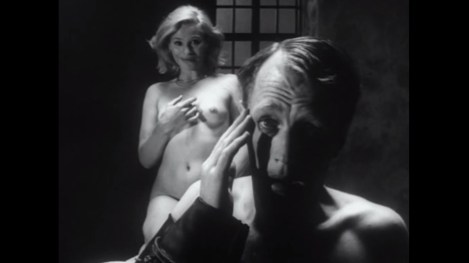
Scene from Ingmar Bergman’s Hour of the Wolf

Scene from Ingmar Bergman’s Hour of the Wolf

This being the start of Halloween Season, I thought I’d recommend thirteen horror films that have, over the years, continued to scare me. (Let me begin, however, by saying that nothing has scared me more than seeing Ted Cruz try to do Dr. Seuss’s Green Eggs and Ham.)

It was difficult to limit the list down to thirteen. In the process, I had to omit some real classics, such as the original Universal Frankenstein and Dracula, plus some more recent films such as Dracula Prince of Darkness and Roman Polanski’s Repulsion. But I guess that is in the nature of things when trying to narrow down such a large field.

The films below are listed in alphabetical order:

The Black Cat (1934), directed by Edgar G. Ulmer, starring both Boris Karloff and Bela Lugosi. Frightening and very weird.

Black Sunday (1960), directed by Mario Bava, starring Barbara Steele. One of the very best of all the vampire films.

Carnival of Souls (1962), directed by Herk Harvey, starring Candace Hilligoss. A superb film made by a bunch of nobodies in the Midwest, but curiously affecting. See it if you can.

The Cat People (1942), produced by Val Lewton and directed by Jacques Tourneur. One of Lewton’s atmospheric horror films that are among my favorites.

Curse of the Demon (1957), also called Night of the Demon, directed by Jacques Tourneur and starring Dana Andrews. Probably the scariest film on this list. After multiple viewings, it still works!

The Hour of the Wolf (1968), directed by Ingmar Bergman. Another take on the vampire myth, this time from Sweden.

Kwaidan (1964), directed by Masaki Kobayashi, an anthology film based on stories compiled by Lafcadio Hearn in the 19th century. In wide screen and gorgeous Technicolor.

The Leopard Man (1943), produced by Val Lewton and directed by Jacques Tourneur. (I was torn between this and the same duo’s I Walked with a Zombie).

Nosferatu (1922), directed by F. W. Murnau and starring Max Schreck (“Terror”). The original Bram Stoker Dracula plot, set on the Continent. Probably the best of the silent horror films.

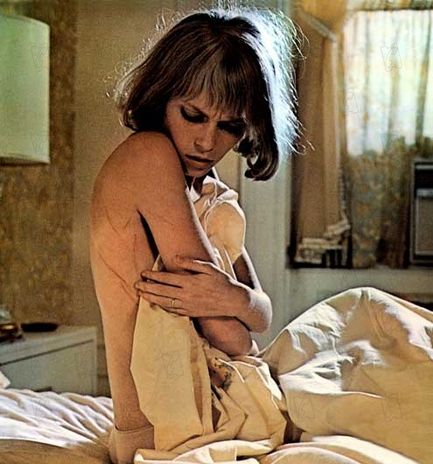
Scene from Rosemary’s Baby

Scene from Rosemary’s Baby

Rosemary’s Baby (1968), directed by Roman Polanski and starring Mia Farrow. Polanski had a gift for making great horror films.

The Shining (1980), directed by Stanley Kubrick and starring Jack Nicholson. Find out why all work and no play makes Jack a dull boy.

Ugetsu Monogatari (1952), directed by Kenji Mizoguchi. A classic and lyrical Japanese ghost story that just happens to be one of the greatest films ever made.

Vampyr (1932), directed by Carl Theodor Dreyer. This is probably the scariest vampire film ever made. There are a lot of bad prints of this Danish film, so it’s worth getting your copy from a good source, like Kino-Lorber.

Are there any horror classics you’d like to add to this list? Use the comments for your suggestions.

In the Land of the Tattooed Monkeys

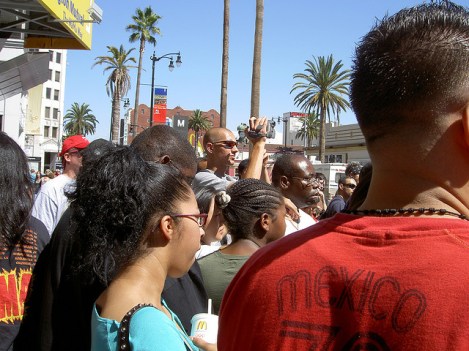
Labor Day Weekend in Hollyweird

Labor Day Weekend in Hollyweird

All the tourists who (1) watch too much television; (2) don’t know much about Southern California; and (3) are decorated all over with piercings and tattoos usually end up on Hollywood Boulevard. Labor Day Weekend is particularly crowded, as crowds stop and take pictures of “tweakers” dressed up as Darth Vader, Spider Man, Wonder Woman and other superheroes and superheroines. Or they take pictures of the thousands of star-shaped plaques embedded into the sidewalks honoring key entertainment figures. Or they just take pictures of each other. (The star commemorating Marilyn Monroe in front of Ripley’s “Believe-It-Or-Not” museum is always a mob scene.)

Yesterday evening, Martine and I found a short cut to get us around the crowd pressing around what was once Grauman’s Chinese Theater (and now called the TCL Chinese Theater). Out of the Loew’s Hollywood Hotel (formerly called the Hollywood Renaissance Hotel), we walked past the entrance to the Dolby Theater (formerly the Eastman Kodak Theater) to a tour bus station on Orange Avenue. That saved us at least 15 minutes on the way to Roubo’s Russian and Armenian Restaurant. Of course, all the re-branding made my head spin.

Especially on holiday weekends such as this, it is impossible to go more than a hundred feet without being solicited by tour bus operators. I always tell them that, as a long-time resident, I am better qualified to offer them a tour.

In fact, at any given time around Labor Day, about 30-40% of all vehicles on the boulevard are tour buses.

The movies at Cinecon made it all worthwhile, though it is something of a gauntlet going between the Egyptian Theater, where the films are screened, to the Loew’s Hollywood Hotel, where the dealers’s booths are set up, or to any restaurant serving halfway decent food.


More Morose Delectation

Bessie Love (1898-1986)

Bessie Love (1898-1986)

Once again it is Labor Day Weekend in the United States, and Martine and I have celebrated by seeing loads of films and seeing old friends at Cinecon 49 in Hollywood. Among the pictures we saw were:

  • The Holy Terror (1937) with Jane Withers
  • A Blonde’s Revenge (1926) with Ruth Taylor
  • The Good Bad Man (1926) with Douglas Fairbanks Sr and Bessie Love, directed by Allan Dwan
  • Transient Lady (1935) with Frances Drake
  • Their First Execution (1913) by Mack Sennett
  • Suddenly It’s Spring (1947) with Paulette Goddard and Fred MacMurray

Once again, I was impressed how beautiful many of the young actresses were almost a hundred years ago. Bessie Love in The Good Bad Man wasn’t much of an actress, but her beauty was heartbreaking.

Ruth Taylor (1905-1984)

Ruth Taylor (1905-1984)

Then there was Ruth Taylor with a small role in the Ben Turpin two-reeler A Blonde’s Revenge. It’s difficult to believe that she was the mother of Buck Henry.

Tomorrow, I’ll have to go in to work to help our computer consultant set up a new file server and seven workstations. But then, on Monday, Martine and I return to Hollywood and Cinecon for more movies.


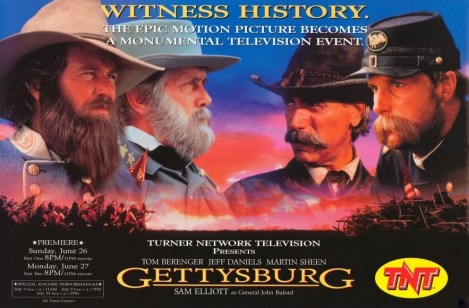
Favorite Films: Gettysburg (1993)

Probably the Greatest Ever Movie Made for Television

Probably the Greatest Ever Movie Made for Television

Since reading the second volume of Shelby Foote’s magnificent The Civil War: A Narrative, I have decided to read some more histories during the heat of the summer. But first, I thought it was a good time to see the Turner movie of Gettysburg directed by Ronald F. Maxwell.

The film is a real labor of love, with excellent performances by Martin Sheen as Robert E. Lee (he was too short for the role, but was most convincing), Tom Berenger as General James Longstreet, Sam Elliott as General John Buford, and Jeff Daniels as Colonel Joshua Chamberlain. What is so remarkable is that so many of the minor roles were acted with so much passion that they stick in the mind even after twenty years. I am thinking particularly of Richard Jordan as General “Lo” Armistead; Patrick Gorman as General John Bell Hood; and Brian Mallon as General Winfield Scott Hancock.

The use of Civil War re-enactors on both sides made a big difference. This was literally a cast of thousands—thousands of enthusiastic volunteers who had their own uniforms and were accoutered with all the authentic accessories. The only disadvantage to using re-enactors is that so many of them are stout and in late middle age, but one can overlook that.

Also significant was that the script was based on Michael Shaara’s novel The Killer Angels, which focussed on several key parts of the battle, namely the charge on Little Round Top and Pickett’s suicidal charge on the center of the Union line on Cemetery Ridge. There were other actions that never quite make it to the forefront in histories, not to speak of this movie: I am thinking of Ewell’s assaults on Cemetery Hill (not to be confused with the Ridge) and Culp’s Hill. Without that focus, the battle, like many Civil War battles, tends to be too diffuse. (The classic example of a diffuse battle was Chickamauga fought near Chattanooga later that year.)

As good as Gettysburg the movie is, the same director tried to make a prequel ten years later: Gods and Generals (2003) was a rather flaccid failure. Jeff Daniels plays the same role, but he had gained quite a few pounds while he was at Chancellorsville a scant few months earlier.


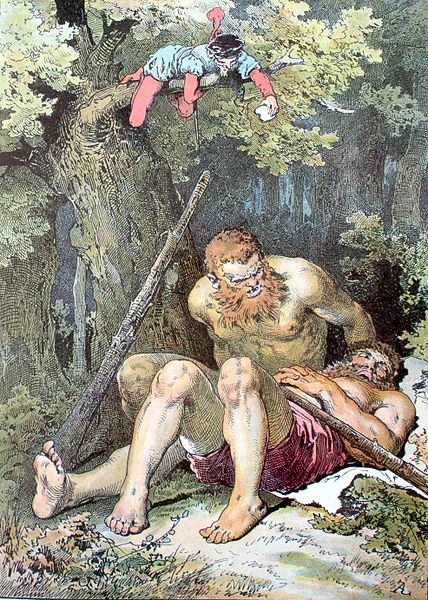
“I Killed Seven With One Blow”

What a Valiant Little Tailor!

What a Valiant Little Tailor!

The tale comes from the Brothers Grimm: It is the story of a little tailor who kills seven flies with one blow of his swatter. Then, to make sure the world knows what a valiant little tailor he was, he makes inscribes the line “I killed seven with one blow” on his belt and goes out into the world to—what else?—make his fortune. Of course, everyone misunderstands the saying on the belt and thinks the tailor killed seven men with one blow.

I felt much the same way when I read an interview with Gore Vidal in The Paris Review in which he states “But then I’m typically American. We weren’t brought up with theater like the English or the Germans. On the other hand, I saw every movie I could in my youth. I once saw four movies in one day when I was fourteen. That was the happiest day of my life.”

What, only four? I think I have had at least ten days in my time when I have seen five or even six movies in one day. I remember two days at the University of Southern California (USC) when I saw five Westerns directed by Budd Boetticher and another when I saw not only five films by John Ford, but John Ford himself showed up. I don’t count the day I saw five films directed by Hitchcock—but only because the 35mm nitrate print of Rope (1948) exploded into flames in the projection booth.

Then there were all the days I spent at the Cinecon show in Hollywood watching early silent and sound films, one after the other, with breaks only for lunch and dinner.

For the first time in nearly a decade, I don’t think I’ll be attending the Cinecon show this time, for reasons I hinted at in a post I wrote a year ago. Of course, I could still change my mind; and Martine is interested in attending at least one day of the screenings. We’ll see.

The Story of Will Rogers

Lobby Card from the Film The Story of Will Rogers

Lobby Card from the Film The Story of Will Rogers (1952)

It has become a tradition for Martine and me to attend the annual outdoor screening each August to mark the anniversary of the star’s death in a 1935 Alaska airplane accident. This year, it was held last Friday. The event is co-sponsored by the Will Rogers Ranch Foundation, to which we belong, and the Will Rogers Motion Picture Pioneers Foundation. This year, instead of screening a film starring Will Rogers, we got a film about Will, starring Will’s son, Will Jr., who is a dead-ringer for his father.

The Story of Will Rogers is an A-list film starring not only Will Jr., but Jane Wyman as Betty Rogers and a great cast of supporting actors, including James Gleason, Slim Pickens, Noah Beery Jr, and Mary Wickes.

As usual, the film was screened outdoors as soon as the sky darkened (around 8 pm). The audience sat around on either blankets or (like us) chairs that we brought from home with us.

I have always thought that Will Rogers was, in many ways, the ideal American. Not only did he have Cherokee blood from both his parents, but his sense of humor was completely non-partisan. Everyone got gored—and fairly, too!

Just to leave you with one of his thoughts: “Too many people spend money they haven’t earned, to buy things they don’t want, to impress people they don’t like.”

The Endless Trek

The Immortal NCC-1701

The Immortal NCC-1701

Today I saw Star Trek Into Darkness—by myself because Martine refuses to see any film that’s over ninety minutes long. I had wanted to see the film because, well, I’m sort of a Trekkie. No costumes or anything like that. Perhaps I just have a hankering for green women.

While I enjoyed the film for the most part, all the CGI work bored me. I have no doubt that most of the production money was spent on scenes that meant nothing to me. Ever since the original Star Wars, space ships have been at least as big as the Burj Kalifa (the world’s tallest building, these particular fifteen minutes) and have featured leagues of heavy metal whose mining would have reduced Planet Earth to the size of an inconsequential cinder. What I want to know is: Who did all the dusting and mopping?

On the plus side, the acting was pretty good, with Chris Pine as a believable, super-insubordinate James T. Kirk; Zachary Quinto as the son of the Leonard Nimoy Spock (that seems to go against the chronology, as this takes place before the Shatner/Nimoy original); John Cho as a fearsome Sulu; and Alice Eve (below) as an exceptionally cute addition to the Enterprise.

Alice Eve in a Gratuitous but Welcome Cheesecake Shot

Alice Eve in a Gratuitous but Not Unwelcome Cheesecake Shot

What worked best were when Director J. J. Abrams paid homage to the original series. Referred to in this version were The Wrath of Khan and the TV episode on which it was based (“Space Seed”), and also the TV episode entitled “The Trouble with Tribbles.”

In the end, I think Star Trek Into Darkness was a good addition to the franchise, but no masterpiece.

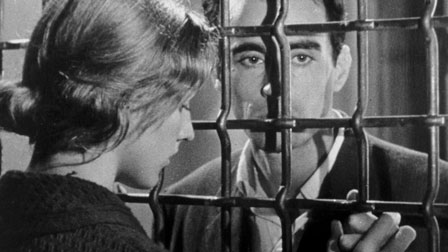
Favorite Films: Pickpocket (1959)

A Still from Robert Bresson’s Pickpocket

A Still from Robert Bresson’s Pickpocket with Martin LaSalle

One film I will never tire of watching is Robert Bresson’s Pickpocket (1959). At a time when the French New Wave was in full flower, it was a resolutely old-fashioned film that was—in my opinion—better than any of the New Wave films. It starred two unknowns, the Uruguayan Martin LaSalle and Marika Green, and shows how a young man (who looks startlingly like a young Henry Fonda) falls in with a pickpocketing gang, and with a young woman who loves him.

Bresson only made a handful of films, but fully half of them are among the greatest films ever made. As I say this, I have to interject that you may or may not think as highly of him as I do: His films may seem preternaturally slow, but there is an unmistakeable development of character that seems missing altogether in the films of today. Pickpocket’s Michel and Jeanne are deeply, even tragically, in love with each other, in a world where crime seems to be the only way to get ahead.

If you are interested in seeing some of Bresson’s films, I highly recommend the following titles:

  • Diary of a Country Priest (1951)
  • A Man Escaped (1956)
  • The Trial of Joan of Arc (1962), based on the original trial records
  • Au Hasard Balthazar (1966)
  • Mouchette (1967)
  • Lancelot of the Lake (1974)

Bresson died in 1999, but his films will never die.

William of Lugos

BelaLugosiHeadstone

Headstone of Bela Lugosi at Holy Cross Cemetery in Culver City

His real name was Béla Ferenc Dezsö Blaskó, but that didn’t sound cool enough for the title role in Universal Pictures’ new film Dracula (1931). Béla, or William as it’s translated into English, was born in Lugos in then Austro-Hungarian Empire. Now it is known as Lugoj and is located in Rumania. And, just so you know, in Transylvania, near Timisoara, known by the Hungarians as Temesvár. So Béla Lugosi is none other than William of Lugos.

By the way, his name is really pronounced BAY-lah LOO-gauche-ee, with the accent on the first syllable of first and last name.

Martine has always loved Lugosi’s acting. In fact, on her favorite sweater, she wears a metal pin of a 32¢ stamp issued in his honor, as shown below:

1997 USPS Stamp Commemorating Famous Monsters of Hollywood

1997 USPS Stamp Commemorating Famous Film Monsters of Hollywood

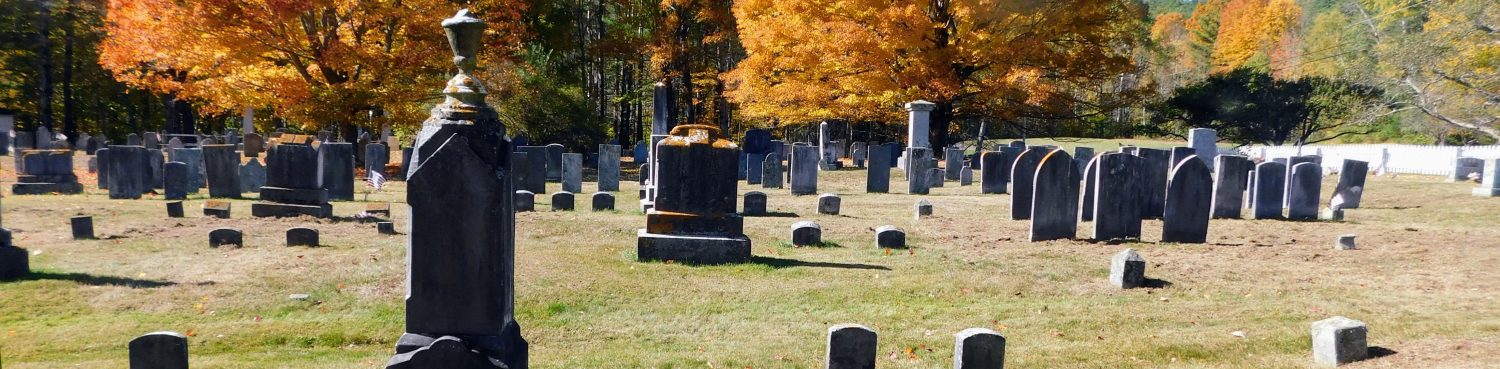
Martine has a set of DVDs for Lugosi’s films; and when we visit Holy Cross Cemetery, we always check out his grave on a hillside near a grotto.

It always surprises me how many famous people don’t have any flowers or other marks of family or fan affection by their graves. Note, however, that there is a little votive candle by the bottom right of Béla’s headstone.