Triptych

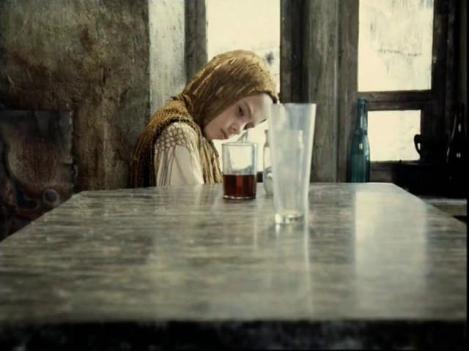
Last Scene from Andrei Tarkovsky’s Film Stalker

Last Scene from Andrei Tarkovsky’s Film Stalker

The following is adapted from my review of Geoff Dyer’s Zona: A Book About a Film About a Journey to a Room as posted to Goodreads.Com.

What we have here is a triptych: three linked works of art, one loosely based on the other. First there was Boris and Arkady Strugatsky’s Roadside Picnic (1972), perhaps the most memorable of the Russian brothers’ science fiction novels. Then came Andrei Tarkovsky’s film Stalker (1979), ostensibly based on it and, in fact, employing the Strugatsky brothers as screenwriters. Now there is Geoff Dyer’s long essay entitled Zona: A Book About a Film About a Journey to a Room. This last is in a genre by itself, an extended commentary retelling the story of the film with lengthy footnoted riffs about how the film has impacted Dyer’s life and imagination.

All three works are masterpieces in their own right. I have now read both books as well as seen the film, and I yearn to reacquaint myself with all three of them.

Is there something perhaps a little perverse about writing a ruminative essay about something that comes from something else. Have we somehow put ourselves too many removes from the original work by the Strugatsky brothers? Or does it matter, inasmuch as both Stalker and Zona are totally absorbing, as was Roadside Picnic.

Perhaps I should draw back a little and give you some idea of the world of the composite work of art I think of as “The Roadside Stalker Zone.” We are some time in the future, in a grimy post-industrial wasteland in a small country near an area once visited by extraterrestrials who just happened, for whatever reason, to leave strange inexplicable things behind—including a room in a deserted building which, if you enter it, grants all your innermost desires. (Never mind that the only known person to have visited it, a man code-named Porcupine, hanged himself shortly thereafter.)

These zones formerly visited by the extraterrestrials (who have all moved on without getting their visas stamped) have been sealed off by the authorities. But there is an active group of individuals called stalkers who, in contravention of the law, take people to visit the zones and perhaps bring some things back—things which are marvelous and inexplicable. The children of these stalkers are themselves strange, like Monkey, the film’s Stalker’s daughter (shown above), who has the power of telekinesis, which we do not learn until the very end of the film.

Stalker takes two individuals, referred to in the film only as Professor and Writer, into the zone. Their journey is a journey of self-discovery. Do they enter the room? I do not wish to spoil the story for you, so I urge you to consume the entire triptych, in order of publication or release, to come to the same realization that I have arrived at: That Geoff Dyer is a phenomenal writer whose work I am going to enjoy reading in the months and years to come.

Feature Attractions

4.2.3

Tarkovsky’s Stalker

This long tracking sequence, following the trolley as it clanks and clangs along, is the most straightforward journey imaginable—horizontal, flat, right to left, in a straight line—and full of all the promised wonders of cinema. That’s what we are being sold in the trailers that precede what used to be called the “feature presentation”. Unfortunately, this has become the most debased wonder in the history of the earth. It means explosions, historical epics in which the outcome of the Battle of Hastings is reversed by the arcane CGI prowess of Merlin the Magician, it means five-year-old children turning suddenly into snarling devils, it means wrecking cars and reckless driving, it means a lot of noise, it means I have to time my arrival carefully (twenty minutes at least) after the advertised programme time if I am to avoid all this stuff which, if one were exposed to it for the full hour and a half, would cause one’s capacity for discernment to drop by fifty percent (or, conversely, one’s ability to tolerate stuff like this to increase a hundredfold). It means sitting there shaking one’s middle-aged head; it means that one is wary about going to the cinema. It means that there are more and more things on the street, in shops, on-screen and on telly from which one has to avert one’s ears and eyes.—Geoff Dyer, Zona

Les Mis(sables)

The Good, the bad, and the Ugly

The Good, the bad, and the Ugly

To begin with, I never saw the Broadway musical upon which this movie is based, so my discussion of it is based solely on the movie, with some surviving memories of Victor Hugo’s novel.

The movie had some problems which detracted from my enjoyment. Most particularly, it is startling to have a film shot almost entirely in close-up. I know the scene is, for the most part, fairly gritty; but I am more familiar with the dermatological issues of some rather well-known cast members as Hugh Jackman (Jean Valjean), Russell Crowe (Javert), Anne Hathaway (Fantine), and Amanda Seyfried (the grown-up Cosette) than I ever wanted to be. Gad, I would hate to see my face plastered across eighty feet of screen at a cinema.

A second issue I had with Les Misérables was that it was 100% sung. Now I don’t mind that with a great opera, but with a musical—especially one that runs almost three hours—I would appreciate some plain spoken lines. Especially when most of the people in the cast would scarcely last more than thirty seconds in a grand opera audition.

Finally, most of the film consists of night scenes. There is something about a color film that demands more light: Otherwise everything begins to look brown after a while.

Some of the supporting roles were excellent, especially Sacha Baron Cohen (?!) and Helena Bonham Carter as the thieving Thénardiers. In the Revolution of 1832 scenes, there was a superb child actor, Daniel Huttlestone, playing the part of the urchin Gavroche. And the ending actually brought some tears to my eyes, as sentimental and overblown as it was.

All in all, Les Misérables is a mixed bag. You may enjoy it, or you can just as easily mis [sic] it.

Best American Films By Year, Part Three

Poster for The Wild Bunch (1969)

Poster for The Wild Bunch (1969)

This is the final installment of my series on The Best American Films By Year series, from 1915 to 1980. Why do I stop with 1980? Essentially, I think that by then, most of the great American directors were either not working or had passed on. As in the other postings, I begin with the choice of my friend Lee Sanders, who has seen far more films than I have.

Lee’s list stops at 1977. The choices for 1978-1980 are all my own.

When there is a second choice, it’s my selection when I have either not seen Lee’s choice or have my own preference. My choices are shown in red.

1961 – Two Rode Together (John Ford)
1962 – The Man Who Shot Liberty Valance (John Ford)
1963 – The Birds (Alfred Hitchcock)
1964 – Marnie (Alfred Hitchcock)
1965 – Red Line 7000 (Howard Hawks); Inside Daisy Clover (Robert Mulligan)
1966 – Seven Women (John Ford)
1967 – El Dorado (Howard Hawks)
1968 – The Legend of Lylah Clare (Robert Aldrich)
1969 – Once Upon a Time in the West (Sergio Leone); The Wild Bunch (Sam Peckinpah)
1970 – On a Clear Day You Can See Forever (Vincente Minnelli); Patton (Franklin Schaeffner)

1971 – The Grissom Gang (Robert Aldrich); They Might Be Giants (Anthony Harvey)
1972 – Travels With My Aunt (George Cukor); The Godfather (Francis Ford Coppola)
1973 – American Graffiti (George Lucas)
1974 – The Tamarind Seed (Blake Edwards); Godfather II (Francis Ford Coppola)
1975 – Night Moves (Arthur Penn); The Man Who Would Be King (John Huston)
1976 – A Matter of Time (Vincente Minnelli); Taxi Driver (Martin Scorsese)
1977 – Twilight’s Last Gleaming (Robert Aldrich); 3 Women (Robert Altman)
1978 – Days of Heaven (Terrence Malick)
1979 – Apocalypse Now (Francis Ford Coppola)
1980 – Popeye (Robert Altman)

And that’s how the American Cinema ended, not with a bang but a whimper….

Sunday Movie Interlude

Ben Affleck, Star and Director of ARGO

It’s so rare for me now to see a film that is currently playing—and by the look of it, it’s nearing the end of its run—that I thought I would write about it. What makes it doubly rare is that both Martine and I liked the film.

When I asked her as we walked out of the theater whether she liked the film, Martine answered that she thought it was all made up. Then she mentioned she knew one of the six people who worked at the embassy who escaped imprisonment by the Ayatollah Khomeini’s Revolutionary Guard because her real name was used in the film: It was Cora Lijek, one of Martine’s algebra classmates from her high-school days in West Long Branch, New Jersey.

When we got home from the theater, we looked up the story of the Teheran embassy hostage crisis: Sure enough, Martine saw that the story of the six who hid out at the Canadian ambassador’s residence really happened. You can see for yourself by clicking on Wikipedia. The article there actually names names and gives details of which embassy employees were captured, which released early by the Ayatollah, and which escaped by hiding out as guests of the Canadian government.

As for the film itself, it was strictly an edge-of-the-seat tale, with a liberal admixture of humor, especially in the scenes with John Goodman and Alan Arkin as filmmakers. Ben Affleck plays the role of Tony Mendez, a CIA specialist in getting people across borders. He concocts a seemingly far-fetched idea of pretending to be a Canadian film crew filming a sci-fi fantasy epic in Iran and providing the six escapees with fake Canadian passports and new identities as members of the film crew scouting out locations for the upcoming production of a film to be called Argo.

The actual film called Argo is definitely worth seeing. If Affleck has any more films like this in his plans, he may well become one of our more interesting directors, of which there are so few in Hollywood.


Best American Films By Year, Part Two

John Wayne in The Searchers

In this posting, I continue my list of “The Best American Films By Year” covering the period 1915 to 1977. What I am going from is a list produced by my friend Lee Sanders, with whom I am in substantial agreement. When there are two films for a particular year and the second one is in red, the second one is because I disagree with Lee’s choice (which you will find is not too often). Below is the continuation of the list from 1941 to 1960:

1941 – How Green Was My Valley (John Ford)
1942 – The Magnificent Ambersons (Orson Welles); Casablanca (Michael Curtiz) – Lee actually had both films tied; I prefer the second
1943 – Air Force (Howard Hawks)
1944 – Meet Me in St. Louis (Vincente Minnelli)
1945 – They Were Expendable (John Ford)
1946 – My Darling Clementine (John Ford); The Big Sleep (Howard Hawks) – Lee had both films tied, a decision with which I agree.
1947 – Pursued (Raoul Walsh); Out of the Past (Jacques Tourneur)
1948 – Letter from an Unknown Woman (Max Ophuls)
1949 – Caught (Max Ophuls); She Wore a Yellow Ribbon (John Ford)
1950 – Rio Grande (John Ford)

1951 – On Dangerous Ground (Nicholas Ray); Strangers on a Train (Alfred Hitchcock)
1952 – The Quiet Man (John Ford)
1953 – The Bandwagon (Vincente Minnelli)
1954 – The Sun Shines Bright (John Ford)
1955 – Rebel Without a Cause (Nicholas Ray)
1956 – The Searchers (John Ford)
1957 – Written on the Wind (Douglas Sirk)
1958 – Vertigo (Alfred Hitchcock)
1959 – Rio Bravo (Howard Hawks)
1960 – Home from the Hill (Vincente Minnelli); Psycho (Alfred Hitchcock)

When I conclude this list, we will look at American films of the 1960s and 1970s (up to 1977, and I will bring the list up to 1980 with my own choices).


Best American Films By Year, Part One

Lobby Card for Josef Von Sternberg’s The Scarlet Empress (1934)

One day, my friend Lee Sanders and I started chatting about our favorite American films. From a capacious bag full of various literature, Lee whipped out a list of “The Best American Films of the Year,” spanning the years 1915 through 1977.  Now, for the most part, Lee and I see eye-to-eye. Where we don’t, I propose my own alternative. Where two films are listed for a particular year, the first one is Lee’s; the second, mine:

1915 – The Birth of a Nation (D. W. Griffith)
1916 – Intolerance (D. W. Griffith)
1917 – Straight Shooting (John Ford)
1918 – The Whispering Chorus (Cecil B. DeMille); Shoulder Arms (Charles Chaplin)
1919 – Broken Blossoms (D. W. Griffith)
1920 – Way Down East (D. W. Griffith); The Last of the Mohicans (Maurice Tourneur)

1921 – Dream Street (D. W. Griffith); The Kid (Charles Chaplin)
1922 – Robin Hood (Allan Dwan)
1923 – The White Rose  (D. W. Griffith); Our Hospitality (Buster Keaton)
1924 – He Who Gets Slapped (Victor Seastrom)
1925 – Seven Chances (Buster Keaton)
1926 – The General (Buster Keaton)
1927 – Sunrise (F. W. Murnau)
1928 – The Docks of New York (Josef Von Sternberg)
1929 – Lady of the Pavements (D. W. Griffith); The Love Parade (Ernst Lubitsch)

1931 – Dishonored (Josef Von Sternberg)
1932 – Trouble in Paradise (Ernst Lubitsch)
1933 – Design for Living (Ernst Lubitsch)
1934 – The Scarlet Empress (Josef Von Sternberg)
1935 – Barbary Coast (Howard Hawks); The Devil Is a Woman (Josef Von Sternberg)
1936 – The Road to Glory (Howard Hawks)
1937 – Make Way for Tomorrow (Leo McCarey)
1938 – Bringing Up Baby (Howard Hawks)
1939 – Stagecoach (John Ford)
1940 – His Girl Friday (Howard Hawks)

That’s all for the first installment. My differences with Lee in the above listings relate more to his love of D. W. Griffith’s later melodramas. I will continue in a week or so with the remainder of the list.

Any comments? We old film freaks used to call this activity “trading bubble gum cards.”

A Prickly Individual

Alzheimer’s Disease

In 1968, I was hitchhiking on Wilshire Boulevard in West L.A., hoping to get a ride as close to the Los Feliz Theater on Vermont as possible. I forget the movie I was originally intending to see: All I know was that it was a French film.

I was picked up within a few minutes by a guy a few years older than me in a slate gray stick-shift Volvo. Just by coincidence, he was going to see a movie, too, except that his destination was a screening of Splendor in the Grass (1961) with Warren Beatty and Natalie Wood. After a few miles on the road, I decided to go with him, not having seen the Elia Kazan picture and not being averse to the luminescent eyes of Natalie Wood.

My new friend, whom I shall call Marvin, and I became movie-going buddies. We would see a film and then eat dinner, doing the bubble-gum card trading which with us passed for film criticism. Films were either “great” or “a piece of sh*t”—there was no middle ground. Inevitably, we drifted apart, as we were both pretty stubborn in our views. Marvin moved back East and ran a comic book store in Northampton, Massachusetts. And I went on to do the things I did, working in computer software and marketing and eventually accounting.

About twenty-five years ago, Marvin started coming to the film memorabilia and comics shows in Southern California. We reestablished contact. Then Martine started working for him as a helper: Marvin’s hearing was rapidly deteriorating. His hearing aid was about as efficacious as a banana. Fortunately, Martine was able to interface with the customers while passing written notes to Marvin when it required his input.

This year, Marvin came to the Cinecon show displaying alarming symptoms of Alzheimer’s Disease. He had forgotten to ship his film posters, which were the big money-maker for him, and instead just sold a few lobby cards, stills, books, and film magazines. He would keep asking me repeatedly what day of the week it was, and then promptly forget what I told him.

He knew something was happening to him. He frequently referred to his requiring a new memory chip. At the same time, he would frequently appear confused and agitated. He even misidentified Dorothy Dandridge in a still from Otto Preminger’s Porgy and Bess (1959). This is the type of mistake which, hitherto, Marvin had never made before; and other symptoms of mental slippage were beginning to appear.

Despite that, my friend was still his opinionated self and took issue with me because I read too many works of foreign literature that were translated into English (he never read anything not in English), and too much history. At the same time he was reading a John Grisham, an author deliberately not represented in my collection of mysteries.

Yesterday, when the show ended, we drove Marvin to the airport and dropped him off at the Delta Airlines terminal. I was relieved to hear from him by e-mail that he got back home safely, if tired. By return e-mail, I suggested that he see his doctor about his memory. With luck (my fingers are crossed) something could be done to reverse or ameliorate what looks like a precipitous decline.

Marvin is a prickly individual to say the least. He lives alone, though he had hopes of linking up with a woman from Northampton whom he knew. Alas, she died last year of taking several medications which didn’t agree with one another. Since then, Marvin has been more despondent than usual.

I’ve known the s.o.b. for forty-four years now, and I sincerely hope that his health improves so that we could continue our contentious friendship..

Morose Delectation

Mack Sennett Bathing Beauties

Certain stylistic differences separate us from our ancestors; but every once in a while, we can see people from eighty or a hundred years ago as if they were alive today. That was brought home to me at Cinecon today, when I saw a rare reel of Mack Sennett Bathing Beauties outtakes shot at nearby Venice Beach.

The scene was that the director had the girls run into the ocean. Evidently, the water was too cold for them, and they pleaded with the director off-screen to let them get used to the cold. Suddenly, the outlandish bathing costumes of a century ago and the stupid ringlets that the girls curled their hair into didn’t matter any more. In every other way, the scene could have been shot yesterday; and the girls were cute and rather appealing.

On Saturday morning, I saw a 1930 Fox Movietone newsreel of a stage rehearsal of a troupe of chorus girls entitled Backstage on Broadway. Again, once you looked past the inevitable blonde ringlets, the girls were incredibly beautiful, with gams that most of today’s women would kill for.

It is sad to think that virtually all of these girls are now dead. We snicker at minor details that divide their time from ours, and which place a spurious distance between us and them. No doubt their slang was outrageously different; and their everyday beliefs were probably more puritanical (though that’s hard to know for sure). In the Mack Sennett film, the bathing beauties were probably seen as brazen women, and the very large and appreciative male crowd along the Boardwalk lent credence to that that guess.

One of the poster dealers at the Cinecon show had a nude frontal body shot of the lovely Louise Brooks, whose dark bangs make her sexy even today. But, alas, she was found dead in her house from a heart attack after years of suffering from emphysema and arthritis. Mabel Normand, the most famous of Mack Sennett’s Bathing Beauties, died of tuberculosis in a sanatorium in 1930.

I suppose it’s dangerous to fall in love with ghosts. And yet the Lloyd E. Rigler Theater of the Egyptian Theater was filled with aging film fans, some of them in wheelchairs, whose eyes lit up at memories of their youth and of the women who made their lives seem worthwhile. Now they themselves are slowly vanishing into the past. New generations will take their place with dreams of tattooed and pierced young women in the outlandish costumes of Hollywood nightclubs.

Just remember: The outlandishness doesn’t count. They’re just people like us.

Silents, Golden and Not So Golden

Nancy Nash and Earle Foxe in John Ford’s Upstream (1927)

Silent movies are not for everyone. Because of the times in which most of them were produced, the results can be off-putting because of hokiness or a tendency toward melodrama. This week at Cinecon, I have seen silents that were great, some that were merely interesting, and some that were just plain bad.

The best of the lot was John Ford’s backstage drama, Upstream (1927), a film which was thought to have been lost. In 2009, however, a print was discovered by the New Zealand Film Archive. Although many scenes were spoiled by rotting of the nitrate stock, enough came through to make this one of Ford’s best silents, better even than the more famous The Iron Horse (1924).

The story was about a down at heels Shakespearean actor named Eric Brasingham (Foxe), who is courting Gertie Ryan (Nash), the partner of vaudeville knife-thrower Juan Rodriguez (Grant Withers). He gets his chance for the big time because a London theater is willing to take a chance on him because the Brasinghams are a famous acting family (even though Eric himself is a nonentity). His fellow denizens in a theatrical New York boardinghouse give him a big send-off, but he leaves Gertie in the lurch.

In London, he manages to succeed. He becomes conceited and supercilious, and omits writing to Gertie. She, tired of waiting, marries the knife-thrower. Then, suddenly, Brasingham descends on the boardinghouse as a publicity stunt and finds his reception is not what he had hoped.

Director John Ford does here what he specialized in: Characters who are well developed and interesting. Even the vaudevillian song-and-dance Callahan Brothers are unforgettable, as is the  “star boarder,” played by actual Broadway star Raymond Hitchcock. Even though the theatrical subject matter is not typical Ford—better known for his Westerns and Irish films—the director is at home regardless what he does. And certain stylistic touches link it with films as different as the Hamlet scene in My Darling Clementine (1946), in which Grant Withers is one of the Clanton boys.

More typical of the silents I saw was the excellent The Goose Woman (1925), directed by Clarence Brown and starring Louise Dresser. Graphically, it was a gorgeous film, but the melodramatic plot comes across as risible today: A famed Italian opera star has to make a choice between having a child and continuing to sing at La Scala. She has a child, and her voice goes kaput. What kind of illness is this? Was the baby delivered via the vocal chords? In any case, the singer becomes a goose woman on a farm and a full time lush, until she must make a Sophie’s Choice type of decision regarding her son, who is accused of murder.