The Man Who Created a Nation

Mustafa Kemal Atatürk

Mustafa Kemal Atatürk (1881-1938)

Although the leaders of Turkey seem embattled now because of the protests taking place in Istanbul, one has to consider that, for the most part, the nation has been admirably stable. Especially when one considers the immediate neighborhood: Syria, Iraq, Iran, Cyprus, Greece, and Bulgaria. That was mostly due to the efforts of one man, Mustafa Kemal Atatürk, who almost single-handedly changed the course of Turkish history.

Born in Salonika (now Thessaloniki in Greece), Atatürk was not even Turkish. Although a Muslim, he always considered himself a Macedonian. Commissioned as an officer in 1907, he began his career at a time when the Ottoman Empire was in transition between the absolutism of the Sultan (and Caliph) and the rising Committee of Union and Progress (CUP), which has come to be known as the Young Turks.

Mustafa always preferred to stay at arm’s length from the CUP officers and their leader Enver Pasha, whom he felt to be a poseur. Knowing this, the CUP leadership essentially sent him to various places to keep him out of the way.

Until World War One. The Empire allied itself with the Kaiser and put German officers in charge of army units. At the Battle of Gallipoli, however, it was Mustafa Kemal who ignored the advice of Liman von Sanders of the German General Staff and destroyed an Allied army consisting mostly of Australian and New Zealand troops.

Then, after the war, Greece under Eleftherios Venizelos attacked Turkey. Many of the coastal areas of Turkey were at this time under control of Britain, Italy, and France; so Mustafa Kemal based himself in Angora (now called Ankara) where he would be free of the Greek-loving Allies. Once again, he proved his mettle by destroying the Greek army and driving them into the sea. In connection with this, he is usually blamed for atrocities at Smyrna (now Izmir). Although casualties were in the low thousands, most of the damage was done by fires set by the fleeing Greeks.

This military victory, combined with equally important diplomatic victories at European peace conferences, led to the Allied occupations coming to an end and Atatürk’s government in Angora becoming the de facto power.  In short order, Atatürk abolished the Sultanate, allowing the last Sultan to go into exile in Europe, and choosing one of the ex-Sultan’s family to be the Caliph. Within a year, he also abolished the Caliphate and put Turkey on the road to becoming a secular Muslim republic. (Sounds like an oxymoron, doesn’t it?)

Within the first few years of his rule, Mustafa Kemal abolished Arabic script in favor of the European alphabet, abolished the fez and turban as required headgear for Turks, and secularized the Turkish Army. He stayed in Angora, partly because Istanbul was crawling with elements of the discredited CUP faction.

Curiously, the old Ottoman Empire was only partly Turkish. Toward the end, the Sultans had drawn their heirs from a harem of Albanian, Greek, Circassian, and other women, mostly from far-flung parts of the Empire. Nominally, they were still descendants of Osman, after whom the Empire was named, but did not give any special privileges to the Turks of Asia Minor. It was Atatürk who made Turkey a Turkish nation, with relatively small minorities of Armenians and Kurds. (In case you’re wondering, the Armenian genocide took place before he came into power.)

Mustafa Kemal could have become another Hitler, Mussolini, or Stalin, but instead he wanted to empower his people. Admittedly, he kept his fingers on the scales and would intervene personally when he felt that his successors were going in the wrong direction. He was something of a dictator, and something of a founding father. But he created a nation.

There is an interesting biography by Lord Kinross entitled Atatürk: A Biography of Mustafa Kemal, Father of Modern Turkey.

Laughing in the Face of Death

A Viking Battle Scene

A Viking Battle Scene

Once again, I am inspired by one of Jóhannes Benediktsson’s “Daily Life” columns on the Iceland Review website. This one appeared on March 7 of this year, while I was involved in a typical tax season imbroglio not unlike the one illustrated above.

The subject of Jóhannes’s column was based on a meditation about the inevitability of death:

I’ve come to the conclusion, that I must somehow cheat death. Like artists do. They live on through their art. And the same goes for politicians. They will always be remembered in history books.

But there is another way to become immortal, I’ve discovered. And it is so much easier.

The trick is, according to the Icelandic Sagas, to say something incredibly witty, right before you die. It doesn’t matter who you are.

Following are some (well, actually most) of the highlights from his column. First up is a messenger sent by some assassins to see whether Gunnar of Hlidarendi was home:

“You’ll have to find that out for yourself. I do know his halberd was home.”

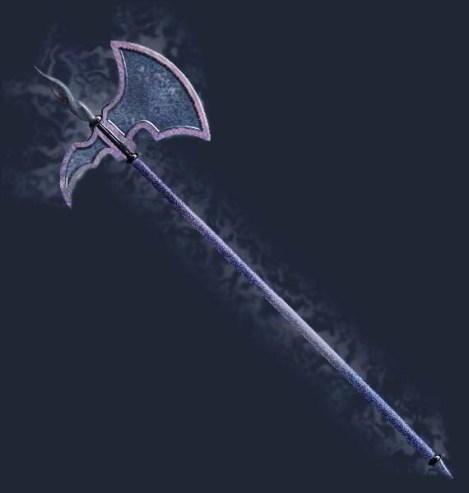
The name of the assassin, according to Njals Saga (the greatest of all the Icelandic sagas), was Þorgrímur Austmaður, and it is his only appearance in the saga. After his famous line, he collapsed in his own blood. Shown below is a halberd:

A Halberd

A Halberd

When gutted by a spear in the Gisla Saga (a.k.a. Gisli Sursson’s Saga), Véstein Vésteinsson cried out, “Bullseye!” (Mighty sporting of him, that!)

Then, in my second favorite saga, Grettir’s Saga, Átli Asmundarson cries out when hit by a broad spear: “Ah! It seems that broad spears have become fashionable.”

Finally, there is poor Þormóður Kolbrúnarskáld in The Saga of the Confederates who is all but disemboweled. Looking at his guts lying on the ground, he exclaims, “The king has fed us well!”

Now there are many reasons to love the sagas, and there is far more than gory violence and unbelievable sangfroid to be encountered in them (though it is by no means absent). I have read all the sagas from which Jóhannes quotes, most of them more than once, and keep finding myself sucked in by a frontier society that strives to arrive at some sort of balance in the absence of a king or any effective hierarchical government.

All the early Icelanders had to rely on was themselves, with the occasional help of some of the more prosperous families who offered their services as intermediaries in the disputes that inevitably arose.

In many ways, it was very much like our own Wild West.

Can This Be Me?

Budé

Guillaume Budé

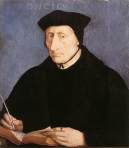
In 1503 he married the daughter of an ancient Norman house, and it is said that, on his wedding-day, by an exceptional act of self-denial, he limited his time of study to three hours only. In his studies he was aided in every possible way by the devotion of his wife. Once, when he was busy reading in his library, one of the servants suddenly rushed in to inform him that the house was on fire. The scholar, without lifting up his eyes from his book, simply said to his informant:—allez avertir ma femme; vous savez bien que je ne m’occupe pas des affaires du menage! (Translated as: “Go tell my wife. You know I don’t concern myself with household matters.”) His health was seriously impaired by his prodigious industry, and the surgeons of the day vainly endeavoured to cure him of his constant headaches by applying a red-hot iron to the crown of his head. Happily he was enabled to find a safer remedy by taking long walks and by cultivating his garden.—John Edwin Sandys, A History of Classical Scholarship, Vol. II, Entry on “Guillaume Budé”

Aristocide

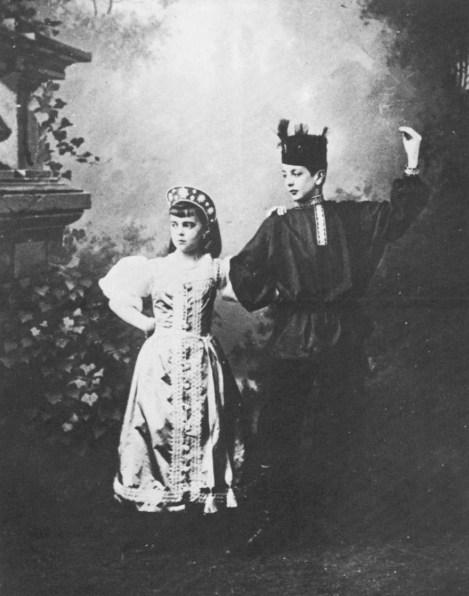
Children of the Nobility Wearing Russian Peasant Costumes

Children of the Nobility Wearing Russian Peasant Costumes

What happened to the Russian nobility after the October Revolution of 1917? Either they escaped the Soviet Union, or they became targets for extermination under Stalin. Around 1918 Grigory Zinoviev declared that as much as ten percent of Russia’s then population of ten million would have to be annihilated as being “counterrevolutionaries.” As Zinoviev’s colleague Martin Latsis said:

Do not look in the file of incriminating evidence to see whether or not the accused rose up against the Soviets with arms or words…. Ask him instead to which class he belongs, what is his background, his education, his profession. These are the questions that will determine the fate of the accused. That is the meaning and essence of the Red Terror.

Ironically, after the assassination of Sergei Kirov in 1934, Zinoviev was ordered to be arrested and tried during the first of the big show trials what became Stalin’s purges. Of course, he was found guilty and executed, along with thousands of others.

In a new book by Douglas Smith entitled Former People: The Final Days of the Russian Aristocracy, a brief description entailed what happened to one noble family, the Obolenskys:

Prince Vladimir Obolensky was killed at his estate in early 1918; later that year his older brother Alexander was shot at the Fortress of Peter and Paul in Petrograd. Prince Mikhail Obolensky was beaten to death by a mob at a railroad station in February 1918. Prince Pavel Obolensky, a cornet in the Hussars, was shot by the Bolsheviks in June 1918 and left for dead…. Princess Yelena Obolensky was killed at her estate in November 1918; her dead body was burned along with her manor house. Many more Obolenskys suffered similar horrific fates; they included seven members of the family who perished in Stalin’s prisons years later.

Particularly brutal were the fates of those aristocrats who sided with the White Army during the Civil War that followed the Revolution. And then along came Stalin, who did his best to demolish what remained.

This is not to say that there weren’t survivors, former aristos who “blended in” with the proletariat and lay low to avoid the attention of the Chekhist agencies of the Red Terror. What is astonishing was that the Bolsheviks and Stalinists found it necessary to execute an entire class which had already forfeited all its powers and wealth. But then, that’s what tyranny is all about: It is not above kicking you when you’re already down.


Serendipity: The Janissaries

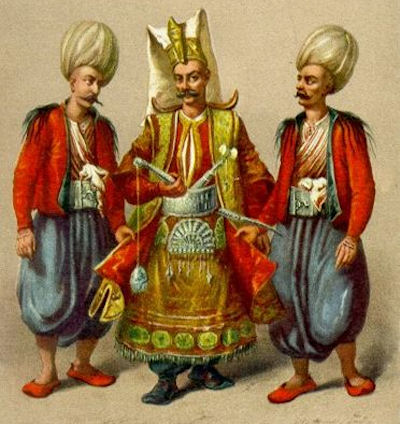
At One Time, They Were Feared by the Enemies of the Ottoman Empire

At One Time, They Were the Most Feared Infantry in Europe

They look rather silly, don’t they? But in the 15th and 16th centuries, they were the elite infantry of the Ottoman Empire. The Janissaries conquered the Balkans, much of the Black Sea coast, and Hungary. Little known to most people is that they were almost exclusively Christians, who were either kidnapped or bought from their parents by recruiters under the empire’s devshirme system. But, like many things that were once a good idea, it didn’t look so good any more by the time the 1800s rolled around.

The following discussion comes from David Brewer’s excellent book The Greek War of Independence: The Struggle for Freedom from Ottoman Oppression and the Birth of the Modern Greek Nation:

The Sultan’s problem within his borders lay, as it had done before, with the corps of janissaries. They were now practically useless as a military force, and [the Sultan] Mahmoud had to fight his wars with mercenaries and with troops raised by local pashas. The janissary regiments in the provinces drew pay and rations in idleness, while those in the capital were an unruly menace, as a contemporary visitor described. “Lords of the day,” he wrote,

they ruled with uncontrolled insolence in Constantinople, their appearance portraying the excess of libertinism; their foul language; their gross behaviour; their enormous turbans; their open vests; their bulky sashes filled with arms; their weighty sticks; rendering them objects of fear and disgust. Like moving columns, they thrust everybody from their path without any regard of age or sex, frequently bestowing durable marks of anger or contempt.

In 1807 Mahmoud’s predecessor Selim III had tried to bring the janissaries under control by incorporating them into his so-called Army of the New Order. The janissaries reacted violently, the New Army was formally abolished and Selim lost his throne. In the following year, the first of Mahmoud’s reign, his grand vizier publicly advocated reforming the janissaries and curbing their abuses, but lost his life in the ensuing janissary revolt.

In the space of some four hundred years, the janissaries went from an elite military force to a kind of mafia, with members of the corps selling “protection” to merchants. They acted as the firemen of Constantinople, but it was also widely believed that they set the fires in the first place.

For a delightful novel about the decay of the janissary corps, I recommend Jason Goodwin’s The Janissary Tree, a 19th century mystery whose “detective” is a eunuch connected with the Sublime Porte. In 1826, the Sultan could take no more and began arresting and executing the remnants of the corps. In Ottoman history, the persecution is referred to as the “Auspicious Event.”

By the way, Jason Goodwin not only writes entertaining detective stories set in the Ottoman Empire, but he is also a historian whose Lords of the Horizons is perhaps the best introduction to the Empire.

A Jesuit Paradise?

Stamps Commemorating the Jesuit Missions of Paraguay

Stamps Commemorating the Jesuit Missions of Paraguay

It is interesting to me that, for the first time in its history, the papacy is in the hands of a Jesuit, from South America no less. In southeastern Paraguay and in the Argentinean state of Misiones, there are numerous ruins attesting to the 17th and 18th century Jesuit missions—missions that were so powerful that they were, in effect, in control of the Guarani Indians of the area. If you ever saw Roland Joffe’s 1986 movie, The Mission, with Robert DeNiro, Liam Neeson, and Jeremy Irons, you have some idea of what the Jesuit government of Paraguay was like.

You can find out even more by reading the forgotten classic history by R. B. Cunninghame Graham entitled A Vanished Arcadia: Being Some Account of the Jesuits in Paraguay 1607 to 1767.

It even finds its way into Voltaire’s Candide, but its author being such an anticlerical cuss, he has his hero kill the Jesuit commandant of one of the missions. Yet he writes in Histoire Politique et Philosophique des Indes:

When in 1768 the missions of Paraguay left the hands of the Jesuits, they had arrived at perhaps the highest degree of civilization to which it is possible to conduct a young people, and certainly at a far superior state than that which existed in the rest of the new hemisphere. The laws were respected there, morals were pure, a happy brotherhood united every heart, all the useful arts were in a flourishing state, and even some of the more agreeable sciences: plenty was universal.

I have long thought that, if my thoughts had ever taken a turn toward the Catholic priesthood, I would have become a Jesuit. My teachers at St. Peter Chanel in Bedford, Ohio, wanted me to become one of them, a Marist. But, in the end, I became neither.

So now Pope Francis is a Jesuit from Argentina. He, I am sure, is quite aware of the history of the Jesuits in the southern cone of South America. It would be nice if he did for the Catholic Church what the Jesuits did for the Guarani in Paraguay and Argentina. Benedict XVI was a good man, but not strong enough for the task of making his faith relevant to a world that is falling away from the Church.


East

Are We Wearing Blinders When We Look at European History?

Are We Wearing Blinders When We Look at European History?

Our understanding of history is based on what happened in England and France, with an occasional detour to Spain, Germany, or Italy. We think of the First World War as having begun in 1914 and ended in 1918, and the Second World War as having begun in 1939 and ended in 1945. That those were merely the dates in which Western Europe and the United States were involved somehow doesn’t make it into our textbooks, let alone our consciousness.

We are so inundated with books and films about the Second World War that we forget that the whole Western European involvement was only a sideshow. Once Hitler had begun Operation Barbarossa and invaded Russia in June 1941, it was the beginning of the end for his dreams of a Thousand Year Reich. Things looked up for a while for the Panzer invaders, but soon they were dying by the millions—after having caused millions of civilian and military casualties in the Ukraine and Belarus.

Also, long before 1939, the Japanese had invaded Manchuria and Southern China, and the Germans had marched into Austria and Czechoslovakia. That wasn’t war?

Perhaps because I am increasingly conscious of my Hungarian roots, I prefer to not concentrate on the usual Western sequence of Hundred Years War, Crusades, Magna Carta, Renaissance, Reformation, Thirty Years War, Enlightenment, French Revolution, Napoleon, Metternich, and so on. There was also history occurring when Hungary was conquered by Suleiman the Magnificent and his Janissaries at the battle of Mohacs in 1526, when Poland was partitioned three times in the eighteenth century, when two Balkan Wars were fought in 1912-1913 leading up to the “main event” after Archduke Ferdinand was assassinated in Sarajevo, when Greece invaded Turkey in the early 1920s and was soundly defeated by Kemal Ataturk, resulting in thousands of Greek refugees being forced out of Smyrna and the rest of Ionia.

There is ever so much more: the war between the Reds and the Whites after the October Revolution of 1917, Stalin’s purges of the late 1930s, the Hungarian Revolution of 1956, the brave Polish resistance to Communist rule under the leadership of men like Adam Michnik and Lech Walesa, and Tito’s repudiation of Stalin.

The next time you are tempted to read a history book, remember that there are probably large lacunae in your knowledge. Instead of another book on the cockamamie British royalty, read Robert D. Kaplan’s Balkan Ghosts or Antony Beevor’s Stalingrad or The Fall of Berlin. Read poetry by Czeslaw Milosz, Russian novels like Vasili Grossman’s Life and Fate, or the journalism of the Hungarian Gyula Krúdy in Krúdy’s Chronicles.

But mostly, recognize that there is a whole world out there with which you may not be acquainted, but which will influence the course of history to come for generations to come.


Old Bones

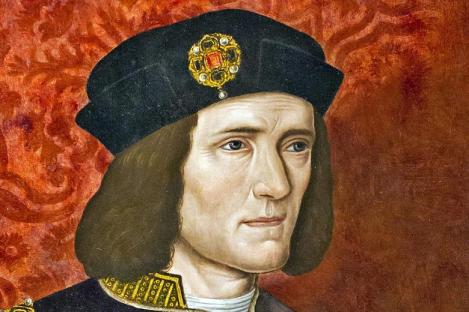
Richard III (1452-1485)

Richard III (1452-1485)

I was on a Laker Airlines flight from London Gatwick to Los Angeles in October 1976 when I read Josephine Tey’s novelized biography of Richard III entitled The Daughter of Time. In it, Tey’s Inspector Allan Grant, while recovering in a hospital, decides to investigate the life of Richard III. Based on the picture above, he could not believe that Richard could be such as arrant villain as Shakespeare portrayed him in his play.

There is little doubt that Richard seized the crown that properly belonged to his young nephews, the so-called Princes in the Tower, whom he may or may not have ordered to be killed. As king, he was not so very bad; but there is always that suspicion of evildoing at its outset.

Richard is one of the few kings of England who have a fan club dedicated to restoring his reputation.

Well, it appears that they have found and identified the remains of Richard, which were discovered in a shallow grave in a parking lot where Greyfriars Abbey once sat before Henry VIII had it razed. DNA was taken and compared with that of a lineal descendent in Canada and found to be a match. And, what is more, Richard’s body was slightly misshapen, not quite an out-and-out hunchback, but near to it.

Now, was he a good king or a bad king? Or was he merely indifferent? The question rages on.


The More Things Change …

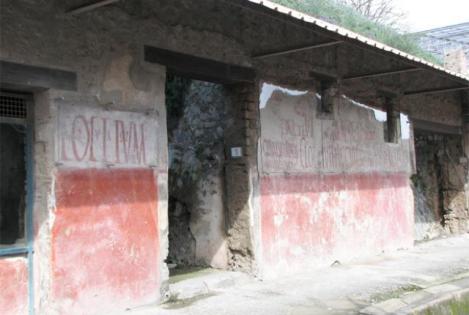
Roman Graffiti from Pompeii

Roman Graffiti from Pompeii

Let us say we were seated across the table from an ancient Roman and, say, a Viking. Aside from the obvious language problem, would there be enough commonality to allow for a spirited discussion? I think there would be, primarily because I have read enough Roman and Viking (I should say Icelandic and Norse) literature to vouch for the fact that, when all is said and done, we are not all that different from one another.

Let me take as a case in point graffiti that has been discovered from the ruins of Pompeii and Herculaneum. You can probably find the equivalent in any nightclub’s restroom wall:

  • Philiros spado – “Philiros is a eunuch”
  • Apollinaris, medicus Titi Imperatoris hic cacavit bene – “Apollinaris, physician to the Emperor Titud, had a good crap here”
  • Oppi, emboliari, fur, furuncle – “Oppius, you’re a clown, a thief, and a cheap crook”
  • Miximus in lecto. Faetor, peccavimus, hospes. Si dices: quare? Nulla matella fuit –
    This one was found in an inn: “We have wet the bed. I admit we were wrong, my host, but if you ask why, it is because there was no chamber pot.”
  • Virgula Tertio su: Indecens esVirgula to Tertius: You are a nasty boy.“
  • Suspirium puellam Celadus thraex – “Celadus makes the girls moan”

Now I have not seen the graffiti of Ancient Rome, but I saw the viking graffiti in the tomb at Maes Howe in the Orkneys. Built over 5,000 years ago, Maes Howe was frequently visited by Viking raiders in the hopes that some buried treasure could be found there. They found none, but left such observations as the following in their Futharc runes:

  • “Thorni fucked. Helgi carved.”
  • “Ingigerth is the most beautiful of all women” next to a picture of a slobbering dog.
  • “These runes were carved by the man most skilled in runes in the Western Ocean.”

You can find more about the Pompeiian graffiti by clicking here. The runes at Maes Howe are explained here.

The more things change, the more they remain the same.

The Man from Stalingrad

Vasily Grossman (1905-1964)

Vasily Grossman (1905-1964)

Over the last year, I have been participating in a European History Meetup Group that, for a while anyway, turned into a Russian history group. We did readings and discussions on Peter the Great, Catherine the Great, Napoleon’s invasion of Russia, the Russian Revolution and Civil War, Stalin’s purges beginning in 1937, and two sessions on the Russian contribution to the Second World War.

Vasily Grossman was a loyal supporter of Stalin and, as such, served as a war correspondent for Krasnaya Zvezda, the official Red Army newspaper. He was in Moscow, Stalingrad, Kursk, and Berlin during the battles for those cities; and he provided eyewitness accounts of the liberation of the Nazi extermination camp at Treblinka.

Only toward the end of Stalin’s rule, when the dictator began to persecute the Russian Jews, did Grossman begin to rue his former attachment to the State. His great 900-page novel, Life and Fate, shows the actual change of mind taking place.

His extended Jewish family of Shaposhnikov women and their in-laws both suffer and are rewarded for their contributions to the State. Mostly, though, they suffer. Even the heroic tank commander, Nikolov, who leads the first Soviet armored units into the Ukraine, ends the book with an order to report to the stavka (General Staff) in Moscow. His scientist/academician, Viktor Shtrum, receives a congratulatory call from Stalin just when he thinks he is about to be arrested and interrogated—but then he is pressured into signing a statement that two physicians he respects were responsible for murdering the writer Maxim Gorky.

Stalin gives with one hand and takes away with the other. At the end of the Siege of Stalingrad, Grandma Shaposhnikov walks through the ruins and ponders:

And here she was, an old woman now, living and hoping, keeping faith, afraid of evil, full of anxiety for the living and an equal concern for the dead; here she was, looking at the ruins of her home, admiring the spring sky without knowing that she was admiring it, wondering why the future of those she loved was so obscure and the past so full of mistakes, not realizing that this very obscurity and unhappiness concealed a strange hope and clarity, not realizing that in the depths of her soul she already knew the meaning of both her own life and the lives of her nearest and dearest, not realizing that even though neither she herself nor any of them could tell what was in store, even though they all knew only too well that fate alone has the power to pardon and to chastise, to raise up to glory and to plunge into need, to reduce a man to labour-camp dust, nevertheless neither fate, nor history, nor the anger of the State, nor the glory and infamy of battle has any power to affect those who call themselves human beings. No, whatever life holds in store—hard-won glory, poverty and despair, or death in a labour camp—they will live as human beings and die as human beings, the same as those who have already perished; and in this alone lies man’s eternal and bitter victory over all the grandiose and inhuman forces that ever have been or will be …

Life and Fate is one of the great novels of twentieth century Russia, on a par with (and perhaps even a little bit better than) Anatoli Rybakov’s Arbat trilogy (Children of the Arbat, Fear, and Ashes and Dust).

As I wrote in my review of the book for Goodreads.Com:

I rather doubt that most readers will have the sitzfleisch to attack either Grossman or Rybakov. Unless one is somewhat familiar with the history and with Russian character names and patronymics, one is not likely to stray too far from the tried and true and excessively familiar. But, know this, there are rewards for those who do.

For an interesting perspective on Grossman, check out this site from the Jewish Daily Forward.