The End of HalloThankMas

Our End of Year Holiday Ordeal Is Now Over!

From the beginning of October to the end of the Tournament of Roses Parade is one unending holiday, which I call HallowThanksMas, but others shorten (not by much) to HalloThankMas. It’s supposed to be a time of family closeness, warmth, and happiness—but isn’t, not by a long shot.

This is why I love the whole idea of Festivus—a holiday for the rest of us—as introduced by the Seinfeld show in 1997. It consists of the following:

  • A vertical, unadorned aluminum pole
  • A Festivus dinner, during which there is an “airing of grievances”
  • In response to pushback from the diners, there are “feats of strength,” during which the whiners are wrestled to the ground
  • “Festivus Miracles” are easily explained coincidences

I actually like Halloween, though I never attend Halloween parties, nor would any of my friends be so unwise as to invite me to one. But Thanksgiving and Christmas could and probably should be replaced by something like Festivus. It’s cheaper, does not involve the consumption of dry birds, does not involve greeting cards or gifts, and airs out all the hidden aggressions behind the holidays.

Think about it.

Return to Uayeb Yet Again Part Deux

To date, I have written five posts about the Maya “month” of Uayeb or Wayeb, which consists of the last five days of the Haab Calendar of 365 days. The Haab calendar has twenty months of eighteen days each, which isn’t quite enough to make up the full complement, so the Maya added a short stub of a month containing the five “nameless days.”

There is also a Maya god named Uayeb, who is the god of misfortune. That sounds about right.

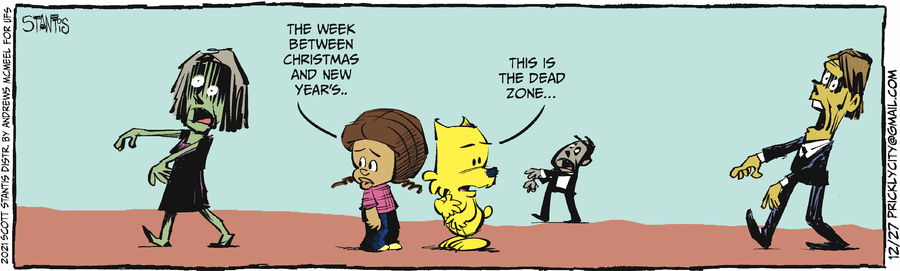
The Cartoonist Scott Stantis Has an Intuitive Understanding of Uayeb

Here is a link to my previous posts on the subject:

Below is the Maya glyph for the “month” of Uayeb, or Wayeb (kind of looks like a tiny-headed god flexing his muscles, doesn’t it?)

In his comments to last year’s post, my friend Mudpuddle noted that “the glyph looks like a surfer headed for muscle beach!”

I am amused by how well a Maya calendrical belief fits in so well with our civilization, in which the days between Christmas and New Year and almost universally considered as dead time.

So don’t make any big plans until the New Year. But you kind of knew that anyway, no?

Hello Darkness, My Old Friend

Today Is the Darkest Day of the Year

In the Northern Hemisphere, where 90% of the Earth’s population lives, this is the Winter Solstice, the shortest day of the year. Conversely, in the Southern Hemisphere, it is the Summer Solstice, the longest day of the year. Apparently, it all has something to do with the way our planet is tilted on its axis, with us in the North being farther from the Sun.

Since I am retired, it doesn’t matter to me that it gets dark early. I no longer have to put up with December traffic on my way home from work in the dark.

And as for darkness, it really isn’t all that dark, With all the external building lighting, together with the numerous fairy lights from my computer, television, air purifier, microwave, and whatnot, I can usually make way way around my apartment in the wee hours of the morning without kicking the furniture with my bare feet.

As for the title of this post, it comes from Simon & Garfunkel’s hit song, “The Sound of Silence”:

Hello darkness, my old friend
I've come to talk with you again
Because a vision softly creeping
Left its seeds while I was sleeping
And the vision that was planted in my brain
Still remains
Within the sound of silence

Tall and Short

From left, Moscow-appointed head of Kherson Region Vladimir Saldo, Moscow-appointed head of Zaporizhzhia region Yevgeny Balitsky, Russian President Vladimir Putin, Denis Pushilin, leader of self-proclaimed Donetsk People’s Republic and Leonid Pasechnik, leader of self-proclaimed Luhansk People’s Republic pose for a photo during a ceremony to sign the treaties for four regions of Ukraine to join Russia, at the Kremlin in Moscow, Friday, Sept. 30, 2022. The signing of the treaties making the four regions part of Russia follows the completion of the Kremlin-orchestrated referendums.” (Dmitry Astakhov, Sputnik, Government Pool Photo via AP)

Why is it no surprise to me that Vladimir Putin is so much shorter than his political lieutenants? Actually, he is 5 feet 7 inches (170 cm), which is only an inch shorter than the mean height of men around the world. (For the record, I myself am 5 feet 8 inches, the average height.)

Well, that isn’t very short after all. But then look at the height of all the U.S. Presidents and presidential candidates since FDR:

2020Joe Biden5 ft 11+1⁄2 in182 cmDonald Trump6 ft 3 in191 cm3+1⁄2 in9 cm
2016Donald Trump6 ft 3 in191 cmHillary Clinton5 ft 5 in165 cm10 in25 cm
2012Barack Obama6 ft 1+1⁄2 in187 cmMitt Romney6 ft 1+1⁄2 in187 cm0 in0 cm
2008Barack Obama6 ft 1+1⁄2 in187 cmJohn McCain5 ft 9 in175 cm4+1⁄2 in11 cm
2004George W. Bush5 ft 11+1⁄2 in182 cmJohn Kerry6 ft 4 in193 cm4+1⁄2 in11 cm
2000George W. Bush5 ft 11+1⁄2 in182 cmAl Gore6 ft 1 in185 cm1+1⁄2 in4 cm
1996Bill Clinton6 ft 2+1⁄2 in189 cmBob Dole6 ft 1+1⁄2 in187 cm1 in3 cm
1992Bill Clinton6 ft 2+1⁄2 in189 cmGeorge H. W. Bush6 ft 2 in188 cm1⁄2 in1 cm
1988George H. W. Bush6 ft 2 in188 cmMichael Dukakis5 ft 8 in173 cm6 in15 cm
1984Ronald Reagan6 ft 1 in185 cmWalter Mondale5 ft 11 in180 cm2 in5 cm
1980Ronald Reagan6 ft 1 in185 cmJimmy Carter5 ft 9+1⁄2 in177 cm3+1⁄2 in9 cm
1976Jimmy Carter5 ft 9+1⁄2 in177 cmGerald Ford6 ft 0 in183 cm2+1⁄2 in6 cm
1972Richard Nixon5 ft 11+1⁄2 in182 cmGeorge McGovern6 ft 1 in185 cm1+1⁄2 in4 cm
1968Richard Nixon5 ft 11+1⁄2 in182 cmHubert Humphrey5 ft 11 in180 cm1⁄2 in1 cm
1964Lyndon B. Johnson6 ft 3+1⁄2 in192 cmBarry Goldwater5 ft 11 in180 cm4+1⁄2 in11 cm
1960John F. Kennedy6 ft 1 in185 cmRichard Nixon5 ft 11+1⁄2 in182 cm1+1⁄2 in4 cm
1956Dwight D. Eisenhower5 ft 10+1⁄2 in179 cmAdlai Stevenson II5 ft 10 in178 cm1⁄2 in1 cm
1952Dwight D. Eisenhower5 ft 10+1⁄2 in179 cmAdlai Stevenson II5 ft 10 in178 cm1⁄2 in1 cm
1948Harry S. Truman5 ft 9 in175 cmThomas Dewey5 ft 8 in173 cm1 in3 cm
1944Franklin D. Roosevelt6 ft 2 in188 cmThomas Dewey5 ft 8 in173 cm6 in15 cm

I was shocked to find that the only times in recent history that the shorter candidate won was when Jimmy Carter defeated Gerald Ford; George W. Bush beat John Kerry and Al Gore; and Joe Biden defeated Donald Trump.

Americans seem to vote for the taller candidate. Why is that? Do we think that taller candidates are more imposing? Is that, perhaps, why we have never had a woman in the White House? Perhaps one of the reasons Hillary Clinton lost to the man from Mar-a-Lardo is that she is a full ten inches shorter than him.

The only candidate who was my height was Michael Dukakis, who was trounced by George H. W. Bush. And that was a pretty ignominious defeat, so you can bet that I’m not tempted to run for anything. (Though there are not a few things I would run from.)

Don’t Try.

Poet Charles Bukowski (1920-1994)

Whoever ordered the tombstone for poet and counterpuncher Charles Bukowski knew what he (or she) was about. There is a two-word epitaph: “Don’t Try.” Below it is a silhouette drawing of a boxer with his gloves raised.

The poet’s grave is at Green Hills Memorial Park in San Pedro which I have passed scores of times 0on visits to my friend Peter who lives a couple miles further south. Maybe next town, I’ll stop by and pay my last respects.

On Bukowski.Net, there is an explanation by Bukowski’s wife Linda which sheds some light on he meant:

See those big volumes of books? [Points to bookshelf] They’re called Who’s Who In America. It’s everybody, artists, scientists, whatever. So he was in there and they asked him to do a little thing about the books he’s written and duh, duh, duh. At the very end they say, ‘Is there anything you want to say?’, you know, ‘What is your philosophy of life?’, and some people would write a huge long thing. A dissertation, and some people would just go on and on. And Hank just put, “Don’t try.”

I am reminded of Portuguese writer Fernando Pessoa in The Book of Disquiet, who sees life as a roadside inn where we all have to stay until the coach from the abyss pulls up:

Night will fall on us all and the coach will pull up. I enjoy the breeze I’m given and the soul I was given to enjoy it with, and I no longer question or seek. If what I write in the book of travellers can, when read by others at some future date, also entertain them on their journey, then fine. If they don’t read it, or are not entertained, that’s fine too.

In the days to come, I plan several more posts about Bukowski and what he means to me.

Dancy Dancy

How Convincing Are the Happy Dances, Really?

I cannot help but think that life is grimmer than ever, based on all the happy dances on TikTok and TV commercials. Together with all the pharmaceutical commercials, with their family-happiness-in-the-outdoors tropes, the happy dances are a promise that is almost never fulfilled. How does that delirious couple in the photo above look when medical bills and their mortgage are more than they could bear. Even if they got that great house for the cheap price of a zillion dollars.

The one happy dance which doesn’t bother me is Matt Harding’s “Where the Hell Is Matt? 2008.” That son of a bitch had something to dance about—the sheer joy of life—and it would be my pleasure to join him:

Bibliotherapy

The Last Bookstore in Downtown Los Angeles

There is no question in my mind that reading books can be a form of therapy. Not all books, but certainly those that make you think. Some books could be the opposite of therapeutic, like anything by Ayn Rand or Donald J. Trump.

I read incessantly. Only when I am ill do I not pick up a book. Since September 1998, I have read 2,750 books, ranging from literary classics to poetry to philosophy to history to travel.

Beginning in 1975, the year of my first real vacation (in Yucatán, Mexico), I decided to prepare several months in advance by reading books about my destination. They included archaeology, history, fiction, and descriptions of journeys. That way, when I finally reached my destination, I was there as a person who knew all sorts of things about where he was. That made me feel good about traveling. I didn’t feel like an ignorant interloper.

The therapeutic aspect was there, too. I came to the conclusion that the best philosophy books were written by the ancient Greeks and Romans. Cicero, Marcus Aurelius, and Epictetus had more to say about the human condition than the vast majority of academic philosophers, whose works were by and large unreadable. And it didn’t involve swallowing a whole lot of dogma administered by organized religion.

If you were to read the four dialogues of Plato about the death of Socrates (Euthyphro, Apology, Crito, and Phaedo), you will have read the greatest works of Western Philosophy ever written.

Also worth considering are some of the Hindu, Taoist, and Buddhist texts, such as The Bhagavad Gita, The Tao Te Ching, and the literature of Zen Buddhism. They taught me that desire is always accompanied by suffering. The less one desires, the happier one is. And happiness is not a lasting thing: It goes into hiding and manifests itself only at irregular intervals.

Now if I can only declare my book purchases as medical expenses….

“The Best Is Yet To Be”

I never thought I would be alive at the age of 77. My father died at 74 years old; and my mother, at 79. When I was a student at St. Henry Elementary School, I thought, “Gosh, I’ll be 55 years old when we get to the year 2000.” I passed that milestone at a run.

In the illustration above, I am somewhere between the third and fourth figure. Thankfully, my health is good. I can get about without a cane, though I find going down a flight of stairs to be painful. Kneeling on a hard surface is out of the question.

When I think about aging, I call to mind the first stanza of Robert Browning’s poem “Rabbi Ben Ezra”:

Grow old along with me!
The best is yet to be,
The last of life, for which the first was made:
Our times are in His hand
Who saith “A whole I planned,
Youth shows but half; trust God: see all, nor be afraid!” 

I see some of my friends fall by the wayside, some dying, some suffering personality disorders as they age, and some just isolating themselves.

This is not a subject anyone likes to think about. There are, however, dangers inherent in suppressing any important subject.

The times are always bad—and always have been. Yes, what is happening in Ukraine is terrible. But so was ducking under my school desk at St. Henry to practice for a Communist H-Bomb attack. So was World War Two. So was … oh … Genghis Khan.

I always wanted to be a writer. And in a manner of speaking, I am one. I don’t care about compensation or fame. Just sitting down around 9 o’clock most evenings and writing this blog is a worthwhile effort. It makes me feel good about myself.

The Third Degree

Louis Jouvet (Right) Sweating a Suspect (2nd from Left)

The French criminal justice system is very different from our own. I have just finished reading Georges Simenon’s Maigret and the Burglar’s Wife [Maigret et la grande perche] (1951); plus I have just recently seen Henri-Georges Clouzot’s film Quai des Orfêvres (1947). In both works, the investigating inspectors give their suspects the third degree. It is a process of intimidating the suspect until he or she talks, no matter how long it takes. In the film, there was a kind of tag team of interrogation, involving Inspector Antoine (Louis Jouvet) and the two detectives above with cigarettes hanging from their lips.

I wonder if things have changed that much in the last seventy years or so. France’s laws are based on the Napoleonic Code of 1804, in which there is a presumption of guilt rather than innocence, as in English Common Law. Suspects could be held in custody for longer periods of time until the evidence was clear.

In the Simenon novel, Inspector Maigret proceeds with the arrest even before this point, because he is so sure that the evidence is forthcoming. In the movie, the suspects, Maurice Martineau and Jenny Lamour, are convinced they will be framed by Inspector Antoine, who actually frees them when he gets a confession (albeit by sustained intimidation) from the real murderer.

It is interesting to see and read about police procedurals from other countries. In the United States, we have adopted English law. I rather suspect that, in the end, both legal systems are equally fair—or unfair.

How (Not) to Celebrate New Years

A traditional way of celebrating New Years Eve in France is by setting cars alight. According to the BBC, as of some 12 hours ago, a total of 874 cars have been set on fire. I’m sure that’s kind of like a firecracker, but multiplied out, that’s got to be about 10 million dollars in damages.

Far better is a series of two cartoons from Brooke McEldowney in his “9 Chickweed Lane” series. The first cartoon ran on December 31 and was a bit confusing:

It all came clear with today’s cartoon:

I loved this set of images. We make a jump from one reality to another. Actually, it’s the same reality: Just a different template overlaying it. BTW, the look on the little girl’s face is priceless.

So let’s take that leap without incinerating any automobiles, if you please.