The Paris Family 1950

1950 Census Records of My Family

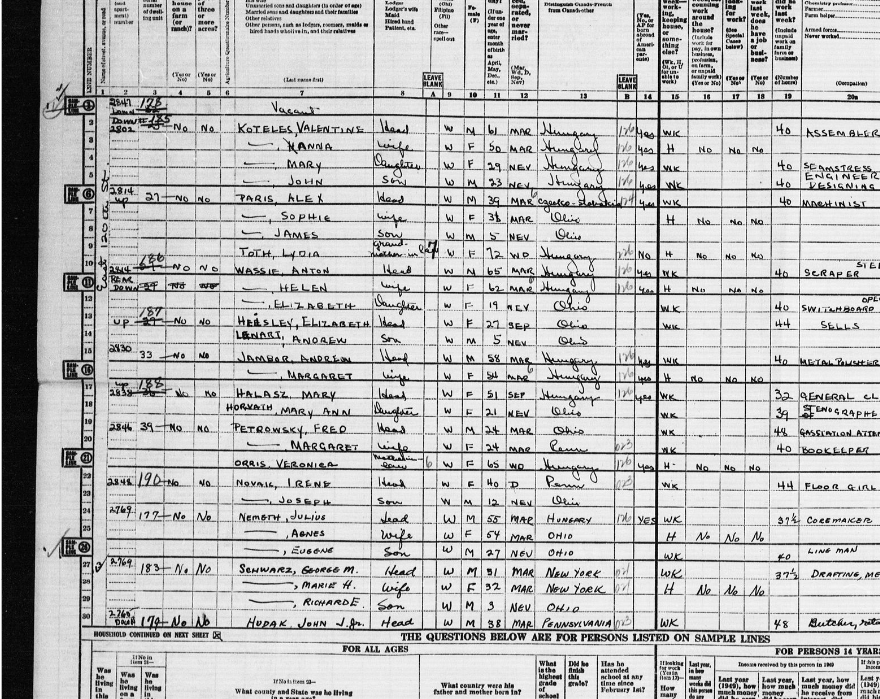
The 1950 Census has been unsealed and is now available for searching. Above is the page of the census (look starting with line 6). At the time, we lived at 2814 East 120th Street in the Buckeye Road Hungarian neighborhood of Cleveland, Ohio. In our household were:

  • My father Alex, born in what at the time of his birth was the Austro-Hungarian Empire, but in 1950 was part of Czechoslovakia.
  • My mother Sophie, born in the U.S. but raised in Hungary.
  • Me—but not my brother, who was to come along the next year.
  • My great-grandmother Lidia Toth (correct spelling: the enumerator goofed). Since both parents worked, she served as a live-in caregiver to me. She was born in Felcsut, Hungary, and spoke no English.

Note that my father was listed as a machinist. He was then employed by Lees-Bradner and Company, which manufactured gear-hobbing machines.

If you are curious about your own family, you can search the 1950 Census for yourself by clicking here. Please confine your search to the head of the household, as things get a little scattered when it comes to wives, children, and other live-in family members.

Tiny Treasures

Beware Malefactors!

My Martine is as sweet as sweet can be, but her heart can be steel-plated when it comes to street hooligans. On most days, she takes a long walk in the neighborhood, keeping a weather eye out for what she calls “tiny treasures.” Sometimes these are foreign coins or interesting lanyards or any number of things.

Lately, however, some of her discoveries have been on the alarming side:

  • Two baseball bats, near a bus stop ad that had been vandalized
  • A bolt cutter
  • A large sledgehammer

In each case, she walked the item to the Santa Monica Police Station and handed it to the officer on duty. I cannot help but think that the local police are wondering what she will bring in next. Will it be an AK-47? An RPG (that’s rocket propelled grenade)? A box of land mines?

The streets of West L.A. and Santa Monica are getting rougher each year, and that’s reflected in what she finds.

Among the Hippies

You Won’t Find Me in This Photo

Although I arrived in Southern California right around the time the Hippies sprang into existence, I was never one myself. I had just undergone brain surgery in Cleveland, and my worries were too basic for me to work on being cool. I was, in a word, decidedly uncool. I didn’t have a beard, though in 1968 I started to grow a mustache, not because it was fashionable, but because it reminded me of my Hungarian Huszár (Hussar) ancestors.

All around me, people were wearing tie-dyed shirts and blouses, headbands, and other regalia suggestive of Native Americans and Asians, the only Hippie trait I adopted was long hair. I had always disliked the crew cuts and flattops that my parents liked, so I let my hair grow when I came to the Coast. As for beards, I tried but it was way too itchy.

Some of my friends were Hippies, and by and large I got along well with many of them. I tended, however, to avoid kids who took their stance too seriously. I smoked grass from time to time, but I was probably more likely to get an asthma attack than to get high. As for more serious drugs, like LSD, mescaline, and psilocybin, I didn’t mess with them.I had no way of knowing how long I would live without a pituitary gland, so I didn’t want to experiment too much. I was into surviving.

And so, more than half a century later, I am still infesting the Earth—with perhaps the prospect of continuing a few years longer. My continued survival came as a pleasant surprise to me.

Escaping Thayer

It’s now called the Class of 1953 Commons, but when I was attending Dartmouth College between 1962 and 1966, it was called Thayer Hall. All students were required to eat there, which for me was a disaster. The meat was like slabs of granite, accompanied by bland potatoes and overcooked vegetables.

Supposedly it has improved since the days when Miss Jeanette Gill (who was reputed to be a retired marine) ruled the dining hall with an iron spatula. But then there were troops of dogs fighting for table scraps. When we saw the truck from the Precinct Pig Farm parked outside of Thayer, we were wondering whether they were picking up to slop the hogs or delivering to slop the students.

When I returned to Cleveland for Christmas vacation in December 1962, I managed to get a doctor’s note excusing me from eating at Thayer because it was making me sick. Which it was.

That left the handful of restaurants in Hanover, New Hampshire for me to explore. Probably my favorite was Lou’s Restaurant, owned by Louis Bressett, who, once every blue moon, served a devilish good spaghetti with meatballs. There was the usually reliable College Inn, and always the possibility of a splurge at the Hanover Inn.

I also enjoyed a local restaurant called Minichiello’s. Let me quote a 2015 post:

One of the places I ate was Minichiello’s: They had good pizza and were friendly. The only problem was they thought I was such a nice boy. You must remember that when I was a college senior, I looked as if I were still twelve; and I was subject to bullying by the local high schoolers until they saw I was carrying a college ID. So there I was, munching away at my pizza, when they introduce their daughter to me. She was very cute in a bad girl sort of way, and here her parents were holding me up as an example she should follow—instead of those bad boys who worked at the local garage.

God knows, if it weren’t for the fact that I was seriously ill with a pituitary tumor and, as a result, had not yet physically reached the age of puberty, I would much rather be doing with her those things her parents feared she was doing with the bad boys.

So for the rest of my college career, I avoided Thayer Hall. Where food is concerned, there’s a lot to be said for the privilege of being able to choose.

Waterless Tuesday

I woke up this morning to bad news. A notice was taped to our front door indicating that our water would be shut off on Tuesday between 8 am and 4 pm. That meant I would have to camp out for several hours where I would have access to a lavatory. What came to mind was the Westfield Shopping Center in Culver City, perhaps after I took my car in for an inspection of hoses, belts, fluids, and tires for next week’s trip to Las Vegas.

The apartment building management stated that the water shut-off was for “maintenance repairs,” never specifying the exact nature of the maintenance repairs.

Today meant even more bad news for the homeless encampment across the street. The police showed up with several trucks and disposed of a number of (but not all) the tents, and most of the associated piles of rubbish that accompanied them.

I have tried to avoid interacting with these campers, though I had a run-in when I returned from the desert two weeks ago. Tired from a 130-mile (201 km) drive from Palm Desert, I pulled into my parking spot only to find it occupied by a bicycle bum sitting on the pavement and eating a bowl of cereal. He was incensed that I asked him to move and urged me to go f—k myself. I returned the favor, and he left in a surly mood. When next I returned to my parking spot, I saw that my vehicle was decorated with spilled milk and some kind of multi-colored fruity cereal. Naturally, I had to get my car washed that afternoon.

Escape to the Desert

It’s off to the Coachella Valley for me this weekend to spend some time with my brother. I figured it was best to go now before it started to get hot, as it does late in the spring. My next post will probably be on Monday. With luck, I will have some new scenic photographs with desert views.

Heavy Industry

Though I understand that the brand-name still exists, the company for which my father worked as a machine-tool builder for many years no longer does. The Lees Bradner Company manufactured gear-hobbing (cutting) machines and thread milling machines, primarily for export.

Alex Paris was for a number of years the shop steward for Mechanics Educational Society of America (MESA), Local 19. He stayed with the firm until the bitter end, when new owner White Consolidated Industries decided to close the factory at West 121st and Elmwood and move the operation to Dexter, Maine to its Fayscott Division in 1975. My father and most of his colleagues decided not to make the move—which was just as well as White sold off the division eleven years later.

Cleveland used to be a major center for the machine tool building industry. No more. In fact, most of that industry is now in China.

You can still find lots of used Lees Bradner machines for sale. Apparently, they had a pretty good reputation.

Crickets in the Kitchen

As I sit here to write this blog entry, I am on the receiving end of a concert by the crickets who inhabit my kitchen. For many years, I thought the sound was coming from my Amana refrigerator—until I actually started seeing the crickets, usually as I smashed them with a fly swatter thinking they were one of the mega cockroaches, which, alas, also inhabit this apartment.

The apartment building in which I live is almost as old as I am, having been built around 1946. As I have been told, my building as well as several others in the immediate vicinity, were meant to house the Cleveland Rams, which were soon to be called the Los Angeles Rams. The apartment in which I live could once have been the home of William “Bud” Cooper, Harry “The Horse” Mattos, or Stan Pincura.

I moved in here in 1985. My landlady was the kindly Anna Ficele, who was the original building owner and a terrific cook. After she died in 2001, her slightly retarded son took over, until he passed on a few years later from a life of dissipation. The next owner lasted only a few years. His widow, as I understand it, now owns the papers. Fortunately, we only have to deal with the management company.

We have no intention of complaining about the crickets. I rather enjoy their music.

Glory Days

There are many possible pathways through a life. For many, the high point of their lives came early, in high school or college. As they settled down into family life, they rarely ever cracked a book or veered in a different direction. When one talks to them, most of their talk is of their glory days—and their present lives are a long comedown.

Although I was a high school valedictorian who was accepted for a four-year scholarship at an Ivy League college, I never felt I had any real laurels upon which to rest. The first seven years of my life were spent in a Hungarian household, where the Magyar language was the only one spoken. This gave me a slightly different outlook from most others. As I learned English and began to see myself as an American, I also saw myself as something of a hyphenated American who had his feet in two cultures.

During my high school and college years, I was walking around with a pituitary tumor that gave me severe headaches as it pressed against the optic nerve. So my glory days of youth were spent mostly in pain. When I was successfully operated on after I graduated in 1966, I looked like an 11-year-old rather than a college graduate. You can imagine how that affected my self-image.

In the intervening years I had two careers: first, as a computer programmer and director of marketing for a demographic data supplier, and then as a computer specialist and office manager for two tax accounting firms. In both professions, I saw myself as a mercenary who was actually after different game.

Now that I am retired, I am coming into my own as a writer here on this WordPress site. Oh, I am no “influencer.” I have no intention of getting you to buy crap, or anything else. If I am selling anything, it is my thoughts and feelings as a human being living in difficult times. I feel good and am considerably happier than I was during my youth.

It looks as if I am now living through my glory days.

On the Bewitched Staircase

If you want to see a happy post, don’t catch me between Christmas and New Year. It is no accident that all my posts this week are unusually dark. My lone adherence to the Maya religion is my belief in the Uayeb, the unlucky five days that follow the 360 day Haab calendar to bring the total up to 365. According to an interesting website about the Uayeb:

Despite the fact that these days share the calendar with 18 other periods lasting 20 days each, the Uayeb had a bad reputation among the Maya people. According to writings found during the colonial period, these days were considered black periods in which the universe had released dark forces and therefore they didn’t share in the blessings of time.

In the Songs of Dzibalche, a codex found in 1942, a series of allusions to the Uayeb were discovered. These expressed the discomfort the days caused the Maya people:

The days of weeping, the days of evil/ The devil is loose, hell is open/ There is no goodness, only evil… the month of nameless days has come/ Days of pain, days of evil, the black days.

Several theories describe how the Maya passed through such dark times. Some specialists maintain that during these periods they stayed in their homes and washed their hair. Others claim they undertook great processions in thanks for what they’d experienced during the year. One thing that’s certain is that the word Uayeb could be translated as “bewitched staircase.”

So let’s just say I am having a bad Uayeb.