The Avila Adobe

In the Middle of Olvera Street, L.A.’s Oldest Still-Existing House

In the Middle of Olvera Street, L.A.’s Oldest Still-Existing House

In my semi-retirement, I’ve taken to going downtown at least once a week and doing some exploring. Today, I started out at the Central Library reading Claude Izner’s In the Shadows of Paris, set in the City of Lights back in the 1890s.

I picked out a volume of Charles Bukowski’s letters in the literature section and checked it out, making my way to Meeting Room A at 12:30 for something completely different: A guided session on meditation by Giselle Jones. It was super-relaxing. I will look out for other meditation events at the Library.

Then it was on to Dash Bus B to Olvera Street. I had a hankering for some more of Cielito Lindo’s taquitos and chile rellenos. Yum! They were even better than last time.

Finally, I paid a visit to the oldest surviving house in Los Angeles: The Avila Adobe. Although L.A. was first settled in 1781, all the houses were destroyed by the ravages of time, except for the Avila Adobe, which was built in 1818 by Francisco Avila, one of the city’s earliest alcaldes (mayors). The house was an oasis of calm amid the frantic crowds looking to buy souvenirs.

From there, it was a short walk to the bus stop for the Santa Monica Big Blue Bus #R10 to return home.

Unaccustomed Cool Breezes

Burton W. Chace Park in Marina Del Rey

Burton W. Chace Park in Marina Del Rey

As the siege of hot, humid weather continues throughout Southern California—fed by moist monsoonal clouds from Mexico—it behooved me to find someplace where I could be cool. There is one odd little park in Marina Del Rey which is on a small peninsula surrounded on three sides by boat channels.

For some reason which I cannot understand, even on the hottest days of the year, a cool breeze is always blowing. On Sunday, Martine and I spent several hours there with Bill and Kathy Korn. Today I went by myself, taking a new Santa Monica Big Blue Bus line (the #16) that takes me from within three blocks of where I live to within three blocks of the park for a measly half dollar.

Once there, I found myself a bench in the shade and proceeded to read Yugoslavia: Death of a Nation by Laura Silber and Allan Little, and also parts of a Henry David Thorough essay called, simply, “Walking.” I had my earphone and MP3 player as well and enjoyed a concert of Peruvian folk music.

It was, altogether, a good afternoon. I must do it again a few more times this summer.


Euripides and Moderation in Love

The Greek Playwright Euripides (480-406 BC)

The Greek Playwright Euripides (480-406 BC)

On the Laudator Temporis Acti website, I ran into two quotes from Euripides which go a long way toward explaining the genius of the ancient Greeks.

From the David Kovacs translation of Medea, lines 627-641, comes these lines:

Loves that come to us in excess bring no good name or goodness to men. If Aphrodite comes in moderation, no other goddess brings such happiness. Never, O goddess, may you smear with desire one of your ineluctable arrows and let it fly against my heart from your golden bow!

May moderation attend me, fairest gift of the gods! May dread Aphrodite never cast contentious wrath and insatiate quarreling upon me and madden my heart with love for a stranger’s bed! But may she honor marriages that are peaceful and wisely determine whom we are to wed!

I am reminded of the truth of this observation from a birthday party I attended many years ago. An acquaintance whom I will not name, in the middle of all his friends, gave his bride thirty pounds of potatoes, one for each year of her life. Their love match had clearly turned sour, and the party broke up early after his shaming of his wife.

The next lines come from Euripides’s Iphigeneia in Aulis, also translated by Kovacs:

Blessed are they who with moderation
and self-control where the goddess is concerned
share in the couch of Aphrodite,
experiencing the calm absence
of mad passion’s sting. In love
twofold are the arrows of pleasure
golden-haired Eros sets on his bowstring,
the one to give us a blessed fate,
the other to confound our life.
I forbid him, O Cypris most lovely,
to come to my bedchamber!
May my joy be moderate,
my desires godly,
may I have a share in Aphrodite
but send her away when she is excessive!

I, too, could have been in this situation had the beautiful young pediatrician I was pursuing had turned around and acceded to my passion. But she didn’t, and I found someone better—though I did go through a few rocky years in the interval.


Poor Cleveland

I Have Many Happy Memories of the Place

I Have Many Happy Memories of the Place

No, this is not about the Oompa-Loompa coronation ceremony taking place in my old home town, nor of GOP dumpster fire that threatens to engulf the United States. This is about my happy memories of Cleveland going back to my childhood.

No one outside the Chamber of Commerce would think of Cleveland has a happening sort of place. But I did when, as a student at Saint Henry School on the East Side. Back then, the metro area was the seventh largest in the nation, with a population of approximately 900,000. There were huge auto plants, and the city was a major machine tool building center. That’s the industry my Dad worked in, building giant gear-hobbing machines for Lees-Bradner. My Uncle Emil ran a small factory in the Flats of the Cuyahoga River.

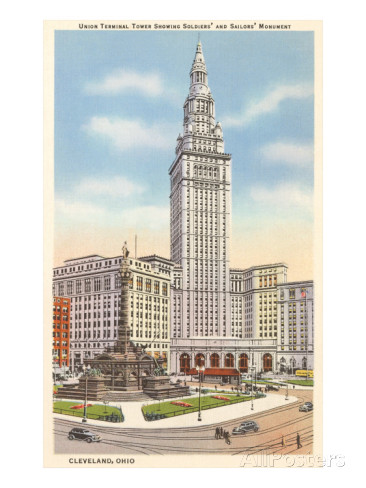
The symbol of Cleveland was the Terminal Tower—oh, how unfortunately symbolic!—on downtown’s Public Square. (You can catch glimpses of it in the movie A Christmas Story (1983), many of whose exteriors were shot in the area.) It was during those school years the largest building in the country outside of New York.  Underneath was a large concourse and the main rail passenger terminal for Northeastern Ohio.

When I graduated from high school in 1962, I marveled that so many of my classmates were leaving town. And, it turned out, never to return. By then blight had set in, the auto industry was beginning to tank, and many machine-related industries were moving to Asia. Worst of all, people were starting to laugh at Cleveland. The Cuyahoga River caught fire from the pollutants flowing downstream from the factories in the Flats, and one mayor—Ralph Locher—was photographed with his hair on fire when he refused to wear a hard hat when visiting a steel mill. Worst of all was Maynard G. Krebs (Bob Denver) on the “Dobie Gillis” show always going to see a film called The Monster That Devoured Cleveland.

Until the Cavs won the NBA championship this year, the records of local sports teams have been dismal. For a while, we even lost the Cleveland Browns NFL franchise, until they re-formed in 1999.

I wish Cleveland well, and I hope they survive this week’s political onslaught.


Hill Street Blues

I Am Talking About the Real Hill Street—Not the One from the TV Series

I Am Talking About the Real Hill Street—Not the One from the TV Series

Basically, I should have stayed in bed. I have one of those nagging, persistent summer colds characterized by a raw throat and coughing. Still, I decided to go downtown to the Central Library, have lunch at the Grand Cenral Market, and even stop in at the Last Bookstore at 5th and Spring.

It all started as our train approached the second last stop before getting to the 7th Street Metro Station. We were all let out some 15 blocks south of our final destination because a train from either the Blue or Expo Line was stuck in the tunnel. By the time I got to the Pico Boulevard station, I noticed that the trains were running again; so I boarded and made it all the way to the 7th Street Metro Station.

So far, not too bad. Then, after stopping at the bookstore, I took the Dash bus to Union Station. Instead of boarding the Santa Monica #10 Freeway Bus, I decided at the last minute to take the Red Line subway to 7th Street Metro and transfer to the Expo Line. But that was not to be. As the Red Line approached the Pershing Square Station, an announcement was made that because of “police activity,” the Red Line would not be stopping at 7th Street Metro.

I jumped off at Pershing Square and trudged several blocks south on Hill Street, even as I felt my sore throat becoming rawer and more insistent. When I got to 7th Street Metro, I saw that the whole area was cordoned off by the LAPD and that included the Metro Rail station.

That precipitated the second part of my afternoon trek. I knew that the Santa Monica #10 bus would have to make a detour around the police cordon, so I walked down to Grand Avenue and 9th Street, where I waited … and waited … and waited. Finally, a bus came and I got on, actually getting a seat, and made it home about an hour and a half later than when I planned—and in rush hour traffic.

When I searched the Internet for the nature of the police action, I discovered that someone had left an unattended package in the station, probably some homeless person jettisoning a part of his junk load. It figures.

My Japanese Years

Mifune Toshiro in Hiroshi Inagaki’s Duel at Ichijoji Temple

Toshiro Mifune in Hiroshi Inagaki’s Duel at Ichijoji Temple

It all came back to me while I had a Japanese meal with Martine at the Aki Restaurant in West Los Angeles. When I first came to Los Angeles in late 1966 I quickly became a Nipponophile. I lived for a while on Mississippi Avenue in the middle of the Sawtelle neighborhood, the old Japanese plant nursery district. Even before I started my explorations of Mexican food, I started becoming a Japanese foodie. I even thought the little tofu cubes in my miso soup were shark’s fin. (I marveled at my sophistication in eating “shark’s fin” soup.)

Since i was a graduate student in film at UCLA, I made a point of seeing as many Japanese films as I could. I remember taking the MTA #81 bus down Wilshire Boulevard to La Brea and walking a couple blocks south to the old Toho La Brea theater. The first films I saw there were Hiroshi Inagaki’s Miyamato Musashi (based on Eiji Yoshikawa’s novel) trilogy: Samurai (1954), Duel at Ichijoji Temple (1955), and Duel at Ganryu Island (1956). I fancied myself falling love with the sweet Kaoru Yachigusa, who played the part of Otsu; and of course I hero-worshipped Toshiro Mifune as the hero of he saga.

The Toho La Brea theater had a clock over the left emergency exit that was illuminated with the words Sumitomo Bank. All features were preceded by an Asahi Shimbun newsreel in Japanese without subtitles. Although I couldn’t understand a word, I looked forward to the newsreels.

A few years later, I joined with my film freak friends in visiting the other Japanese theaters in town: the Kokusai and Sho Tokyo (both Daiei studio), Kabuki (Shochiku), and the Linda Lea (Tohei). Today all five Japanese theaters are gone.

By the way, ever wonder why I call this website Tarnmoor? That was a pseudonym I used along with two of my friends in a UCLA Daily Bruin column entitled “The Exotic Filmgoer,” which was mostly about these Japanese theaters.

Mexican Heartbeat

¡Muy Delicioso!

¡Muy Delicioso!

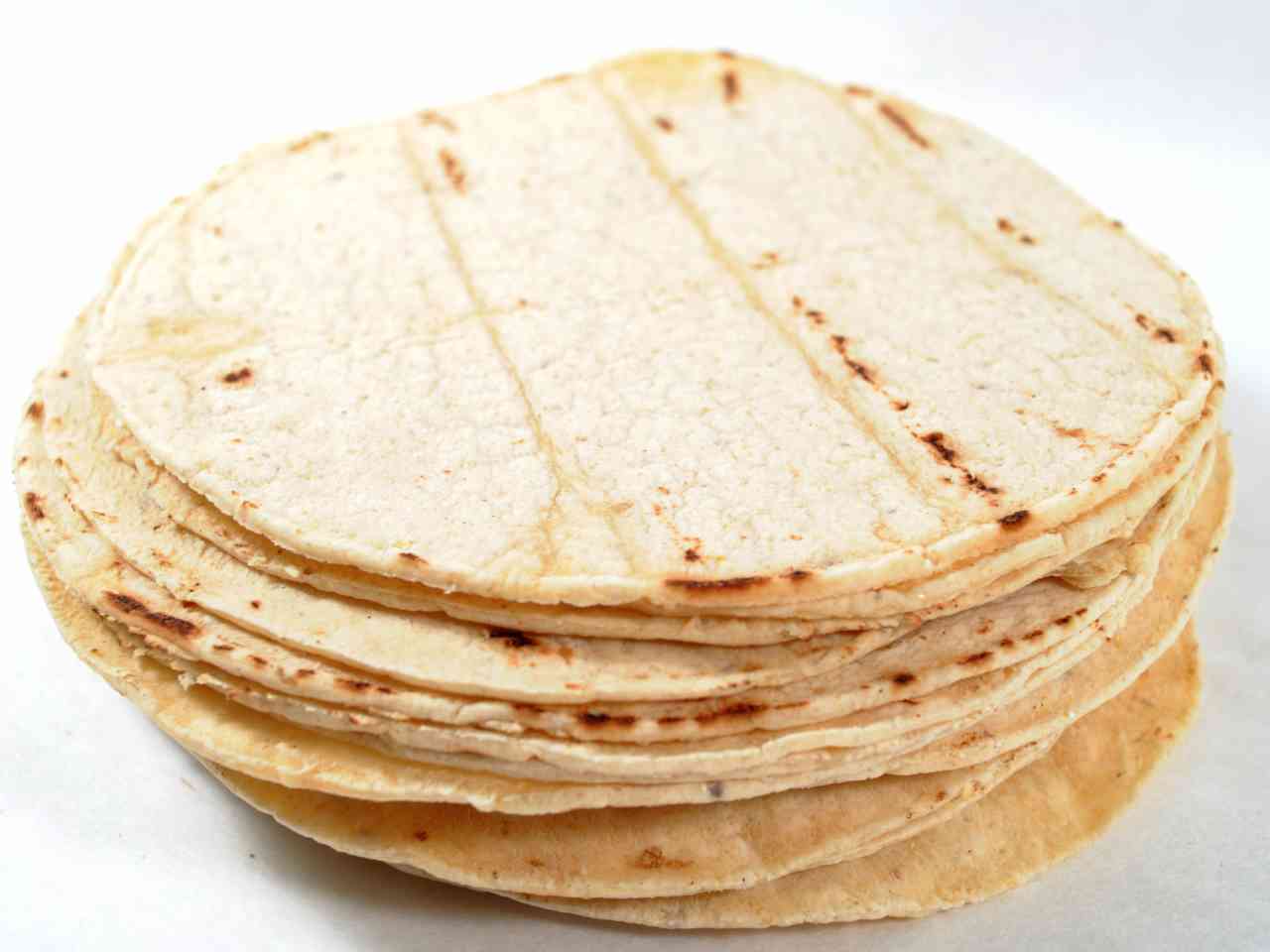
Fifty years in Los Angeles, and I’m turning into a Mexican! So many of the foods I used to like before—like rice, potatoes, bread, and gooey pastries—are now part of my pre-diabetic past. Lately, I’ve been eating a couple of tacos for lunch, preferably nopalitos (marinated prickly pear cactus) or fish with raw cabbage slaw. And for breakfast, I like to warm up some corn tortillas over a flame, roll them up in aluminum foil, and pop them in the oven. Warm them for a few minutes, and they taste great with sweet butter and a dash of salt.

I have heard it said that the sound of women’s hands rhythmically slapping the masa de maíz into little round cakes the heartbeat of Mexico. Perhaps I am developing a Mexican heart. There are far worse things in this world—though at least one presidential candidate would demur.

Apparently, the tortillas are helping my glucose readings stay lower. They satisfy my appetite without sending my sugar into the stratosphere.

The Reluctant Saxophonist

Not One of My Happier Memories

Not One of My Happier Memories

There are three things that I absolutely cannot do—and they are all connected to music:

  1. I cannot play music well.
  2. I cannot move in time to music.
  3. I cannot sing or carry a tune.

It took me ten years to discover these things, ten long years. It all started at a music store in downtown Cleveland (very near Prospect and Ontario). I was a little boy who was moderately interested in playing a musical instrument, say a trombone, for example. My parents and the sales clerk both agreed that a trombone would not suit me because I did not have buck teeth. Are buck teeth a requirement for trombonists? I wondered.

My parents talked me into choosing the alto saxophone. I was snookered into it, not even knowing what a saxophone looked like or sounded like.

I was soon to find out. The first thing I found out was that reed instruments like the saxophone are very mucky. All the gook in the mouth congeals around the reed, adding occasional squeaks from hell.

Then I found out I had to take lessons (with Jack Upson on East 4th Street) and practice half hour a day. And to make matters worse, my parents’ favorite piece of music was “The Londonderry Air,” which they called “Danny Boy” after the first line of the lyrics. My brother Danny was sure to add to my pleasure by smirking through the piece.

At Chanel High School, I was in the marching band. A marching band with only about 25 participants is pretty sure not to make a big impression, especially when the only thing anyone could hear was the drums. Because I memorized the scales, I was appointed First Saxophone, even though Chuck Matousek, who got Second Sax, was far better than me. He always played “Night Train” on the bus on the way to the football games. Me, I couldn’t play without the music in front of me. I had zero improvisational skills.

My big chance was in college. I was 600 miles from home, so I didn’t practice. I made a desultory attempt to join the Dartmouth Marching Band, but then said to myself, “Who’s going to know if I just quit?” And so I did. It turned out to be a good decision, though my parents were cheesed off when they discovered the truth.

The Raisin in the Oatmeal

Sam: Johnson’s Bookstore in Culver City

Sam: Johnson’s Bookshop in Culver City

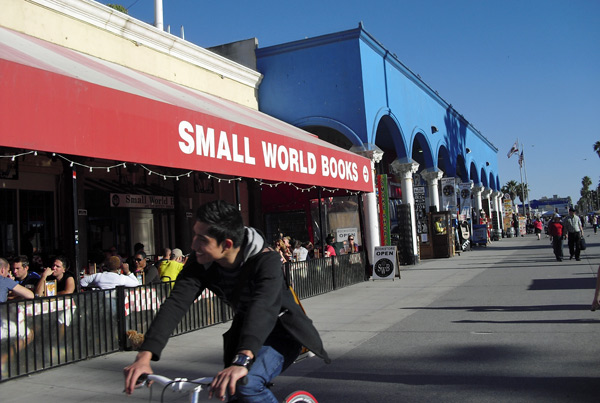
My doctor prescribed that I take long walks four days a week. Now that I am working only two days a week, it is much easier to comply. This morning, for example, I walked from Pico and Pacific down to where Windward meets the ocean—along two miles of “boardwalk” including parts of Santa Monica and Venice. My destination was Small World Books, one of the few remaining independent bookstores in West Los Angeles.

When I walk south, I go along Bundy to Venice Boulevard, where (not coincidentally) Sam: Johnson’s Bookshop is located. It is easily the best used bookshop for miles around.

Do I head west? Then my turnaround point is the three-story Barnes & Noble on the Promenade in Santa Monica.

Small World Books on the Venice Boardwalk

Small World Books on the Venice Boardwalk

Even with bookstores disappearing at an alarming rate, I have this book-buying habit that I have to somehow keep within reasonable limits. On my long walks, bookstores are like the raisin in the oatmeal. They give me a tangible reward for all that exercise.

When the temperature begins to heat up, I may have to join an air-conditioned health club that has treadmills and exercise bicycles. Hot weather is a powerful disincentive to outdoor exercise.

A Death in the Mountains

Tahquitz Peak Near Palm Springs

Tahquitz Peak Near Palm Springs

I used to have a good friend named Alex (or Iskander) Toubia, a Arab Christian from Nabatiyah, Lebanon. He married a cute blonde nurse from Cincinnati and had a daughter by her. Then something happened to the marriage, and the wife left with the daughter.

Then began a period of depression for my friend. He was in business for a while with his brothers in a manufacturing company that made parts for the auto industry. He bought a big house in Orange County. One year, he went to Rio for Carnival and engaged in some dissipation, bringing back some soft core porn videos.

Somewhere around this time, I lost track of Alex. One day, I decided to do an Internet search for his name and found out what happened with him: He had gone hiking on Tahquitz Peak in Riverside County wearing crampons (for the first time). He slipped and fell—fell quite a long way, striking his head against a tree, killing him instantly.

The website from the Riverside Mountain Rescue Unit that describes the attempt to recover his body is still up on the Internet and is well worth reading. One of the rescuers suffered a similar fate, hit his head against a tree, and went into a coma—from which, fortunately, he recovered.

The whole story sounded very much like Alex. He loved to go hiking, and he had become something of a loner. That’s not the best combination. I love to hike, too, but would not venture on a difficult trail on my own, especially in the mountains. Life is fragile enough as it is.