Ezra Pound’s “The Seafarer”

If he did nothing else during his life, Ezra Pound (1885-1972) gave us a magnificent translation of one of the great surviving Anglo-Saxon poems:

The Seafarer

May I for my own self song’s truth reckon,
Journey’s jargon, how I in harsh days
Hardship endured oft.
Bitter breast-cares have I abided,
Known on my keel many a care’s hold,
And dire sea-surge, and there I oft spent
Narrow nightwatch nigh the ship’s head
While she tossed close to cliffs. Coldly afflicted,
My feet were by frost benumbed.
Chill its chains are; chafing sighs
Hew my heart round and hunger begot
Mere-weary mood. Lest man know not
That he on dry land loveliest liveth,
List how I, care-wretched, on ice-cold sea,
Weathered the winter, wretched outcast
Deprived of my kinsmen;
Hung with hard ice-flakes, where hail-scur flew,
There I heard naught save the harsh sea
And ice-cold wave, at whiles the swan cries,
Did for my games the gannet’s clamour,
Sea-fowls, loudness was for me laughter,
The mews’ singing all my mead-drink.
Storms, on the stone-cliffs beaten, fell on the stern
In icy feathers; full oft the eagle screamed
With spray on his pinion.
Not any protector
May make merry man faring needy.
This he little believes, who aye in winsome life
Abides ‘mid burghers some heavy business,
Wealthy and wine-flushed, how I weary oft
Must bide above brine.
Neareth nightshade, snoweth from north,
Frost froze the land, hail fell on earth then
Corn of the coldest. Nathless there knocketh now
The heart’s thought that I on high streams
The salt-wavy tumult traverse alone.
Moaneth alway my mind’s lust
That I fare forth, that I afar hence
Seek out a foreign fastness.
For this there’s no mood-lofty man over earth’s midst,
Not though he be given his good, but will have in his youth greed;
Nor his deed to the daring, nor his king to the faithful
But shall have his sorrow for sea-fare
Whatever his lord will.
He hath not heart for harping, nor in ring-having
Nor winsomeness to wife, nor world’s delight
Nor any whit else save the wave’s slash,
Yet longing comes upon him to fare forth on the water.
Bosque taketh blossom, cometh beauty of berries,
Fields to fairness, land fares brisker,
All this admonisheth man eager of mood,
The heart turns to travel so that he then thinks
On flood-ways to be far departing.
Cuckoo calleth with gloomy crying,
He singeth summerward, bodeth sorrow,
The bitter heart’s blood. Burgher knows not —
He the prosperous man — what some perform
Where wandering them widest draweth.
So that but now my heart burst from my breast-lock,
My mood ‘mid the mere-flood,
Over the whale’s acre, would wander wide.
On earth’s shelter cometh oft to me,
Eager and ready, the crying lone-flyer,
Whets for the whale-path the heart irresistibly,
O’er tracks of ocean; seeing that anyhow
My lord deems to me this dead life
On loan and on land, I believe not
That any earth-weal eternal standeth
Save there be somewhat calamitous
That, ere a man’s tide go, turn it to twain.
Disease or oldness or sword-hate
Beats out the breath from doom-gripped body.
And for this, every earl whatever, for those speaking after —
Laud of the living, boasteth some last word,
That he will work ere he pass onward,
Frame on the fair earth ‘gainst foes his malice,
Daring ado, …
So that all men shall honour him after
And his laud beyond them remain ‘mid the English,
Aye, for ever, a lasting life’s-blast,
Delight mid the doughty.
Days little durable,
And all arrogance of earthen riches,
There come now no kings nor Cæsars
Nor gold-giving lords like those gone.
Howe’er in mirth most magnified,
Whoe’er lived in life most lordliest,
Drear all this excellence, delights undurable!
Waneth the watch, but the world holdeth.
Tomb hideth trouble. The blade is layed low.
Earthly glory ageth and seareth.
No man at all going the earth’s gait,
But age fares against him, his face paleth,
Grey-haired he groaneth, knows gone companions,
Lordly men are to earth o’ergiven,
Nor may he then the flesh-cover, whose life ceaseth,
Nor eat the sweet nor feel the sorry,
Nor stir hand nor think in mid heart,
And though he strew the grave with gold,
His born brothers, their buried bodies
Be an unlikely treasure hoard.
The Path to the Milky Way Leads Through Los Angeles

I am completely entranced by the poetry of Joy Harjo, a Muscogee Indian who is also Poet Laureate of the United States. I found the following poem in her collection A Map to the Next World. By the way, Okmulgee is the Oklahoma city that is the center of the Muscogee nation.

The Path to the Milky Way Leads Through Los Angeles

There are strangers above me, below me and all around me and we are all strange in this place of recent invention
This city named for angels appears naked and stripped of anything resembling the shaking of turtle shells, the songs of human voices on a summer night outside Okmulgee.
Yet, it’s perpetually summer here, and beautiful. The shimmer of gods is easier to perceive at sunrise or dusk
when those who remember us here in the illusion of the marketplace
turn toward the changing of the sun and say our names.
We matter to somebody,
We must matter to the strange god who imagines us as we revolve together in the dark sky on the path to the Milky Way,
We can’t easily see that starry road from the perspective of the crossing of boulevards, can’t hear it in the whine of civilization or taste the minerals of planets in hamburgers.
But we can buy a map here of the stars’ homes, dial a tone for dangerous love, choose from several brands of water or a hiss of oxygen for gentle rejuvenation.
Everyone knows you can’t buy love but you can still sell your soul for less than a song to a stranger who will sell it to someone else for a profit
until you’re owned by a company of strangers
in the city of the strange and getting stranger,
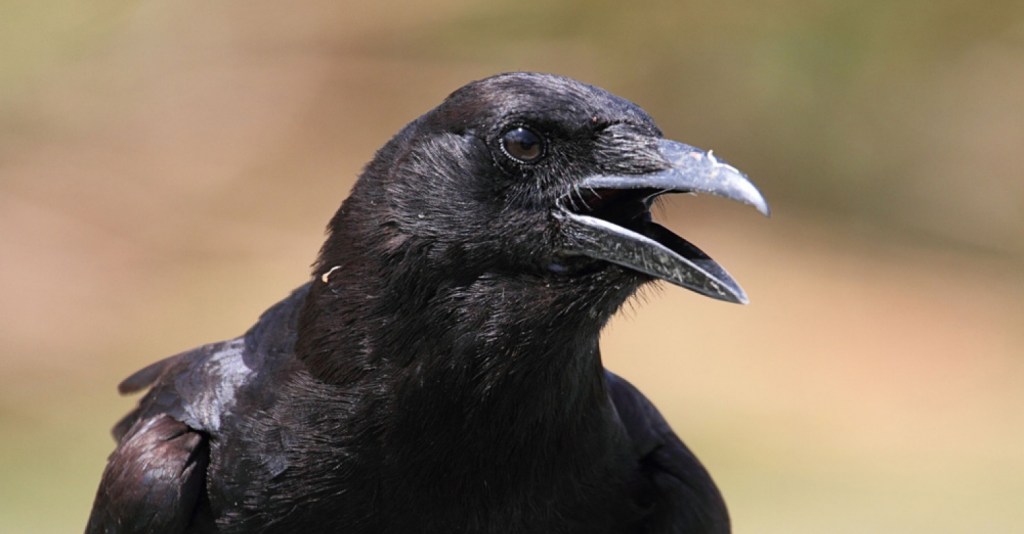
I’d rather understand how to sing from a crow
who was never good at singing or much of anything
but finding gold in the trash of humans.
So what are we doing here I ask the crow parading on the ledge of falling that hangs over this precarious city?
Crow just laughs and says wait, wait and see and I am waiting and not seeing anything, not just yet.
But like crow I collect the shine of anything beautiful I can find.

“Don’t Bother the Earth Spirit”

I have just finished reading Joy Harjo’s Crazy Brave: A Memoir, which made me hungry to read more of her poetry. Harjo is a Muscogee (Creek) Indian who also happens to be the Poet Laureate of the United States. Below is a short prose poem of hers:

Don’t Bother the Earth Spirit

Don’t bother the earth spirit who lives here. She is working on a story. It is the oldest story in the world and it is delicate, changing. If she sees you watching she will invite you in for coffee, give you warm bread, and you will be obligated to stay and listen. But this is no ordinary story. You will have to endure earthquakes, lightning, the deaths of all those you love, the most blinding beauty. It’s a story so compelling you may never want to leave; this is how she traps you. See that stone finger over there? That is the only one who ever escaped.

“Beyond the Far Cathayan Wall”

By no means is Clark Ashton Smith (1893-1961) considered as a mainstream American writer. Yet his poems and stories have a certain quality, reinforced by his association with H. P. Lovecraft and Robert E Howard. Of him, Lovecraft said, “in sheer daemonic strangeness and fertility of conception, Clark Ashton Smith is perhaps unexcelled.” And Ray Bradbury said that Smith “filled my mind with incredible worlds, impossibly beautiful cities, and still more fantastic creatures.”

Below is a poem of his entitled “Beyond the Great Wall”:

Beyond the Great Wall

Beyond the far Cathayan wall,
A thousand leagues athwart the sky,
The scarlet stars and mornings die,
The gilded moons and sunsets fall.

Across the sulphur-colored sands
With bales of silk the camels fare,
Harnessed with vermeil and with vair,
Into the blue and burning lands.

And ah, the song the drivers sing
To while the desert leagues away—
A song they sang in old Cathay
Ere youth had left the eldest king,

Ere love and beauty both grew old
And wonder and romance were flown
On irised wings to worlds unknown,
To stars of undiscovered gold.

And I their alien words would know,
And follow past the lonely wall
Where gilded moons and sunsets fall,
As in a song of long ago.

I think that Smith deserves a long second look, both for his poems and his eldritch short stories.

His Cardboard Heart

Puerto Rican poet Martin Espada has recently won the National Book Award for his collection of poems entitled Floaters, named after the famous photograph of a father and daughter who drowned in the Rio Grande swimming to supposed safety in Trump’s United States. One of the poems in that collection is the following prose poem:

Letter to My Father

You once said: My reward for this life will be a thousand pounds of dirt shoveled in my face. You were wrong. You are seven pounds of ashes in a box, a Puerto Rican flag wrapped around you, next to a red brick from the house in Utuado where you were born, all crammed together on my bookshelf. You taught me there is no God, no life after this life, so I know you are not watching me type this letter over my shoulder.

When I was a boy, you were God. I watched from the seventh floor of the projects as you walked down into the street to stop a public execution. A big man caught a small man stealing his car, and everyone in Brooklyn heard the car alarm wail of the condemned: He’s killing me. At a word from you, the executioner’s hand slipped from the hair of the thief. The kid was high, was all you said when you came back to us.

When I was a boy, and you were God, we flew to Puerto Rico. You said: My grandfather was the mayor of Utuado. His name was Buenaventura. That means good fortune. I believed in your grandfather’s name. I heard the tree frogs chanting to each other all night. I saw banana leaf and elephant palm sprouting from the mountain’s belly. I gnawed the mango’s pit, and the sweet yellow hair stuck between my teeth. I said to you: You came from another planet. How did you do it? You said: Every morning, just before I woke up, I saw the mountains.

Every morning, I see the mountains. In Utuado, three sisters, all in their seventies, all bedridden, all Pentecostales who only left the house for church, lay sleeping on mattresses spread across the floor
when the hurricane gutted the mountain the way a butcher slices open a dangled pig, and a rolling wall of mud buried them, leaving the fourth sister to stagger into the street, screaming like an unheeded prophet about the end of the world. In Utuado, a man who cultivated a garden of aguacate and carambola, feeding the avocado and star fruit to his nieces from New York, saw the trees in his garden beheaded all at once like the soldiers of a beaten army, and so hanged himself. In Utuado, a welder and a handyman rigged a pulley with a shopping cart to ferry rice and beans across the river where the bridge collapsed, witnessed the cart swaying above so many hands, then raised a sign that told the helicopters: Campamento los Olvidados: Camp of the Forgotten.

Los olvidados wait seven hours in line for a government meal of Skittles and Vienna sausage, or a tarp to cover the bones of a house with no roof, as the fungus grows on their skin from sleeping on mattresses drenched with the spit of the hurricane. They drink the brown water, waiting for microscopic monsters in their bellies to visit plagues upon them. A nurse says: These people are going to have an epidemic. These people are going to die. The president flips rolls of paper towels to a crowd at a church in Guaynabo, Zeus lobbing thunderbolts on the locked ward of his delusions. Down the block, cousin Ricardo, Bernice’s boy, says that somebody stole his can of diesel. I heard somebody ask you once what Puerto Rico needed to be free. And you said: Tres pulgadas de sangre en la calle: Three inches of blood in the street. Now, three inches of mud flow through the streets of Utuado, and troops patrol the town, as if guarding the vein of copper in the ground, as if a shovel digging graves in the backyard might strike the ore below, as if la brigada swinging machetes to clear the road might remember the last uprising.

I know you are not God. I have the proof: seven pounds of ashes in a box on my bookshelf. Gods do not die, and yet I want you to be God again. Stride from the crowd to seize the president’s arm before another roll of paper towels sails away. Thunder Spanish obscenities in his face. Banish him to a roofless rainstorm in Utuado, so he unravels, one soaked sheet after another, till there is nothing left but his cardboard heart.

I promised myself I would stop talking to you, white box of gray grit. You were deaf even before you died. Hear my promise now: I will take you to the mountains, where houses lost like ships at sea rise blue and yellow from the mud. I will open my hands. I will scatter your ashes in Utuado.

Even the Dreadful Martyrdom Must Run Its Course

Look at the bottom right of the above painting, Pieter Breughel the Elder’s “The Fall of Icarus.” I would particularly direct your attention to the bare legs of Icarus, who has fallen from the sky into the ocean—punishment for presuming to fly too close to the sun. The following poem by W. H. Auden refers to it in the last stanza. The poem is called “Musée des Beaux Arte.”

 About suffering they were never wrong,
The old Masters: how well they understood
Its human position: how it takes place
While someone else is eating or opening a window or just walking dully along;
How, when the aged are reverently, passionately waiting
For the miraculous birth, there always must be
Children who did not specially want it to happen, skating
On a pond at the edge of the wood:
They never forgot
That even the dreadful martyrdom must run its course
Anyhow in a corner, some untidy spot
Where the dogs go on with their doggy life and the torturer’s horse
Scratches its innocent behind on a tree.

In Breughel’s Icarus, for instance: how everything turns away
Quite leisurely from the disaster; the ploughman may
Have heard the splash, the forsaken cry,
But for him it was not an important failure; the sun shone
As it had to on the white legs disappearing into the green
Water, and the expensive delicate ship that must have seen
Something amazing, a boy falling out of the sky,
Had somewhere to get to and sailed calmly on. 

Limits

Here is one of my favorite poems by the Argentinian Jorge Luis Borges (1899-1986). Above is a view of a street in the San Telmo neighborhood of Buenos Aires.

 
Limits
Of all the streets that blur in to the sunset,
There must be one (which, I am not sure)
That I by now have walked for the last time
Without guessing it, the pawn of that Someone

Who fixes in advance omnipotent laws,
Sets up a secret and unwavering scale
for all the shadows, dreams, and forms
Woven into the texture of this life.

If there is a limit to all things and a measure
And a last time and nothing more and forgetfulness,
Who will tell us to whom in this house
We without knowing it have said farewell?

Through the dawning window night withdraws
And among the stacked books which throw
Irregular shadows on the dim table,
There must be one which I will never read.

There is in the South more than one worn gate,
With its cement urns and planted cactus,
Which is already forbidden to my entry,
Inaccessible, as in a lithograph.

There is a door you have closed forever
And some mirror is expecting you in vain;
To you the crossroads seem wide open,
Yet watching you, four-faced, is a Janus.

There is among all your memories one
Which has now been lost beyond recall.
You will not be seen going down to that fountain
Neither by white sun nor by yellow moon.

You will never recapture what the Persian
Said in his language woven with birds and roses,
When, in the sunset, before the light disperses,
You wish to give words to unforgettable things.

And the steadily flowing Rhone and the lake,
All that vast yesterday over which today I bend?
They will be as lost as Carthage,
Scourged by the Romans with fire and salt.

At dawn I seem to hear the turbulent
Murmur of crowds milling and fading away;
They are all I have been loved by, forgotten by;
Space, time, and Borges now are leaving me.

The Bishop Orders His Tomb at St. Praxed’s Church

Robert Browning (1812-1889)

This is one of my favorite poems by Robert Browning. It tells the tale of a dying ecclesiastic who, before he dies, learns that he is not highly regarded.

The Bishop Orders His Tomb at St. Praxed’s Church
Rome, 15—

VANITY, saith the preacher, vanity!	
Draw round my bed: is Anselm keeping back?	
Nephews—sons mine … ah God, I know not! Well—	
She, men would have to be your mother once,	
Old Gandolf envied me, so fair she was!	        
What ’s done is done, and she is dead beside,	
Dead long ago, and I am Bishop since,	
And as she died so must we die ourselves,	
And thence ye may perceive the world ’s a dream.	
Life, how and what is it? As here I lie	
In this state-chamber, dying by degrees,	
Hours and long hours in the dead night, I ask	
“Do I live, am I dead?” Peace, peace seems all.	
Saint Praxed’s ever was the church for peace;	
And so, about this tomb of mine. I fought	      
With tooth and nail to save my niche, ye know:	
—Old Gandolf cozened me, despite my care;	
Shrewd was that snatch from out the corner South	
He graced his carrion with, God curse the same!	
Yet still my niche is not so cramped but thence	       
One sees the pulpit on the epistle-side,	
And somewhat of the choir, those silent seats,	
And up into the aery dome where live	
The angels, and a sunbeam ’s sure to lurk:	
And I shall fill my slab of basalt there,	      
And ’neath my tabernacle take my rest,	
With those nine columns round me, two and two,	
The odd one at my feet where Anselm stands:	
Peach-blossom marble all, the rare, the ripe	
As fresh-poured red wine of a mighty pulse.	      
—Old Gandolf with his paltry onion-stone,	
Put me where I may look at him! True peach,	
Rosy and flawless: how I earned the prize!	
Draw close: that conflagration of my church	
—What then? So much was saved if aught were missed!	        
My sons, ye would not be my death! Go dig	
The white-grape vineyard where the oil-press stood,	
Drop water gently till the surface sink,	
And if ye find … Ah God, I know not, I!…	
Bedded in store of rotten figleaves soft,	       
And corded up in a tight olive-frail,	
Some lump, ah God, of lapis lazuli.	
Big as a Jew’s head cut off at the nape,	
Blue as a vein o’er the Madonna’s breast …	
Sons, all have I bequeathed you, villas, all,	        
That brave Frascati villa with its bath,	
So, let the blue lump poise between my knees,	
Like God the Father’s globe on both his hands	
Ye worship in the Jesu Church so gay,	
For Gandolf shall not choose but see and burst!	        
Swift as a weaver’s shuttle fleet our years:	
Man goeth to the grave, and where is he?	
Did I say basalt for my slab, sons? Black—	
’Twas ever antique-black I meant! How else	
Shall ye contrast my frieze to come beneath?	      
The bas-relief in bronze ye promised me,	
Those Pans and Nymphs ye wot of, and perchance	
Some tripod, thyrsus, with a vase or so,	
The Saviour at his sermon on the mount,	
Saint Praxed in a glory, and one Pan	       
Ready to twitch the Nymph’s last garment off,	
And Moses with the tables … but I know	
Ye mark me not! What do they whisper thee,	
Child of my bowels, Anselm? Ah, ye hope	
To revel down my villas while I gasp	      
Bricked o’er with beggar’s mouldy travertine	
Which Gandolf from his tomb-top chuckles at!	
Nay, boys, ye love me—all of jasper, then!	
’Tis jasper ye stand pledged to, lest I grieve	
My bath must needs be left behind, alas!	        
One block, pure green as a pistachio-nut,	
There ’s plenty jasper somewhere in the world—	
And have I not Saint Praxed’s ear to pray	
Horses for ye, and brown Greek manuscripts,	
And mistresses with great smooth marbly limbs?	        
—That ’s if ye carve my epitaph aright,	
Choice Latin, picked phrase, Tully’s every word,	
No gaudy ware like Gandolf’s second line—	
Tully, my masters? Ulpian serves his need!	
And then how I shall lie through centuries,	        
And hear the blessed mutter of the mass,	
And see God made and eaten all day long,	
And feel the steady candle-flame, and taste	
Good strong thick stupefying incense-smoke!	
For as I lie here, hours of the dead night,	       
Dying in state and by such slow degrees,	
I fold my arms as if they clasped a crook,	
And stretch my feet forth straight as stone can point,	
And let the bedclothes, for a mortcloth, drop	
Into great laps and folds of sculptor’s work:	       
And as yon tapers dwindle, and strange thoughts	
Grow, with a certain humming in my ears,	
About the life before I lived this life,	
And this life too, popes, cardinals, and priests,	
Saint Praxed at his sermon on the mount,	       
Your tall pale mother with her talking eyes,	
And new-found agate urns as fresh as day,	
And marble’s language, Latin pure, discreet,	
—Aha, ELUCESCEBAT quoth our friend?	
No Tully, said I, Ulpian at the best!	       
Evil and brief hath been my pilgrimage.	
All lapis, all, sons! Else I give the Pope	
My villas! Will ye ever eat my heart?	
Ever your eyes were as a lizard’s quick,	
They glitter like your mother’s for my soul,	        
Or ye would heighten my impoverished frieze,	
Piece out its starved design, and fill my vase	
With grapes, and add a vizor and a Term,	
And to the tripod ye would tie a lynx	
That in his struggle throws the thyrsus down,	        
To comfort me on my entablature	
Whereon I am to lie till I must ask	
“Do I live, am I dead?” There, leave me, there!	
For ye have stabbed me with ingratitude	
To death: ye wish it—God, ye wish it! Stone—	       
Gritstone, a-crumble! Clammy squares which sweat	
As if the corpse they keep were oozing through—	
And no more lapis to delight the world!	
Well go! I bless ye. Fewer tapers there,	
But in a row: and, going, turn your backs	        
—Ay, like departing altar-ministrants,	
And leave me in my church, the church for peace,	
That I may watch at leisure if he leers—	
Old Gandolf, at me, from his onion-stone,	
As still he envied me, so fair she was!

“A Bird Came Down the Walk”

Bird With Captive Worm

Here is another delightful poem from Emily Dickinson (1830-1886), Queen of American Poets. It is called:

A Bird Came Down the Walk


A Bird, came down the Walk - 
He did not know I saw -
He bit an Angle Worm in halves
And ate the fellow, raw, 
 
And then, he drank a Dew
From a convenient Grass -
And then hopped sidewise to the Wall
To let a Beetle pass -
 
He glanced with rapid eyes,
That hurried all abroad -
They looked like frightened Beads, I thought,
He stirred his Velvet Head. - 
 
Like one in danger, Cautious,
I offered him a Crumb,
And he unrolled his feathers, 
And rowed him softer Home -
 
Than Oars divide the Ocean,
Too silver for a seam,
Or Butterflies, off Banks of Noon,
Leap, plashless as they swim. 

The Dreamer

Roberto Bolaño (1953-2003)

Here are sixteen poems from Roberto Bolaño’s collection entitled Tres. The poetic fragments have no titles, but they are striking in their variety and suggestiveness.

31. I dreamt that Earth was finished. And the only 
human being to contemplate the end was Franz 
Kafka. In heaven, the Titans were fighting to the 
death. From a wrought-iron seat in Central Park, 
Kafka was watching the world burn.

32. I dreamt I was dreaming and I came home 
too late. In my bed I found Mário de Sá-Carneiro 
sleeping with my first love. When I uncovered them 
I found they were dead and, biting my lips till they 
bled, I went back to the streets.

33. I dreamt that Anacreon was building his castle 
on the top of a barren hill and then destroying it. 
 
34. I dreamt I was a really old Latin American 
detective. I lived in New York and Mark Twain 
was hiring me to save the life of someone without 
a face. “It’s going to be a damn tough case, Mr. 
Twain,” I told him.

35. I dreamt I was falling in love with Alice Sheldon. 
She didn’t want me. So I tried getting myself killed 
on three continents. Years passed. Finally, when I 
was really old, she appeared on the other end of the 
promenade in New York and with signals (like the 
ones they use on aircraft carriers to help the pilots 
land) she told me she’d always loved me.

36. I dreamt I was 69ing with Anaïs Nin on an 
enormous basaltic flagstone.

37. I dreamt I was fucking Carson McCullers in a 
dim-lit room in the spring of 1981. And we both felt 
irrationally happy.

38. I dreamt I was back at my old high school 
and Alphonse Daudet was my French teacher. 
Something imperceptible made us realize we were 
dreaming. Daudet kept looking out the window 
and smoking Tartarin’s pipe

39. I dreamt I kept sleeping while my classmates 
tried to liberate Robert Desnos from the Terezín 
concentration camp. When I woke a voice was 
telling me to get moving. “Quick, Bolaño, quick, 
there’s no time to lose.” When I got there, all I 
found was an old detective picking through the 
smoking ruins of the attack.

40. I dreamt that a storm of phantom numbers was 
the only thing left of human beings three billion 
years after Earth ceased to exist.

41. I dreamt I was dreaming and in the dream 
tunnels I found Roque Dalton’s dream: the dream 
of the brave ones who died for a fucking chimera.

42. I dreamt I was 18 and saw my best friend at 
the time, who was also 18, making love to Walt 
Whitman. They did it in an armchair, contemplating 
the stormy Civitavecchia sunset.

43. I dreamt I was a prisoner and Boethius was 
my cellmate. “look, Bolaño,” he said, extending 
his hand and his pen in the shadows: 
“they’re not trembling! they’re not 
trembling!” (after a while, 
he added in a calm voice: “but they’ll tremble when 
they recognize that bastard Theodoric.”)

44. I dreamt I was translating the Marquis de Sade 
with axe blows. I’d gone crazy and was living in the 
woods.

45. I dreamt that Pascal was talking about fear with 
crystal clear words at a tavern in Civitavecchia: 
Miracles don’t convert, they condemn, he said.

46. I dreamt I was an old Latin American detective 
and a mysterious Foundation hired me to find the 
death certificates of the Flying Spics. I was traveling 
all around the world: hospitals, battlefields, pulque 
bars, abandoned schools.