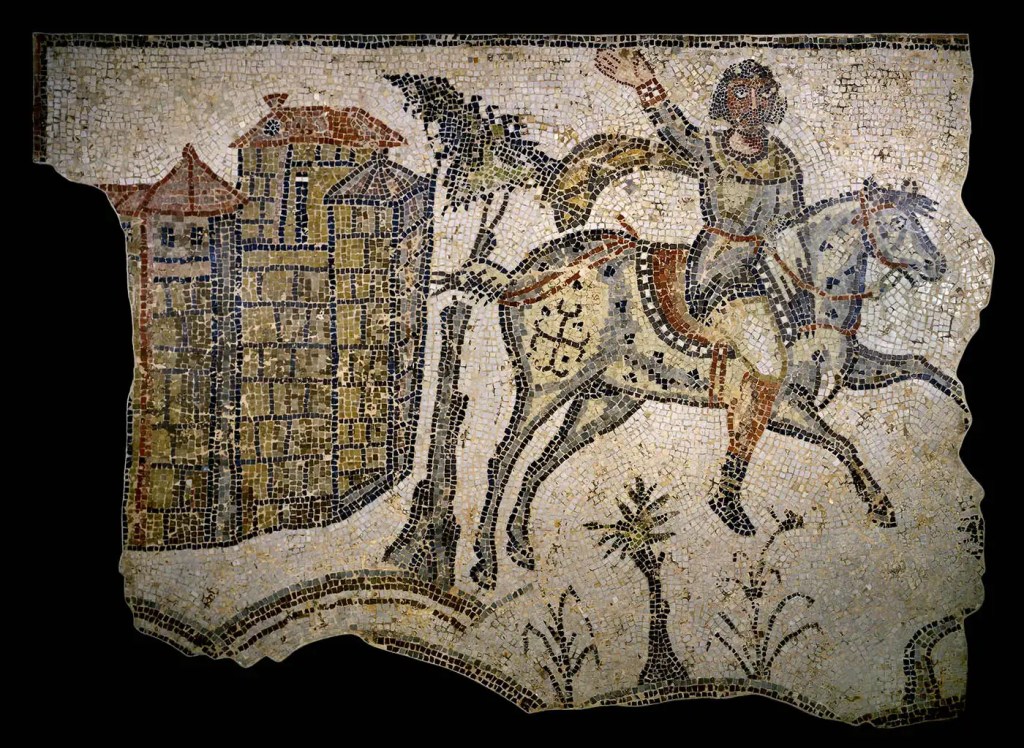
After the Spanish conquistadores conquered the Maya peoples, they published one more work in Maya. It was called The Chilam Balam of Chumayel and consisted of a series of prophetic books looking pessimistically into the future. The poet Christopher Sawyer-Lauçanno in The Destruction of the Jaguar wrote a poetic retelling of these prophecies. Below is the prophecy of Ah Kauil Chel:
What has been written
will be fulfilled.
Though you may not comprehend it
though you may not understand it
he will come who knows
how the ages unfold
like the stone steps
on the palace of the governor.
For now
the priests, the prophets
will interpret
what is to be fulfilled,
shall herald with sorrow
the destruction of the jaguar.
In the summer of 1956, when I was 11 years old, Jack Kerouac spent 63 days manning a fire watch tower in Washington’s North Cascades, atop Desolation Peak. On the Road, which was to be the main source of his fame, followed by The Dharma Bums, were not yet published. The recently published Desolation Peak is a collection of Kerouac’s many writing projects—many of them fragmentary—while he scanned the horizon for fires during those 63 days.
Jack was desperately poor having spent all his money to get to Washington from Mill Valley. He began his job as a fire watcher with a total of 2¢.
This year I have become entranced by Kerouac. Like most of the members of my generation, I read On the Road while I was still in high school, and then stopped there. I have become newly fascinated by his work and am resolved to read all his work that I can find. That assumes I will live long enough, as Jack was a busy boy.
Below is a selection of what Kerouac called his “Desolation Pops.” In form, they resemble traditional Japanese haiku, but they do not adhere to the genre strict rules concerning the number of syllables per line. They’re still interesting. After all, English is a very different language than Japanese.
Jack Kerouac (1922-1969)
(7)
A stump with sawdust
     —a place
To meditate

(11)
The clouds assume
     as I assume,
Faces of hermits

(24)
There’s nothing there
     because
I don’t care

(36)
Poor gentle flesh—
     there is
No answer

(42)
Wednesday blah
     blah blah—
My mind hurts

(55)
Rig rig rig—
     that’s the rat
On the roof

(59)
I called Hanshan            | A Zen Buddhist recluse
     in the fog—
Silence, it said

(60)
I called—Dipankara        | One of the Buddhas of the past
     instructed me
By saying nothing

(70)
Aurora borealis
     over Mount Hozumeen—
The world is eternal
I have just finished reading Volume II of Thomas Hodgkin’s monumental Italy and Her Invaders, which tells of the Hun and Vandal invasions and the Herulian Mutiny that unseated the last of the Western Roman Emperors in CE 476. In essence, it tells of the painful last twenty-five years of the Empire, during which most of the emperors were murdered in a year or two.
There was no benefit to wearing the imperial purple in those last few years. A couple of days ago, I posted a blog in which Apollinaris Sidonius explained why it was no fun in being chosen as emperor.
Those last years of the empire were no fun. Not only were the invading Huns and Vandals brutal, but the empire itself was brutal to its own citizens, taxing them to death to pay for the huge military required to protect the borders.
It makes me think about our own situation. Our problem is not barbarian invasions (unless you don’t particularly like Canadians or Latin Americans), but our seemingly unbridgeable political divisions. The insurrection of January 6, 2021, was, to me, very like Gaiseric and the Vandals’ sack of Rome in CE 455. They may have been barbarians in the end, but they were our very own native-born barbarians. The result, in the end, is no better than the sad end of Rome.
I keep thinking of a poem by the Greek poet Constantine P. Cavafy entitled:
Waiting for the Barbarians
What are we waiting for, assembled in the forum?

      The barbarians are due here today.


Why isn’t anything going on in the senate?
Why are the senators sitting there without legislating?

      Because the barbarians are coming today.
      What’s the point of senators making laws now?
      Once the barbarians are here, they’ll do the legislating.


Why did our emperor get up so early,
and why is he sitting enthroned at the city’s main gate,
in state, wearing the crown?

      Because the barbarians are coming today
      and the emperor’s waiting to receive their leader.
      He’s even got a scroll to give him,
      loaded with titles, with imposing names.


Why have our two consuls and praetors come out today
wearing their embroidered, their scarlet togas?
Why have they put on bracelets with so many amethysts,
rings sparkling with magnificent emeralds?
Why are they carrying elegant canes
beautifully worked in silver and gold?

      Because the barbarians are coming today
      and things like that dazzle the barbarians.


Why don’t our distinguished orators turn up as usual
to make their speeches, say what they have to say?

      Because the barbarians are coming today
      and they’re bored by rhetoric and public speaking.


Why this sudden bewilderment, this confusion?
(How serious people’s faces have become.)
Why are the streets and squares emptying so rapidly,
everyone going home lost in thought?

      Because night has fallen and the barbarians haven't come.
      And some of our men just in from the border say
      there are no barbarians any longer.


Now what’s going to happen to us without barbarians?
Those people were a kind of solution.
This is a poem about a famous photograph of a Salvadoran refugee and his child found drowned in the Rio Grande while attempting to cross it near Matamoros. Poet Brenda Cárdenas refers to the Mayan goddess Ix Chel in the course of her poem. She bases her work on a drawing by Erik Ricardo de Luna Genel which I have not been able to find. Below is the photograph:
Cien nombres para la muerte: La hilacha/The Loose Thread
Ix Chel, skeleton moon at her loom, wipes her furrowed forehead, daddy longlegs dangling like loose threads from the corners of her eyes dark as ditches. She stitches crossbones into skirts, weaves skulls into blankets she will trade with travelers. “Mantillas, rebozos!” she’ll sing unfurling her wares for parents to wrap around babes she has guided from their mothers’ oceans to Earth.
Under one moon, a Salvadoran father and mother cannot wait any longer in the winding lines of starved asylum seekers ordered to halt. So their daughter, not yet two, wraps her tiny arms around the bough of papi’s neck, clings to his trunk as he wades into the big river, swims strong as salmon, against churning currents.
But when he spills her on the bank, warns her to wait, and lunges back into the torrent for mami, the little one panics, follows. Under one sun, the river carries them away, defying the border it never meant to become.
Ix Chel’s waning crescent finds them first, face down in the mud, wrapped together in the black shroud of papi’s shirt. And from her great jug, holding all the waters of heaven, she spills storms to wash away the lines we’ve carved, dug, drilled, the walls we’ve built in chain link, barbed wire, concrete, and steel between desert and desert, river and river, earth and earth, between father and mother, mother and child under one moon.
Poet Roger Reeves at the Los Angeles Times Book Festival
As I have mentioned before, the highlight of my visit to the Los Angeles Times Festival of Books was the Poetry Pavilion, where I could sit in the cool shade on a hot spring day and listen to some outstanding poets. One of them was Roger Reeves, an Associate Professor of Poetry at the University of Texas in Austin. The following poem, entitled “Rat Among the Pines” comes from his collection Best Barbarian, a finalist for the National Book Award. It tells in terse poetic language the violence of life in America.
Rat Among the Pines
Terror, tonight
Is the moon Slipping from a rat’s gray grasp,
Finding its way back Into the sky, which is America—
A white moon Leaning on the night’s neck
With its hand in its pocket, Moon hung calm above
Catastrophe, the police Breaking the neck of a man
Who had just brushed summer’s First bead of rain from his eye-
Lashes. Who—knocking a Newport Against a wrist, watching smoke
Break its head against a brick Wall—is preparing to die
Unaware they are preparing to die. Heavy the moon, silly the tasking
Of a rat with delaying death. Terror, tonight
Is the candor of the earth Where someone is preparing to die
And the earth receives that dying With its hands in its pockets.
And the moon that once burnt the silk Hump of a rat, back in the sky.
And my daughter hiding in the rose Bushes, asking who, who the sirens
Have come to kill. And someone calling It beautiful—summer, moon—
And someone dying beneath that beauty, Which is America.
Former Los Angeles Poet Laureate Eloise Klein Healy
As I mentioned in my previous post, what I enjoyed most at the Los Angeles Times Book Festival were the poetry readings at the Poetry Stage sponsored by Small World Books of Venice. One poet that impressed me for her sheer cojones was the 80-year-old Eloise Klein Healy who clawed her way back from aphasia. Let the introduction to her poetry collection Another Phase tell the story:
You cannot understand what you hear or read. You cannot speak or write and be understood. Your use of language has been lost. You speak and write words in a nonsensical manner. You hear what people say, but it makes no sense.
Her post-aphasia collection entitled Another Phase consists of haiku-like five-line poems that discuss her triumph. Below is one of them, entitled “Another Phase,” which lends its title to the collection:
Another Phase
It’s hard for me to read the L.A. Times.
I want to relearn, to refine part of me.
How did my brain twist?
How did the whack of it phase me?
Every page. Every word blank.
The subject of her rehab in the world of poetry is also covered in a poem entitled “Problem”:
Problem
When first I wrote a poem,
I couldn't change anything.
Didn't plan to edit or write another.
“Brain fry” was my reality time.
Step two wasn't there yet.
What I learned from listening to Healy read her poetry and then reading the poems in Another Phase was the woman’s courage and persistence in the face of calamity. She is still a little unsteady on her pins, but I find her to be an inspiration to me. And that’s not something I say about a lot of people.
Thomas Hardy (1840-1928) is best known for his novels. Although I admire them as much as anybody, I now like his poetry even more. His subjects seem to be on the somber side, but I love their simplicity and rugged construction, such as this one:
The Echo Elf Answers
How much shall I love her?
For life, or not long?
“Not long.”

Alas! When forget her?
In years, or by June?
“By June.”

And whom woo I after?
No one, or a throng?
“A throng.”

Of these shall I wed one
Long hence, or quite soon?
“Quite soon.”

And which will my bride be?
The right or the wrong?
“The wrong.”

And my remedy – what kind?
Wealth-wove, or earth-hewn?
“Earth-hewn.”
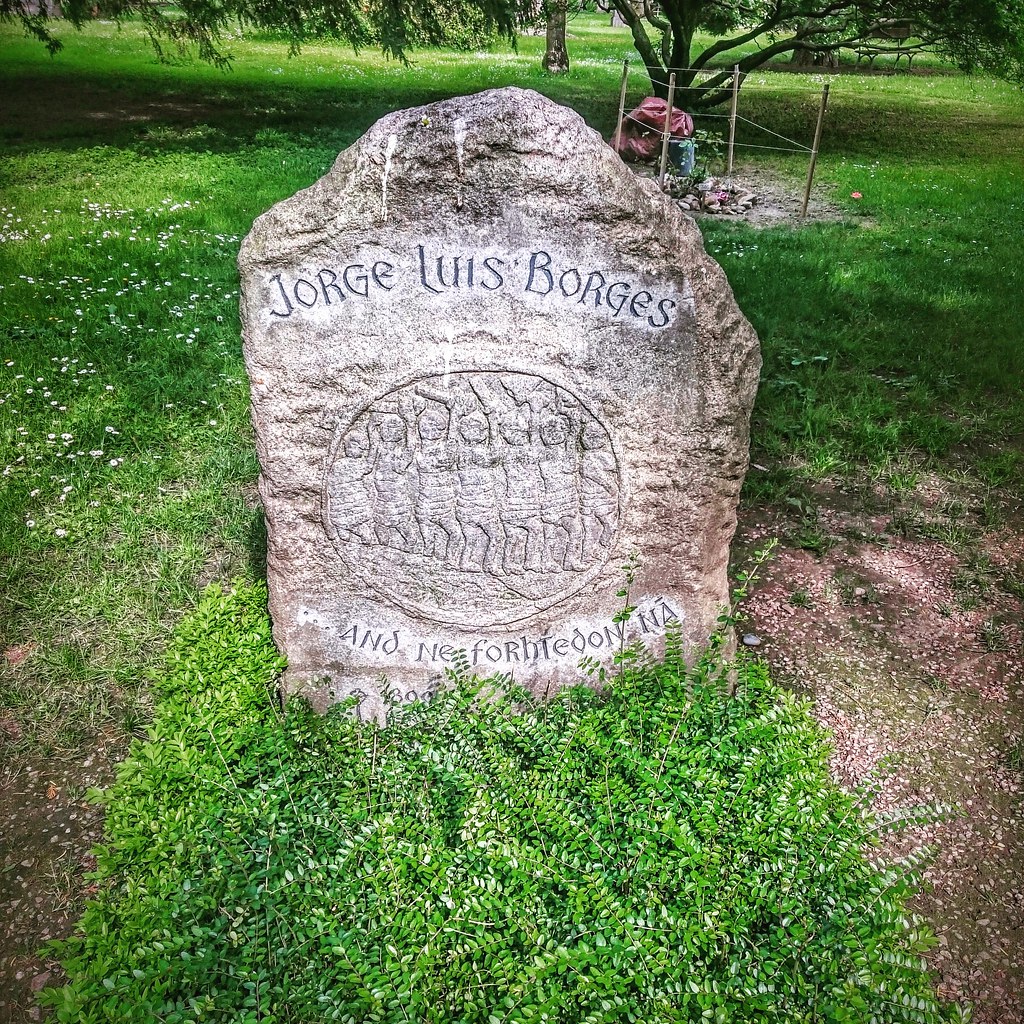
The Tomb of Jorge Luis Borges (1899-1986) in Geneva Switzerland
The title of this post is in Anglo-Saxon from the gravestone of Jorge Luis Borges. It comes from The Battle of Maldon. Translated, it means “Be not afraid.” Toward the end of his life, Borges learned Anglo-Saxon and even studied Old Norse, which is the language of Iceland.
Here is an early poem by Borges (from Fervor de Buenos Aires, 1923) on the subject of death. The translation is by W. S. Merwin.
Remorse for Any Death
Free of memory and hope,
unlimited, abstract, almost future,
the dead body is not somebody: It is death.
Like the God of the mystics,
whom they insist has no attributes,
the dead person is no one everywhere,
is nothing but the loss and absence of the world.
We rob it of everything,
we do not leave it one color, one syllable:
Here is the yard which its eyes no longer take up,
there is the sidewalk where it waylaid its hope.
It might even be thinking
what we are thinking.
We have divided among us, like thieves,
the treasure of nights and days.
There is something in the voice of American Indian writers that is worth listening to. I have just finished reading Louise Erdrich’s Tracks, and now I have come across this delightful poem by Joy Harjo, a Muscogee Creek who was poet-laureate of the United States:
Desire’s Dog
I was desire’s dog. I ate when I was fed. I did what I was told. I knew how to sit, stand and roll over on command. When I was petted, I was made whole. Even when I dreamed, I dreamed a chain around my neck.
Desire is a bone with traces of fat. It’s the wag smell of a bitch in heat. It’s that pinched hit at the end of a beat. It’s a stick thrown into a rabbit chase.
I lay at the feet of desire for years.
Then I heard this song, calling me. It was a woman in a red dress, It was a man with a gun in his hand. It was a table filled with fruit and flowers. It was a fox of fire, a bird of stone.
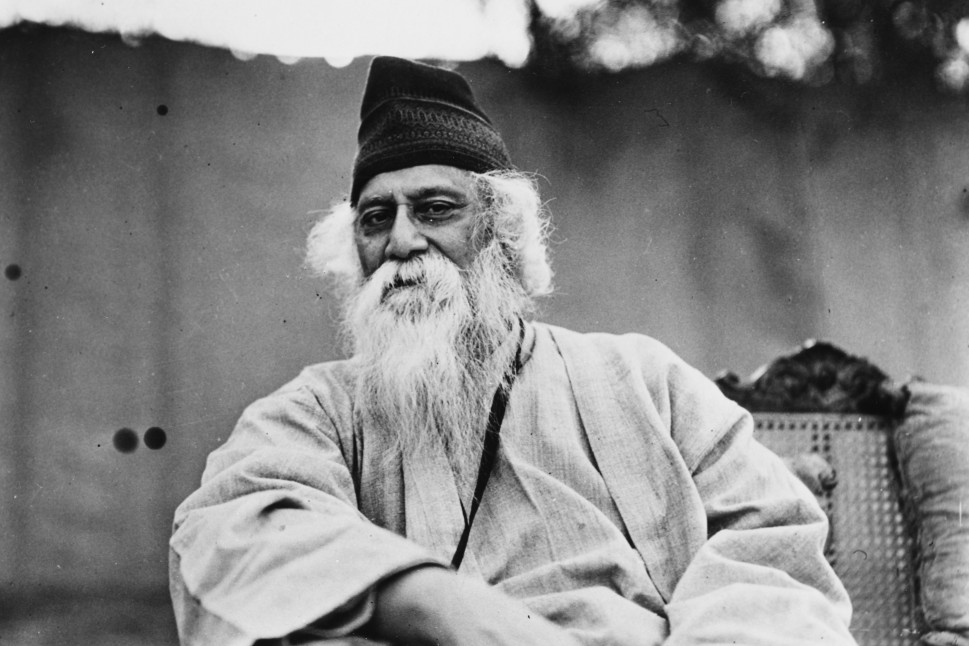
An early winner of the Nobel Prize in Literature in 1913, Rabindranath Tagore is almost forgotten today. How is that so? He was a prolific writer of poetry, prose, plays, novels, and songs. He was offered a knighthood by the British, but turned it down. He did not live to see the creation of a free India, but he led a rich and full life. Here is a short excerpt from his poetry:
The Gardener 85
Who are you, reader, reading my poems an hundred years hence?
I cannot send you one single flower from this wealth of the spring, one single streak of
     gold from yonder clouds.
Open your doors and look abroad.

From your blossoming garden gather fragrant memories of the vanished flowers of an
     hundred years before.
In the joy of your heart may you feel the living joy that sang one spring morning, sending its glad voice across an hundred years.











You must be logged in to post a comment.