Serendipity: The Acorn Woodpecker

Sometimes There Just Doesn’t Seem To Be Any Rhyme or Reason …

I have been reading Ursula K. Le Guin’s collection of stories and poems entitled Buffalo Gals and Other Animal Presences (1990) with the usual rapture that goes with reading her work. The following is from an introduction to a group of “Seven Bird and Beast Poems” followed by the relevant bird poem. Enjoy!

The first [poem] is a joke about one of my favorite kinds of bird, the acorn woodpecker (Melanerpes formicivorus in Latin, boso in Kesh). They are handsome little woodpeckers, still common in Northern California, splendidly marked, with a red cap, and a white circle around the eye giving them a clown’s mad stare. They talk all the time—the loud yacka-yacka-yacka call, and all kinds of mutters, whirs, purrs, comments, criticisms, and gossip going on constantly among the foraging or housekeeping group. They are familial or tribal. Cousins and aunts help a mated pair feed and bring up the babies. Why they make holes and drop acorns into them when they can’t get the acorns back out of the holes is still a question (to ornithologists—not to acorn woodpeckers). When we removed the wasp- and woodpecker-riddled outer wall of an old California farmhouse last year, about a ton of acorns fell out, all worm-hollowed husks; they had never been accessible to the generations of Bosos who had been diligently dropping them since 1870 or so. But in the walls of the barn are neat rows of little holes, each one with a long Valley Oak acorn stuck in, a perfect fit, almost like rivets in sheet iron. These, presumably, are winter supply.On the other hand, they might be a woodpecker art form. Another funny thing they do is in spring, very early in the morning, when a male wants to assert the tribal territory and/or impress the hell out of some redhead. He finds a tree that makes a really loud sound, and drums on it. The loudest tree these days—a fine example of the interfacing of human and woodpecker cultures—is a metal chimney sticking up from a farmhouse roof. A woodpecker doing the kettledrum reveille on the stovepipe is a really good way to start the day at attention.

What Is Going On in the Oaks Around the Barn

The Acorn Woodpeckers
are constructing an Implacable
Pecking Machine to attack oaks
and whack holes to stack acorns in.

They have not perfected
it yet. They keep cranking
it up ratchet by ratchet
by ratchet each morning
till a Bluejay yells, “SCRAP!”
and it all collapses
into black-and-white flaps and flutters
and redheads muttering curses
in the big, protecting branches.

God, how I miss Ursula and her keen insights!


“So You Want To Be a Writer”

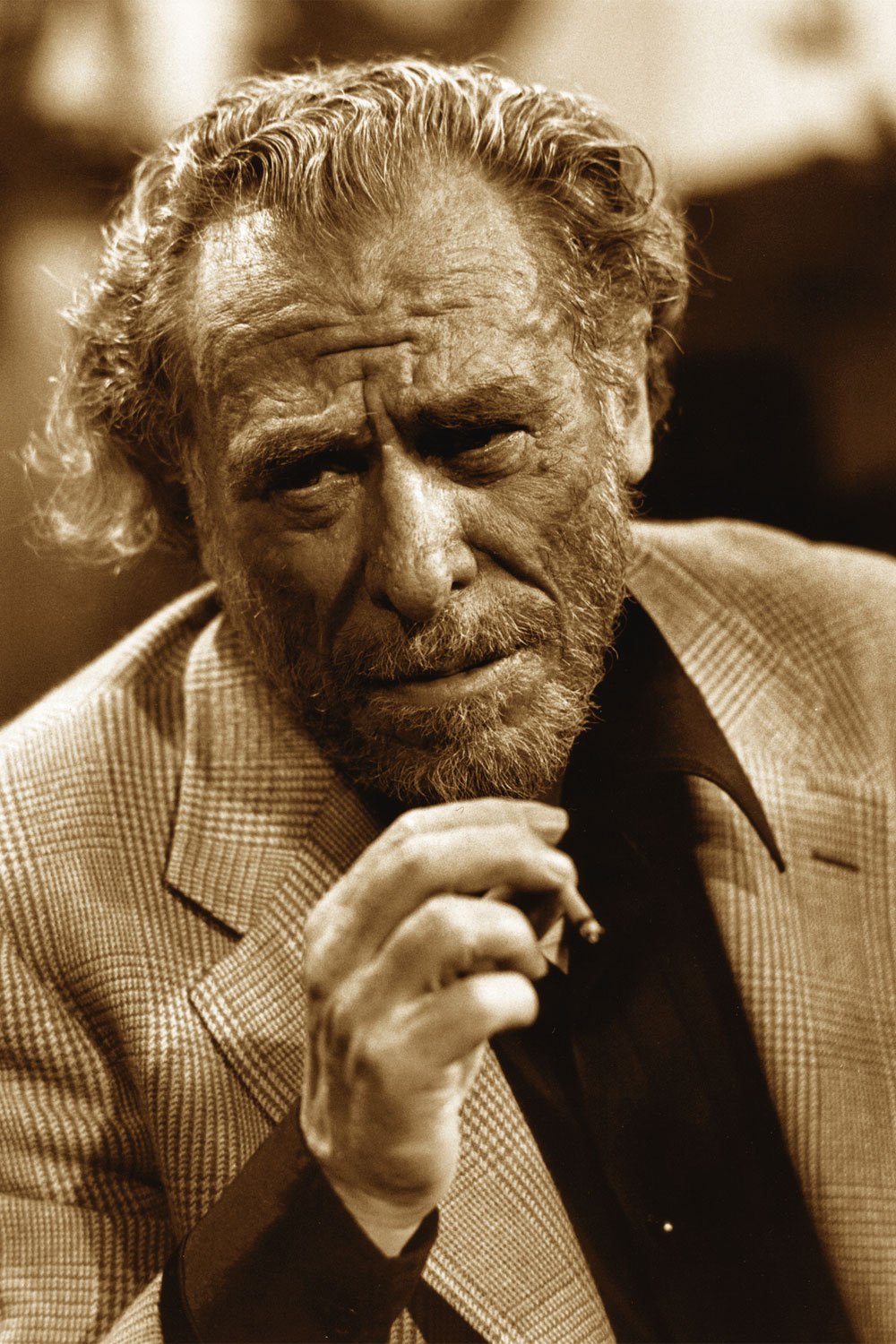
Poet Charles Bukowski (1920-1994)

I know he drank a lot and you probably wouldn’t let your sister go out with him, but the man was a real poet and he had something serious going with the muse. This is one of my favorites among his poems. It’s called “So You Want To Be a Writer.” Good stuff.

if it doesn’t come bursting out of you
in spite of everything,
don’t do it.
unless it comes unasked out of your
heart and your mind and your mouth
and your gut,
don’t do it.
if you have to sit for hours
staring at your computer screen
or hunched over your
typewriter
searching for words,
don’t do it.
if you’re doing it for money or
fame,
don’t do it.
if you’re doing it because you want
women in your bed,
don’t do it.
if you have to sit there and
rewrite it again and again,
don’t do it.
if it’s hard work just thinking about doing it,
don’t do it.
if you’re trying to write like somebody
else,
forget about it.
if you have to wait for it to roar out of
you,
then wait patiently.
if it never does roar out of you,
do something else.

if you first have to read it to your wife
or your girlfriend or your boyfriend
or your parents or to anybody at all,
you’re not ready.

don’t be like so many writers,
don’t be like so many thousands of
people who call themselves writers,
don’t be dull and boring and
pretentious, don’t be consumed with self-
love.
the libraries of the world have
yawned themselves to
sleep
over your kind.
don’t add to that.
don’t do it.
unless it comes out of
your soul like a rocket,
unless being still would
drive you to madness or
suicide or murder,
don’t do it.
unless the sun inside you is
burning your gut,
don’t do it.

when it is truly time,
and if you have been chosen,
it will do it by
itself and it will keep on doing it
until you die or it dies in you.

there is no other way.

and there never was.


On Giving

Guatemala’s Nobel Laureate in Literature, Miguel Ángel Asturias

Miguel Ángel Asturias (1899-1974) was the greatest writer that Guatemala ever produced. Although many of his owrks were translated into English, most are out of print now and hard to find. Here is a short poem by Asturias that I hope you’ll like. It’s called “Caudal (The Fortune)”:

To give is to love,
To give prodigiously:
For every drop of water
To return a torrent.

We were made that way,
Made to scatter
Seeds in the furrow
And stars in the ocean.

Woe to him, Lord,
who doesn’t exhaust his supply,
And, on returning, tells you:
“Like an empty satchel
Is my heart.”

Mayan Stela at Père Lachaise Cemetery Commemorating Asturias

When Martine and I visited Paris’s Père Lachaise cemetery in 2000, we turned a corner and suddenly found a very Mayan stela commemorating the Guatemalan writer.


The Narrow Road to the Deep North

Matsuo Bashō by Hokusai

Several times over the last thirty years, I have returned to the 17th century haiku and commentaries by Matsuo Bashō on the subject of travel:

Amid mountains of high summer,
I bowed respectfully before
The tall clogs of a statue,
Asking a blessing on my journey.

There is a quality to Bashō’s writing that makes me want to hit the road. As he wends his way through Shogunate Japan, stopping at temples along the way, I see him as the ideal traveling companion.

This grassy hermitage,
Hardly any more
Than five feet square,
I would gladly quit
But for the rain.

I think of his poem about a ruined castle:

A thicket of summer grass
Is all that remains
Of the dreams and ambitions
Of ancient warriors.

Bashō’s prose, too, has a certain quality that is worth remembering:

Go to the pine if you want to learn about the pine, or to the bamboo if you want to learn about the bamboo. And in doing so, you must leave your subjective preoccupation with yourself. Otherwise you impose yourself on the object and do not learn. Your poetry issues of its own accord when you and the object have become one—when you have plunged deep enough into the object to see something like a hidden glimmering there. However well phrased your poetry may be, if your feeling is not natural—if the object and yourself are separate—then your poetry is not true poetry but merely your subjective counterfeit.

How marvelous! This is what I seek from my travels—not that I write poetry—a “hidden glimmering” that makes itself manifest when I confront it with my entire being.

The name of this post, and of Bashō’s poetic journal, was also used by Australian novelist Thomas Kavanagh in his novel The Narrow Road to the Deep North, which tells of its physician hero’s imprisonment in World War Two Burma building the bridge on the River Kwai made famous by David Lean’s movie.


Lawrence Ferlinghetti at Dartmouth

Dartmouth Hall

I was shocked to find that Lawrence Ferlinghetti (born in March 1919) was still alive. Today, I borrowed one of his poetry collections from the L.A. Central Library and remembered with great pleasure running into the poet himself at Dartmouth College around the mid 1960s. He was on campus to read a selection of poems from his collection A Coney Island of the Mind (1958) and to answer questions.

Never in my life had I seen someone with his uncanny ability to deflect questions. My classmates posed the usual bullshit queries that were typical of people who wanted to look very intellectual but didn’t know what they were talking about. I enjoyed the poems, and I liked all the anecdotes of the beatnik poets he published, such as Allen Ginsburg,  Gregory Corso, and Gary Snyder. But I kept my mouth shut lest I be exposed like so many of my classmates were.

Ferlinghetti’s Poetry Collection

I was pleasantly surprised to find that A Coney Island of the Mind is the best-selling poetry collection ever published in the United States, having sold in excess of a million copies.

Letter from Iceland

View Around Mývatn in Northeast Iceland

In the Thirties, two English poets, W. H. Auden and Louis MacNeice, took a trip to Iceland. Auden wrote a book, published in 1936, called Letters from Iceland, which consisted of mixed prose, poetry, and photographs. The following is from a longer poem in Chapter III entitled “Letter to Graham and Anne Shepard”:

So I came here to the land the Romans missed,
Left for the Irish saint and the Viking colonist.
But what am I doing here? Qu’allais je faire
Among these volcanic rocks and this grey air?
Why go north when Cyprus and Madeira
De jure if not de facto are much nearer?
The reason for hereness seems beyond conjecture,
There are no trees or trains or architecture,
Fruits and greens are insufficient for health
And culture is limited by lack of wealth.
The tourist sites have nothing like Stonehenge,
The literature is all about revenge,
And yet I like it if only because this nation
Enjoys a scarcity of population
And cannot rise to many bores or hacks
Or paupers or poor men paying Super-Tax.
Yet further, if you can stand it, I will set forth
The obscure but powerful ethics of Going North.
*     *     *     *     *     *     *     *     *     *     *    *     *
In England one forgets—in each performing troupe
Forgets what one has lost, there is no room to stoop
And look along the ground, one cannot see the ground
For the feet of the crowd, and the lost is never found.
I dropped something, I think, but I am not sure what
And cannot say if it mattered much or not,
So let us get on or we shall be late, for soon
The shops will close and the rush hour be on.

The reference to a “lack of wealth” refers to the relative poverty of Iceland until it became an independent country in 1946. Under the Danes,  the Icelanders were one of the poorest peoples in Europe. No longer.

Bukowski: “A Dog Walking Backwards”

Poet Charles Bukowski

The title of this poem is “For the Foxes.” I do not understand why. But that’s okay with poetry. It takes quite a lot of readings sometimes to understand what is going on. Whatever it means—specifically—I like the feel of this poem.

Don’t feel sorry for me.
I am a competent,
satisfied human being.

be sorry for the others
who
fidget
complain

who
constantly
rearrange their
lives
like
furniture.

juggling mates
and
attitudes

their
confusion is
constant

and it will
touch
whoever they
deal with.

beware of them:
one of their
key words is
‘love’

and beware those who
only take
instructions from their
God

for they have
failed completely to live their own
lives.

don’t feel sorry for me
because I am alone

for even
at the most terrible
moments
humor
is my
companion.

I am a dog walking
backwards

I am a broken
banjo

I am a telephone wire
strung up in
Toledo, Ohio

I am a man
eating a meal
this night
in the month of
September.

put your sympathy
aside.
they say
water held up
Christ:
to come
through
you better be
nearly as
lucky.


“The Peace of Wild Things”

Finding the Ultimate Peace

I was wondering what to write about today, when I saw this poem quoted on Facebook by my friend Lynette Cahill. At that point, I said to myself, “Yep, that’ll do it!” It is called “The Peace of Wild Things” and was composed by Wendell Berry.

When despair for the world grows in me
and I wake in the night at the least sound
in fear of what my life and my children’s lives may be,
I go and lie down where the wood drake
rests in his beauty on the water, and the great heron feeds.
I come into the peace of wild things
who do not tax their lives with forethought
of grief. I come into the presence of still water.
And I feel above me the day-blind stars
waiting with their light. For a time
I rest in the grace of the world, and am free.

Los Encuentros

Highland Guatemala Town

I picked up a book from the library today by a Fulbright Scholar named Stephen Connely Benz entitled Guatemalan Journey and found the following poem entitled “Los Encuentros” in the front matter. I hope you like it as much as I did:

The phrase book tells me I’m at a crossroads,
I should expect encounters
in the vellum margins of this highway
where buses cough black clouds
and hanging men cry out destinations
I cannot find on the map.
I’ve heard rumors of what lies
ahead, the incidents hidden in hairpin
turns, dire straits for those who seek
passage through gullies, ravines, lava valleys.
The topography of this country,
an explorer said, is like a crumpled page:
palimpsest mountains, parchment plains,
hieroglyphic highlands awaiting interpretation.
Lexicographers take notes on each twisting
nuance in the road, turns of phrase promise
arrival or departure, movement along this text
I’m traveling. I read ahead
through the codex of curves
And straightaways to the congested towns
where babblers hail strangers
in unrelated vocables.
I study the morphemes in a parrot’s squawk,
signals sent up in volcano smoke,
stories revealed in aboriginal textile.
I skim long vistas of calligraphied macadam,
an endless panorama of road signs encoding
a traveler’s tale, a new message
But the phrase book’s no help now,
it all translates the same—
I’m at a crossroads,
expecting encounters, still waiting.

The book itself seems like an excellent introduction to Guatemala. I wonder if he wrote anything else.


Working Within the System

Time Magazine Cover Story on Yevgeny Yevtushenko

There are two Yevtushenkos. Coming to light in the early 1960s was the young Siberian poet who gave poetry readings to huge crowds in the Soviet Union, like some kind of rock star. He was critical of Stalin, of Russian anti-Semitism, and the “blue envelopes” with extra pay given to writers who toed the official line. Yet he clearly worked within the system, considered himself a loyal Communist, and was allowed to visit foreign countries without fear of his escaping.

I have just finished reading the poet’s A Precocious Autobiography, published in 1963, at the height of his fame—at a time when the Western press was touting him as a Communist they admired. It was a book that was at the same time critical of the government and eager to please it. According to an article in The Guardian:

Mr. Yevtushenko did so working mostly within the system, however, taking care not to join the ranks of outright literary dissidents. By stopping short of the line between defiance and resistance, he enjoyed a measure of official approval that more daring dissidents came to resent.

While they were subjected to exile or labor camps, Mr. Yevtushenko was given state awards, his books were regularly published, and he was allowed to travel abroad, becoming an international literary superstar.

As the exiled Russian poet Joseph Brodsky said about Yevtushenko: “He throws stones only in directions that are officially sanctioned and approved.” Here we have the second Yevtushenko, a figure of controversy.

Where do I stand on the poet? I have read his poems, but don’t care for them. But then, I don’t know Russian, and he could be badly translated—or else he might be one of those poets whose works don’t translate well into other languages.

When the Soviet Union blinked out of existence around 1989-1990, the the poet moved to the United States, where he taught courses at colleges in New York and Tulsa, Oklahoma. He died in Tulsa in 2017.