He Died in Paris After All

Peruvian Poet César Vallejo

Peruvian Poet César Vallejo

Since I’ve been reading so much about Peru, I felt bad that I had not read any Peruvian poetry. According to what I’ve read, the national poet of that land was César Vallejo (1892-1938). I took a fancy to the following poem, which I present in both English and Spanish:

Black Stone on Top of a White Stone

I shall die in Paris, in a rainstorm,
On a day I already remember.
I shall die in Paris—it does not bother me—
Doubtless on a Thursday, like today, in autumn.

It shall be a Thursday, because today, Thursday
As I put down these lines, I have set my shoulders
To the evil. Never like today have I turned,
And headed my whole journey to the ways where I am alone.

César Vallejo is dead. They struck him,
All of them, though he did nothing to them,
They hit him hard with a stick and hard also
With the end of a rope. Witnesses are: the Thursdays,
The shoulder bones, the loneliness, the rain, and the roads…

Here is the original Spanish:

Piedra Negra Sobre Piedra Blanca

Me moriré en París con aguacero,
un día del cual tengo ya el recuerdo.
Me moriré en París—y no me corro—
tal vez un jueves, como es hoy, de otoño.

Jueves será, porque hoy, jueves, que proso
estos versos, los húmeros me he puesto
a la mala y, jamás como hoy, me he vuelto,
con todo mi camino, a verme solo.

César Vallejo ha muerto, le pegaban
todos sin que él les haga nada;
le daban duro con un palo y duro

también con una soga; son testigos
los días jueves y los huesos húmeros,
la soledad, la lluvia, los caminos…

It’s a rather somber poem about a man who dies alone in exile, after having been beaten with a stick and the end of a rope. And who are his witnesses? Thursdays, shoulder bones, loneliness, rain, and the streets. I would like to know more about the poet’s life, but I’ll just have to content myself for now with his lonely death on the streets of Paris.

Pacheco and the Dogs

Another Great Poet Leaves Us

Another Great Poet Leaves Us

It is a well-known fact that poets don’t grow on trees. Belatedly, I am recognizing the death of José Emilio Pacheco, the Mexican poet who just recently died after a fall at the age of seventy-four. I am not familiar enough with Pacheco’s poetry—to be honest, I am not nearly familiar enough with poetry in general. I should read more, even though there is nothing that is more demanding—or rewarding. Take this simple example, called “A Dog’s Life”:

A Dog’s Life

We despise dogs for letting themselves
be trained, for learning to obey.
We fill the noun dog with rancor
to insult each other.
And it’s a miserable death
to die like a dog.

Yet dogs watch and listen
to what we can’t see or hear.
Lacking language
(or so we believe),
they have a talent we certainly lack.
And no doubt they think and know.

And so
they probably despise us
for our need to find masters,
for our pledge of allegiance to the strongest.

Thanks to Fred Runk, here is the Spanish text of the poem:

Despreciamos al perro dejarse
domesticar y ser obediente.
Llenamos de rencor sustanivo perro
para insultarmnos.
Y una muerte indigna
es morir como un perro.

Sin embargo los perros miran y eschucan
lo que no vemos ni escucharmos.
A falta de lenguaje
(o eso creemos)
poseen un don que ciertamente nos falta .
Y sin duda piensan y saben.

Asi pues,
resulta muy probable que nos desprecien
por nuestra necesidad de buscar amos,
poe nuestro voto de obediencia al mas fuerte.

A Frugal Chariot

Emily Dickinson

Emily Dickinson

Here is one of Emily Dickinson’s simpler poems—but no less powerful for all that. It is called “A Book”:

There is no frigate like a book
To take us lands away,
Nor any coursers like a page
Of prancing poetry.
This traverse may the poorest take
Without oppress of toll;
How frugal is the chariot
That bears a human soul!

At a time when poetry is being pushed aside by the young in favor of video games and other more spurious entertainments, it is good to see a simple statement of why it should not be so.

There are few things one can read that can so work the mind and enliven the spirit as a powerful poem, such as those of Emily Dickinson. Usually, they are complex arrangements of relatively few words. Fortunately, there is a reward for making the effort, a reward in the form of greater understanding.


“A Lonely Impulse of Delight”

British Biplane in World War One

British Biplane in World War One

William Butler Yeats is one of my favorite Twentieth Century poets, and one of my favorites among his poems is “An Irish Airman Foresees His Death.” Although deeply shrouded in skepticism, the poem speaks to all people who find themselves somewhere between a rock and a hard place:

An Irish Airman Foresees His Death

I know that I shall meet my fate
Somewhere among the clouds above;
Those that I fight I do not hate,
Those that I guard I do not love;
My country is Kiltartan Cross,
My countrymen Kiltartan’s poor,
No likely end could bring them loss
Or leave them happier than before.
No law, nor duty bade me fight,
Nor public men, nor cheering crowds,
A lonely impulse of delight
Drove to this tumult in the clouds;
I balanced all, brought all to mind,
The years to come seemed waste of breath,
A waste of breath the years behind
In balance with this life, this death.

Kiltartan is a barony in Ireland’s County Galway, home to Augusta, Lady Gregory. Also, it was the occasional residence of the poet himself.

I am particularly drawn to the final quatrain, in which the airman makes an existential decision to fly for the RAF despite his lack of loyalty to the British cause and uncertainty that his people would be worse off if the Kaiser won. He appears to have been a young wastrel who hazards his life in an uncertain cause, joying only in the delight of flying into battle.

Metaphor

Polish Poet Adam Zagajewski

Polish Poet Adam Zagajewski

Increasingly often and striking powerful chords, Eastern Europe calls to me. While I was looking for something else on my shelves, I pulled out Adam Zagajewski’s Unseen Hands and started scanning it. Here is a poem of his called “Metaphor”:

Metaphor

Every metaphor is a failure, said
the very old poet in the hotel bar,
turning to his rapt pupils.
The very old poet was in fine form
and said, with a wineglass in his hand:
It’s the fundamental problem of incarnation,
the things we love, the unseen things,
take flesh, of course, in what can
be seen and said, though never
absolutely, one to one,
so it follows that there’s always a little too much
or a little too little, the seams remain on the surface,
fingers jut, buttons, umbrellas, fingernails,
uncollected letters in azure airmail envelopes,
the sense of shortfall or excess remains,
someone is ominously silent, someone else
summons help, the ice cracks, the ambulance
arrives, too late, alas, but just wait,
thanks to this, thanks to this incongruity,
thanks to this inexplicable rupture,
we may keep chasing the chimera of metaphor,
all our lives we walk in darkness,
in a dim forest, we track the trail of simile,
imperfect, just like my
speech, just now reaching
its conclusion, although there is
no doubt much more to add,
but I fear that I’m already
growing weary and seem
to hear sleep calling.

I can just imagine the very old poet beginning to nod off, somewhat dismayed by the imperfection of language. Just as, I might add, I am beginning to nod off as my bedtime hour approaches. I like the use of the word “incarnation” to describe metaphor, an “unseen thing taking flesh.”

The Brotherhood of Silence

Saint G. K. Chesterton?

Saint G. K. Chesterton?

G. K. Chesterton has for many years been one of my favorite writers. And now I hear there is a movement to have him canonized as a saint. That would be all right with me. In the current issue of Gilbert, the publication of the American Chesterton Society (of which I am a member), there is even a jocular article entitled “Why G. K. Chesterton Ought to be Canonized,” in which eighteen reasons which some cite against his canonization are turned around by author Peter Kreeft into reasons espousing his sainthood.

At the bottom of the second and last page of his article was this slight poem, which is typical of the man:

Love’s Trappist

There is a place where lute and lyre are broken,
Where scrolls are torn and on a wild wind go,
Where tablets stand wiped naked for a token,
Where laurels wither and the daisies grow.

Lo: I too join the brotherhood of silence,
I am Love’s Trappist and you ask in vain,
For man through Love’s gate, even as through Death’s gate,
Goeth alone and comes not back again.

Yet here I pause, look back across the threshold,
Cry to my brethren, though the world be old,
Prophets and sages, questioners and doubters,
O world, old world, the best hath ne’er been told!

I will write more about Chesterton soon. When I first started reading him, only a few of his works were in print. Now, partly thanks to the Ignatius Press’s edition of his complete works (which is slowly coming out one or two volumes a year), and to a resurgence of interest in works in the public domain, virtually all of his published books are available. Because he was a prolific journalist as well as a poet, novelist, and essayist, much of his works in newspapers and more obscure magazines has not yet been collected.


Things That Might Have Been

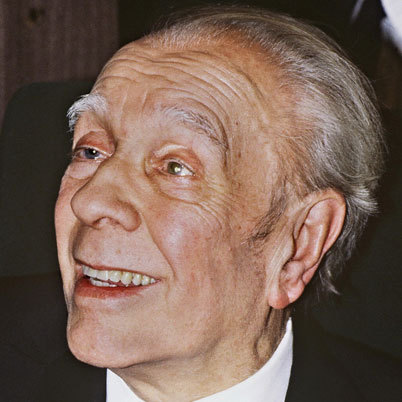
Jorge Luis Borges

Jorge Luis Borges

It takes a massively creative mind to imagine not only what has been, but what has not been—though they might well have been! I love the poetry of the late Argentinean Jorge Luis Borges, who died in 1986. Blind for much of his adult life, Borges saw things few poets have seen. Although he wrote less as he aged, everything he wrote is precious.

Things That Might Have Been

I think of things that weren’t, but might have been.
The treatise on Saxon myths Bede never wrote.
The inconceivable work Dante might have had a glimpse of,
As soon as he’d corrected the Comedy’s last verse.
History without the afternoons of the Cross and the hemlock.
History without the face of Helen.
Man without the eyes that gave us the moon.
On Gettysburg’s three days, victory for the South.
The love we never shared.
The wide empire the Vikings chose not to found.
The world without the wheel or the rose.
The view John Donne held of Shakespeare.
The other horn of the Unicorn.
The fabled Irish bird that lights on two trees at once.
The child I never had.

In another of his poems, Borges imagines that Don Quixote never left his library, but imagined all his adventures based on the epics of chivalry he read there.

Read Borges, and before long you, too, will see the other horn of the unicorn.


Looking Backward

PICcrab

Crab

A poet in our times is a semi-barbarian in a civilized community. He lives in the days that are past. His ideas, thoughts, feelings, associations, are all with barbarous manners, obsolete customs, and exploded superstitions. The march of his intellect is like that of a crab, backward. The brighter the light diffused around him by the progress of reason, the thicker is the darkness of antiquated barbarism, in which he buries himself like a mole, to throw up the barren hillocks of his Cimmerian labours.—Thomas Love Peacock, “The Four Ages of Poetry,” Works Vol. III

Horace Odes 1.11 in Three Languages

Fortunetelling Cards

Fortunetelling Cards

ENGLISH (Literal Translation)

Don’t ask—it’s forbidden to know—what final fate the gods have given to me and you, Leuconoe, and don’t consult Babylonian horoscopes. How much better it is to accept whatever shall be, whether Jupiter has given many more winters or whether this is the last one, which now breaks the force of the Tuscan sea against the facing cliffs. Be wise, strain the wine, and trim distant hope within short limits. While we’re talking, grudging time will already have fled: seize the day, trusting as little as possible in tomorrow.

LATIN (Original)

Tu ne quaesieris, scire nefas, quem mihi, quem tibi
finem di dederint, Leuconoe, nec Babylonios
temptaris numeros. ut melius, quicquid erit, pati,
seu pluris hiemes seu tribuit Iuppiter ultimam,
quae nunc oppositis debilitat pumicibus mare
Tyrrhenum: sapias, vina liques, et spatio brevi
spem longam reseces. dum loquimur, fugerit invida
aetas: carpe diem, quam minimum credula postero.

SCOTTISH DIALECT (With Glossary)

Ne’er fash your thumb what gods decree
To be the weird o’ you or me,
Nor deal in cantrip’s kittle cunning
To speir how fast your days are running;
But patient lippen for the best,
Nor be in dowie thought opprest.
Whether we see mair winter’s come,
Than this that spits wi’ canker’d foam.
Now moisten weel your geyzen’d wa’s
Wi’ couthy friends and hearty blaws;
Ne’er let your hope o’ergang your days,
For eild and thraldom never stays;
The day looks gash, toot aff your horn,
Nor care ae strae about the morn.

ae: one, a single
blaws: blows (back-slappings?)
canker’d: gusty, stormy
cantrip: magic
couthy: agreeable, sociable
dowie: sad, melancholy
eild: age, time of life
fash: trouble, bother, fret (fash your thumb = care a rap)
gash: pale, dismal
geyzen’d: dried out
kittle: tricky
lippen: trust, have confidence
morn: tomorrow
speir: ask
strae: straw
wa’s: ? The context requires something like weasand (Scots weason) = throat, but the only definitions I can find for wa’s are walls and ways, from which I can extract no satisfactory sense. Or could it be waes = woes?
weird: fate, destiny

“No More Than Weeds or Chaff”

Winter Landscape by Sesshu Toyo

Winter Landscape by Sesshu Toyo

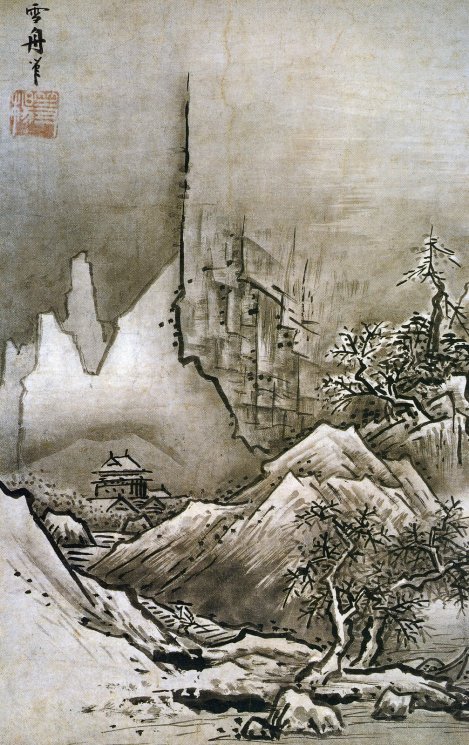
Years ago, at the opening of Dartmouth College’s Hopkins Center, I saw an exhibit of Sesshu Toyo’s Long Scroll and fell in love with it and with the Chinese landscape artists it was imitating. That was the beginning of my fascination with old Chinese landscapes and poetry.

The following lines by Fu Xuan (A.D. 217-278) are as good as the best:

A gentle wind fans the calm night:
A bright moon shines on the high tower.
A voice whispers, but no one answers when I call:
A shadow stirs, but no one comes when I beckon,
The kitchen-man brings in a dish of lentils:
Wine is there, but I do not fill my cup.
Contentment with poverty is Fortune’s best gift:
Riches and Honour are the handmaids of Disaster.
Though gold and gems by the world are sought and prized,
To me they seem no more than weeds or chaff.

Perhaps this Thanksgiving, we should be like the narrator of this poem. Living in the midst of abundance, perhaps we do not need to fill our glass with wine. As the poet says, “Contentment with poverty is Fortune’s best gift.” There is something to that. Today, and always, enjoy your dish of lentils.