“All Things Are Their Own Prophecy of Dust”

Death Mask from Mycenae

Death Mask from Mycenae

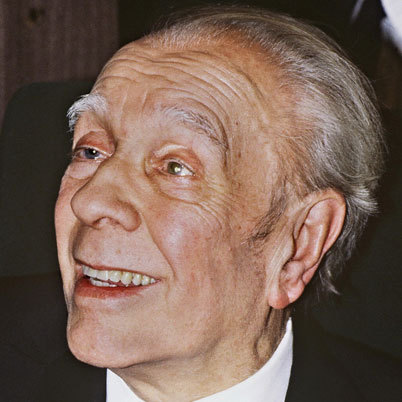
Perhaps of all the writers I have read in my long and checkered life, none has had such an outsize influence on me as Jorge Luis Borges. Even at this late date, years after he has left us, he still guides my thinking. Here is a wonderful poem about mutability by the Argentinian poet:

Adam Is Your Ashes

The sword will die just like the ripening cluster.
The glass is no more fragile than the rock.
All things are their own prophecy of dust.
Iron is rust. The voice, already echo.
Adam, the youthful father, is your ashes.
The final garden will also be the first.
The nightingale and Pindar both are voices.
The dawn is a reflection of the sunset.
The Mycenaean, his burial mask of gold.
The highest wall, the humiliated ruin.
Urquiza, he whom daggers left behind.
The face that looks upon itself in the mirror
Is not the face of yesterday. The night
Has spent it. Delicate time has molded us.

What joy to be the invulnerable water
That ran assuredly through the parable
Of Heraclitus, or the intricate fire,
But now, on this long day that doesn’t end,
I feel irrevocable and alone.

José Justo Urquiza was President of the Argentinian Confederation between 1854 and 1860. In 1852, he defeated the dictator Juan Manuel de Rosas at the Battle of Caseros.

Heraclitus was the Pre-Socratic Greek philosopher who said that one never crosses the same river twice: “We step and do not step into the same rivers, we are and we are not.”

The “long day that doesn’t end” could refer to his blindness. Unfortunately for all of us, that long day finally did end on June 14, 1986. (Could it have been that long ago?)

Even as I read this poem, my heart yearns for a return to Argentina. Last night, on a cold January day with my apartment heater blasting away, I drank a steaming cup of mate cocido and thought of that remote land at the tip of South America—a land that produced so many of my favorite writers (in addition to Borges, César Aira and Adolfo Bioy-Casares) and so many wonderful experiences. Even when I broke my shoulder by falling on the ice in Tierra del Fuego back in 2006—an event that would usually be seen as a bad sign—I loved the place and wanted to return. I did in November 2011. Now I am only marking time until my return.

Zeus Goes A-Wooing

Leda and the Swan

Whenever the Greek God Zeus was felt attracted toward mortal women, he disguised himself as someone or something else and just raped them. That happened in the case of Europa (either as a bull according to Ovid or as an eagle according to Robert Graves); Danae (as a golden shower—hey, I don’t make this stuff up); Callisto (as the Goddess Artemis); and Alcmene (as her husband who was away at war at the time).

Probably the most famous coupling was with Leda, for which Zeus became a swan. The result was Helen of Troy and Polydeuces. Leda’s legitimate children by King Tyndareus of Sparta were Castor and Clytemnestra. You may recall that Clytemnestra married Agamemnon and later murdered him in his bath when he returned from the Trojan War.

The above photo was taken earlier today by me at the Getty Villa in Malibu, one of the best collections of ancient Greek and Roman antiquities in the New World.

All this comes out in this magnificent poem by William Butler Yeats:

Leda and the Swan by W. B. Yeats

A sudden blow: the great wings beating still
Above the staggering girl, her thighs caressed
By the dark webs, her nape caught in his bill,
He holds her helpless breast upon his breast.

How can those terrified vague fingers push
The feathered glory from her loosening thighs?
And how can body, laid in that white rush,
But feel the strange heart beating where it lies?

A shudder in the loins engenders there
The broken wall, the burning roof and tower
And Agamemnon dead.
                    Being so caught up,
So mastered by the brute blood of the air,
Did she put on his knowledge with his power
Before the indifferent beak could let her drop?

“The Just Man Rages in the Wilds”

Frontispiece

Rintrah roars & shakes his fires in the burden’d air;
Hungry clouds swag on the deep

Once meek, and in a perilous path,
The just man kept his course along
The vale of death.
Roses are planted where thorns grow.
And on the barren heath
Sing the honey bees.

Then the perilous path was planted:
And a river, and a spring
On every cliff and tomb;
And on the bleached bones
Red clay brought forth.

Till the villain left the paths of ease,
To walk in perilous paths, and drive
The just man into barren climes.

Now the sneaking serpent walks
In mild humility.
And the just man rages in the wilds
Where lions roam.

Rintrah roars & shakes his fires in the burden’d air;
Hungry clouds swag on the deep.—William Blake, opening of “The Marriage of Heaven and Hell”

“The Beast Not Found In Verse”

Borges and His Tigers

As you may (or may not) know, I am and always have been a devotee of the stories, poems, and essays of Argentinean writer Jorge Luis Borges. Here is a poem in which he tries to bring a tiger to life through sheer artistry, but fails—or does he?

The Other Tiger by Jorge Luis Borges

A tiger comes to mind. The twilight here
Exalts the vast and busy Library
And seems to set the bookshelves back in gloom;
Innocent, ruthless, bloodstained, sleek
It wanders through its forest and its day
Printing a track along the muddy banks
Of sluggish streams whose names it does not know
(In its world there are no names or past
Or time to come, only the vivid now)
And makes its way across wild distances
Sniffing the braided labyrinth of smells
And in the wind picking the smell of dawn
And tantalizing scent of grazing deer;
Among the bamboo’s slanting stripes I glimpse
The tiger’s stripes and sense the bony frame
Under the splendid, quivering cover of skin.
Curving oceans and the planet’s wastes keep us
Apart in vain; from here in a house far off
In South America I dream of you,
Track you, O tiger of the Ganges’ banks.

It strikes me now as evening fills my soul
That the tiger addressed in my poem
Is a shadowy beast, a tiger of symbols
And scraps picked up at random out of books,
A string of labored tropes that have no life,
And not the fated tiger, the deadly jewel
That under sun or stars or changing moon
Goes on in Bengal or Sumatra fulfilling
Its rounds of love and indolence and death.
To the tiger of symbols I hold opposed
The one that’s real, the one whose blood runs hot
As it cuts down a herd of buffaloes,
And that today, this August third, nineteen
Fifty-nine, throws its shadow on the grass;
But by the act of giving it a name,
By trying to fix the limits of its world,
It becomes a fiction not a living beast,
Not a tiger out roaming the wilds of earth.

We’ll hunt for a third tiger now, but like
The others this one too will be a form
Of what I dream, a structure of words, and not
The flesh and one tiger that beyond all myths
Paces the earth. I know these things quite well,
Yet nonetheless some force keeps driving me
In this vague, unreasonable, and ancient quest,
And I go on pursuing through the hours
Another tiger, the beast not found in verse.

Last year around this time, Martine and I were in Buenos Aires. Because she was curious about guanacos, we visited the Buenos Aires Zoo in Palermo at Sarmiento and Las Heras. Now that was the same zoo where Borges would visit before the days of his blindness set in to see the tigers.

He would write frequently about tigers, even titling one of his books Dreamtigers. The above poem is probably my favorite of all.

“There Is No Path”

Antonio Machado

Wanderer, the road is your
footsteps, nothing else;
wanderer, there is no path,
you lay down a path in walking.

In walking, you lay down a path
and when turning around
you see the road you’ll
never step on again.
Wanderer, path there is none,
only tracks on the ocean foam.—Antonio Machado

O Canada

Canoe

I no longer think that Canadians lack their own identity. They are not just Northern Yankees. Over the last four hundred years, they have developed an identity of their own based on their bilingual history, largely forged by the French and Indian War that preceded our own Revolution, and added to by the Scottish Highland Clearances, the arrival of the Loyalists (whom we call Tories) from the Thirteen Colonies, and waves of Eastern European immigration similar to our own.

“Canada” is a poem by Billy Collins, a native New Yorker who has a special feeling for the north.

Canada by Billy Collins

I am writing this on a strip of white birch bark
that I cut from a tree with a penknife.
There is no other way to express adequately
the immensity of the clouds that are passing over the farms
and wooded lakes of Ontario and the endless visibility
that hands you the horizon on a platter.

I am also writing this in a wooden canoe,
a point of balance in the middle of Lake Couchiching,
resting the birch bark against my knees.
I can feel the sun’s hands on my bare back,
but I am thinking of winter,
snow piled up in all the provinces
and the solemnity of the long grain-ships
that pass the cold months moored at Owen Sound.

O Canada, as the anthem goes,
scene of my boyhood summers,
you are the pack of Sweet Caporals on the table,
you are the dove-soft train whistle in the night,
you are the empty chair at the end of an empty dock.
You are the shelves of books in a lakeside cottage:
Gift from the Sea by Anne Morrow Lindbergh,
A Child’s Garden of Verses by Robert Louis Stevenson,
Anne of Avonlea by L. M. Montgomery,
So You’re Going to Paris! by Clara E. Laughlin,
and Peril Over the Airport, one
of the Vicky Barr Flight Stewardess series
by Helen Wills whom some will remember
as the author of the Cherry Ames Nurse stories.
What has become of the languorous girls
who would pass the long limp summer evenings reading
Cherry Ames, Student Nurse, Cherry Ames, Senior Nurse,
Cherry Ames, Chief Nurse, and Cherry Ames, Flight Nurse?
Where are they now, the ones who shared her adventures
as a veterans’ nurse, private duty nurse, visiting nurse,
cruise nurse, night supervisor, mountaineer nurse,
dude ranch nurse (there is little she has not done),
rest home nurse, department store nurse,
boarding school nurse, and country doctor’s nurse?

O Canada, I have not forgotten you,
and as I kneel in my canoe, beholding this vision
of a bookcase, I pray that I remain in your vast,
polar, North American memory.
You are the paddle, the snowshoe, the cabin in the pines.
You are Jean de Brébeuf with his martyr’s necklace of hatchet heads.
You are the moose in the clearing and the moosehead on the wall.
You are the rapids, the propeller, the kerosene lamp.
You are the dust that coats the roadside berries.
But not only that.
You are the two boys with pails walking along that road,
and one of them, the taller one minus the straw hat, is me.

Billy Collins, “Canada” from The Art of Drowning. Copyright © 1995 by Billy Collins. All rights are controlled by the University of Pittsburgh Press. Reprinted without the permission of the University of Pittsburgh Press,

Private Voices

House Overgrown with Vines

I haven’t written any blog posts incorporating poems since I moved here to WordPress. To remedy that oversight, here is a gentle poem by Denise Levertov entitled “Aware”:

When I opened the door
I found the vine leaves
speaking among themselves in abundant
whispers.

My presence made them
hush their green breath,
embarrassed, the way
humans stand up, buttoning their jackets,
acting as if they were leaving anyway, as if
the conversation had ended
just before you arrived.

I liked
the glimpse I had, though,
of their obscure
gestures. I liked the sound
of such private voices. Next time
I’ll move like cautious sunlight, open
the door by fractions, eavesdrop
peacefully.

“Aware” by Denise Levertov, from This Great Unknowing. © New Directions Publishing, 1999. Reprinted without permission.

One place I like to check for interesting poems from time to time is Garrison Keillor’s website The Writer’s Almanac. Every day, rain or shine, you can see a poem selected by Keillor and read out loud in his sonorous voice.