Horace Odes 1.11 in Three Languages

Fortunetelling Cards

Fortunetelling Cards

ENGLISH (Literal Translation)

Don’t ask—it’s forbidden to know—what final fate the gods have given to me and you, Leuconoe, and don’t consult Babylonian horoscopes. How much better it is to accept whatever shall be, whether Jupiter has given many more winters or whether this is the last one, which now breaks the force of the Tuscan sea against the facing cliffs. Be wise, strain the wine, and trim distant hope within short limits. While we’re talking, grudging time will already have fled: seize the day, trusting as little as possible in tomorrow.

LATIN (Original)

Tu ne quaesieris, scire nefas, quem mihi, quem tibi
finem di dederint, Leuconoe, nec Babylonios
temptaris numeros. ut melius, quicquid erit, pati,
seu pluris hiemes seu tribuit Iuppiter ultimam,
quae nunc oppositis debilitat pumicibus mare
Tyrrhenum: sapias, vina liques, et spatio brevi
spem longam reseces. dum loquimur, fugerit invida
aetas: carpe diem, quam minimum credula postero.

SCOTTISH DIALECT (With Glossary)

Ne’er fash your thumb what gods decree
To be the weird o’ you or me,
Nor deal in cantrip’s kittle cunning
To speir how fast your days are running;
But patient lippen for the best,
Nor be in dowie thought opprest.
Whether we see mair winter’s come,
Than this that spits wi’ canker’d foam.
Now moisten weel your geyzen’d wa’s
Wi’ couthy friends and hearty blaws;
Ne’er let your hope o’ergang your days,
For eild and thraldom never stays;
The day looks gash, toot aff your horn,
Nor care ae strae about the morn.

ae: one, a single
blaws: blows (back-slappings?)
canker’d: gusty, stormy
cantrip: magic
couthy: agreeable, sociable
dowie: sad, melancholy
eild: age, time of life
fash: trouble, bother, fret (fash your thumb = care a rap)
gash: pale, dismal
geyzen’d: dried out
kittle: tricky
lippen: trust, have confidence
morn: tomorrow
speir: ask
strae: straw
wa’s: ? The context requires something like weasand (Scots weason) = throat, but the only definitions I can find for wa’s are walls and ways, from which I can extract no satisfactory sense. Or could it be waes = woes?
weird: fate, destiny
“No More Than Weeds or Chaff”

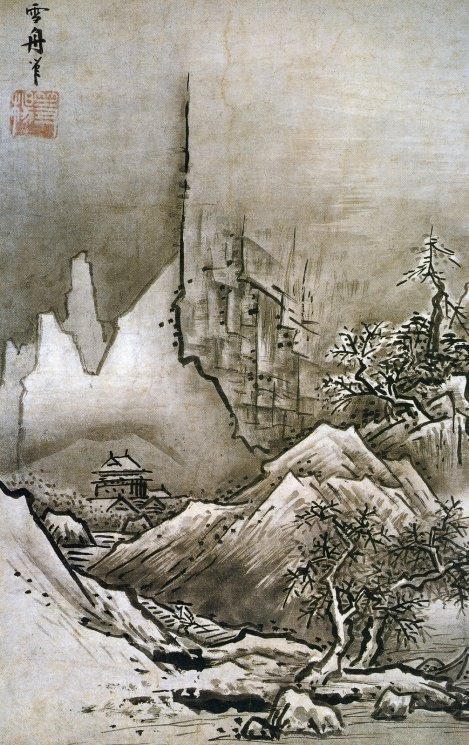
Winter Landscape by Sesshu Toyo

Winter Landscape by Sesshu Toyo

Years ago, at the opening of Dartmouth College’s Hopkins Center, I saw an exhibit of Sesshu Toyo’s Long Scroll and fell in love with it and with the Chinese landscape artists it was imitating. That was the beginning of my fascination with old Chinese landscapes and poetry.

The following lines by Fu Xuan (A.D. 217-278) are as good as the best:

A gentle wind fans the calm night:
A bright moon shines on the high tower.
A voice whispers, but no one answers when I call:
A shadow stirs, but no one comes when I beckon,
The kitchen-man brings in a dish of lentils:
Wine is there, but I do not fill my cup.
Contentment with poverty is Fortune’s best gift:
Riches and Honour are the handmaids of Disaster.
Though gold and gems by the world are sought and prized,
To me they seem no more than weeds or chaff.

Perhaps this Thanksgiving, we should be like the narrator of this poem. Living in the midst of abundance, perhaps we do not need to fill our glass with wine. As the poet says, “Contentment with poverty is Fortune’s best gift.” There is something to that. Today, and always, enjoy your dish of lentils.

For Love of a Tree

Fanning Her Insomnia with Dreams

Fanning Her Insomnia with Dreams

Poems written in other languages have a difficult passage to get to English. In the end, what we see is a mere simulacrum of the original. Still, the greatness of a poem will out. If a poem was originally written in French, Spanish, or Hungarian, I can get more of a feeling for the original; but what of the poems of the great Anna Akhmatova (1889-1966), which were written in Russian? I have approached several of her translated works and loved them, or else loved the pale reflections they cast in English, such as this one:

Willow

In the young century’s cool nursery,
In its checkered silence, I was born.
Sweet to me was not the voice of man,
But the wind’s voice was understood by me.
The burdocks and the nettles fed my soul,
But I loved the silver willow best of all.
And, grateful for my love, it lived
All its life with me, and with its weeping
Branches fanned my insomnia with dreams. But
—Surprisingly enough!—I have outlived
It. Now, a stump’s out there. Under these skies,
Under these skies of ours, are other
Willows, and their alien voices rise.
And I am silent … As though I’d lost a brother.

(Translated by D. M. Thomas)

The poem becomes clearer when you understand what its author endured through her long life. I quote one paragraph from the Wikipedia entry on her:

Primary sources of information about Akhmatova’s life are relatively scant, as war, revolution and the totalitarian regime caused much of the written record to be destroyed. For long periods she was in official disfavour and many of those who were close to her died in the aftermath of the revolution. Akhmatova’s first husband, Nikolai Gumilev was executed by the Soviet secret police, and her son Lev Gumilev and her common-law husband Nikolay Punin spent many years in the Gulag, where Punin died.

Perhaps if an ogre like Stalin could take everyone you ever loved away from you, then perhaps your soul will be fed by “the burdocks and the nettles.”


“A Frail Jetty Facing North”

Oedipus and Antigone

Oedipus and Antigone

What is unwisdom but the lusting after
Longevity: to be old and full of days!
For the vast and unremitting tide of years
Casts up to view more sorrowful things than joyful;
And as for pleasures, once beyond our prime,
They all drift out of reach, they are washed away.
And the same gaunt bailiff calls upon us all,
Summoning into Darkness, to those wards
Where is no music, dance, or marriage hymn
That soothes or gladdens. To the tenements of Death.

Not to be born is, past all yearning, best.
And second best is, having seen the light,
To return at once to deep oblivion.
When youth has gone, and the baseless dreams of youth,
What misery does not then jostle man’s elbow,
Join him as a companion, share his bread?
Betrayal, envy, calumny and bloodshed
Move in on him, and finally Old Age—
Infirm, despised Old Age—joins in his ruin,
The crowning taunt of his indignities.

So is it with that man, not just with me.
He seems like a frail jetty facing North
Whose pilings the waves batter from all quarters;
From where the sun comes up, from where it sets,
From freezing boreal regions, from below,
A whole winter of miseries now assails him,
Thrashes his sides and breaks over his head.—Sophocles, Oedipus at Colonus (Trans. Anthony Hecht)

Omigosh, What Have I Done?

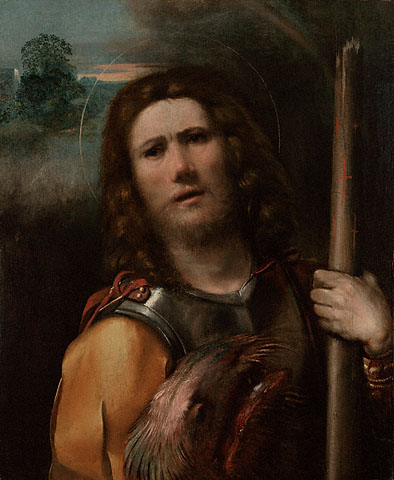
Saint George by Dosso Dossi (ca. 1515)

Saint George by Dosso Dossi (ca. 1515)

Today Martine and I drove to the Getty Center and looked at the paintings, special exhibitions, and decorative arts. What particularly interested me was a painting by the Italian Dosso Dossi (born Giovanni di Niccolò de Luteri) around 1515 of Saint George immediately after slaying the dragon. It’s not an expression of joy or celebration by any means. Almost, it seems as if the saint is asking himself, “Oh my God, what have I done?” Perhaps some ancient knowledge of the dragon’s has been conveyed to the Roman soldier, and he foresees that the world will never be the same again.

The painting is a small one, measuring 27½ x 24 inches, and by no means in a dominant location in the exhibition hall. Still, the facial expression drew my attention immediately and held it. I would have liked to photograph it (without flash, of course), but the guard in that particular hall forbade it; so I noted the name of the artist and luckily found it on the Getty Center website, which describes the oil as follows:

Dosso Dossi depicted the aftermath of Saint George’s battle with the dragon, in which he wields the creature’s bloodied head and the lance broken during the fight. Under an emerging rainbow, the victorious patron saint of Ferrara, Italy, emerges from the darkness of the battle. Dossi poignantly expressed his subject’s recent emotional turmoil in the saint’s penetrating expression. He appears weary yet resolute in his triumph.

The symbols of Saint George’s Christian faith—crosses rendered in vivid strokes of red paint as though the blood of his opponent drips down its shaft—mark the weapon. The color of the crosses echoes the blood ringing the beast’s mouth and also symbolizes the blood of Christ.

I don’t altogether agree with Saint George appearing “weary but resolute in his triumph.” I guess each work of art speaks to different people in different ways.

There is a poem by Jorge Luis Borges entitled “Limits” which, to me, conveys the spirit of this painting:

There is a line of Verlaine I shall not recall again,
There is a nearby street forbidden to my step,
There is a mirror that has seen me for the last time,
There is a door I have shut until the end of the world.
Among the books in my library (I have them before me)
There are some I shall never reopen.
This summer I complete my fiftieth year:
Death reduces me incessantly.

(Translated by Anthony Kerrigan)

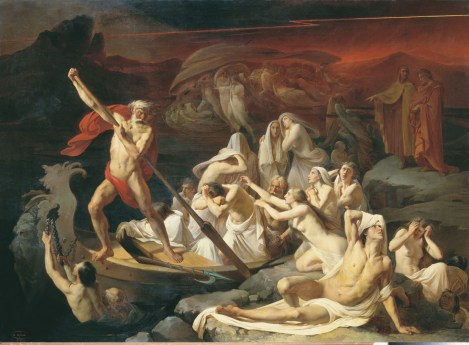
Charon the Boatman

Back and Forth Across the River Styx

Back and Forth Across the River Styx

I haven’t printed any poems lately, so I paid a visit to the work of America’s Serbian-born poet, Charles Simic.

Charon’s Cosmology
By Charles Simic

With only his dim lantern
To tell him where he is
And every time a mountain
Of fresh corpses to load up

Take them to the other side
Where there are plenty more
I’d say by now he must be confused
As to which side is which

I’d say it doesn’t matter
No one complains he’s got
Their pockets to go through
In one a crust of bread in another a sausage

Once in a long while a mirror
Or a book which he throws
Overboard into the dark river
Swift and cold and deep

Now, why, I wonder, would Charon toss books into the Styx? God knows, if I were one of his fares, I would probably have a book on me. Eternity lasts a long time, and there’s plenty of time to read Tolstoy, Dostoyevsky, and everything else. There exists some doubt, however, that at that point it would do me any earthly good.

Fragments of Eternity

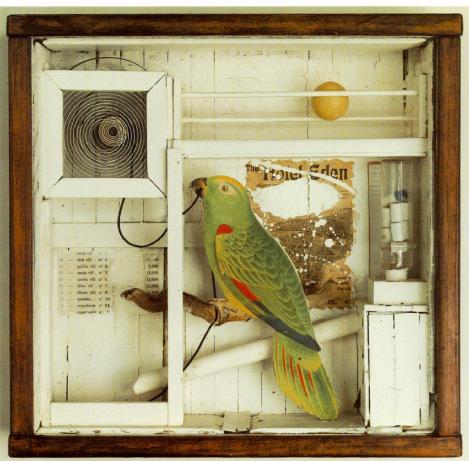
Joseph Cornell’s Hotel Eden

Joseph Cornell’s Hotel Eden

Sometimes even a fragment can set one’s mind a-roving. Today while eating lunch at the Attari Persian Sandwich Shop in Westwood, I started reading an article about the poetry of Charles Simic in the July 11, 2003 issue of The New York Review of Books. Because I was almost finished with my iced tea, I stopped reading the article and got up to make room for other diners. Before I folded up the issue, I saw an intriguing comparison between the poems of Emily Dickinson and the bricolage art of Joseph Cornell (1903-1972). Now who was this Joseph Cornell? I got back to the office and looked at several samples of his work, two of which I include here. I also read a poem by Emily Dickinson entitled “A Bird Came Down,” which I present below in its entirety:

A bird came down the walk:
He did not know I saw;
He bit an angle-worm in halves
And ate the fellow, raw.

And then he drank a dew
From a convenient grass,
And then hopped sidewise to the wall
To let a beetle pass.

He glanced with rapid eyes
That hurried all abroad,—
They looked like frightened beads, I thought;
He stirred his velvet head

Like one in danger; cautious,
I offered him a crumb,
And he unrolled his feathers
And rowed him softer home

Than oars divide the ocean,
Too silver for a seam,
Or butterflies, off banks of noon,
Leap, splashless, as they swim.

Everything is fairly clear until we come to the last two stanzas. At this point, Dickinson compares the bird’s wings to oars and butterflies, whose movement suggests to her a resemblance to swimming in the air. Now, let me ask you this: Did the bird accept the proffered crumb or not? Did the bird suddenly take to flight and suddenly remind the poet of butterflies diving, as it were, into the air?

You may notice: I do not present answers, merely questions. I am not such a tyrant as to wish to impose my interpretation (which, in any case, I have not yet arrived at and probably never will) on you. To me, poetry that is great suggests a multiplicity of questions, and no dogmatic answers. Poetry leads you to strange places and makes you see strange relationships. But, if it’s great poetry, it leaves the answers up to you. So, too, does the following box by Joseph Cornell:

Joseph Cornell’s Medici Boy

Joseph Cornell’s Medici Boy

What is it with that thing in the lower center that looks like a small fan? And what about those photos and drawings along the sides of the main image and the blocks at the bottom? Then there are those numbers that look like something taken off an oversized railroad schedule.

Eventually I’ll read the article about Charles Simic’s poetry. Perhaps tomorrow. In the meantime, certain fragments have made me see things that set my mind reeling. Even if my conclusions are different from those of the reviewer, I will have taken an interesting little journey.

“Air and Light and Space and Time”

Charles Bukowski

Charles Bukowski

“–you know, I’ve either had a family, a job,something has always been in the
way
but now
I’ve sold my house, I’ve found this
place, a large studio, you should see the space and
the light.
for the first time in my life I’m going to have
a place and the time to
create.”

no baby, if you’re going to create
you’re going to create whether you work
16 hours a day in a coal mine
or
you’re going to create in a small room with 3 children
while you’re on
welfare,
you’re going to create with part of your mind and your body blown
away,
you’re going to create blind
crippled
demented,
you’re going to create with a cat crawling up your
back while
the whole city trembles in earthquake, bombardment,
flood and fire.

baby, air and light and time and space
have nothing to do with it
and don’t create anything
except maybe a longer life to find
new excuses
for.

© Charles Bukowski, Black Sparrow Press

For a graphic version, click here.

“Secret Movements of a Puppet Show”

Charles Churchill (1732-1764)

Charles Churchill (1732-1764)

Peace to such triflers; be our happier plan
To pass through life as easy as we can.
Who’s in or out, who moves this grand machine,
Nor stirs my curiosity nor spleen.
Secrets of state no more I wish to know
Than secret movements of a puppet-show:
Let but the puppets move, I’ve my desire,
Unseen the hand which guides the master-wire.—Charles Churchill, “Night: An Epistle to Robert Lloyd”

“It Will be Summer—Eventually”

A Poem from Emily Dickinson Looking Forward to Summer

A Poem from Emily Dickinson Looking Forward to Summer

As this year’s horrible tax season grinds to a close, I look forward to having weekends to myself once again, and time to enjoy them with Martine. Now, as often, I turn to the poems of Emily Dickinson to express my feelings:

It Will Be Summer—Eventually
by Emily Dickinson

 It will be Summer — eventually.
Ladies — with parasols —
Sauntering Gentlemen — with Canes
And little Girls — with Dolls —

Will tint the pallid landscape —
As ’twere a bright Bouquet —
Tho’ drifted deep, in Parian —          [porcelain, snow?
The Village lies — today —

The Lilacs — bending many a year —
Will sway with purple load —
The Bees — will not despise the tune —
Their Forefathers — have hummed —

The Wild Rose — redden in the Bog —
The Aster — on the Hill
Her everlasting fashion — set —
And Covenant Gentians — frill —          [blue flowers

Till Summer folds her miracle —
As Women — do — their Gown —
Or Priests — adjust the Symbols —
When Sacrament — is done —

“It will be Summer—eventually” (#342) by Emily Dickinson, from The Complete Poems of Emily Dickinson. © Back Bay Books, 1960. Reprinted without permission.

I am curious about that concluding dash in the poem. I cannot help but think that it is deliberate and contains its own message, such as: And the whole process will be repeated again one more time.