Every time I read this poem by William Blake, I am impressed anew by its greatness. Its very simplicity is deceptive, as it hints at levels of mystery and savagery that underlie our workaday world. I have posted this poem before, but I continue to be mightily impressed by it.
The Tyger
Tyger Tyger, burning bright, In the forests of the night; What immortal hand or eye, Could frame thy fearful symmetry?
In what distant deeps or skies. Burnt the fire of thine eyes? On what wings dare he aspire? What the hand, dare seize the fire?
And what shoulder, & what art, Could twist the sinews of thy heart? And when thy heart began to beat. What dread hand? & what dread feet?
What the hammer? what the chain, In what furnace was thy brain? What the anvil? what dread grasp. Dare its deadly terrors clasp?
When the stars threw down their spears And water’d heaven with their tears: Did he smile his work to see? Did he who made the Lamb make thee?
Tyger Tyger burning bright, In the forests of the night: What immortal hand or eye, Dare frame thy fearful symmetry?
Octavio Paz is Mexico’s lone winner of the Nobel Prize in Literature. He is best known for his poetry, but he also wrote a great long essay about Mexico entitled The Labyrinth of Solitude (1950). Below is a haunting poem by him about human isolation:
The Street
Here is a long and silent street. I walk in blackness and I stumble and fall and rise, and I walk blind, my feet trampling the silent stones and the dry leaves. Someone behind me also tramples, stones, leaves: if I slow down, he slows; if I run, he runs I turn: nobody.
Everything dark and doorless, only my steps aware of me, I turning and turning among these corners which lead forever to the street where nobody waits for, nobody follows me, where I pursue a man who stumbles and rises and says when he sees me: nobody.
Stamp Honoring Hungarian Poet Radnóti Miklós (1909-1944)
The title of this post is the Magyar (Hungarian) word for “Roots.” Radnóti was a Jewish-Hungarian poet who was conscripted into forced labor by the Nazis and marched to the point of exhaustion. The poem below was found in his pocket when his body was exhumed from a mass grave.
Roots
Strength courses in the root; It drinks the rain, it lives together with the soil, And its dream is white as snow.
From beneath the soil to above the soil it bursts; The root crawls, cunning, Its arms like ropes.
On the root’s arms, worms sleep; On the root’s legs, worms sit; The world grows worm-ridden.
Yet the root lives on below; The world does not concern it — Only the branch does, full of leaves.
Marveling at the branch, it feeds it constantly; To it it sends its savors, Its sweet, celestial savors.
Now I too am a root; I too now live among worms; It is there that poetry is made.
I was once a flower; now I have become a root, With the heavy dark soil above me; My fate now ended, A saw wails above my head.
Below is the first stanza of the poem in Hungarian, just to give you an idea of the severe compression possible in the Magyar language:
Gyökér
A gyökérben erő surran, esőt iszik, földdel él és az álma hófehér.
We know his Walden, even his essay “Civil Disobedience.” But do we know his poetry? Probably not, though some of it is pretty good, such as this short number:
Epitaph on the World
Here lies the body of this world, Whose soul alas to hell is hurled. This golden youth long since was past, Its silver manhood went as fast, An iron age drew on at last; ’Tis vain its character to tell, The several fates which it befell, What year it died, when ’twill arise, We only know that here it lies.
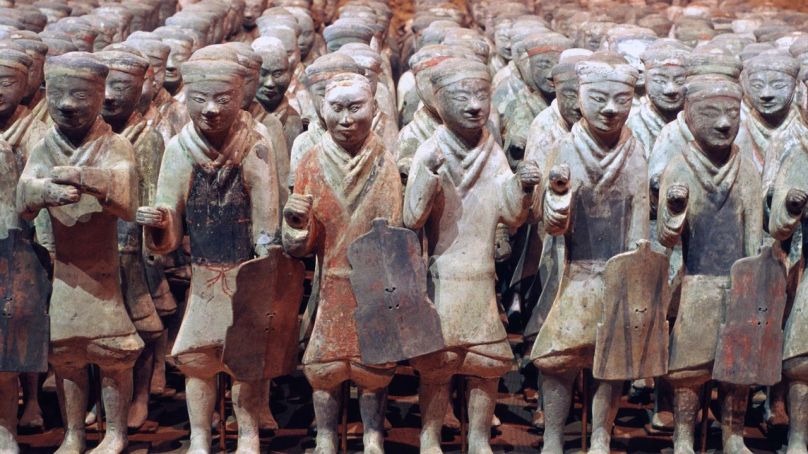
Chinese Soldiers Around Time of Tu Fu (8th Century)
Two of the greatest poets who have ever lived are Li Po and Tu Fu (a.k.a. Du Fu), who not only lived around the same time in China but who knew each other. Here is a heartbreaking poem by Tu Fu about coming back home after the wars to find his home has changed irrevocably.
A Homeless Man’s Departure
After the Rebellion of 755, all was silent wasteland, gardens and cottages turned to grass and thorns. My village had over a hundred households, but the chaotic world scattered them east and west. No information about the survivors; the dead are dust and mud. I, a humble soldier, was defeated in battle. I ran back home to look for old roads and walked a long time through the empty lanes. The sun was thin, the air tragic and dismal. I met only foxes and raccoons, their hair on end as they snarled in rage. Who remains in my neighborhood? One or two old widows. A returning bird loves its old branches, how could I give up this poor nest? In spring I carry my hoe all alone, yet still water the land at sunset. The county governor’s clerk heard I’d returned and summoned me to practice the war-drum. This military service won’t take me from my state. I look around and have no one to worry about. It’s just me alone and the journey is short, but I will end up lost if I travel too far. Since my village has been washed away, near or far makes no difference. I will forever feel pain for my long-sick mother. I abandoned her in this valley five years ago. She gave birth to me, yet I could not help her. We cry sour sobs till our lives end. In my life I have no family to say farewell to, so how can I be called a human being?
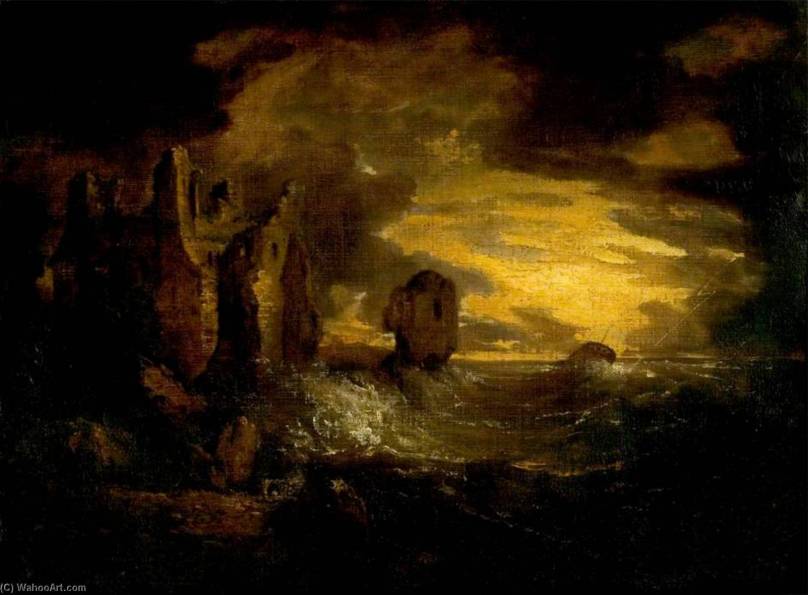
George Howland Beaumont: “Peele Castle in a Storm, Cumbria, 1800”
William Wordsworth is and always has been one of my favorite poets. The Beaumont named in the poem is the painter George Howland Beaumont (1753-1827), creator of the above painting.
Elegiac Stanzas Suggested by a Picture of Peele Castle in a Storm, Painted by Sir George Beaumont
I was thy neighbour once, thou rugged Pile! Four summer weeks I dwelt in sight of thee: I saw thee every day; and all the while Thy Form was sleeping on a glassy sea.
So pure the sky, so quiet was the air! So like, so very like, was day to day! Whene’er I looked, thy Image still was there; It trembled, but it never passed away.
How perfect was the calm! it seemed no sleep; No mood, which season takes away, or brings: I could have fancied that the mighty Deep Was even the gentlest of all gentle things.
Ah! then, if mine had been the Painter’s hand, To express what then I saw; and add the gleam, The light that never was, on sea or land, The consecration, and the Poet’s dream;
I would have planted thee, thou hoary Pile mid a world how different from this! Beside a sea that could not cease to smile; On tranquil land, beneath a sky of bliss.
Thou shouldst have seemed a treasure-house divine Of peaceful years; a chronicle of heaven;— Of all the sunbeams that did ever shine The very sweetest had to thee been given.
A Picture had it been of lasting ease, Elysian quiet, without toil or strife; No motion but the moving tide, a breeze, Or merely silent Nature’s breathing life.
Such, in the fond illusion of my heart, Such Picture would I at that time have made: And seen the soul of truth in every part, A steadfast peace that might not be betrayed.
So once it would have been,—’tis so no more; I have submitted to a new control: A power is gone, which nothing can restore; A deep distress hath humanised my Soul.
Not for a moment could I now behold A smiling sea, and be what I have been: The feeling of my loss will ne’er be old; This, which I know, I speak with mind serene.
Then, Beaumont, Friend! who would have been the Friend, If he had lived, of Him whom I deplore, This work of thine I blame not, but commend; This sea in anger, and that dismal shore.
O ’tis a passionate Work!—yet wise and well, Well chosen is the spirit that is here; That Hulk which labours in the deadly swell, This rueful sky, this pageantry of fear!
And this huge Castle, standing here sublime, I love to see the look with which it braves, Cased in the unfeeling armour of old time, The lightning, the fierce wind, the trampling waves.
Farewell, farewell the heart that lives alone, Housed in a dream, at distance from the Kind! Such happiness, wherever it be known, Is to be pitied; for ’tis surely blind.
But welcome fortitude, and patient cheer, And frequent sights of what is to be borne! Such sights, or worse, as are before me here.— Not without hope we suffer and we mourn.
Yesterday, I posted a quote from Loren Eiseley’s The Unexpected Universe about spiders. He frequently thought about and wrote about seemingly small and insignificant creatures. Here is a poem he wrote about spiders in 1928 that was published in Prairie Schooner:
Spiders
Spiders are poisonous, hairy, secretive. Spiders are old—
they watch from dark corners while wills are made.
They weave grey webs for flies, and wait… tiles drop from the roof, leaves turn moldy under the black, slanting rain, people die… and the spiders inherit everything.
Spiders are antiquarians— fond of living among ghosts and haunted ruins, The black jade pillars totter in the halls of Marduk;
stones fall from the archways, at night grey sand whines by the lampless windows.
The god lies shattered, his green-jeweled eyes are gone; the sockets are hacked and empty as a skull. Upon his face a squat tarantula is creeping…
a bland yellow noon smiles at a black tarantula creeping on the skull of a god!
Spiders are ghouls— they live secret lives in graveyards,
A red spear of light pierces the stained vault-window and makes a warm pool on a black coffin in a niche.
A lean spider droops on a thread from above, falls into the light, and changes color… a crimson spider sprawling on an ebony coffin mumbles a fly in his toothless mouth.
Spiders… time is a spider, the world is a fly caught in the invisible, stranded web of space.
It sways and turns aimlessly in the winds blowing up from the void.
Slowly it desiccates… crumbles… the stars weave over it.
English Poet and Novelist Thomas Hardy (1840-1928)
He was a great novelist, but then gave it up and became a great poet. Alas, we do not recognize him as such, but I think in time people will realize his greatness.
Hap
If but some vengeful god would call to me From up the sky, and laugh: “Thou suffering thing, Know that thy sorrow is my ecstasy, That thy love’s loss is my hate’s profiting!”
Then would I bear it, clench myself, and die, Steeled by the sense of ire unmerited; Half-eased in that a Powerfuller than I Had willed and meted me the tears I shed.
But not so. How arrives it joy lies slain, And why unblooms the best hope ever sown? —Crass Casualty obstructs the sun and rain, And dicing Time for gladness casts a moan. . . . These purblind Doomsters had as readily strown Blisses about my pilgrimage as pain.
American Poet and Writer Dorothy Parker (1893-1967)
Here is a funny poem from Dorothy Parker, whose work I have hereto ignored but now begin to see the light:
Bohemia
Authors and actors and artists and such Never know nothing, and never know much. Sculptors and singers and those of their kidney Tell their affairs from Seattle to Sydney. Playwrights and poets and such horses’ necks Start off from anywhere, end up at sex. Diarists, critics, and similar roe Never say nothing, and never say no. People Who Do Things exceed my endurance; God, for a man that solicits insurance!
Argentinian poet Jorge Luis Borges was a big admirer of Robert Louis Stevenson (as am I). The above illustration of the old pirate Blind Pew by N. C. Wyeth was for a 1911 edition of Stevenson’s Treasure Island. Here is a poem by Borges on the subject of the character who dominates the first chapter of the book:
Blind Pew
Far from the sea and from the lovely war (For so love praises most what has been lost), This blind, foot-weary pirate would exhaust Road after English road or sodden moor.
Barked at by every dog from every farm, Laughingstock of the young boys of the village, He slept a poor sleep, trying to keep warm And freezing in the black dust of the ditches.
But in the end, on far-off golden beaches, A buried treasure would be his, he knew; This softened some the hardness of his path. You are like him—on other golden beaches
Your incorruptible treasure waits for you: Immense and formless and essential death.








 Tarnmoor
You must be logged in to post a comment.