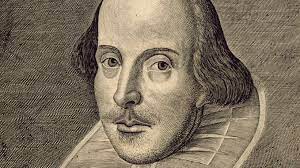
The Martin Droeshout Portrait of Shakespeare for the First Folio
Today is the 457th birthday of William Shakespeare, the Bard of Avon. In my lifetime so far, I have read all the plays attributed to Shakespeare and about half of the poems. Many of the plays I have read multiple times, the leader being Hamlet. Currently, I am re-reading The Winter’s Tale, and, in the months to come, I hope to revisit several other of my favorite comedies, such as Measure for Measure, All’s Well That Ends Well, The Tempest, and Twelfth Night.
I know it would be better to see the plays performed. But even if Covid-19 were still not on the rampage, it’s not easy to see the Bard in performance. So I must reconcile myself to reading the plays.
All in all, he wrote some forty plays, most alone, but some in partnership with other playwrights. No, I do not think that Francis Bacon wrote his plays, nor the Earl of Southampton, nor Wile E. Coyote. I suppose I could live my life in an alternate universe like Donald Trump’s supporters, but I much prefer the real world. Consequently, I am not interested in doubting his authorship. After all, we probably know more about the Bard than we know about any of his contemporaries.
If you like Shakespeare as much as I do, I have a film to recommend: Jacques Rivette’s Paris nous appartient (Paris Belongs to Us) is about a group of young Parisians putting on a performance of Pericles, Prince of Tyre—not one of Shakespeare’s best plays, and one most likely not 100% written by him, but definitely fun for all Bardaholics.
In Northern Chinese cities, such as Beijing, hutongs are usually narrow alleys formed by adjoining sineyuan, or traditional courtyard residences, squeezed together. Over the last few years, I have enjoyed reading contemporary Chinese literature, which gives me an altogether different view of the Chinese people than I get from contemplating the actions of the Xi Jinping government.
I thought I would list here a few of the best Chinese novels of the latter half of the 20th Century:
Geo Xingjian’s Soul Mountain, probably the best Chinese novel I have read, winner of the 2000 Nobel Prize
Mo Yan’s Shifu, You’ll Do Anything for a Laugh, a collection of novellas
Ma Jian’s Red Dust, a novel that is also a fascinating travel guide as the hero escapes Beijing to discover his country
Ge Fei’s The Invisibility Cloak, a delightful comic novella
Su Tong’s Rice, the most serious book of the bunch with its villainous main character
After reading these books, I have a strong feeling for the essential humanity of the Chinese people. I would have no trouble interacting with them—except for the simple matter of the language barrier.
What happens when one of your favorite authors forms a friendship with another of your favorite authors and then writes a book about that friendship? That’s the case when Paul Theroux came out in 1998 with Sir Vidia’s Shadow: A Friendship Across Five Continents. Both authors wrote not only novels but travel books. IMHO, Naipaul was the better novelist (by a long shot); but Paul Theroux’s travel books are far better—to the extent that they have played a major role in the way I lived my life over the last forty years.
Sir Vidiadhar Surajprasad Naipaul was born in Trinidad of a Hindu Indian family. He parlayed his colonial background into a brilliant series of novels which eventually gained for him a knighthood (in 1990) and the Nobel Prize in Literature (in 2001). He encountered Paul Theroux in Uganda, where both were living for a while. They became fast friends even before Theroux published his first novel.
That friendship became an instrumental part of Theroux’s life. Even when separated by thousands of miles, they wrote to each other frequently. He was even sexually attracted to Naipaul’s first wife, Patricia, who died in 1996.
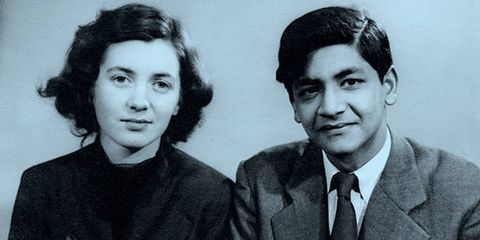
Patricia and Vidia Naipaul
Throughout the long friendship, Vidia Naipaul turned out to be a rather prickly individual. Some of it was due to his Brahmin fastidiousness:
“I can’t sleep in that bed,” he said. “It’s tainted. Why did he do it? The foolish, ignorant man!”
“What happened?” I asked.
“One of the workmen in Vidia’s bedroom was explaining something,” Pat began.
His face twisted in nausea, Vidia said, “And he sat on my bed…. He put his bottom on my bed.”
What would have bothered me more than it seemed to bother Theroux was that Naipaul was notorious about not picking up the check when they went out for dinner. And this was at a time when Paul was at the beginning of his career and constantly short of funds.
When Patricia died, the friendship suddenly came apart. Shortly after the funeral, Vidia married an Indian woman named Nadira, whom he had met previously in Africa. Quite suddenly, all of Paul’s attempts to contact Vidia were intercepted by Nadira, who was highly critical of the American writer.
The coffin nail was driven into the friendship when Paul and his son were taking a walk in London and suddenly encountered Vidia, who did not acknowledge him. When Paul addressed him, Vidia finally recognized him. When asked if he had received a recent fax from Paul, Naipaul was reluctant to discuss the matter further. When Paul asked what was to be done, Naipaul answered, “Take it on the chin and move on.”
Theroux was shocked:
He knew. It was over. It never occurred to me to chase him. There would be no more. And I understood the shock of something’s being over, like being slapped—hurt as the blood whipped through my body. “Like being hit by a two-by-four,” my friend had said when Vidia insulted her in Oregon.
This exchange takes place on the last page of the book. Theroux could have done a job of character assassination on his old friend, but he chose not to. After all those years, the friendship had meant a great deal to him, even if it ended badly.
I, too, have had prickly friends. Some I walked away from. Some I took up with again after a number of years had transpired. Would I have done differently than what I wound up doing in the end? Probably not.
In the end, I really liked Theroux’s book, which demonstrated that—for a time—his friendship with Vidia had great value in his life.
I dedicated last month to reading books only written by women. On March 5, I posted a TBR (To Be Read) list from which I would choose the titles I would undertake to read and review. As was typical, I wound up reading about half the books on the list, adding to them some last-minute choices. Here is the list of what I read:
Celeste Ng (United States), Little Fires Everywhere **** †
Joyce Carol Oates (United States), The Man Without a Shadow ****
Ludmilla Petrushevskaya (Russia), The Time: Night ****
Patricia Highsmith (United States), The Black House (Short Stories) *****
Silvia Moreno-Garcia (Mexico), Gods of Jade and Shadow ***** †
Colette (France), The Pure and the Impure ****
Eve Babitz (United States), L.A. Woman ****
Sofi Oksanen (Finland/Estonia), The Purge **** †
Rosario Santos—Editor (Bolivia), The Fat Man from La Paz (Short Stories) **** †
Clarice Lispector (Brazil), The Hour of the Star *****
There wasn’t a stinker in the bunch, and four of the choices were superb (Woolf, Moreno-Garcia, Highsmith, and Lispector). Five of the books marked with a dagger [†] were by authors I had never read before (Ng, Robinson, Moreno-Garcia, and Santos). On my original TBR list, I thought I had never read any Ludmilla Petrushevskaya before, but I was mistaken.
I will continue to read more books by women authors than I have in the past, though I may not repeat the intensity of March’s reading project. It was an interesting experiment, as all the choices were pretty high quality.
A Great Writer? The Jewish-Ukrainian-Brazilian Clarice Lispector (1920-1977)
As my month of reading only women authors comes to an end, I find I have made a number of discoveries, especially Clarice Lispector, who was born Chaya Pinkhasivna Lispector in Chechelnyk, Ukrainian SSR in 1920. As a child, she emigrated with her family to the Northeast of Brazil, moving eventually to Rio de Janeiro. I am currently reading her last work before she died of ovarian cancer at the age of 57, a novelette entitled The Hour of the Star, from which the following is taken:
That girl didn’t know she was what she was, just as a dog doesn’t know it’s a dog. So she didn’t feel unhappy. The only thing she wanted was to live. She didn’t know for what, she didn’t ask questions. Maybe she thought there was a little bitty glory in living. She thought people had to be happy. So she was. Before her birth was she an idea? Before her birth was she dead? And after her birth she would die? What a thin slice of watermelon.
Also:
She thought she’d incur serious punishment and even risk dying if she took too much pleasure in life. So she protected herself from death by living less, consuming so little of her life that she’d never run out. This savings gave her a little security since you can’t fall farther than the ground.
The portraits of Lispector haunt me, with her high cheekbones. And her writing haunts me. I can see myself reading everything I can find by her.
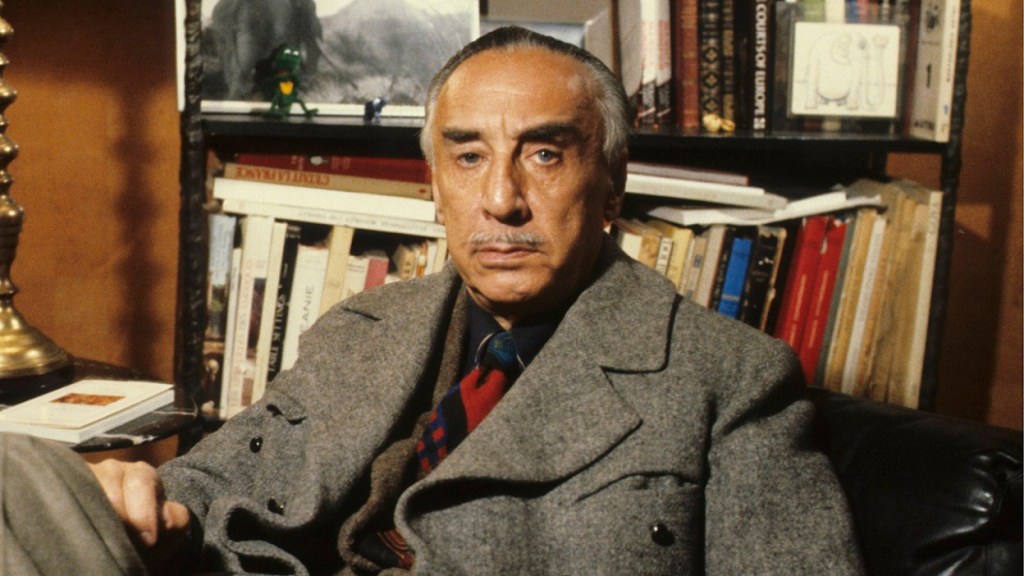
Romain Gary (1914-1980), French writer, at his place the day before his suicide. Paris, on December 1st, 1980.
There I was, reading the August 21, 2020 issue of the Times Literary Supplement in an article on the Franco-Lithuanian novelist Romain Gary, I suddenly came upon a new pantheon for our times:
Totoche, the god of stupidity
Merzavka, the god of absolute ideas
Filoche, the god of bigotry
The article goes into greater detail:
Totoche is a red-arsed monkey, adored by all who hurry humanity towards destruction: dim politicians who thump tubs, pure scientists who release genies from bottles, social psychologists who lead us up blind alleys, and demagogues who shout and bully. Merzavka is a cossack who stands gleefully, horsewhip in hand, on heaps of corpses industrially produced by concentration camps and torture chambers. Half of us lick his boots and the other half live or die by the religious, political and moral ideologies by which he rules and kills. Filoche is a concierge waiting to pounce on petty infringements of house rules, a hyena scavenging for scraps of racism, intolerance and orthodoxy with which to justify lynchings, holy wars and persecution.
The article, entitled “Brought to Book,” was written by David Coward.
In many ways, Gary’s invented deities were to perfectly describe the United States during the Trump Administration, even though Gary himself had long since (1980) passed on.
Some of the world’s most intrepid travelers were women. I am thinking particularly of Freya Stark, who tromped all through the Middle East and Afghanistan, in the processing writing a couple dozen excellent books, and died at the ripe age of 100. In her book Baghdad Sketches (1937), she wrote:
To awaken quite alone in a strange town is one of the pleasantest sensations in the world. You are surrounded by adventure. You have no idea of what is in store for you, but you will, if you are wise and know the art of travel, let yourself go on the stream of the unknown and accept whatever comes in the spirit in which the gods may offer it. For this reason your customary thoughts, all except the rarest of your friends, even most of your luggage – everything, in fact, which belongs to your everyday life, is merely a hindrance. The tourist travels in his own atmosphere like a snail in his shell and stands, as it were, on his own perambulating doorstep to look at the continents of the world. But if you discard all this, and sally forth with a leisurely and blank mind, there is no knowing what may not happen to you.
In her book Valleys of the Assassins (1934), she added:
To awaken quite alone in a strange town is one of the pleasantest sensations in the world. You are surrounded by adventure. You have no idea of what is in store for you, but you will, if you are wise and know the art of travel, let yourself go on the stream of the unknown and accept whatever comes in the spirit in which the gods may offer it. For this reason your customary thoughts, all except the rarest of your friends, even most of your luggage – everything, in fact, which belongs to your everyday life, is merely a hindrance. The tourist travels in his own atmosphere like a snail in his shell and stands, as it were, on his own perambulating doorstep to look at the continents of the world. But if you discard all this, and sally forth with a leisurely and blank mind, there is no knowing what may not happen to you.
This woman makes Ernest Hemingway look like a wussy boy in short pants.
And Freya Stark is not the only woman traveler who dared to go solo into the uncharted areas of the earth. There was also Isabella L. Bird (1831-1904), who traveled extensively in Asia, and Mary Kingsley (1862-1900), whose destination was West Africa. In fact, Wikipedia compiled a list of female explorers which sets one to thinking. You can find it here.
I have just read a library book in which the entire text was edited for political correctness by some ignorant vandal. The book was Rosario Santos’s The Fat Man from La Paz: Contemporary Fiction from Bolivia. If you’ve read yesterday’s post, you know that I am interested in visiting Bolivia, which is one of two Andean countries I have not seen (the other is Colombia).
The copy I checked out from L.A.’s Central Library is full of ballpoint editings enforcing a rigid code of PC relating to feminism, religion, sexual preference, and aboriginal peoples. The stories ranged from interesting to outstanding, but I was constantly being outraged by the marginal comments.
Below is a table showing some typical examples:
Page
Original Text
PC Corrections and [Notes]
68
a prayer of health to the Virgin
a prayer of health to Mary
104
Since Rosemary had her baby
[Birth Control!]
134
saints with expressions of satisfaction
“saints” with expressions of satisfaction
141
they went around poisoning the lives of others
[Sexist]
143
why her grandmother hated men
why her grandmother hated marriage
235
a mestizo born of an Indian woman
a mestizo born of a native woman
236
the spire of the Mother Church
[Patriarchal]
239
the Indians shifted restlessly
the people shifted restlessly
246
his worn out little love of his dreams
his worn out love of his dreams
250
making holes for their women to toss in seeds
making holes for the women to toss in seeds
254
the Indians maintained their balance
the workers maintained their balance
I have decided that the only punishment worthy of this vandalism is to locate the individual responsible, strip him or her naked, and tattoo them all around their body with the most politically incorrect terminology possible. Anyone want to join me?
This Month I Am Reading Only Books Written by Women, Such as Virginia Woolf
I read a lot of books, but I feel I have not given women authors their due. So far, I have read Celeste Ng’s Little Fires Everywhere and am within a few pages of finishing Joyce Carol Oates’s The Man Without a Shadow. Ng is new to me, but I have always loved Oates, though I haven’t nearly enough of her prolific works.
Among the books I will be selecting from for the rest of March (in no particular order):
Something by Svetlana Alexievich, most likely Secondhand Time [Russia]
Rosario Santos’s The Fat Man from La Paz: Contemporary Fiction from Bolivia*
Ludmilla Petrushevskaya’s The Time: Night* [Russia]
Marilynne Robinson’s Gilead* [USA]
Simone de Beauvoir’s The Ethics of Ambiguity [France]
Patricia Highsmith’s The Black House [USA]
Dorothy B. Hughes’s In a Lonely Place [USA]
Selma Lagerlof’s The Saga of Gosta Berling* [Norway]
Virginia Woolf’s To the Lighthouse [England]
Clarice Lispector’s Hour of the Star [Brazil]
Silvia Moreno-Garcia’s Gods of Jade and Shadow* [Mexico/Canada]
Marie NDiaye’s Three Strong Women [France]
Dawn Powell’s The Locusts Have No King* [USA]
Valeria Luiselli’s Lost Children Archive* [Mexico/USA]
Invariably, I will not read some of the above and likely add some other writers, such as Charlotte Brontë, Willa Cather, Madeleine Albright, or Helen Hunt Jackson. It all depends on how I like the books I have selected.
Books marked with an asterisk [*] are by authors I have not yet read.
A Scene from the Merchant Ivory Production of A Room with a View (1986)
I have never ceased to marvel how some homosexual authors as Marcel Proust were so brilliant at translating their knowledge of relationships into a more “acceptable” heterosexual context. This is also true of E. M. Forster, whose A Room with a View I have recently read. The following is taken from Chapter Seventeen of that novel:
It did not do to think, nor, for the matter of that, to feel. She gave up trying to understand herself, and joined the vast armies of the benighted, who follow neither the heart nor the brain, and march to their destiny by catch-words. The armies are full of pleasant and pious folk. But they have yielded to the only enemy that matters—the enemy within. They have sinned against passion and truth, and vain will be their strife after virtue. As the years pass, they are censured. Their pleasantry and their piety show cracks, their wit becomes cynicism, their unselfishness hypocrisy; they feel and produce discomfort wherever they go. They have sinned against Eros and against Pallas Athene, and not by any heavenly intervention, but by the ordinary course of nature, those allied deities will be avenged.









 Tarnmoor
You must be logged in to post a comment.