Notorious

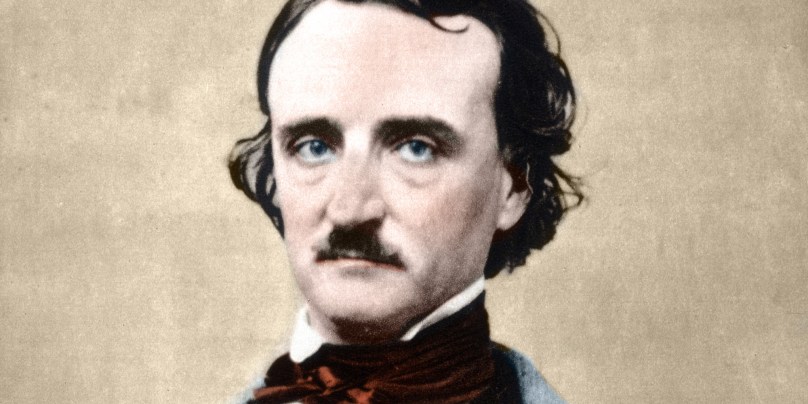
Edgar Allan Poe (1809-1849)

As part of my Halloween reading, I am reading Penguin Books’ The Portable Edgar Allan Poe. After having read numerous popular editions of Poe, I decided to concentrate on an edition that took him seriously as one of the greatest literary figures of the young Republic.

There is little doubt in my mind that Poe is a genius. At the same time, there is little doubt in my mind that Poe was anything but warm and fuzzy as a person. He admitted as much in his story “MS. Found in a Bottle” (1832): “Of my country and of my family I have little to say. Ill usage and length of years have driven me from the one, and estranged me from the other.”

Later in the same paragraph:

I have often been reproached with the aridity of my genius; a deficiency of imagination has been imputed to me as a crime; and the Pyrrhonism of my opinions has at all times rendered me notorious.

Looking back at Poe’s life, one can see him constantly produce brilliant stories and poems, yet struggle to earn a living or find happiness in marriage or family. He was orphaned at the age of two and had a tempestuous relationship with his stepfather John Allan, whose last name he adopted as his middle name.

Over and over again, we find that the characters in life died young of consumption. Poe did not react well: He took to the bottle. In fact, he died of alcohol poisoning at the age of forty, though the newspapers of the time blamed “congestion of the brain” or “cerebral inflammation.”

It requires some extra discipline for me to forget Poe’s unhappy life and concentrate on his works. Let’s face it: some very unhappy people have created works of such vivid imagination that made him ever so much more than the lunatic that critic Rufus Wilmot Griswold described as walking “the streets, in madness or melancholy, with lips moving in indistinct curses, or with eyes upturned in passionate prayers, (never for himself, for he felt, or professed to feel, that he was already damned).”

Poe’s life is a closed book, but his works will live on forever.

Preparing for Halloween

British Gothic Novelist Ann Radcliffe (1764-1823)

Usually, I spend much of the month of October each year reading gothic or horror fiction. I have already started reading Ann Radcliffe’s The Italian, or the Confessional of the Black Penitents (1797), after which she quietly stopped writing and spent the last twenty-six years of her life as a private person. I have fond memories of reading her novels The Romance of the Forest (1791) and The Mysteries of Udolpho (1794).

Also, I will inevitably read one of Joyce Carol Oates’s underrated gothic novels or collections of short fiction. Other possibles are Thomas Ligotti and Robert Aickman. And I will certainly re-read some of Edgar Allan Poe’s stories.

In November, I will write a post detailing with gothic/supernatural/horror titles I have read.

Arkady and Boris Strugatsky

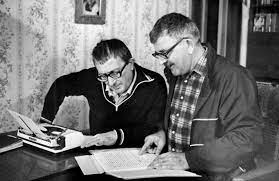
Soviet Writers Arkady (1925-1991) and Boris (1933-2012) Strugatsky

They were by far the greatest science fiction authors who ever lived. The two brothers produced a string of masterpieces (the greatest being Roadside Picnic, or Пикник на обочине) that are unlikely to be surpassed, ever!

I am currently reading two of their novels whose chapters are artfully interleaved. They wrote Ugly Swans (Гадкие лебеди) in 1972; in 1986, they wrote Lame Fate (Хромая судьба) and shuffled the chapters together. Reading it is an amazing experience. I’ve finished about 40% of the nested novels at this point. I haven’t even encountered the science fiction yet, though I feel it is lurking and waiting to pounce.

Among the brothers’ works I have read are:

  • Space Apprentice (1962)
  • Far Rainbow (1963)
  • Hard to Be a God (1964)
  • The Final Circle of Paradise (1965)
  • The Second Invasion from Mars (1967)
  • Prisoners of Power (1969)
  • The Dead Mountaineers’ Hotel (1970)
  • Roadside Picnic (1972)
  • Definitely Maybe (1977)
  • Beetle in the Anthill (1980)
  • The Time Wanderers (1986)

Many of the Strugatskys’ titles have never been translated into English. I think that, ultimately, they will all be. I can think of few Soviet writers working in any genre that have such a large and consistently excellent body of work.

There are only a handful of science fiction writers I admire. After the Strugatsky brothers, there are Stanislaw Lem from Poland and, in the United States, Philip K. Dick and Clifford D. Simak.

The Oldest Book in My Collection

It was September 1962. I was 13½ years old, and newly enrolled as a freshman at Chanel High School in Bedford, Ohio. The school was a Catholic school and taught by the Marist Fathers, who lived in a community on the top floor of the high school building.

Probably the strangest (to me) course in my first year was Latin 1, in which we studied Julius Caesar’s The Gallic Wars in the original Latin.

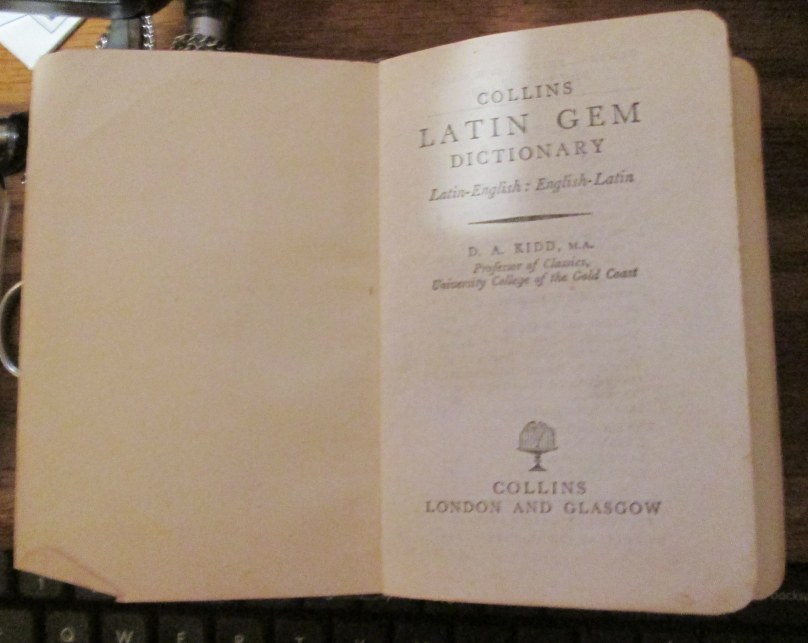
Most of the kids from wealthier families picked up a copy of Cassell’s Latin-English dictionary, but I chose instead to get the Collins Latin Gem Dictionary, which could fit in my shirt pocket. (Eventually, I also got the White’s Latin Dictionary, which looked to have been originally published in the 1800s.)

My Collins Latin Gem Dictionary is still in good condition and still eminently usable. The nice thing about Latin is that books in and about the Latin language never go out of date.

Omnia Gallia in tres partes divisa est.

The Most Influential Books in My Life

I Read All These Books Multiple Times, Starting at Least Thirty Years Ago

The following is a re-post from ten years ago. I still feel the same way about all these titles.

These are not necessarily the greatest books I have ever read. They are, however, the ones that have most influenced me. Each of them, I have read multiple times, and I first read them all before 1985. I have presented them here in alphabetical order by author:

  1. Anonymous. Njals Saga. Why haven’t more Americans read this book? It tells of a time when Iceland was governed by clans, and justice was crude but effective. It’s one of two Icelandic sagas that have a museum dedicated to them. The Njals Saga museum is in Hvöllsvollur, and I have visited it twice. The other honors Egils Saga and is located in Borgarnes.
  2. Balzac, Honoré de. Old Goriot. How does a young man make his way through life? Balzac’s hero, Eugène de Rastignac, is one of the great heroes in fiction.
  3. Borges, Jorge Luis. Labyrinths. Borges has been one of my teachers, having turned me on to so many of the books, people, and places that have mattered in my life. I am re-reading it now for the fifth time.
  4. Chatwin, Bruce. In Patagonia. Maybe not every word that Chatwin writes is true, but even his fictions have lured me to the southern tip of Argentina twice, and soon, for the third time.
  5. Chesterton, G. K. The Man Who Was Thursday. Learn with Gabriel Syme how to see the lamppost from the light of the tree instead of vice versa. Here we are in the world of paradox.
  6. García Marquez, Gabriel. One Hundred Years of Solitude. This is a book I bought at a souvenir stand at the ruins of Chichén Itzá in Yucatán. It showed me that life was magical.
  7. Highet, Gilbert. The Art of Teaching. Originally, I wanted to become a college professor. I never quite made it, but Highet made me wish I had. I first read this book while I was in high school.
  8. Orwell, George. Keep the Aspidistra Flying. Another high school read: How does one tread the fine line between genteel poverty and selling out?
  9. Proust, Marcel. In Search of Lost Time. I am reading this now for the third time. I hope to live to read it several times more. Generally, it takes me a decade to re-read all seven novels in the series. When reading it, I am totally absorbed in the world of Marcel.
  10. Strunk, William and White, E. B. The Elements of Style. Strunk & White showed me that good writing is essentially simple and direct. Another classic from my teen years.

I could easily add more titles, but these titles keep swirling around in my head and influencing me.

A Writer Like No Other

Uruguayan Writer Felisberto Hernández (1902-1964)

I have just begun reading Piano Stories by the late Uruguayan writer Felisberto Hernández. It is very clearly unlike anything else I have ever read. He was an author admired by Italo Calvino, Julio Cortázar, and Francine Prose. According to Italo Calvino:

Hernández’s most typical stories are those that are centered on a rather complicated mise-en-scène, a spectacular ritual that unfolds within the depths of an elegant house: a flooded patio in which lighted candles float; a little theatre of dolls large as real women striking enigmatic poses; a dark gallery in which one is supposed to recognize by touch objects that elicit associations of images and thoughts.

His translator, Luis Harss, provides some rather odd biographical details:

He married four times; was a great eater and raconteur at literary soirees; had a passion for fat women; loved to improvise on the piano in the styles of various classical composers; once toured Argentina with his own trio, other times with a flamboyantly bearded impresario called Venus González. He preferred to write in shuttered rooms or basements; suffered a life-long emotional dependence on his mother; was haunted by morbid vanity and a sense of failure; became ill-humored and reactionary in middle age; and died of leukemia, his body so bloated it had to be removed through the window of the funeral home in a box as large as a piano.

Pain(e)sville

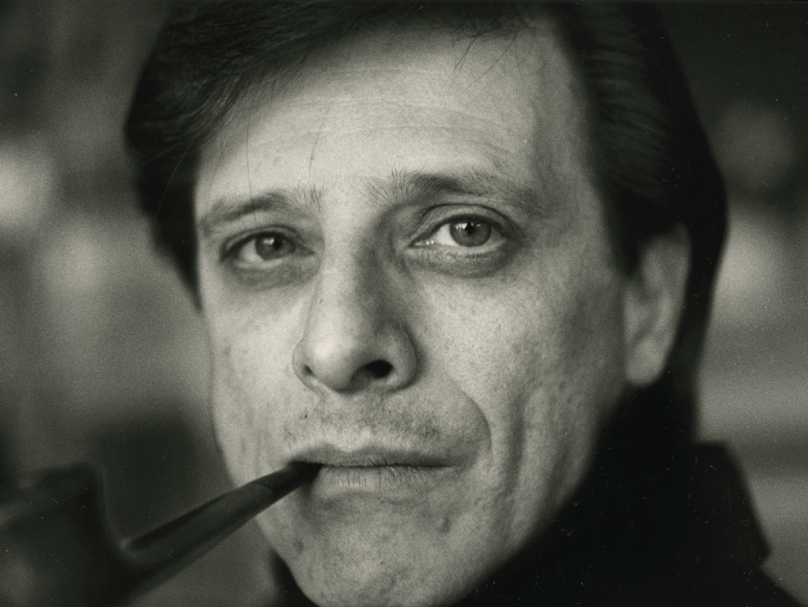
Writer Harlan Ellison (1934-2018)

He’s from the same part of the world from which I hail. Painesville, the county seat of Lake County, is some 30 miles northeast of Cleveland. He has been called a science fiction writer, a designation which he (rightfully) hates. It’s more speculative fiction, with an emphasis on the short story form.

The man from Painesville was known for being something of a pain. His obituary in the Los Angeles Times remarks:

Over the years, Ellison has been described as fiercely independent, vengeful, sardonic, opinionated, confrontational, foul-mouthed, petulant, infuriating, defiant and a general all-around nuisance—as well as engaging, gregarious, funny, fastidiously organized and generous to his friends.

By his own measure, he was “a hard pill to swallow.”

He is gone, with all his objectionable behavior, but his stories remain. And they are well worth reading. I suggest you try one of the following collections:

  • I have No Mouth and I Must Scream (1967)
  • The Beast That Shouted Love at the Heart of the World (1969)
  • Approaching Oblivion (1974)
  • Deathbird Stories (1975)
  • Shatterday (1980)

You might also want to try reading the sci-fi story collection he edited in 1967 entitled Dangerous Visions.

Although he will be remembered as much for being a prickly character as a brilliant writer, I think that over time the latter will replace the former in the estimation of readers.

Agenbite of Bookwit

I find myself rereading books more often, sometimes by design, but more often by accident. For instance, I am reading the L.A. Central Library’s copy of Lawrence Ferlinghetti’s Writing Across the Landscape: Travel Journals 1960-2010. As I started reading it yesterday, I noticed the same light pencil marks I used to mark passages. “A kindred spirit,” was the first thought that crossed my mind. Then, when I loaded Goodreads.Com, I noticed that I wrote a review of the book in 2023. The stray marks were, in fact, mine. A kindred spirit, indeed!

Here are the books that I have reread so far this year, with the ones I have accidentally reread marked with an asterisk:

  • Lawrence Durrell: Balthazar, Mountolive, and Clea (the last three volumes of The Alexandria Quartet)
  • Lope de Vega: Fuente Ovejuna
  • Tom Bissell: Chasing the Sea: Lost Among the Ghosts of Empire in Central Asia *
  • Joseph Wood Krutch: The Desert Year *
  • César Aira: The Famous Magician *
  • Clifford D Simak: A Choice of Gods *
  • Georges Simenon: Maigret and the Good People of Montparnasse
  • Carlos Castaneda: Tales of Power

The funny thing is that I have enjoyed the rereads as much as the first-time reads, even when they were accidental.

I keep a log of 99+% of the books I have read since 1972. When I choose a book to read, I don’t always check the three data files—one a PDF and the other two Excel spreadsheets—which log all several thousand books I have read in the interval. Sometimes, I notice when rereading a book that I have somehow changed in some small or large particular.

For instance, I used to be a big fan of Jules Verne, even some of his lesser-known works. But when I reread From Earth to the Moon and Round the Moon a few years ago, I was disappointed. Perhaps I’ll reread 20,000 Leagues Under the Sea—my favorite among his works—to see how it plays now.

WEC: SB on Bateson

A Very Influential Book Back Then

On June 15, I posted about the effect that the Whole Earth Catalog (WEC) series by Stewart Brand has had on me. And I promised that I would present a series of some of editor Brand’s more interesting comments. This is his take on Gregory Bateson’s Steps to an Ecology of Mind, which was first published in 1972. I had never read the book, but found it was influencing a number of my friends who were film historians and film critics. Now, I think I will find the book and read it.

Here is what SB (Stewart Brand) wrote about it:

Bateson has informed everything I’ve attempted since I read Steps in 1972. Through him I became convinced that much more of whole systems could be understood than I thought—that mysticism, mood, ignorance, and paradox could be rigorous, for instance, and that the most potent tool for grasping these essences—these influence nets—is cybernetics.

Bateson is responsible for a number of formal discoveries, most notably the “Double Bind” theory of schizophrenia. As an anthropologist he did pioneer work in New Guinea and (with Margaret Mead) in Bali. He participated in the Macy Foundation meetings that that founded the science of cybernetics but kept a healthy distance from computers. He has wandered thornily in and out of various disciplines—biology, ethnology,, linguistics, epistemology, psychotherapy—and left each of them altered with his passage.

The book chronicles the journey. It is a collection of his major papers, 1935-1971. In recommending the book I’ve learned to suggest that it be read backwards. Read the recent broad analyses of mind and ecology at the end of the book and then work back to see where the premises come from.

In my view Bateson’s special contribution to cybernetics is in exploring its second, more difficult realm (where the first is feedback, a process influencing itself, what Bateson calls “circuit,” and the second is the meta-realm of hierarchic levels, the domain of context, of paradox and abundant pathology, and of learning).

Strong medicine.

The Book

NASA Image of the Earth from Space

For over twenty years, I considered Stewart Brand’s Whole Earth Catalog as one of the major influences of my life. This evening, I unearthed the most recent edition I had, entitled The Next Whole Earth Catalog and published in October 1981.

In the original issue dated 1969, the following appeared on the opening page:

Function

The WHOLE EARTH CATALOG functions as an evaluation and access device. With it, the user should know better what is worth getting and where and how to do the getting.

An item is listed in the CATALOG if it is deemed:

  1. Useful as a tool,
  2. Relevant to independent education,
  3. High quality or low cost,
  4. Not already common knowledge,
  5. Easily available by mail.

CATALOG listings are continually revised according to the experience and suggestions of CATALOG users and staff.Purpose

We are as gods and might as well get good at it. So far, remotely done power and glory—as via government, big business, formal education, church—has succeeded to the point where gross defects obscure actual gains. In response to this dilemma and to these gains a realm of intimate, personal power is developing—power of the individual to conduct his own education, find his own inspiration, shape his own environment, and share his adventure with whoever is interested. Tools that aid this process are sought and promoted by the WHOLE EARTH CATALOG.

The items in the original catalog are grouped under seven main sections:

  • Understanding Whole Systems
  • Shelter and Land Use
  • Industry and Craft
  • Communications
  • Community
  • Nomadics
  • Learning

It would seem that I’m not really that self-sufficient, not even like my brother Dan, who builds homes of logs (and other materials). I am by nature a bookworm, but I would have to admit that the WEC has contributed hugely to my well being.

For years I used to order my loose tea from Murchie’s in Vancouver, British Columbia. That’s how I discovered the Darjeeling, Ceylon, and Assam teas with which I start just about every day. (Since then, I have discovered Ahmad of London teas, which are readily available at local Middle Eastern and Indian food stores.)

The WEC also pointed the way to that encyclopedic American cookbook, The Joy of Cooking by Irma S. Rombauer and Marion Rombauer Becker. I still use my 1980s edition.

The Nomadics section is largely responsible for the travel bug that has infected me since my first trip abroad in 1975. Much of my information came from Carl Franz’s The People’s Guide to Mexico. As WEC says, “Reading the book is almost like being there and going through the problems and frustrations, pleasures and wonders of dealing with a new environment, new people and new ways of doing things.”

I was not yet ready for South and Central America, but the WEC Nomadics advice influenced me. Two decades before I flew to Argentina, I religiously read editions of The South American Handbook published in America by RandMcNally.

In the coming weeks, I hope to share some of the nuggets from WEC that have influenced me.

Stewart Brand is still around, but perhaps the Internet has probably replaced WEC. The problem with the Internet, however, is that you will find great advice and terrible advice in the same session. And how are we Americans at making good decisions? Pretty crappy, I think.