The Book Collector

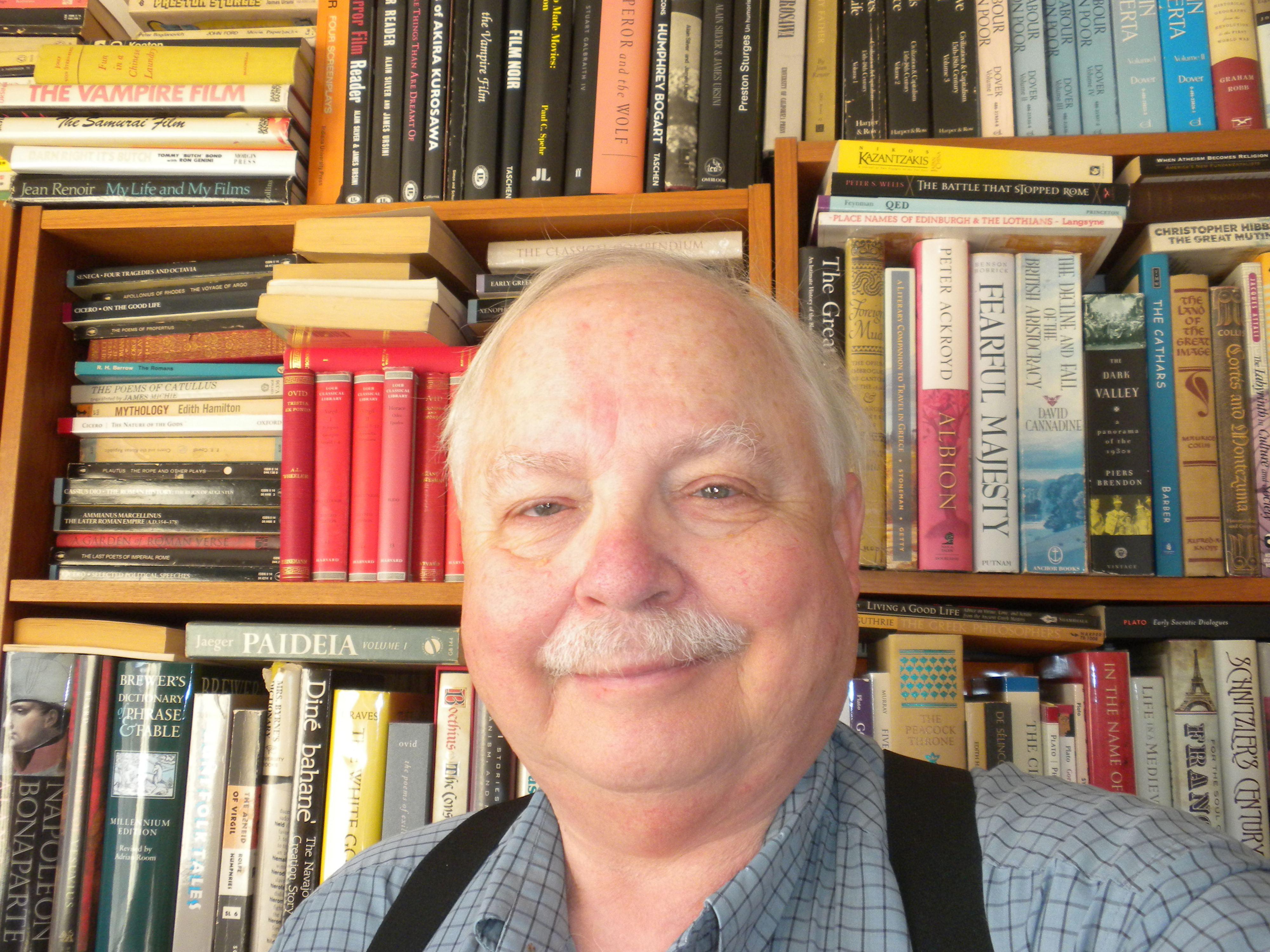
Me in My Library in Palmier Times

Ever since I was very young, I wanted to live surrounded by books. And I did, spending hundreds of dollars a month on books—hardbounds, paperbacks, even e-books. There is a tendency for accumulations to get out of hand. I have known collectors who lived in fear of being crushed under their film collections, movie poster collections, book collections. Collections can grow so out of bounds that they become a kind of illness, related to hoarding. When Martine and I moved from room to room, we had to take prescribed paths, because the floor was piled high with books. It was frequently a bone of contention between us.

Beginning late last year, I started donating books to the Mar Vista Branch of the Los Angeles Public Library. In a twelve-month period, I have given well over a thousand books to the library. Some will be sold by the library at one of their bimonthly sales, some will be sold for a dollar a book at the branch, some (the cheaper ones) will just be given away. Who knows? Perhaps some of them might even be incorporated into he library’s own collection. A lot of them are great titles in prime condition.

If you look at the books behind me in this picture, I would have to say that about 30-40% are no longer in my possession. Twice a week, a put together a box of books for donation, with Martine’s eager cooperation.

Now that I am living on a fixed income, I buy relatively few books, and then only if I intend to read them in the near future. Today, for example, I purchased a nice harbound copy of Paul Theroux’s Sir Vidia’s Shadow, about the author’s decades-long friendship with V. S. Naipaul.

Do I read as much as ever? Of course I do—perhaps even more so. It’s just that I no longer feel I have to own all the books I love. I just have to read them.


Traveling with Mister Thorax

Paul Theroux in 2015

The photograph shows the office of the ultimate travel writer. His first book was The Great Railway Bazaar in 1975. Not coincidentally, that was the first year when the travel bug got me. Its bite was long lasting: I am still suffering from the effects of it. His next travel book was The Old Patagonian Express: By Train Through the Americas (1979). This was the book that set me to thinking about South America, though it was to be almost a quarter century later that I felt I was able to follow in his footsteps.

It was in his 1992 The Happy Isles of Oceania that he was mistakenly called Mr. Thorax by a hotel employee in Australia or New Zealand. I rather like the name.

Below are some of his observations on travel taken from a 2015 Wall Street Journal interview. (Much better, if you can get a copy, is his 2011 book The Tao of Travel.) My own comments on travel are appended in indented text..

I never splurge on: comfort or luxury when I’m traveling alone. I eat in simple restaurants, wandering like a dog rather than taking taxis. Traveling through the Deep South I often stayed at inexpensive chain motels, the ones that serve a free breakfast of weak coffee, Kool Aid and Froot Loops in a Styrofoam bowl.

I’m with Paul—except you won’t find me sharing his breakfast of weak coffee, Kool Aid and Froot Loops.

The difference between travel and tourism: is the difference between walking in the hot sun to meet an angry person who is going to insult me and then tell me his amazing story, and lying in the sun sipping a cool drink and reading, say, “Death in Venice.” The first is more profitable; the second more pleasant. Both are enlightening.

My idea of travel is a combination of the two. During the day, I will be out in the hot sun, ready for anything. At night, I usually read. A lot. Mostly from my Amazon Kindle.

The greatest advantage to being an older traveler: is being invisible, unregarded, ignored. This allows one to eavesdrop and to see much more of a place or a people. There is a detachment, too, in being older: You’re not looking for a new life, not easily tempted. So you see a place clearly. Perfect for writing.

There’s a lot of truth to this. To be in your seventies is to be quite invisible. I would prefer to be totally invisible when confronted by chatty American tourists. (I have been known to answer their questions in Hungarian.)

I am a nightmare to travel with: when I am reporting a book, which is why I always take such trips alone. I seldom think, “Where am I going to eat?” or “Where am I going to sleep?” The true traveler has very little idea of what is coming next.

Here’s where I differ from Paul. Some of the best trips I have taken have been with Martine (Britain, France, Belgium, the Netherlands, Argentina) and my brother Dan (Mexico and Ecuador). I would prefer to travel with someone who is compatible, and I am willing to compromise on destinations providing that I am not absolutely opposed to visiting them.

I never take photographs because: people who take pictures lose their capacity for close observation. Without a camera, you study a thing more carefully and remember it better. Taking a picture is a way of forgetting.

Unlike Paul, I take a lot of pictures, though no selfies and damn few posed pictures in front of famous tourist destinations. I prefer to use my own pictures of the places I visit, though I am not averse to hijacking some off the Internet if I don’t have what I want for my blog postings.


“The Land of Counterpane”

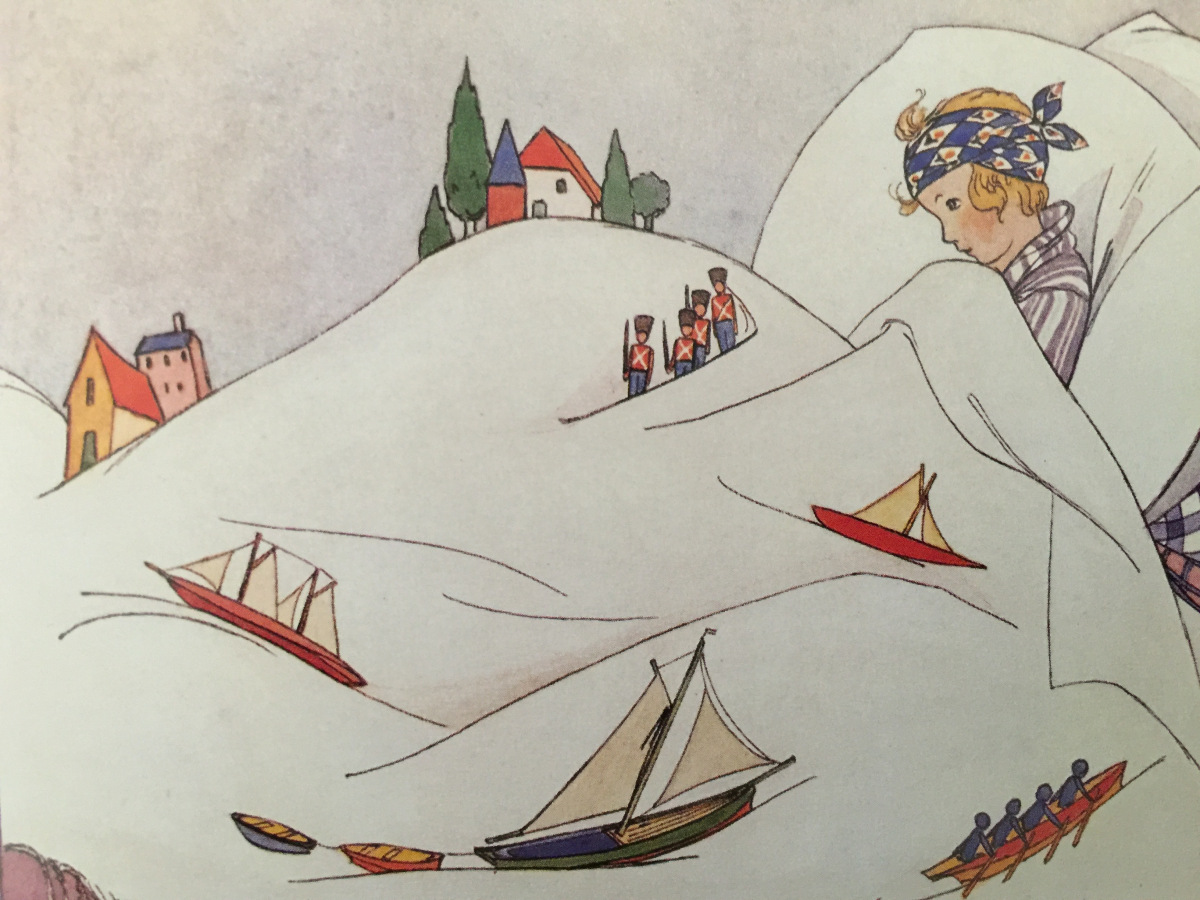
I Remember This Illustration from My Childhood

The first poem I remember was “The Land of Counterpane” from Robert Louis Stevenson’ A Child’s Garden of Verses. I was in grade school and sick with some childhood disease. While Mom and Dad were off at work, and I was being cared for by my great-grandmother Lidia Toth, I was allowed to lie in their bed. Mom had gotten be a library book with this poem in it—and with the above illustration. I don’t know which impressed me more, the words of the poem or the illustration. In any case, the memory has stuck with me through the years. Here’s the words of the poem:

When I was sick and lay a-bed,
I had two pillows at my head,
And all my toys beside me lay,
To keep me happy all the day.

And sometimes for an hour or so
I watched my leaden soldiers go,
With different uniforms and drills,
Among the bed-clothes, through the hills;

And sometimes sent my ships in fleets
All up and down among the sheets;
Or brought my trees and houses out,
And planted cities all about.

I was the giant great and still
That sits upon the pillow-hill,
And sees before him, dale and plain,
The pleasant land of counterpane.

Now, many years later, I am rediscovering RLS, especially his last years in the South Pacific. I wonder if, somehow, my memory over the great gulf of years, has anything to do with my wanting to go back to Stevenson and reacquaint myself with his work. In any case, that’s what I’m doing … and I am enjoying every moment of it.


The Revenger’s Tragedy

Illustration from Thomas Kyd’s Play The Spanish Tragedy (1587)

I have just re-read William Shakespeare’s Hamlet in honor of the Bard’s 455th birthday. Although it has been several decades since my last approach to the play, I was surprised how familiar the language was. Apparently, over the years such expressions as “the dead vast and middle of the night” and “I am but mad north-north-west—when the wind is southerly I know a hawk from a handsaw” have become part of my speech and writing.

This time, however, a new thought struck: The play is not just about Hamlet’s dilatoriness in revenging the death of his father by his uncle (who thereupon married his mother, the queen). It is also about the difficulty of straightforward revenge. And that despite the fact that revenge plays were a popular genre. Even Shakespeare, early in his career, came out with Titus Andronicus (ca 1590), in which there is rape, murder, cannibalism, and oodles of blood. Then, in 1606 came Thomas Middleton’s The Revenger’s Tragedy.

In Hamlet, however, Shakespeare shows that the road to revenge can be rocky. The last scene in Act V begins with the Prince telling his friend Horatio:

Sir, in my heart there was a kind of fighting
That would not let me sleep. Methought I lay
Worse than the mutinies in the bilboes. Rashly,
And prais’d be rashness for it,—let us know,
Our indiscretion sometime serves us well,
When our deep plots do pall; and that should teach us
There’s a divinity that shapes our ends,
Rough-hew them how we will.

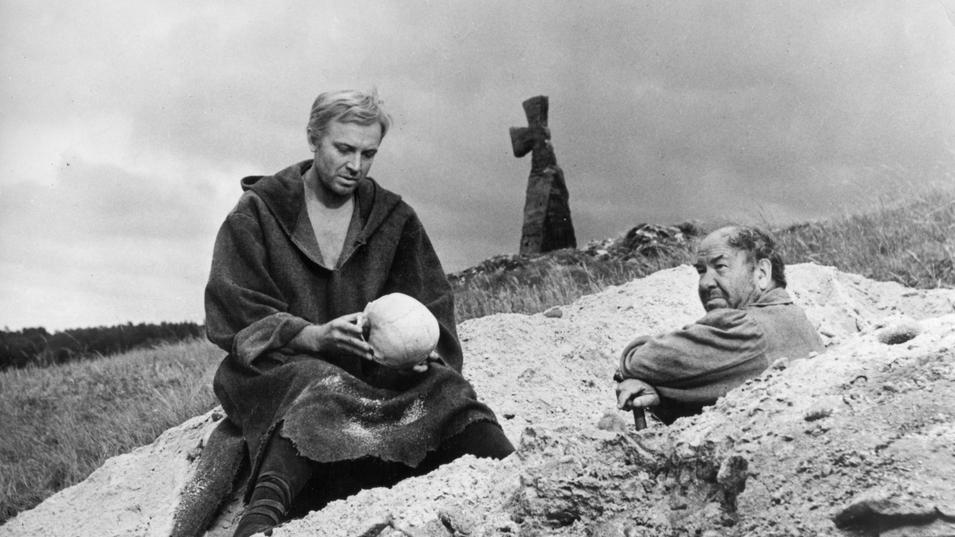
The Graveyard Scene from Grigory Kozintsev’s Russian Film of Hamlet (1964)

This realization on Hamlet’s part after his many hesitations earlier on shows that he has learned a lesson from all his agonizing:

HORATIO.
If your mind dislike anything, obey it. I will forestall their repair hither, and say you are not fit.

HAMLET.
Not a whit, we defy augury. There’s a special providence in the fall of a sparrow. If it be now, ’tis not to come; if it be not to come, it will be now; if it be not now, yet it will come. The readiness is all. Since no man has aught of what he leaves, what is’t to leave betimes?

I wonder how many discoveries await me on re-reading Shakespeare’s plays. I think perhaps it’s worth the effort to make the effort.


Did Balzac Ever Go to Java?

Cover of a French Edition of the Voyage

Well, not exactly. But he is known to have drunk approximately fifty cups of Java each day. No doubt that helped inspire him to write this hilarious spoof of voyages to exotic locales. It is not until the last couple of pages that Honoré de Balzac writes:

In truth, soon I will be losing no time in taking the stagecoach once again, travelling back to Paris across the fields of Touraine and Poitou that I thought I should never see again. During my first days back in Paris I had a lot of trouble persuading myself that I had not indeed been to Java, so much had that traveller [M. Grand-Besançon] struck my imagination with his tales.

So in the end it is a delightful hoax. Balzac tells a series of tall tales redolent of earlier (unsubstantiatable) journeys full of tall tales about the flora, fauna, and women of the Far East. Not all of it consists of tall tales, such as this realistic warning to travelers to be alert at all times:

Go inside a shop selling precious cloths; bargain, buy some cashmere or a length of tamava … if you turn your back for a moment while the merchant is rolling up your purchase on the counter, wrapping it and tying it with string, the package flies to the back of the shop and is replaced by another containing inferior goods, that an apprentice has been preparing in the corner of the shop to look exactly like the one you were buying. With no explanation for this miraculous metamorphosis, you return to the shop furious at having been duped by the Chinese everybody had warned you about; but his only response is to laugh at you.

I have read virtually all of Balzac as translated into English, but this is by far the funniest of his works. An English edition entitled My Journey from Paris to Java (Singapore: Editions Didier Millet, 2010) is available.


The End of Tusitala

RLS (Seated Center, Rear) and His Household in Samoa

His nickname in Samoa was Tusitala, “The Teller of Tales.” He had gone to Oceania for his health. It is not known what the exact nature of his illness was, but it seemed to be hereditary. His mother died of an apparent stroke at the age of 38. When he died on on December 3, 1894, Robert Louis Stevenson was only 44.

I have just finished reading the letters that RLS wrote to his friend and sometime editor Sidney Colvin between November 1890 and October 1894. They have been published as The Vailima Letters, named after the author’s estate in Samoa. In them, he writes about his frequent illnesses, his involvement in island politics, and his intense efforts to make money by writing novels and stories. In those last four years, he wrote:

  • Catriona (1893), aka David Balfour, a sequel to Kidnapped
  • Island Night’s Entertainments (1893), aka South Sea Tales
  • The Ebb-Tide (1894), co-author Lloyd Osbourne
  • Weir of Hermiston (1896), left unfinished at the author’s death
  • St. Ives: Being the Adventures of a French Prisoner in England (1897)

At times, Stevenson’s letters rise to the level of poetry. In March 1891, he writes:

I said I was tired; it is a mild phrase; my back aches like toothache; when I shut my eyes to sleep, I know I shall see before them—a phenomenon to which both Fanny and I are quite accustomed—endless vivid deeps of grass and weed, each plant particular and distinct, so that I shall lie inert in body, and transact for hours the mental part of my day business, choosing the noxious from the useful. And in my dreams I shall be hauling on recalcitrants, and suffering stings from nettles, stabs from citron thorns, fiery bites from ants, sickening resistances of mud and slime, evasions of slimy roots, dead weight of heat, sudden puffs of air, sudden starts from bird-calls in the contiguous forest—some mimicking my name, some laughter, some the signal of a whistle, and living over again at large the business of my day.

In May1892, this description of clouds appears in the letters:

As I rode down last night about six, I saw a sight I must try to tell you of.  In front of me, right over the top of the forest into which I was descending was a vast cloud.  The front of it accurately represented the somewhat rugged, long-nosed, and beetle-browed profile of a man, crowned by a huge Kalmuck cap; the flesh part was of a heavenly pink, the cap, the moustache, the eyebrows were of a bluish gray; to see this with its childish exactitude of design and colour, and hugeness of scale—it covered at least 25°—held me spellbound.  As I continued to gaze, the expression began to change; he had the exact air of closing one eye, dropping his jaw, and drawing down his nose; had the thing not been so imposing, I could have smiled; and then almost in a moment, a shoulder of leaden-coloured bank drove in front and blotted it.  My attention spread to the rest of the cloud, and it was a thing to worship.  It rose from the horizon, and its top was within thirty degrees of the zenith; the lower parts were like a glacier in shadow, varying from dark indigo to a clouded white in exquisite gradations.  The sky behind, so far as I could see, was all of a blue already enriched and darkened by the night, for the hill had what lingered of the sunset.  But the top of my Titanic cloud flamed in broad sunlight, with the most excellent softness and brightness of fire and jewels, enlightening all the world.  It must have been far higher than Mount Everest, and its glory, as I gazed up at it out of the night, was beyond wonder.  Close by rode the little crescent moon; and right over its western horn, a great planet of about equal lustre with itself.  The dark woods below were shrill with that noisy business of the birds’ evening worship.  When I returned, after eight, the moon was near down; she seemed little brighter than before, but now that the cloud no longer played its part of a nocturnal sun, we could see that sight, so rare with us at home that it was counted a portent, so customary in the tropics, of the dark sphere with its little gilt band upon the belly.  The planet had been setting faster, and was now below the crescent.  They were still of an equal brightness.

I could not resist trying to reproduce this in words, as a specimen of these incredibly beautiful and imposing meteors of the tropic sky that make so much of my pleasure here; though a ship’s deck is the place to enjoy them.  O what awful scenery, from a ship’s deck, in the tropics!  People talk about the Alps, but the clouds of the trade wind are alone for sublimity.

I could easily come up with another half dozen passages that impressed me. And I am all the more impressed becau8se today is my father’s birthday. Were he still alive, he would be 108 years old. But, alas, he died at the age of 74—which, to be precise, is my present age—a fact which makes me ever more conscious of my own mortality.

Drugstore Book Rack Literature

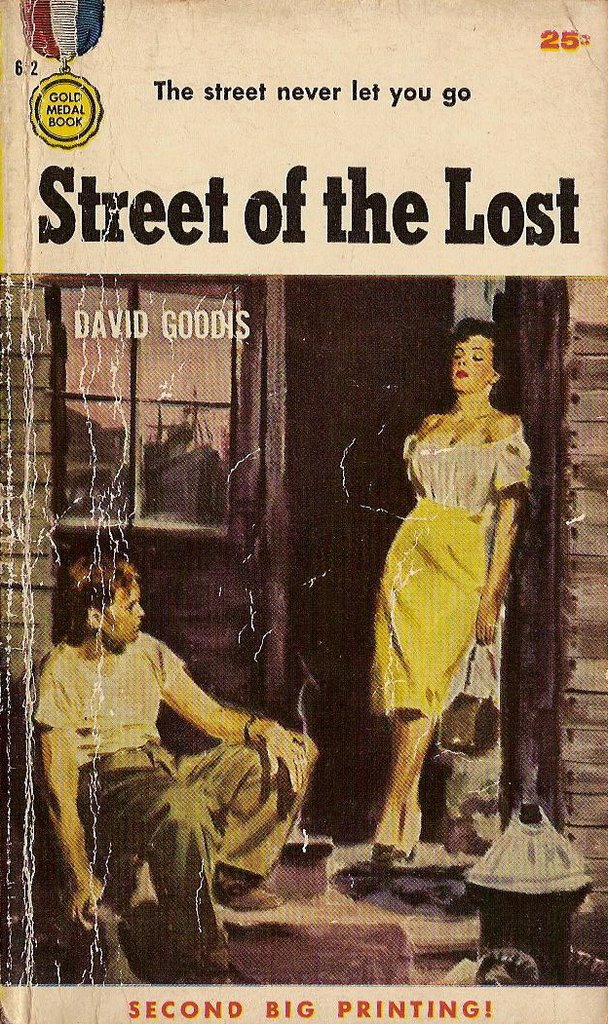
Archetypal American Noir Novel by a Noir Writer

Everybody by now knows about film noir. Where that comes from is a genre of drug store paperbacks focusing on tough guys, bad girls, and thugs. There are great mystery writers of the first rank such as Raymond Chandler, Dashiell Hammett, and Ross Macdonald. But beyond them is a whole pantheon of second-rank writers who have contributed to American literature (and to subjects for American films). Here is a list of some of my favorites, listed in alphabetical order followed by the name of one of their representative works:

  • Robert Edmond Alter: Swamp Sister
  • Barry Gifford: Perdita Durango
  • David Goodis: Shoot the Piano Player
  • Chester Himes: The Real Cool Killers
  • Dorothy B. Hughes: In a Lonely Place
  • Elmore Leonard: Get Shorty
  • Mickey Spillane: I, the Jury
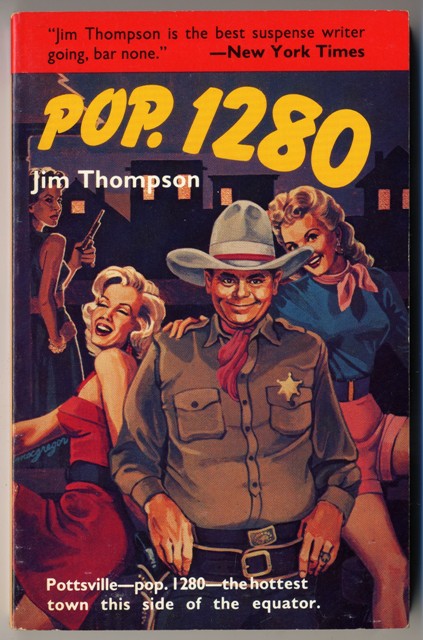
  • Jim Thompson: Pop. 1280
  • Charles Willeford: Pick-Up
  • Cornell Woolrich: I Married a Dead Man

My Favorite Jim Thompson Novel

This list does not attempt to be definitive, as I am still making discoveries in this genre all the time. Fortunately, many of the novels are being regularly re-issued.

Interestingly, there are also several excellent European noir novelists, such as Britain’s James Hadley Chase, whose No Orchids for Miss Blandish is a classic. In France, there are Jean-Patrick Manchette (Fatale) and Boris Vian (I Spit on Your Grave).


Desert Dreamers: Cabot Yerxa 1

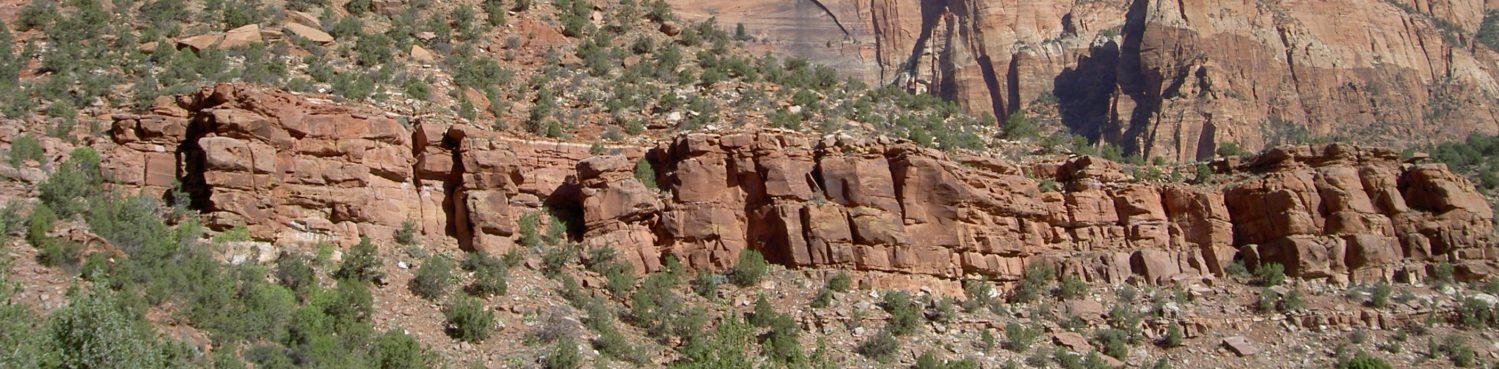
Scene from the Southern California Desert with Joshua Tree (L)

The deserts of Southern California are beautiful, but can be forbidding. I spent the weekend visiting my brother in Palm Desert. On Friday, I took a ride out to Desert Hot Springs to revisit Cabot Yerxa’s Old Indian Pueblo Museum. Simultaneously, I have been reading Yerxa’s collection of newspaper columns for The Desert Sentinel, written, with a few interruptions, between July 1951 and December 1957. They have been published in a book entitled On the Desert Since 1913 by Cabot’s Museum Foundation.

There, I find such gems as the following from December 11, 1952:

The cabin was swept and dusted, beds made up fresh, dishes put through a bath of soap and water. Then holes in the roof were repaired and firewood gathered. Boxes of groceries were opened, and it gave us a great sense of security to see packages of food on the shelf. We, very few of us, would see a store again for seven months, but we cared not. There was flower and yeast to make bread, sugar, salt, dry beans, cornmeal, canned milk, molasses, and a few other items to make many meals. But the greatest overall joy, with a thankful feeling of independence and satisfaction, was the fact that the land under our feet was ours! To no man must we pay rent or tribute for water, gas, electricity, phone, newspapers, or streetcar rides. We were free men in a new, clean, fascinating world.

Back in 1914, he had written:

Yesterday it rained for the first time in nine or ten months, and the desert was drenche. Just a steady, slow rain without any blustering wind. The sandy soil absorbed the welcome moisture completely and none ran off. The greasewood bushes opened their leaves, which are folded close together for protection during dry weather, and the damp air was full of their clean, haunting fragrance. All the sparse desert growh of bunch grass and small plants, usually quite brittle, were as limp and soft as though made of pretty colored rubber.

This post is the first in a series to be called Desert Dreamers. Tomorrow, I will write about his Pueblo Museum and what is to be found there. In future posts, I will write about other California Desert authors, most particularly Mary Austin.


Geographies: Real

A More Recent Edition of This Invaluable City Atlas Than Mine

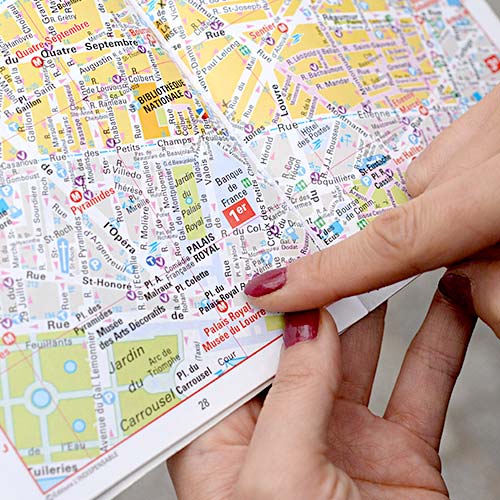
This is one of two posts by an inveterate map freak. I will start with real geographies that inspired some of my more fantastic fictional ones. I have read two novels this month which inspired me to dig up my copy of Paris Pratique Par Arrondissement Édition 2005. The first was Cara Black’s Murder in Clichy; and the second, Georges Simenon’s masterful Maigret and the Bum.

Ever since I was a grade school boy, I loved maps and atlases. It became even more pronounced when, at the same time, I collected stamps from such strange corners of the world as Tannu Touva, Bechuanaland, Liechtenstein, and Nejd. Naturally, I had to know where these geographic entities were, their principal cities, and some knowledge of their economies (if any).

No, I Don’t Wear Nail Polish

The best city street atlas I have ever seen is the abovementioned Paris Pratique Par Arrondissement. Each of the twenty arrondissements (districts) of the city gets either two facing pages, or, if required, two sets of two facing pages. In addition, there are maps of the metro, the RER (suburban rail routes), major bus lines, the Bois de Boulogne, the Bois de Vincennes, and La Défense. Throughout, it is organized so logically that I cannot imagine using any other map to follow the action in novels set in the City of Lights.

Absent from this handy atlas are the suburban banlieus which tourists are not likely to visit unless they are in the market for recreational drugs or a bit of the old ultra-violence. Unlike American cities, which tend to be hollowed-out at their core and liveable only in the outlying suburbs, Paris reserves the center for historical buildings and the wealthy, while the areas beyond the peripheral highway are strictly for slumming.


GRUBERG: The Papa Bach Story 2

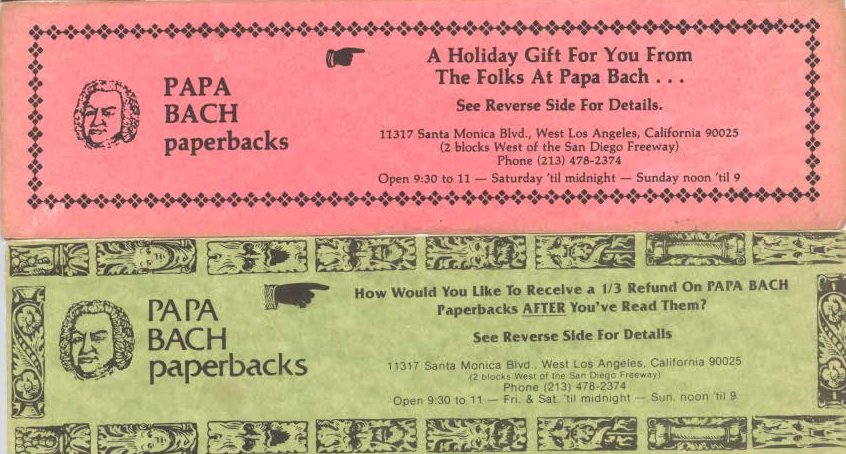
Bookmarks from the Reincarnation of Papa Bach

When Ted and Eva Riedel left Los Angeles in the mid 1970s, the bookstore was taken over by a “poet” named John Harris. I use the quotes around the word poet because I have found nothing on the Internet either by or about him that was not written by his friend, fellow poet William Mohr. It was around this time that I stopped hanging out at Papa Bach’s Bookstore. I missed Ted and Eva, and I had my doubts about the new management. This was mostly because I noticed that the stock on sale started to thin out: I no longer found it a good source for the material I was seeking.

Still, in its second incarnation, Papa Bach had some influence. In his book Literary L.A., Lionel Rolfe writes:

Papa Bach was significant, I think, because it was the closest thing Los Angeles ever had to a City Lights bookstore and publisher Lawrence Ferlinghetti. I’m not sure that Harris himself would have thought he was on that level, for the synergy of Ferlinghetti and San Francisco are a peculiar and special chemistry. But John Harris was a good if not great poet, and his Papa Bach was a bookstore, a cultural center, a publisher and an important link between many things. Harris made no bones about it; he had burned out.

Papa Bach was to limp along for another ten years or so, but the heart of it as a bookstore was no longer there. I was not and still am not interested in Harris’s poetry events or publications: It was the merchandise that had drawn me. Once the bookshelves started showing lots of blank space between isolated books, I knew that the end was in sight.

For a while, the building occupied by Papa Bach’s became “The Writer’s Computer Store,” which I assumed was a shill for Apple software products. Then the building was torn down and replaced by an Enterprise Rent-a-Car agency.