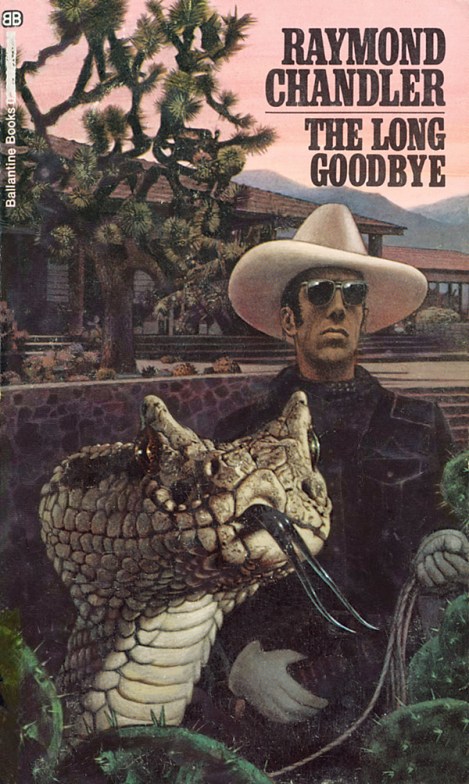
The Man With The Shredded Ear


Speaking of Raymond Chandler

Speaking of Raymond Chandler

While I was scanning the Futility Closet website (it’s on my link list to the left), I found the following alternative titles that Raymond Chandler had listed for possible future works:

The Man with the Shredded Ear
All Guns Are Loaded
The Man Who Loved the Rain
The Corpse Came in Person
The Porter Rose at Dawn
We All Liked Al
Too Late for Smiling
They Only Murdered Him Once
The Diary of a Loud Check Suit
Stop Screaming — It’s Me
Return from Ruin
Between Two Liars
The Lady with the Truck
They Still Come Honest
My Best to the Bride
Law Is Where You Buy It
Deceased When Last Seen
The Black-Eyed Blonde

In addition, there was this delightful little excerpt:

In a 1954 letter to Hamish Hamilton, he invented a “neglected author” named Aaron Klopstein who “committed suicide at the age of 33 in Greenwich Village by shooting himself with an Amazonian blow gun, having published two novels entitled Once More the Cicatrice and The Sea Gull Has No Friends, two volumes of poetry, The Hydraulic Face Lift and Cat Hairs in the Custard, one book of short stories called Twenty Inches of Monkey, and a book of critical essays entitled Shakespeare in Baby Talk.”

How does one shoot oneself with an Amazonian blow gun? I thought those were fairly long. Maybe he got his own toes, or set up some sort of fancy ricochet.


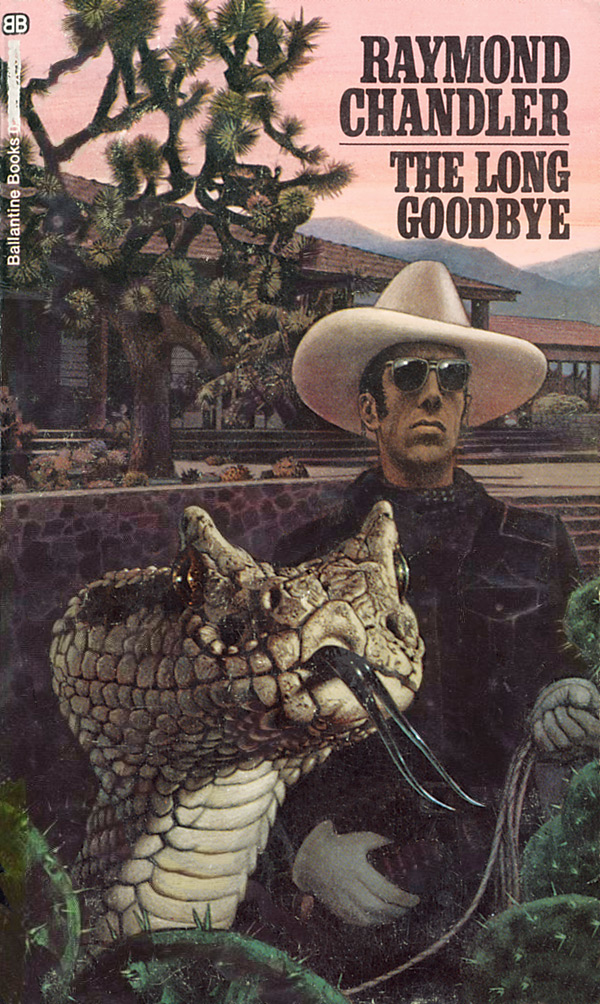
The Long Goodbye


The First Time I Read This Edition

The First Time I Read This Edition

The following is based on my review of Raymond Chandler’s The Long Goodbye for Goodreads.Com:

I had read The Long Goodbye many years ago, and liked it. In the meantime, I have aged—not exactly like a fine wine, but aged nonetheless—and found myself loving Raymond Chandler’s penultimate work. I might even go so far as to say it is his masterpiece, though back then I liked The Big Sleep and Farewell My Lovely more.

This time I detected the raggedness. Chandler’s wife, Cissy, was dying and he felt more vulnerable. This is no tight Agatha Christie thriller than runs like a Swiss clockwork. Not by a long shot. It’s about a nasty, persistent evil that, once you poke it with a stick, keeps coming back to snare you and hurt you. Somehow, Chandler’s detective Marlowe walks the straight and narrow path and comes out alive at the end:

I was as hollow and empty as the spaces between the stars. When I got home I mixed a stiff one and stood by the open window in the living room and sipped it and listened to the groundswell of the traffic on Laurel Canyon Boulevard and looked at the glare of the big angry city hanging over the shoulder of the hills through which the boulevard had been cut. Far off the banshee wail of police or fire sirens rose and fell, never for very long completely silent. Twenty-four hours a day somebody is running, somebody else is trying to catch him. Out there in the night of a thousand crimes people were dying, being maimed, cut by flying glass, crushed against steering wheels or under heavy tires. People were being beaten, robbed, strangled, rape, and murdered. People were hungry, sick, bored, desperate with loneliness or remorse or fear, angry, cruel, feverish, shaken by sobs. A city no worse than others, a city rich and vigorous and full of pride, a city lost and beaten and full of emptiness.
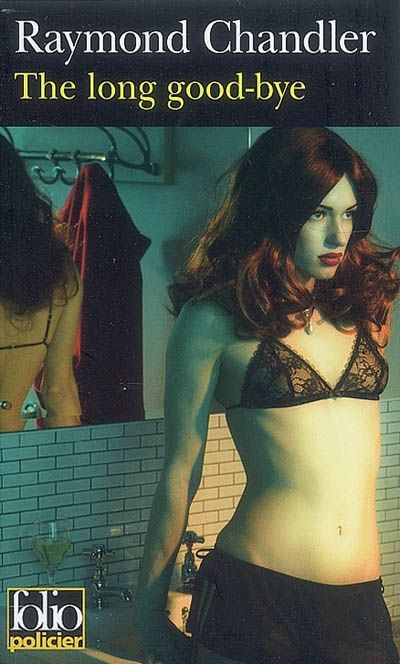
A French Edition of The Long Goodbye

A French Edition of The Long Goodbye

And mind you, this is just the background in which a series of murders and/or suicides take place that call Marlowe’s actions into question and put him in personal peril, such as the time four toughs waylay him in his own house. They included the following:

A man was sitting across the room with his legs crossed and a gun resting sideways on his thigh. He looked rangy and tough and his skin had that dried-out look of people who live in sun-bleached climates. He was wearing a dark brown gabardine-type windbreaker and the zipper was open almost to his waist. He was looking at me and neither his eyes nor the gun moved. He was as calm as an adobe wall in the moonlight.

That last short sentence inspired writer Walter Mosley to begin writing his own series of detective novels featuring Easy Rawlins.

I feel I have not rendered justice to this great novel—probably because it is still working its way through my bloodstream and opening channels in my body that I did not know existed.

On The Other Hand

Icelandic Author Halldór Laxness (1902-1998)

Icelandic Author Halldór Laxness (1902-1998)

In yesterday’s blog post, “[Not] The Nobel Prize for Literature,” I blasted the Swedish Academy for awarding prizes to a lot of mediocre writers who have not stood the test of time. As with all annual awards in the arts—and I include the Oscars and the Pulitzer Prizes in this as well—there are a goodly number of clinkers, but there are also some real finds.

Probably the one Nobelist whose work I have discovered and grew to love, perhaps the greatest is Halldór Laxness, Iceland’s sole laureate in literature. In the last few years, I’ve read mot of his work that is available in English translation, including such masterworks as Independent People, Iceland’s Bell, The Atom Station, and World Light.

Although no one I know has ever read any Laxness, I regard him as a giant of world literature. In 2013, I even visited his house in Mosfellsbaer (see below).

Gljúfrasteinn, Home of Halldór Laxness

Gljúfrasteinn, Home of Halldór Laxness

Other Nobelist authors whose work is little known today, but whose work I love,are Knut Hamsun of Norway, Ivan Bunin of Russia, François Mauriac of France, Ivo Andrić  of Yugoslavia, and Miguel Ángel Asturias of Guatemala.

Sometimes, the awards like the Nobels are useful, when they are not tainted by politics. It is said that Jorge Luis Borges of Argentina lost his chance at the prize when he accepted an honor from Chilean dictator Augusto Pinochet. At that point, one leftist member of the Swedish Academy essentially said, “Over my dead body!”

[Not] The Nobel Prize for Literature

Yet Another Great Writer Who Never Received a Nobel

Yet Another Great Writer Who Never Received a Nobel

I don’t have too much good to say about the Swedish Academy, which decides who will receive the Nobel Prize for Literature. If you look at the list of its recipients, it would not take too much effort to produce a list of as great as or even greater literary figures who have not received the laureate. Let me take a stab at it:

  • Kobo Abe (Japan), Woman in the Dunes
  • Chinua Achebe (Nigeria), Things Fall Apart
  • Ryunosuke Akutagawa (Japan), Rashomon
  • Jorge Amado (Brazil), Gabriela: Clove and Cinnamon
  • W. H. Auden (UK), Poetry
  • Georges Bernanos (France), Mouchette
  • Jorge Luis Borges (Argentina), Ficciones
  • Joseph Conrad (UK/Poland), Nostromo
  • Richard Flanagan (Australia), The Narrow Road to the Deep North
  • Graham Greene (UK), The Heart of the Matter
  • Vassili Grossman (Russia), Life and Fate
  • Henry James (US/UK), The Ambassadors
  • James Joyce (Ireland), Ulysses
  • Yashar Kemal (Turkey), Memed, My Hawk
  • Gyula Krúdy (Hungary), The Red Post Coach
  • Stanislaw Lem (Poland), Solaris
  • Osip Mandelstam (Russia), Poetry
  • Vladimir Nabokov (US/Russia), Lolita
  • Fernando Pessoa (Portugal), The Book of Disquiet
  • Marcel Proust (France), In Search of Lost Time
  • Arkady and Boris Strugatsky (Russia), Roadside Picnic
  • Italo Svevo (Slovenia), Confessions of Zeno
  • Leo Tolstoy (Russia), Novels and Stories
  • Mark Twain (US), Novels and Stories
  • Evelyn Waugh (UK), Brideshead Revisited
  • Virginia Woolf (UK), Mrs Dalloway

As you can see, I have not overloaded the list with the names of American authors, in the interests of being fair. If I wanted to, I can add names like Philip Roth, Ursula K. Le Guin, Joyce Carol Oates, Philip K. Dick, Cormac McCarthy, James Baldwin, Ralph Ellison, and a few others.

These can replace such figures as the following, whose reputations have not kept up with the times: Bjornsterne Bjornson, José Echegaray, Giosue Carducci, Rudolf Christoph Eucken, Paul von Heyse, Verner von Heidenstam, Karl Adolph Gjellerup, Henrik Pontopiddan, Carl Spitteler, Jacinto Benavente, Grazia Deledda, Erik Axel Karlfeldt, Pearl S. Buck, Frans Eemil Sillanpaa [SIC], Johannes Vilhelm Jensen, Earl Russell, and a few dozen others—mostly Scandinavian nonentities which at one time were highly thought of by a couple dozen mouldy Swedish academics. (Please forgive me for being lax about the diacritical marks in the above names.)


Slim Memed

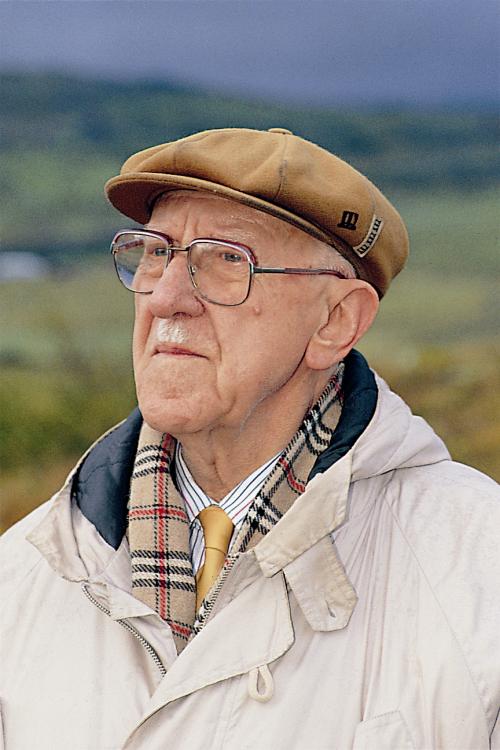
Yasha Kemal (1923-2015)

Yasha Kemal (1923-2015)

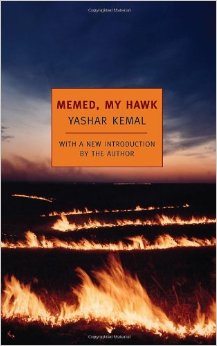
My Turkish friend David urged me to read Yasha Kemal’s Memed, My Hawk (1955). As part of my Januarius program of reading authors I’d never read before, I decided to look into it. It was nothing short of amazing. The following is from my review of the book for Goodreads.Com:

Yashar Kemal is probably the best known author from that most admirable of Middle-Eastern peoples: The Kurds. His Memed, My Hawk is a folk tale of injustice by a cruel landlord turning a young farmer’s son to brigandage. At the same time he is a brigand, he is scrupulously justice, especially when dealing with the poor and the innocent.

“Slim Memed,” as he is called, is a hero created by an author who doesn’t believe in heroes. In his introduction to the New York Review Books edition, Kemal writes:

I have never believed in heroes. Even in those novels in which I focus on revolt I have tried to highlight the fact that those we call heroes are in effect instruments wielded by the people. The people create and protect these instruments and stand or fall together with them.

PICMemedMyHawk

Still and all, Kemal was to write three more books featuring Slim Memed. For the first one, he was shortlisted for the Nobel Prize in Literature in 1973. That award was won by the Australian Patrick White. I think it should have gone to Kemal.

Kemal’s villain is the landlord Abdi Agha, one of the most craven and beastly characters in all of literature. It is not until the end that Memed shoots three bullets into his chest, killing him; but he had been spiritually dead for years after Memed killed his nephew and wounded him.


The Return of Januarius

Janus: God of New Beginnings

Janus: God of New Beginnings

Just as there are drinking games, there can also be reading games. Such is my annual Januarius tradition, which I’ve been doing for more than fifteen years now. I merely wedded the name of Janus, the two-faced god of new beginnings, withthe month of January: During that month, I only read books by authors whom I have never before read.

So far this month, I have completed:

  • Helgi Olafsson’s Bobby Fischer Comes Home: The Final Years in Iceland, a Saga of Friendship and Lost Illusions
  • Zachary Karabell’s Peace Be Upon You: A Story of Muslim, Christian, and Jewish Coexistence
  • Leonid Tsypkin’s Summer in Baden-Baden
  • Stan Jones’s Shaman Pass
  • Pierre Boulle’s The Face of a Hero

… and the month is not yet half over. I am looking forward to reading works by Sjón (the Icelandic novelist), Yashar Kemal, and Thomas Flanagan—among others.

So far, Leonid Tsypkin is my favorite of the five, with the author’s insight into the life of Fyodor Dostoyevsky and his wife Anna Grigori’evna, though all were pretty good.


Serendipity: Summoning Up the Genie

César Aira

César Aira

I have written before a couple of times about Argentinian author César Aira, the man from Coronel Pringles (not related to the potato chip). Today, in the August 13, 2015 issue of The New York Review of Books, I finally read an article that seems to understand him. It is called “Staggering Local Wonderlands” and written by Geoffrey O’Brien, For your delectation, here are the concluding paragraphs of the article:

Finally one sticks around because of the tantalizing possibility that Aira may yet get to the bottom of something that seems to have no bottom. He is the master of a method whose application and ultimate purpose remain in perpetual doubt. He might be a rationalist demonstrating the irrationality of what is; a naturalist of the impossible; a maker of allegories, or of parodistic pastiches of allegories, of parables whose precise lessons deliberately elude clarification. He is just as likely demonstrating that such forms as allegory and parable are no more than imperfect attempts to capture a reality more elusive—“real reality, so distinct from the pale fantasies of reason” (The Miracle Cures of Dr. Aira, 2002). Aira seeks to improve on such earlier, approximate methods by means of his mad-scientist investigation into the neurology of story-making.

The act of storytelling is nowadays conventionally prized for its universal, ageless, benevolent associations. It is our shared heritage of magic; it is a defining human trait. With Aira we are just as aware of the essential cruelty of storytelling—or rather its cosmic indifference, an indifference only partly disguised in the oldest myths and legends and fairy tales. Finally there is nothing to cling to. Emotions are free-floating, personhood itself is free-floating—a state of affairs only thinly masked by the reassuring “thereness” of the voice-over commentary. The stories here do have a life of their own, and it is a life offering much surprise, much humor, much brilliance of observation and invention, but little in the way of even momentary consolation. They summon up a genie who can do everything but fulfill our wishes.

The reader feels at moments as if he has washed up in some successor state of literature, in which outward forms, characteristic tropes and techniques, are carefully maintained, but where former purposes have given way to some new and not yet decipherable intent. Yet in such a situation the old forms are perhaps more potent than ever: they regain the mystery of the incomprehensible that stories are always promising, in vain, to explicate. One of the stories in The Musical Brain begins: “Circumstances had reduced me to begging in the street”: a perfect narrative set-up for The Arabian Nights, that most wonderful, as well as supremely cruel, work. Aira’s reconceiving of such a compendium of all possible stories might be called an Arabian Nights of the corner drugstore; but then it is fair to say that The Arabian Nights itself was an Arabian Nights of the corner drugstore.

The Wonderful Wizard of … Mo?

Oz Was Just One of L. Frank Baum’s Invented Worlds

Oz Was Just One of L. Frank Baum’s Invented Worlds

If great stories constitute one of the riches of the earth, then America has nothing to be ashamed of. We may not have the Brothers Grimm, we might not have Hans Christian Anderson, we might not have Boccaccio—but we do have L. (short for Lyman) Frank Baum. He gave us not only The Wonderful Wizard of Oz (1900) but sixteen sequels! (And they’re all pretty good!)

Then there are the other invented worlds, such as the one represented by The Surprising Adventures of the Magical Monarch of Mo and His People (1900), written the same year he created Oz. That’s only the beginning, for Baum’s fertile mind was busily at work for the last nineteen years of his life, and did not rest until he populated his fairylands with hundreds of characters and situations that not only amaze children, but not a few adults as well. Like me, for instance.

Now with the advent of e-books, it is possible to get virtually all of Baum’s work for free, or for pennies. You can try Kindle, or even Gutenberg.Com, which also contains the original illustrations. If you need cheering up, try one of his lesser-known books, which contain a wealth of treasures.


Where It All Began

Where Star Trek and Alien Began

Where Star Trek and Alien Began

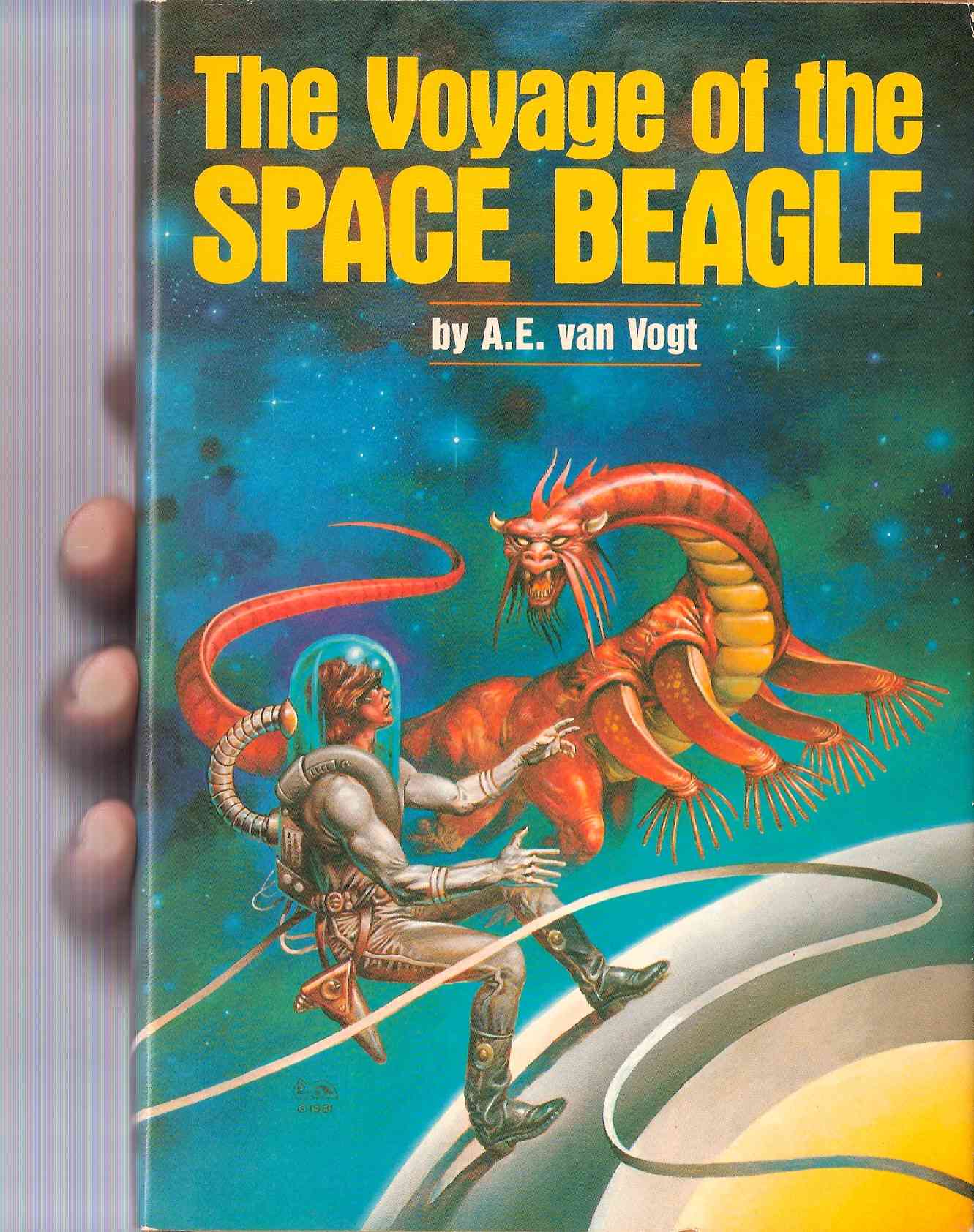
Lest we think of ourselves as too sophisticated and pooh-pooh out of hand some old (1950) science fiction with a somewhat clunky name, perhaps we should reconsider. A. E. Van Vogt’s The Voyage of the Space Beagle is a collection of four short stories cobbled together. From this unlikely source came the idea for Gene Roddenberry’s Star Trek and all its spin-offs and movies. From the third story came the idea for the movie Alien.

You remember the words that started the show: “Space, the final frontier. These are the voyages of the Starship Enterprise. Its five-year mission: to explore strange new worlds, to seek out new life and new civilizations, to boldly go where no man has gone before.” Van Vogt got his idea from Charles Darwin’s The Voyage of the Beagle, which, curiously, lasted five years. While the five years did not figure in Van Vogt’s book, it assumed new importance when Roddenberry lifted the general idea. And he never paid a penny to Van Vogt nor credited him with the idea for the series.

This Scene in Alien Did Not Come from Van Vogt

This Scene in Alien Did Not Come from Van Vogt

The producers of the film Alien did not get off so easily. Van Vogt sued the producers and came to an arrangement with them that was monetarily satisfactory to both sides. Needless to say, the character of Ripley, played by Sigourney Weaver (above), was not part of The Voyage of the Space Beagle, as all its crew were chemically castrated males.

There are many treasures from the Golden Age of Science Fiction (mostly the 1950s) that are worth re-examining. I would submit that the works of A. E. Van Vogt deserve a closer look. I have re-read three of his books recently and found them well worth the effort.

The Whole Enchilada

A Server Farm at Night

A Server Farm at Night

Oscar Wilde said it: “It is only shallow people who do not judge by appearances. The true mystery of the world is the visible, not the invisible.” For Thomas Pynchon, it’s not only the true mystery, but the whole enchilada.

There is no introspection or doubt in his novels: Things happen according to a kind of internally generated gonzo energy. In the case of Bleeding Edge, that energy involves—most especially—the Internet, September 11, hidden server farms, insane conspiracies, Russian gangsters, bent right-wing government men, Satanic CEOs, and a sinister firm called hashslingerz.com that could be either pro or anti government.

What is nowhere are any steps one millimeter closer to finding the meaning of life. That gonzo energy is life itself. Why be paralyzed by doubts, when those omnipresent marionette strings are urging you on to the next adventure?

Okay, no, scratch introspection. What there is, is the energy—and great gobs of interesting trivia and wit. Whenever heroine Maxine Tarnow jumps into action, I want to know what will happen in all these terribly involved situations that would have me, were I in her shoes, edging out the door, down the street, across the country—hell, halfway to Argentina.

Maybe I’m just a big coward. But at least I know what I like, and I do like Thomas Pynchon with his paraphernalia. Maybe Horace Engdahl of the Nobel Prize for Literature selection committee was right about American literature:

“There is powerful literature in all big cultures, but you can’t get away from the fact that Europe still is the centre of the literary world … not the United States,” he told the Associated Press. “The US is too isolated, too insular. They don’t translate enough and don’t really participate in the big dialogue of literature…. That ignorance is restraining.”

But it sure is fun.