
Ghosts on the Pampas

Mapuche Indian Women

Mapuche Indian Women

One doesn’t hear much about the aboriginal population of Argentina. That is because, for the most part, the Indians of Argentina were done away with. Those who didn’t die of the white man’s diseases were rounded up and either executed or imprisoned during the 1870s under the “Conquest of the Desert” fomented by President Julio Argentino Roca (pictured below on the Argentinian 100 peso note).

Two Argentinian writers, however, did a fair job resuscitating the original peoples of the land. In The Witness, Juan José Saer writes of the fictional Colastiné who inhabited La Litoral along the Rio Paraná. A Spanish cabin boy is one of several prisoners from his 16th century landing party. His mates are all cooked and eaten in a cannibal feast. Yet there is a strange beauty to them:

For the Indians everything seems and nothing is. And the appearance of things is situated above all in the field of non-existence. The open beach, the transparent day, the cool green of the trees in spring, the otters with their smooth, rippling skin, the yellow sand, the golden-scaled fish, the moon, the sun, the air and the stars, the tools they skilfully and patiently fashioned from recalcitrant materials, in short everything that presented itself clearly to the senses was for them formless, and had a vague and sticky underside against which the darkness beat.

Saer’s Colastiné are true primitives, whereas César Aira’s Mapuche in The Hare are subtly ironic. Fortunately for them, the Mapuche survive today on the Chilean side of the Andes. (Unlike the Argentineans, the Chileans frequently intermarried with their tribal peoples.)
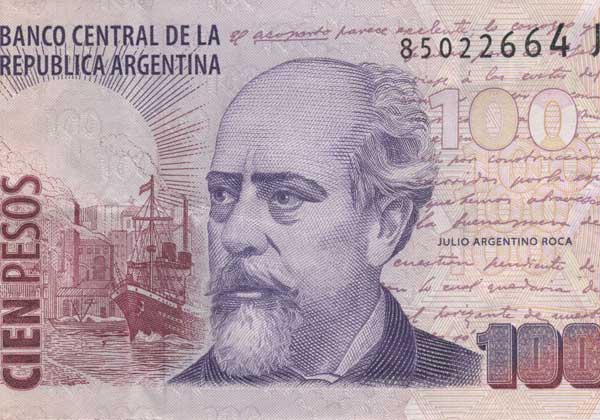
Argentine 100-Peso Note

Argentine 100-Peso Note

In The Hare, the narrator, Clarke, is an Englishman in search of the legendary Legibrerian Hare, which can not only run and leap, but fly when necessary. The Mapuche chief Calfucurá tells Clarke:

We have a word for “government” which signifies, in addition to a whole range of other things, a “path,” but not just an ordinary path—the path that certain animals take when they leap in a zigzag fashion, if you follow me; although at the same time we ignore their deviations to the right and left, which due to a secondary effect of the trajectory end up of course not being deviations at all, but a particular kind of straight line.

Both Saer and Aira are superb writers, and both capture in their own ways the peoples who came before them.

In Search of the Deskable

My Adventures with E-Books

My Adventures with E-Books

About a third of the books I read are on one of my two Kindles—especially if I am traveling where a bag full of books would limit my range. Most of the time, the experience is pleasant, especially when the e-book I purchase is from a reputable publisher such as Penguin. Sometimes, however, you get an otherwise worthy book that is marred by the bane of e-publishing: namely, Optical Character Recognition, or OCR.

I have just finished reading C.S. Lewis’s superb autobiography, Surprised by Joy: The Shape of My Early Life. In between passages of great beauty, I would find sentences such as: “…but the real Deskable would have evaded one, the real Deske would have been left saying, ‘What is this to me?’”

Deskable? Deske?

The publisher of this e-book decided to forego human proofreading in favor of OCR software. Unfortunately, the software used rendered Desire as Deske and Desirable as Deskable.

At one point, I recognized the word “horkon” as the computer’s reading of “horizon.” The first person singular pronoun was frequently rendered by the decimal digit 1.

Fortunately, the work was good enough for me to persist to the end; but, many a time, usually when dealing with cheapster editions, I have given up in disgust.

James Bond and Me

James and I Go Way Back

James and I Go Way Back

I was a student at Dartmouth College when I first saw Sean Connery in Dr. No (1962). The film hit me right between the eyes, as if it had been fired at me from 007’s Beretta. Here was a guy with the ultimate cool: He was a bon vivant, handsome to women, and pitted against enemies who were the ultimate in evil. In Live and Let Die (1954), the second novel in the series after Casino Royale, Bond came up against the massive Mr. Big, a gargantuan Negro with not only pretensions to Voodoo (as Baron Samedi himself), but an operative of SMERSH, short for Смерть шпионам, “Death to Spies,” a Soviet counter-intelligence agency named by Joseph Stalin during World War Two.

The second part is dangled before us, but we don’t see any real Soviet spy business; and its role in the novel is negligible and could have omitted entirely. As with most of the Bond novels, it’s pretty easy to see what’s going to happen: The plot twists are well telegraphed. When 007 is preparing an underwater incursion on Mr. Big’s Jamaican hideaway and we are told that it would take 48 hours for the shark and barracuda repellent to arrive from the States, well we all know what is about to happen: Underwater feeding frenzy!

I must have read most of the Bond thrillers during my college years. It was candy for the mind and great adolescent wish-fulfillment. I guess that, into each life, some froth must fall.

The End of a Book

It Barely Lasted the 3 Days It Took to Read the Book

It Barely Lasted the Three Days It Took to Read the Book

It is always sad whenever I have to throw out a book, especially when I enjoyed reading it like this one. Over the years, I have red about two dozen or more Georges Simenon novels, and loved most of them. This old Signet paperback had glued signatures using cheap pulp paper. Even as I read it, it started shedding little triangles of paper from the cover and the interior. So now I’ll just throw it out before it ends up as a random pile of kipple on my bookshelf.

Whence comes this love of books? I think I got it from my mother. I have vivid memories of lying in my crib while she read stories to me. When she didn’t have enough time to stop in at the library, she made up her own story, usually about a fairy princess in a dark European forest. From the earliest age, I was hooked.

Now my apartment contains literally thousands of books. I love reading them. I even love handling them. Alas, Georges Simenon’s The Bells of Bicêtre has come to the end of the line. No more will someone want to pick it up and gently turn the pages. Requiescat in pace!

Tarnmoor’s ABCs: Russian Novels

What Country Produces the Best Literature?

What Country Produces the Best Literature?

All the blog posts in this series are based on Czeslaw Milosz’s book Milosz’s ABC’s. There, in the form of a brief and alphabetically-ordered personal encyclopedia, was the story of the life of a Nobel Prize winning poet, of the people, places, and things that meant the most to him.

My own ABCs consist of places I have loved (Iceland, Patagonia, Quebec), things I feared (Earthquakes), writers I have admired (Chesterton, Balzac, Proust, and Borges); locales associated with my past life (Cleveland and Dartmouth College), people who have influenced me (John F. Kennedy), foods I love (Olives), and things I love to do (Automobiles and Books). This blog entry is my own humble attempt to imitate a writer whom I have read on and off for thirty years without having sated my curiosity. Consequently, over the weeks to come, you will see a number of postings under the heading “Tarnmoor’s ABCs” that will attempt to do for my life what Milosz accomplished for his. To see my other entries under this category, hit the tag below marked “ABCs”. I don’t guarantee that I will use up all 26 letters of the alphabet, but I’ll do my best. Today the letter is “R” for Russian Novels.

I’ll come right out and say that, over the last two hundred years, Russia has produced the world’s best prose fiction. (They might well also have produced the greatest poetry, but I cannot judge as I do not know the language.) In addition to the 19th century titans—Dostoyevsky and Tolstoy—there are other greats whose work continues to amaze me. I am thinking of Ivan Turgenev, Nikolai Gogol, Ivan Goncharov, Nikolai Leskov, Alexander Pushkin, Anton Chekhov, and Mikhail Lermontov,

Despite the travails of the Communist Century, Russian novels continued to be the best in the world, what with authors like Maxim Gorky, Anatoly Rybakov, Victor Serge (even though he wrote in French), Vladimir Nabokov, Vassily Grossman, Victor Zamyatin, Boris and Arkady Strugatsky, Aleksander Solzhenitsyn, Andrey Gelasimov, Mikhail Bulgakov, Boris Pasternak, Andrey Platonov, Ivan Bunin, Varlam Shalamov, and Sergei Lukyanenko.

And these are just the ones I’ve read! KI suspect I could find another dozen if only I lived long enough.

The most difficult thing most people find about Russian novels is the names of the characters. Let’s take for example the name of one of the major characters in Dostoyevsky’s The Brothers Karamazov. Alexei Fyodorovich Karamazov is he youngest son of Fyodor Karamazov and bears his father’s first name in his patronymic (Fyodorovich). In addition to being called Alexei Fyodorovich, you are likely to see him called by one of his nicknames, which include Alyosha, Alyoshka, Alyoshenka, Alyoshechka, Alexeichik, Lyosha, and Lyoshenka—all depending on who is speaking. After a few decades, you get used to the nicknames. No longer do I ask myself, “Is Dostoyevsky introducing another character here?”

Also, Russian novels are likely to be l-o-n-g. That’s all right with me, because I usually get so wrapped up in the stories that I almost don’t notice it.

If you want to get started, I suggest you pick something more nearly contemporary, such as Sergeyyi Lukyanenko’s eerie Night Watch, with its vampires and witches. (The Russian movie based on it is also worth seeing.)

So, enjoy yourselves, and give my regards to Nevsky Prospekt!

Terrible Harmony

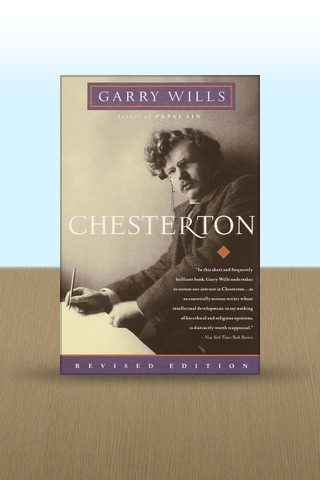
Thoughts Inspired by Garry Wills’s Great Book on Chesterton

Thoughts Inspired by Garry Wills’s Great Book on Chesterton

I can identify the exact moment I fell in love with G.K. Chesterton. Many years ago, as I read The Man Who Was Thursday for the first time, I came across this line by Gilbert Syme, the narrator: “Just at present you only see the tree by the light of the lamp. I wonder when you would ever see the lamp by the light of the tree.” It hit me like a bolt of lightning that here was a man that knew that all was one, and that everything affected everything else. Indeed, why not by the light of the tree?

Decades later, I finally read Garry Wills’s first book, Chesterton. It is not only the best work about the author I have ever read, and perhaps one of the best works of literary criticism I have read for many a year, but it made me come to several realizations:

  1. Chesterton was not some sort of Jolly Green Giant: What peace he finally attained was hard won.
  2. As the First World War and the books he wrote at that time showed, he was a very indifferent political propagandist (see The Appetite of Tyranny and The Utopia of Usurers).
  3. When Chesterton finally converted to Catholicism in 1922, he became another type of propagandist—one for his faith—but considerably more effectively than in his political work.
  4. Perhaps Chesterton’s most interesting work came before the Great War.

The best thing about Chesterton is Wills’s detailed analysis of the early work, including the poems “The Wild Knight” and “The Ballad of the White Horse” and most particularly, my favorite GKC book, The Man Who Was Thursday.

In an essay on dreams in The Coloured Lands, Chesterton wrote one of the most cogent expressions of the complexity of his dance with joy and nightmare:

In this subconscious world, in short, existence betrays itself; it shows that it is full of spiritual forces which disguise themselves as lions and lamp-posts, which can as easily disguise themselves as butterflies and Babylonian temples…. Life dwells alone in our very heart of hearts, life is one and virgin and unconjured, and sometimes in the watches of the night speaks in its own terrible harmony.

I have only one minor quibble, and that is that Wills downplayed much of Chesterton’s fiction, which was almost always good, from his earliest Father Brown stories (which he covers) to such titles as The Club of Queer Trades, The Paradoxes of Mr. Pond, The Return of Don Quixote, and The Poet and the Lunatics. At the same time, what Wills does accomplish is to excellent that I cannot but see myself re-reading this excellent book, and maybe even searching for a hardbound copy for my burgeoning GKC collection.


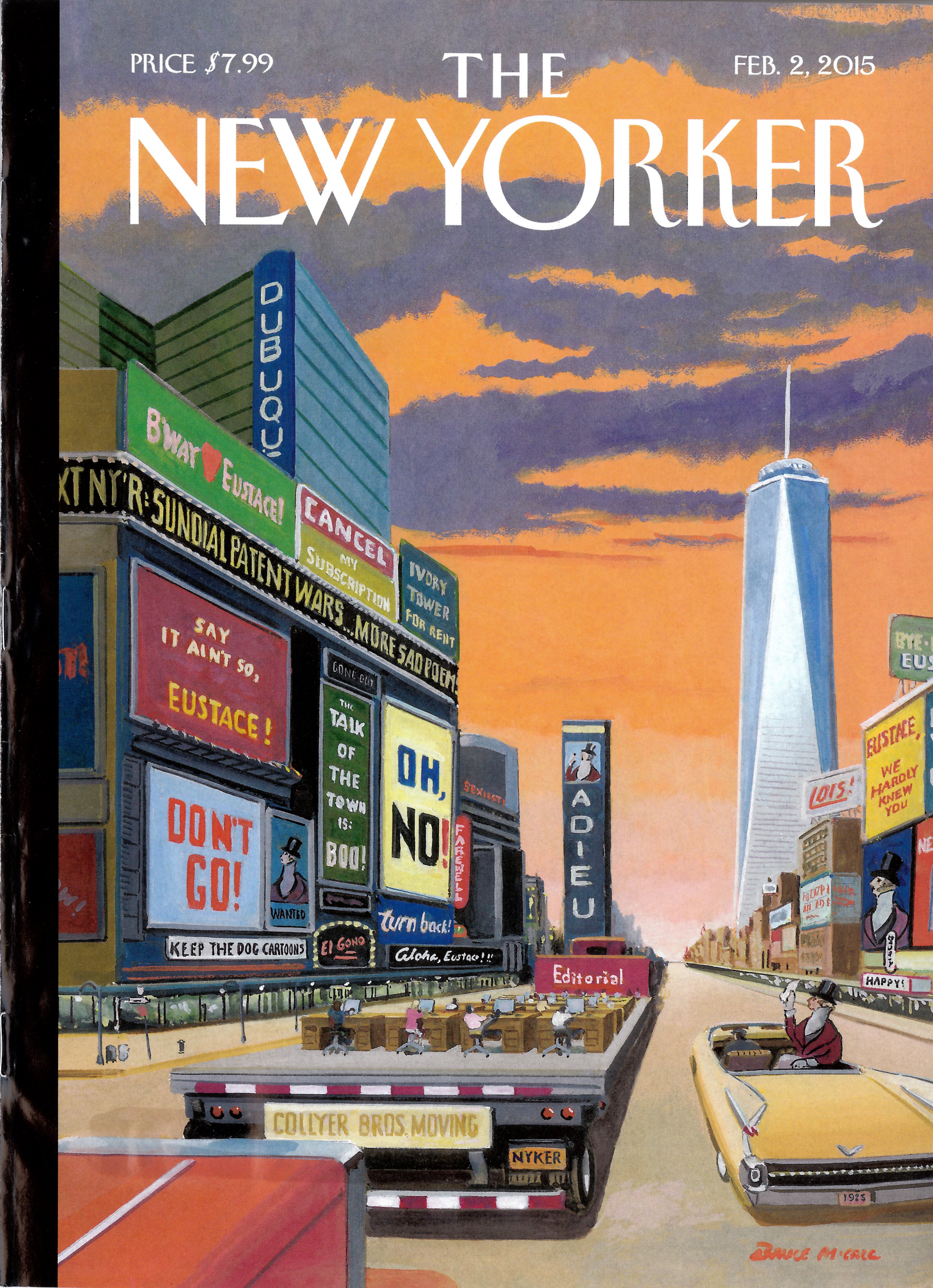
Eustace Tilley’s Last Stand

New Yorker Cover Commemorating the Magazine’s Move to the World Trade Center

New Yorker Cover Commemorating the Magazine’s Move to the World Trade Center

For half a century, I have loved The New Yorker. I remember learning about REM sleep from reading the magazine on a long train trip between Cleveland and White River Junction, VT (I was attending college in nearby Hanover, NH.) Then, in the late 1960s, there was a pioneering article about Magical Realism in Latin America: That started me on Jorge Luis Borges, who in turn led me to hundreds of writers whose work has become precious to me.

It was responsible for publishing Jorge Luis Borges, John Cheever, Roald Dahl, J.D. Salinger, Joseph Mitchell, Haruki Murakami, Philip Roth, Vladimir Nabokov, James Thurber, John Updike, Shirley Jackson, Eudora Welty, and Truman Capote.

But now, alas, I am thinking for the first time of not renewing my subscription when it expires later this year. The New Yorker has survived Harold Ross, William Shawn, Tina Brown, and David Remnick as editors. But I don’t think it can survive continuing ownership by Condé Nast Publications with its focus on the super-rich. Although the magazine has broken its long-standing policy of not endorsing a presidential candidate, it went for John Kerry and Barack Obama in the last three elections.

My bet is that the magazine is veering to the right. It takes its advertising revenue very seriously, and this has slanted its editorial content to fashion-conscious CEOs who are more likely to buy the ridiculously priced merchandise. There are still short stories by world-class writers, but not so often as before. And it seems that the farther The New Yorker goes from Manhattan, the less trustworthy are its articles. They have a particular problem with Southern California: It seems that they haven’t developed any further than Nathanael West, author of Day of the Locust.

Particularly dismaying are the endless bios of CEOs, a subject not dear to my heart.

Oh well, sic transit gloria mundi. I am more likely to get my info from The New York Review of Books and the Times Literary Supplement from London.

Dragged Kicking and Screaming into the 21st Century

A Brave New World

A Brave New World

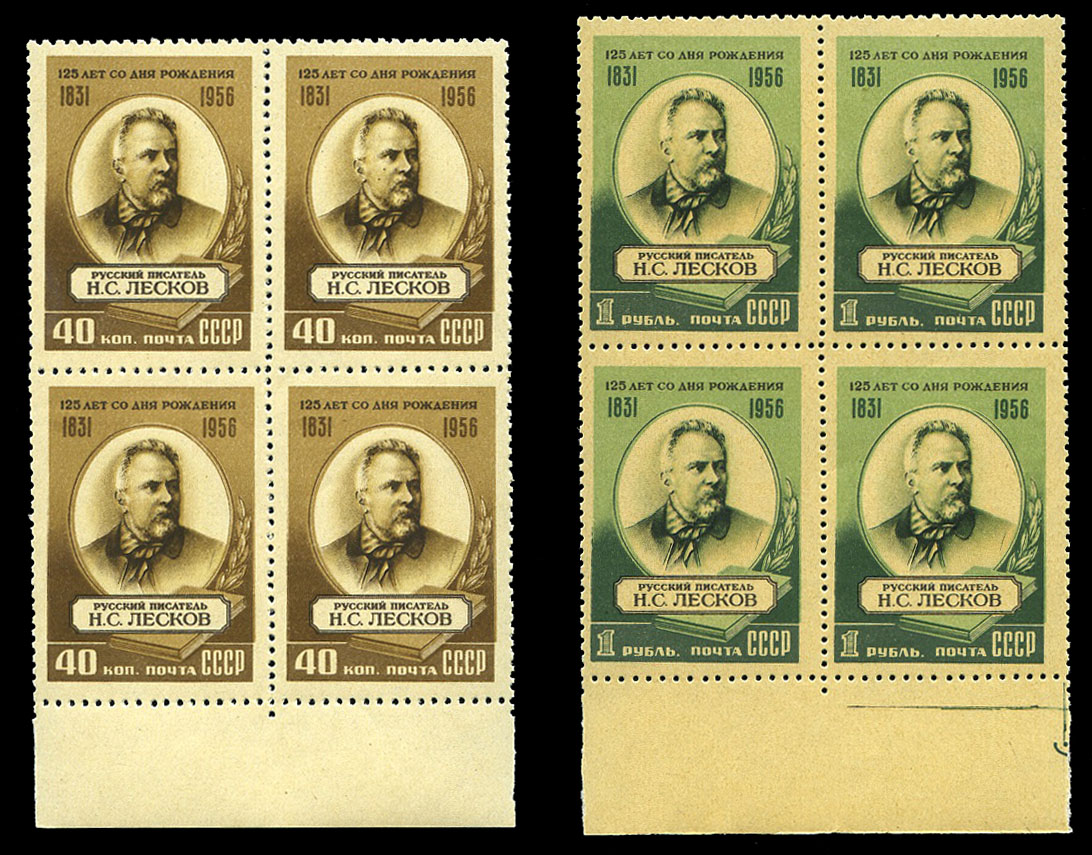
It used to be that, in fiction, the story was king—partly, I think, because God was in His Heaven and all was right with the world. A few things have happened since then: two World Wars, terrorism on a global scale, Charles Darwin, contraception, quantum mechanics, the Internet, and the Atomic Bomb. Mind you, I still love the great storytellers, men like Isaac Bashevis Singer, Nikolai Leskov (see illustration below), Charles Dickens, J.R.R. Tolkien, the authors of the Icelandic sagas, and John Steinbeck. But the world has changed, or at least is in the process of changing, and the only people who still stick with the fundamentalist view of society are the United States (particularly in the Bible Belt) and the Middle East (with the Jihadists).

Slowly, I have been dragged kicking and screaming into the postmodernist 21st century. In 1999, Martine and I walked right by the Picasso Museum in Paris without expressing any interest in its contents. I still actively dislike Mark Rothko, Jackson Pollock, Willem de Kooning, and most abstract expressionists. As for much of current architecture, I curl my lips in disgust. As for music, I tend to be pretty conservative, especially as I listen to most music while reading. Perhaps, for the time being, I am interested only in the literary impact of postmodernism. As for the other art forms, perhaps later….

Russian Stamps Honoring Nikolai Leskov, One of the Great Storytellers

Russian Stamps Honoring Nikolai Leskov, One of the Great Storytellers

What started me down this path is my clear enjoyment at reading such authors as César Aira, Geoff Dyer, Juan José Saer, and Samuel Beckett. Christopher L.C.E. Witcombe has attempted to define the postmodern artist:

The post-modern artist is reflective in that he/she is self-aware and consciously involved in a process of thinking about him/herself and society in a deconstructive manner, “damasking” [i.e., weaving with elaborate design] pretentions [sic], becoming aware of his/her cultural self in history, and accelerating the process of self-consciousness.

In an interesting Chinese blog by Xiaoqing Liu, two characteristics of postmodernism include “a tendency in contemporary culture characterized by the problem of objective truth and inherent suspicion towards global cultural narrative or meta-narrative” and the principle that “the perceiving subject cannot be taken out of the equation.”

One result is that postmodern literature can be painfully difficult to read. There is little respect for straight chronology. Sometimes, as in Geoff Dyer’s The Search, surrealism suddenly intrudes and plays havoc with the susceptibilities of more traditionally-oriented readers.

Still, there are rewards. The Godlike narrator is gone, and time and place are twisted out of shape. One interesting result is that reading becomes an activity similar to crime detection; and that’s partly why postmodernism has certain affinities with the mystery genre.

The painting at the top is by the British postmodern painter Francis Berry and is entitled “Tonic Moment: Search.”


The Melancholy of Departure (and Arrival)

Giorgio di Chirco’s “Gare Montparnasse: The Melancholy of Departure”

Giorgio di Chirco’s “Gare Montparnasse: The Melancholy of Departure”

I usually do not write about a book until I have finished reading it, but I decided that I had to post this while the ideas were still fresh in my mind. Geoff Dyer’s novel The Search (1993) started out as a genre mystery/detection novel, but has transformed into a Giorgio di Chirico painting.

We are in a non-specific country in an area known as The Bay. A man named Walker (no first name given) winds up at a party with his brother and meets an alluring woman known as Rachel Malory and asks him to track down er ex-husband in order to get some papers signed. Walker finds Rachel seductive, but she does not allow herself to be seduced, which only spurs Walker on. Although he does it ostensibly for money, it is really she who is the goal of his endeavors.

So far, so good. But it is not long before strange things begin to happen. First of all, he meets a man named Carver who wants badly to compare notes with him about Malory. When he refuses, Carver threatens to kill him. So while he is chasing Mallory, he is being chased by Carver. Then even stranger things begin to happen:

There was something strange about the city but he was unable to work out what. Then it came to him. There were no trees or pigeons or gardens. Yet all around were the sounds of leaves rustling and the beating of wings, the cooing of departed birds. He was so shocked that he stood at a street corner, listening.

Then there was a closed bridge that was actually vibrating like a plate of Jello in the wind. Walker goes through a series of tatty cities in this strange nondescript landscape. In one, there are no people; and he is able to get a suit and a car without paying for them. In another, there doesn’t seem to be much of a city, but whatever there is is surrounded by a network of wide freeways on which all the motorists are speeding furiously.

There don’t seem to be any clues about Malory, but Carver or some unknown assailant is still chasing him through a series of random cities.

“Enigma of a Day”

“Enigma of a Day”

That’s when I thought of di Chirico, that painter of mysteriously nonspecific cities. Cities like Meridian, Port Ascension, Eagle City, Usfret, Kingston, Monroe, Durban, Iberia, Friendship—the list stretches on. Each town is different from the other, in a sort of alternate United States with black and Latino ghettos. In one unnamed city, he even finds what looks to be a picture of Malory with Rachel.

As the surrealism grows, I almost want to ration the rest of the book so that I don’t finish it too soon.


Where to Pan for Gold

New York Review of Books Titles I Have Read This Month

New York Review Books Titles I Have Read This Month

At different times in my life, I have fallen in love with different publishers: Penguin, Oxford, Dover, Modern Library, New Directions. Now I am mightily enamored with the publications of New York Review Books. The four titles illustrated above are books by authors I had never read before, but which I read this month as part of my Januarius project. Of the three best books I have read this month, two—Andrey Platonov’s Soul and Antal Szerb’s Journey by Moonlight—were New York Review Books. The third, Juan José Saer’s The Witness, was recommended to me by an article in The New York Review of Books, which publishes New York Review Books.

I am always amazed by the editorial acumen of the publishers of New York Review Books: They seek out the best in Twentieth Century literature, whether it be from Russia, Hungary, Finland, Germany, Asia, Africa, or wherever. So many of the best discoveries I have made in the last few years have come from there that I follow their emails and website closely to populate my TBR (To Be Read) list.

Just this month, they came out with Silvina Ocampo’s Thus Were Their Faces: Selected Stories. Silvina and her sister Victoria Ocampo were closely associated with Jorge Luis Borges, who is one of only two or three authors whom I idolize,  collect, and ingest in bulk.