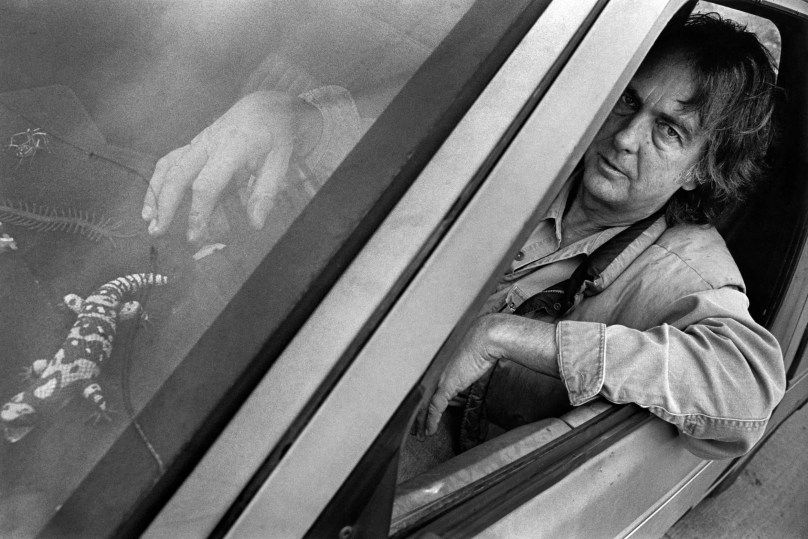
He’s from the same part of the world from which I hail. Painesville, the county seat of Lake County, is some 30 miles northeast of Cleveland. He has been called a science fiction writer, a designation which he (rightfully) hates. It’s more speculative fiction, with an emphasis on the short story form.
The man from Painesville was known for being something of a pain. His obituary in the Los Angeles Times remarks:
Over the years, Ellison has been described as fiercely independent, vengeful, sardonic, opinionated, confrontational, foul-mouthed, petulant, infuriating, defiant and a general all-around nuisance—as well as engaging, gregarious, funny, fastidiously organized and generous to his friends.
By his own measure, he was “a hard pill to swallow.”
He is gone, with all his objectionable behavior, but his stories remain. And they are well worth reading. I suggest you try one of the following collections:
I have No Mouth and I Must Scream (1967)
The Beast That Shouted Love at the Heart of the World (1969)
Approaching Oblivion (1974)
Deathbird Stories (1975)
Shatterday (1980)
You might also want to try reading the sci-fi story collection he edited in 1967 entitled Dangerous Visions.
Although he will be remembered as much for being a prickly character as a brilliant writer, I think that over time the latter will replace the former in the estimation of readers.
I find myself rereading books more often, sometimes by design, but more often by accident. For instance, I am reading the L.A. Central Library’s copy of Lawrence Ferlinghetti’s Writing Across the Landscape: Travel Journals 1960-2010. As I started reading it yesterday, I noticed the same light pencil marks I used to mark passages. “A kindred spirit,” was the first thought that crossed my mind. Then, when I loaded Goodreads.Com, I noticed that I wrote a review of the book in 2023. The stray marks were, in fact, mine. A kindred spirit, indeed!
Here are the books that I have reread so far this year, with the ones I have accidentally reread marked with an asterisk:
Lawrence Durrell: Balthazar, Mountolive, and Clea (the last three volumes of The Alexandria Quartet)
Lope de Vega: Fuente Ovejuna
Tom Bissell: Chasing the Sea: Lost Among the Ghosts of Empire in Central Asia *
Joseph Wood Krutch: The Desert Year *
César Aira: The Famous Magician *
Clifford D Simak: A Choice of Gods *
Georges Simenon: Maigret and the Good People of Montparnasse
Carlos Castaneda: Tales of Power
The funny thing is that I have enjoyed the rereads as much as the first-time reads, even when they were accidental.
I keep a log of 99+% of the books I have read since 1972. When I choose a book to read, I don’t always check the three data files—one a PDF and the other two Excel spreadsheets—which log all several thousand books I have read in the interval. Sometimes, I notice when rereading a book that I have somehow changed in some small or large particular.
For instance, I used to be a big fan of Jules Verne, even some of his lesser-known works. But when I reread From Earth to the Moon and Round the Moon a few years ago, I was disappointed. Perhaps I’ll reread 20,000 Leagues Under the Sea—my favorite among his works—to see how it plays now.
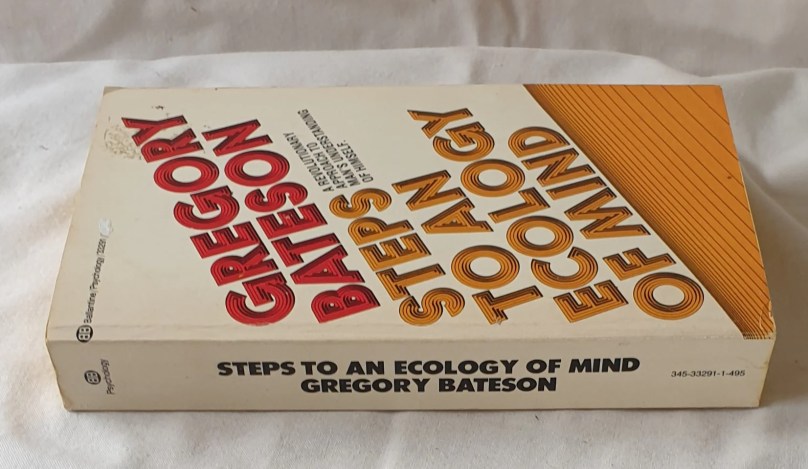
On June 15, I posted about the effect that the Whole Earth Catalog (WEC) series by Stewart Brand has had on me. And I promised that I would present a series of some of editor Brand’s more interesting comments. This is his take on Gregory Bateson’s Steps to an Ecology of Mind, which was first published in 1972. I had never read the book, but found it was influencing a number of my friends who were film historians and film critics. Now, I think I will find the book and read it.
Here is what SB (Stewart Brand) wrote about it:
Bateson has informed everything I’ve attempted since I read Steps in 1972. Through him I became convinced that much more of whole systems could be understood than I thought—that mysticism, mood, ignorance, and paradox could be rigorous, for instance, and that the most potent tool for grasping these essences—these influence nets—is cybernetics.
Bateson is responsible for a number of formal discoveries, most notably the “Double Bind” theory of schizophrenia. As an anthropologist he did pioneer work in New Guinea and (with Margaret Mead) in Bali. He participated in the Macy Foundation meetings that that founded the science of cybernetics but kept a healthy distance from computers. He has wandered thornily in and out of various disciplines—biology, ethnology,, linguistics, epistemology, psychotherapy—and left each of them altered with his passage.
The book chronicles the journey. It is a collection of his major papers, 1935-1971. In recommending the book I’ve learned to suggest that it be read backwards. Read the recent broad analyses of mind and ecology at the end of the book and then work back to see where the premises come from.
In my view Bateson’s special contribution to cybernetics is in exploring its second, more difficult realm (where the first is feedback, a process influencing itself, what Bateson calls “circuit,” and the second is the meta-realm of hierarchic levels, the domain of context, of paradox and abundant pathology, and of learning).
For over twenty years, I considered Stewart Brand’s Whole Earth Catalog as one of the major influences of my life. This evening, I unearthed the most recent edition I had, entitled The Next Whole Earth Catalog and published in October 1981.
In the original issue dated 1969, the following appeared on the opening page:
Function
The WHOLE EARTH CATALOG functions as an evaluation and access device. With it, the user should know better what is worth getting and where and how to do the getting.
An item is listed in the CATALOG if it is deemed:
Useful as a tool,
Relevant to independent education,
High quality or low cost,
Not already common knowledge,
Easily available by mail.
CATALOG listings are continually revised according to the experience and suggestions of CATALOG users and staff.Purpose
We are as gods and might as well get good at it. So far, remotely done power and glory—as via government, big business, formal education, church—has succeeded to the point where gross defects obscure actual gains. In response to this dilemma and to these gains a realm of intimate, personal power is developing—power of the individual to conduct his own education, find his own inspiration, shape his own environment, and share his adventure with whoever is interested. Tools that aid this process are sought and promoted by the WHOLE EARTH CATALOG.
The items in the original catalog are grouped under seven main sections:
Understanding Whole Systems
Shelter and Land Use
Industry and Craft
Communications
Community
Nomadics
Learning
It would seem that I’m not really that self-sufficient, not even like my brother Dan, who builds homes of logs (and other materials). I am by nature a bookworm, but I would have to admit that the WEC has contributed hugely to my well being.
For years I used to order my loose tea from Murchie’s in Vancouver, British Columbia. That’s how I discovered the Darjeeling, Ceylon, and Assam teas with which I start just about every day. (Since then, I have discovered Ahmad of London teas, which are readily available at local Middle Eastern and Indian food stores.)
The WEC also pointed the way to that encyclopedic American cookbook, The Joy of Cooking by Irma S. Rombauer and Marion Rombauer Becker. I still use my 1980s edition.
The Nomadics section is largely responsible for the travel bug that has infected me since my first trip abroad in 1975. Much of my information came from Carl Franz’s The People’s Guide to Mexico. As WEC says, “Reading the book is almost like being there and going through the problems and frustrations, pleasures and wonders of dealing with a new environment, new people and new ways of doing things.”
I was not yet ready for South and Central America, but the WEC Nomadics advice influenced me. Two decades before I flew to Argentina, I religiously read editions of The South American Handbook published in America by RandMcNally.
In the coming weeks, I hope to share some of the nuggets from WEC that have influenced me.
Stewart Brand is still around, but perhaps the Internet has probably replaced WEC. The problem with the Internet, however, is that you will find great advice and terrible advice in the same session. And how are we Americans at making good decisions? Pretty crappy, I think.
In the 1920s and 1930s, Mexico suddenly came to the attention of the English. There had been a messy revolution, numerous political assassinations, persecution of the Catholic Church, and the nationalization of the country’s petroleum assets. English writers seemed to want to understand Mexico, even if it meant an investment of several weeks to do so.
The results were pretty much a hodge-podge. Probably the most interesting works were by Graham Greene in his novel The Power and the Glory (1940) about the religious persecution in Tabasco and Chiapas and The Lawless Roads (1939), a travel book in which the author admits to loathing Mexico. “No hope anywhere. I have never been in a country where you are more aware all the time of hate,” this after he broke his glasses while on the road.
Also interesting is Aldous Huxley (1894-1963) with his tour of Mexico and Central America published in 1934 called Beyond the Mexique Bay.
D. H. Lawrence was hot and cold on the subject of Mexico. His Mornings in Mexico (1927) shows that he knew how to appreciate Mexico, whereas The Plumed Serpent (1926) is a weird and unconvincing novel.
Worst of the books was Evelyn Waugh’s Robbery Under Law: The Mexican Object-Lesson (1939), in which it is apparent that he is in a permanent snit on the subject of Mexico, and his sources were all obviously fascistic jackals. I read the first half of the book with its endless complaints of Lazaro Cardenas’s nationalization of the petroleum industry (was he possibly a disappointed investor?) and the United States’s hamfisted interventions during the Mexican Revolution. At no point did I feel that Waugh was seeing with his own eyes. (And yet, he was such a brilliant novelist. Go figure!)
I found the following in Renata Adler’s Pitch Dark, which was published after her first novel, Speedboat:
We have the sins of silence here. Also the sins of loquacity and glibness. We have the sins of moderation, and also of excess. We have our sinner gluttons, and our sinner anorectics. We have the sins of going first, and of After you, Alphonse. We have the sins of impatience, and of patience. Of doing nothing, and of taking action. Of spontaneity and calculation. Of indecision, and of sitting in judgment on one’s peers. We try to be alert here for infractions, and when we find none, we know we have fallen among the sins of oversight, or of smugness. We have the sins of disobedience, and of just following orders. Of gravity and levity, of complacency, anxiety, indifference, obsession, interest. We have the sins of insincerity, and of telling unwelcome truths. We have the sins of ingratitude for our many blessings, and of taking joy in any moment of our lives. We have the sins of skepticism, and belief. Of promptness, and of being late. Of hopelessness, and of expecting anything. Of failing to think of the starving children in India, of dwelling on thoughts about those children, or to Uncle Bill, or Granny, or poor Joel, or whomever we are being asked to take another spoonful for. We have the sins of depression, and of being comforted. Of ignorance, and being well-informed. Of carelessness, and of exactitude. Of leading, following, opposing, taking no part in. Very few of us, it seems fair to say, are morally at ease.
The following is from Jack Kerouac’s Doctor Sax, about his youth in Lowell, Massachusetts. Here he describes a sobering scene in his typical jazzy style:
A man carrying a watermelon passed us, he wore a hat, a suit in a warm summer night; he was just on the boards of the bridge, refreshed, maybe from a long walk up slummy swilly Moody and its rantankling saloons with swinging doors, mopped his brow, or came up through Little Canada or Cheever or Aiken, rewarded by the bridge of eve and sighs of stone—the great massive charge of the ever stationary ever yearning cataracts and ghosts, this is his reward after a long dull hot dumb walk to the river thru houses—he strides on across the bridge—We stroll on behind him talking about the mysteries of life (inspired we were by moon and river), I remember I was so happy—something in the alchemy of the summernight, Ah Midsummer Night’s Dream, John a Dreams, the clink of clock on rock in river, roar—old gloor-merrimac figalitating down the mark all spread—I was happy too in the intensity of something we were talking about, something that was giving me joy.
Suddenly the man fell, we heard a great thump of his watermelon on wood planks and saw him fallen—Another man was there, also mysterious, but without watermelon, who bent to him quickly and solicitously as by assent and nod in the heavens and when I got there I saw the watermelon man staring at the waves below with shining eyes (‘Il’s meurt, he’s dying,’ my mother’s saying) and I see him breathing hard, feeble-bodied, the man holding him gravely watching him die, I’m completely terrified and yet I feel the profound pull and turn to see what he is staring at so deadly-earnest with his froth stiffness—I look down with him and there is the moon on shiny froth and rocks, there is the long eternity we have been seeking.
As I prepare for our road trip to Tucson this next week, I have been doing a lot of reading in preparation. It struck me that there are a lot of great books about or set in deserts. Here are an even dozen recommendations organized alphabetically by author:
Abbey, Edward. Desert Solitaire: A Season in the Wilderness. A classic of the growing environmental movement and a threnody for the beauties that have been lost.
Anonymous, Arabian Nights (or A Thousand and One Nights). Great stories about Sinbad, Ali Baba, and others.
Austin, Mary. The Land of Little Rain. The author’s experiences in the Owens Valley along the Eastern Edge of the Sierra Nevada Mountains.
Banham, Reyner. Scenes in America Deserta. Delightful essays about travels in the California deserts.
Bissell, Tom. Chasing the Sea. A visit to one of the most desolate places on Earth, namely what used to be the Aral Sea in Uzbekistan.
Bowden, Charles. Desierto. Essays about the desert of Southern Arizona and the State of Sonora in Mexico.
Herbert, Frank. Dune. A great. sci-fi tale of a desert planet caught in the middle between warring factions in a corrupt empire.
Lawrence, T. E. (“Lawrence of Arabia”). The Seven Pillars of Wisdom. A British officer convinces Arabs to revolt against their Ottoman oppressors in World War I.
McCarthy, Cormac. Blood Meridian, or the Evening Redness in the West. Violence on the desert frontier among white settlers and Indians.
Powell, John Wesley. The Exploration of the Colorado River and Its Canyons. The first American to navigate the length of the Colorado River.
Theroux, Paul. On the Plain of Snakes. Unforgettable scenes along the border with Mexico, with chapters on the deserts of the State of Oaxaca.
Thesiger, Wilfred. Arabian Sands. The author’s journeys throughout the Arabian peninsula.
As I write these, I become acutely aware that there are more titles I should include. Perhaps, as I read more, I will re-visit the subject later.
Typically, the only books I read during the month of January are by authors I have not before encountered. I call this my Januarius project. This last January, however, I was too ill to read more than two books—and that at the end of the month. So I decided to hold this year’s Januarius in March.
During this month, I read fifteen books by authors who were new to me:
Lewis Grassic Gibbon, Sunset Song. This was the first (and most popular) volume of a trilogy entitled A Scots Quair. Hard times on a farm near Aberdeen before World War I.
David R. Fideler, Breakfast with Seneca: A Stoic Guide to the Art of Living. Stoicism is one ancient philosophy applicable to modern times.
Renata Adler, Speedboat. Consisting of seemingly unrelated scenes that manage somehow to hold together and be interesting.
Sylvia Plath, The Bell Jar. A somewhat grim book featuring multiple suicide attempts.
Fyodor Sologub, The Petty Demon. A 19th century Russian novel about an annoying school teacher in a country town.
Martial, Epigrams. Amusing sardonic quips about life in Imperial Rome.
Jean-Paul Clébert, Paris Vagabond. Paris seen from the eyes of a highly intelligent hobo.
Edward Said, Orientalism. Intelligent critique of the whole concept of orientalism as being the result of colonialism.
Demetrio Aguilera Malta, Seven Moons and Seven Serpents. Brazilian Magical Realism that allegorizes the whole South American experience.
Jay Parini, Borges and Me: An Encounter. Imagine having to drive Jorge Luis Borges around the Scottish Highlands without ever having read any of his work.
Ralph Waldo Emerson, Self-Reliance. It’s hard to believe that I’ve never before read any Emerson other than a couple of his poems.
Charles Bowden, Desierto: Memories of the Future. The best book I read this month, about life in the Arizona and Sonora desert, the drug lords, mountain lions, and crooked developer/banker Charles Keating Jr.
Andy Miller, The Year of Reading Dangerously: How Fifty Great Books (and Two Not-So-Great Ones) Saved My Life. The title says it all.
Alexander Ostrovsky, The Storm. A 19th century Russian play in which the villain is a mother-in-law.
Gao Yuan, Lure the Tiger Out oi the Mountains: The 36 Strategies of Ancient China. A somewhat lame attempt to show how ancient Chinese philosophy can improve your business acumen.
All in all, it was a good month with some writers I would like to revisit—particularly Charles Bowden. Next week, Martine and I are going to Tucson, Bowden’s home turf, where I plan to read some more of his work.
I have always loved reading classical travel books—even if they were written long ago. Here is a list of some of my favorites, listed below in no particular order:
Matsuo Basho, The Narrow Road to the Deep North (1694). This is the earliest book on the list including a poetic rendering of the author’stravels to shrines in Japan, written in haiku.
Bruce Chatwin, In Patagonia (1977). A not entirely reliable account of the author’s journeys through Patagonia.
John Lloyd Stephens, Incidents of Travel in Central America, Chiapas, and Yucatan (1841). The book that made we want to go to Mexico. Great illustrations by Frederick Catherwood.
Paul Theroux, The Old Patagonian Express (1979). Still my favorite of his works, made me want to visit South America.
Freya Stark, The Valleys of the Assassins and Other Persian Travels (1934). She traveled alone throughout the Middle East and lived to be 100 years old.
Robnert Byron, The Road to Oxiana (1937). A travel book in which the author fails to reach his destination, but what he does see his so interesting that it doesn’t matter.
Sir Richard Francis Burton, Personal Narrative of a Pilgrimage to Al Medinah and Meccah (1855-1856). It took incredible gall for an Englishman to pass himself off as an Afghan physician and visit the holiest sites of Islam.
Jonathan Raban, Passage to Juneau: A Sea and Its Meanings (1999). Life doesn’t stop just because you want to pilot a yacht to Juneau, Alaska.
Ryszard Kapuściński, Travels with Herodotus (2007). A brilliant Polish travel writer tells how the ancient Grfeek historian informed him on his travels.
D. H. Lawrence, Sea and Sardinia (1921). It was written in just a few days, but it’s great anyhow.
Lawrence Durrell, Bitter Lemons (1957). The author of The Alexandria Quartet describes his years spent on the island of Cyprus in the Mediterranean.
Patrick Leigh Fermor, A Time of Gifts (1977). Travels through Central Europe just before the Second World War.
I cannot help but think some of my other favorites are missing. What you won’t find on this list are books like Eat, Pray, Love and such bourgeois fantasies as A Year in Provence. If that’s what you prefer in travel literature, I would prefer that you don’t undertake to read any of my recommendations. Ever.







You must be logged in to post a comment.