One That Got Away

Enroute to Mexico with Neal Cassady in On The Road, Jack Kerouac falls for a young woman he sees briefly in Michigan. Considering Kerouac’s dismal track record with women, maybe it was a good thing she didn’t join him.

I took up a conversation with a gorgeous country girl wearing a low-cut cotton blouse that displayed the beautiful sun-tan on her breast tops. She was dull. She spoke of evenings in the country making popcorn on the porch. Once this would have gladdened my heart but because her heart was not glad when she said it I knew there was nothing in it but the idea of what one should do. “And what else do you do for fun?” I tried to bring up boy friends and sex. Her great dark eyes surveyed me with emptiness and a kind of chagrin that reached back generations and generations in her blood from not having done what was crying to be done—whatever it was, and everybody knows what it was. “What do you want out of life?” I wanted to take her and wring it out of her. She didn’t have the slightest idea what she wanted. She mumbled of jobs, movies, going to her grandmother’s for the summer, wishing she could go to New York and visit the Roxy, what kind of outfit she would wear—something like the one she wore last Easter, white bonnet, roses, rose pumps, and lavender gabardine coat. “What do you do on Sunday afternoons?” I asked. She sat on her porch. The boys went by on bicycles and stopped to chat. She read the funny papers, she reclined on the hammock. “What do you do on a warm summer’s night?” She sat on the porch, she watched the cars in the road. She and her mother made popcorn. “What does your father do on a summer’s night?” He works, he has an all-night shift at the boiler factory, he’s spent his whole life supporting a woman and her outpoppings and no credit or adoration. “What is he aching to do? What are we all aching to do? What do we want?” She didn’t know. She yawned. She was sleepy. It was too much. Nobody could tell. Nobody would ever tell. It was all over. She was eighteen and most lovely, and lost.

Endlessly Wandering the Streets of Paris

Auteuil in Paris’s 16th Arrondissement

Of recent French authors, the one I am most addicted to is Patrick Modiano, winner of the 2014 Nobel Prize for Literature. Since I first read his Out of the Dark (1998) for an Internet French Literature group ten years ago, I have read most of his work and am still hungry for more, though there are only a few titles left to go. And, no doubt, I will probably start re-reading them.

Scene of the Crime (2021) is one of his most recent novels, which I just finished today. Jean Boesman experienced some fascinating but very dicey people back in the 1960s and is haunted by the memory. He has been sought after by several of them for knowing where some swag from past smuggling has been hidden, but he successfully avoids them. Nonetheless, he still endlessly goes over his relationship with the young women in the group. As he says at one point, “We are from our childhood as we are from a country.”

That country was the Paris of the 1960s and 1970s. I cannot read Modiano without a map book of Paris on my lap, following his characters wanderings and evasions through the most walkable city on Earth.

In Scene of the Crime, I tracked Boesman through Boulogne-Billancourt (where Modiano was born), Auteuil, Pigalle/Place Blanche, the Quays along the Seine, and Saint Lazare.

None of Modiano’s books are particularly long: Most can be completed in one or two sittings. I usually take a little longer, because I am following the action on a map of Paris.

Tolstoy’s Journal

Count Leo Tolstoy (1828-1910)

Toward the end of his life, Count Leo Tolstoy wrote entries in a journal. He was a desultory writer by this time, frequently skipping days, weeks, and even months. Many entries end with the expression “If I Live,” highlighting to Tolstoy that he was approaching the end of his life. Most of his entries are about man’s relationship with his Creator and frequently end with short criticisms of what he wrote, such as “Stupid,” “Not clear and not what I want to say,” “I have not succeeded,” “Again, not what I want to to say,” and “I feel that there is something in this, but I can not yet express it clearly.” But then, even when he is struggling, Tolstoy is worth reading. Following are several excerpts from the first 80 pages.

Oh, not to forget death for a moment, into which at any moment you can fall! If we would only remember that we are not standing upon an even plain (if you think we are standing so, then you are only imagining that those who have gone away have fallen overboard and you yourself are afraid you will fall overboard), but that we are rolling on, without stopping, running into each other, getting ahead and being got ahead of, yonder behind the curtain which hides from us those who are going away, and will hide us from those who remain. If we remember that always, then, how easy and joyous it is to live and roll together, yonder down the same incline, in the power of God, with Whom we have been and in Whose power we are now and will be afterwards and forever. I have been feeling this very keenly.

§

I am alive, but I don’t live…. I lay down to sleep, but could not sleep, and there appeared before me so clearly and brightly, an understanding of life whereby we would feel ourselves to be travellers. Before us lies a stage of the road with the same well-known conditions. How can one walk along that road otherwise than eagerly, gaily, friendly, and actively together, not grieving over the fact that you yourself are going away or that others are going ahead of you thither, where we shall again be still more together.

§

I was going from the Chertkovs on the 5th of July. It was evening, and beauty, happiness, blessedness, lay on everything. But in the world of men? There was greed, malice, envy, cruelty, lust, debauchery. When will it be among men as it is in nature? Here there is a struggle, but it is honest, simple, beautiful. But there it is base. I know it and I hate it, because I myself am a man.

Water from the Limpopo

The Library of Water in Stykkishólmur, Iceland

I have just finished reading the first volume of Konstantin Paustovsky’s Story of a Life. In Chapter 14, we are introduced to a geography teacher at the high school Kostik (short for Konstantin) attends in Kyiv named Cherpunov. Paustovsky describes his collection:

Bottles filled with yellowish water, corked and sealed with sealing wax, stood in rows on the classroom table. They had labels, inscribed in an uneven elderly hand: ‘Nile,’ ‘Limpopo,’ ‘Mediterranean.’

There were bottles of water from the Rhine, the Thames, Lake Michigan, from the Dead Sea and the Amazon, but however long we looked at them they all remained equally yellow and uninteresting.

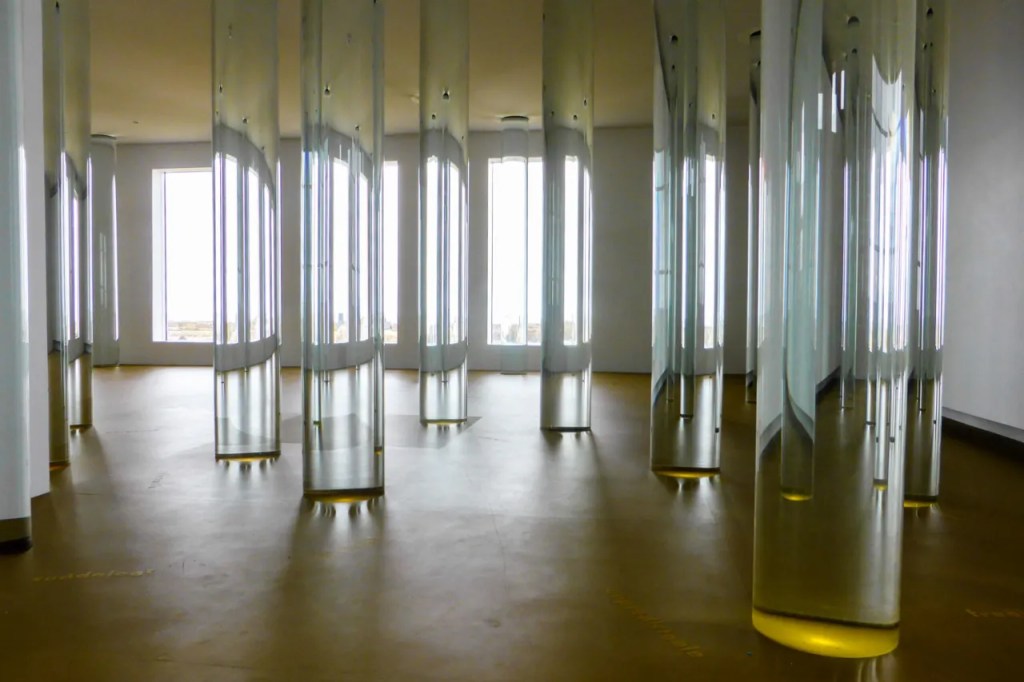
Curiously, there is one such collection in Stykkishólmur, Iceland, on the Snæfellsness Peninsula. It is called the Library of Water. Although I have been in Stykkishólmur twice, I have never bothered to visit it. Perhaps because I suspected what Paustovsky was to find out after Cherpunov’s young wife ran off and the old teacher quit.

‘Do you remember Cherpunov?’

‘Yes, of course.’

‘Well, I can tell you now that there was never anything in his bottles except ordinary water from the tap. You’ll ask me why he lied to you. He rightly believed that he was stimulating your imagination. He attached great value to it. I remember him telling me that it was all that distinguished man from the beasts. It was imagination, he said, that had created art, it expanded the boundaries of the world and of the mind, and communicated the quality we call poetry to our lives.’

My Annual Book Orgy

Where I Will Be This Weekend

What with bookstores becoming rarer than hen’s teeth and the average American seemingly unable to read anything more daunting than the label of a beer can, I am becoming ever more determined to support books and reading. Therefore, I shall be spending the weekend looking at books, buying books, and attending talks by authors as well as poetry readings, My next post will be on Monday, April 22.

The Los Angeles Times Festival of Books has become a huge event that brings together readers of all stripes. I even forego my usual sneering at readers of bodice-ripper romances: They, too, are readers—like me in one way, unlike in all others.

When I am not scanning book titles, I go for rest to the Poetry Pavilion, where there is a new poet every twenty minutes during the day. The pavilion never fills up like some of the other stages with big name celebrities, but it is (1) more comfortable and (2) more rewarding. Although I don’t read as much poetry as I should, it is always interesting to hear poets reading their own work.

Next week, I will write posts about those poets that interested me the most.

On the Rue de l’Aude

The Rue de l’Aude in the XV Arrondissement of Paris

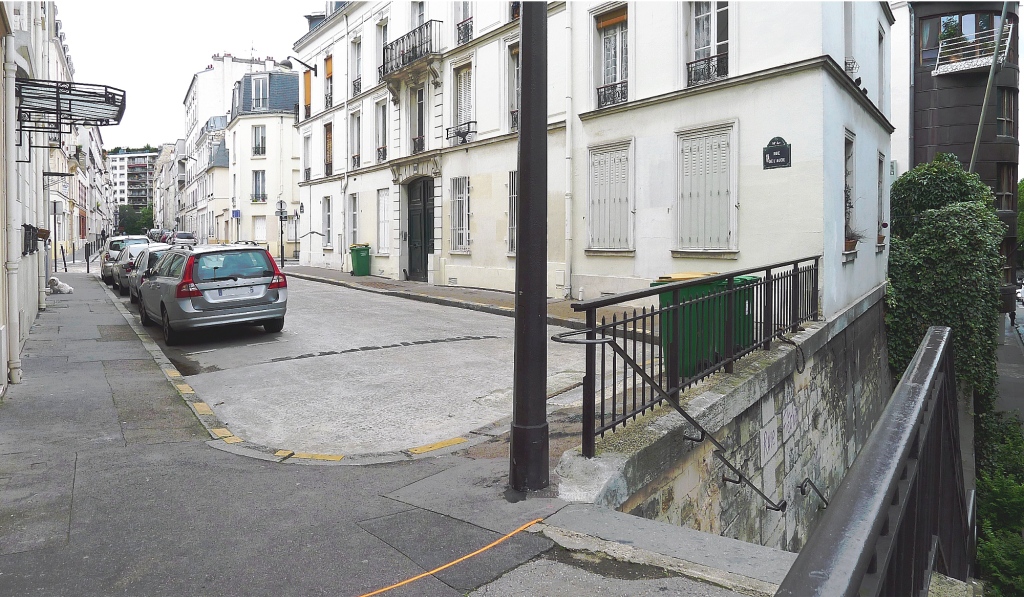
I am fatally in love with the novels of Patrick Modiano. This evening, I re-read his The Black Notebook, published in France in 2012 as L’Herbe des nuits. His fatally lost characters end up wandering the streets of Paris, trying to recover lost memories. Meanwhile, I try following their path using an old copy of Paris Pratique par Arrondissement.

The following is from page 75 of my Houghton-Mifflin edition:

And I was afraid I would be waiting for her in vain that night. Then again, I often waited without knowing if she’d show. Or else she would come by when I wasn’t expecting her, at around four in the morning. I would have fallen into a light sleep, and the sound of the key turning in the lock would startle me awake. Evenings were long when I stayed in my neighborhood to wait for her, but it seemed only natural. I felt sorry for people who had to record appointments in their diary, sometimes months in advance. Everything was prearranged for them, and they would never wait for anyone. They would never know how time throbs, dilates, then falls slack again; how it gradually gives you that feeling of vacation and infinity that others seek in drugs, but that I found just in waiting. Deep down, I felt sure you would come sooner or later.

Horizons East

Romanian Writer Mircea Cărtărescu

For their reading, Americans tend not to look beyond English-speaking North America and the countries of Western Europe. As a Hungarian, I have always delighted in the literature of Eastern Europe. In this post, I will give you a list of some of my favorite recent fiction from the former Soviet satellites, including one Ukrainian author, because Vladimir Putin is trying to turn his country into a Russian satellite.

I do not include any Russian authors—not because of any prejudice against—but because the field is so rich it deserves a separate post. Here’s the list in alphabetical order by author:

Ivo Andrić (Bosnian 1892-1975)

Won the Nobel Prize in 1961 for his novel The Bridge on the Drina about the Bosnian city of Viśegrad under the Ottomans and the Austro-Hungarians who succeeded them.

Ádám Bodor (Transylvanian Hungarian b. 1936)

His The Sinistra Zone (1992) is a delightfully funny story of one man’s quest to find his adopted son in a Romanian bear sanctuary and military zone near the Ukrainian border and spirit him return home with him.

Mircea Cărtărescu (Romanian b. 1956)

I am on the point of finishing his novel Solenoid (2015), which is a wonderful work strongly influenced by Kafka, Borges, and Boris and Arkady Strugatsky. He has been shortlisted for the Nobel Prize and is likely to win it soon.

Bohumil Hrabal (Czech 1914-1997)

I have read several great novels from this Czech writer, including Dancing Lessons for the Advanced in Age (1964), I Served the King of England (1973), and Too Loud a Solitude (1977). His gentle humor is catching.

Franz Kafka (Czech Jew 1883-1924)

Although he wrote in German and died a hundred years ago, his work is a major influence on many of the Eastern European authors. My favorites: The Trial (1925) and his short stories.

Gyula Krúdy (Hungarian 1878-1933)

I have read most of his work that has been translated into English, but my favorites were The Crimson Coach (1913) and his journalism collected in Krúdy’s Chronicles (published in 2000).

Andrey Kurkov (Ukrainian b. 1961)

He wrote most of his works in Russian (a larger audience and more $$$), but after Putin has vowed to switch to the Ukrainian dialect. My favorites: Death and the Penguin (1996) and Grey Bees (2018).

Stanislaw Lem (Polish 1921-2006)

Yes, I know he is a sci-fi writer, but his work, especially Solaris (1961) and The Futurological Congress (1971) are of high literary quality.

Olga Tokarczuk (Polish b. 1962)

Won the 2018 Nobel Prize. So far, I’ve read only one of her novels, namely, House of Day, House of Night (1998), which is one of the best books I’ve read so far this year.

Ablative Absolute

St Peter Chanel High School in Bedford, Ohio

The year was 1958. I began attending a new Roman Catholic high school which had opened the previous year. At the time, there were only a sophomore and freshman class. I was in the latter.

My most memorable teacher was the Rev. Gerard Hageman for English. He was super strict. Some years earlier, he has put together his own summary of grammatical rules which he distributed copies of to the class. Any violation of the rules, and the student received not only a flunking grade, but a zero. Since the numerical grades were averaged out—without any sort of bell curve adjustment—it was possible to get and stay in deep trouble insofar as your English grade was concerned.

Fortunately, I led the pack with an 89% average. I thrived in Father Hageman’s class. Even though I told everyone I wanted to be a nuclear physicist, at the time I did not know that I had no head for the sciences and only an indifferent head for mathematics.

I remember Father Hageman assigned us to write one page essays (graded either 0 or 100—nothing in between). Being a good Catholic, I wrote a whole series of essays on Jesus Christ standing before Pontius Pilate. My writing style was influenced largely by what I gleaned from William Faulkner after reading only The Sound and the Fury and by my class in Latin I.

The only thing I remember clearly is when I actually used an obscure Latin construction called an Ablative Absolute in one of my English essays. The opening phrase of the sentence in question was “Cold sweat covering his dolorous countenance” followed by what I conceived Pontius Pilate was thinking.

Prett6y fancy for a 14-year-old! I guess I’m still the same kind of writer, though I generally avoid obscure Latin grammar. On the other hand, by now I have read all of Faulkner’s novels; so I can copy him with some degree of confidence.

Ten Tens

Over the last quarter of a century, I have read over three thousand books. Ever since I was a sickly child unable to compete in physical sports with my age group, I have used books to feel good about myself and to ready myself to compete in a dog-eat-dog world. Now that I am retired, I find that reading still has huge benefits, particularly when it comes to keeping on an even keel as I enter my eighth decade.

If you want to see the last two thousand or so books I have read and written reviews for, look me up on Goodreads.Com using as your Google search field: Goodreads Tarnmoor.

In the meantime, here are ten of the best books I have read in the last year and a half presented in alphabetical order by the last name of the author:

  1. Ivan Bunin: Collected Stories. Although he is virtually forgotten today, Bunin has written some of the greatest short stories ever penned by a Russian author.
  2. Alejo Carpentier: Explosion in a Cathedral. If you think that a book about the influence of the French Enlightenment on the Caribbean couldn’t be fascinating, guess again!
  3. Geoff Dyer: Last Days of Roger Federer and Other Endings. Superb essays on the theme of the special quality of an artist’s last works.
  4. Tove Jansson: The Summer Book. A gentle and truly lovely book written by a Finnish author in Swedish, of course. If the name sounds familiar, remember the Moomintrolls.
  5. Clarice Lispector: Too Much of Life: The Complete Crônicas. This bizarrely beautiful Ukrainian/Brazilian writer wrote short journalistic essays that are a classic for our times.
  6. Lucretius: The Nature of Things. A long philosophical poem by an ancient Roman that, even today, is worth mining for the author’s unique insights.
  7. John Cowper Powys: Wolf Solent. Another great work by an author who is almost forgotten today. Read this and you will think differently about living in a rural English town.
  8. Juan Rulfo: Plain in Flames. This Mexican writer did not publish much, but these short stories will make you sit upright. Like John Webster, Rulfo could “see the skull beneath the skin.”
  9. Georges Simenon: Strangers in the House. He wrote hundreds of mysteries, but writers like William Faulkner Patricia Highsmith, and John LeCarré recognized his greatness.
  10. Olga Tokarczuk: House of Day, House of Night. This Polish Nobelist describes life in rural Silesia. As one reviewer wrote: “What emerges is the message that the history of any place–no matter how humble–is limitless, that by describing or digging at the roots of a life, a house, or a neighborhood, one can see all the connections, not only with one’s self and one’s dreams but also with all of the universe.”

Probably what all these works have in common is that they are not as well known as most books. Sometimes, the surprise of reading an author like Dyer or Lispector or Tokarczuk can take you to more interesting places simply because you have not heard of them before.

The Necessity of Opposites

John Cowper Powys (1872-1963)

I am in the middle of reading a great novel by British author John Cowper Powys, namely Wolf Solent (1929). In 1960, he added a preface to the Macdonald & Company edition which summarizes what I am coming to see as one of the preeminent works of the last century:

What might be called the purpose and essence and inmost being of this book is the necessity of opposites. Life and Death, Good and Evil, Matter and Spirit, Body and Soul, Reality and Appearance have to be joined together, have to be forced into one another, have to be proved dependent upon each other, while all solid entities have to dissolve, if they are to outlast their momentary appearance, into atmosphere. And all this applies to the difference between our own ego, the self within us, the being of which we are all so vividly aware as something under the bones and ribs and cells and vessels of our physical body with which it is so closely associated. Here we do approach the whole mysterious essence of human life upon earth, the mystery of consciousness. To be conscious: to be unconscious: yes! the difference between these is the difference between life and death for the person, the particular individual, with whom, whether it be ourself or somebody else, we are especially concerned.