He is the patron saint of Naples. At the church named for him, the dried blood of Saint Januarius (or Gennaro) is supposed to liquefy three times a year:
September 19, the saint’s feast day
December 16
The first Saturday in May
When the miracle fails to occur, it portends “imminent disaster including war, famine or disease,” according to one website. Apparently, the miracle occurred again in September, but I have not been able to find whether the December 16 miracle occurred on schedule.
Januarius was a third century bishop of Benevento, Italy, who was martyred during the persecutions of the Emperor Diocletian.
For a number of years, I have pre-empted the name of Januarius to refer to my practice of using the first month of the year to read only authors I have never read before. My reasoning for this is to constantly broaden my horizons. For example, this year I plan to read several Cuban novels.
One result of my Januarius project is also that I read more women authors, which I had not done so much heretofore.
I will report back to you probably in early February if I have made any finds worth noting. (I probably will.)
Statue of Niccolò Machiavelli in Florence’s Uffizi Gallery
Will the real Niccolò Machiavelli please stand up. For over five hundred years, his name has been synonymous with cruelty and immorality in governance. But is that the real Machiavelli, or was his work The Prince not meant to be taken seriously?
Even Jean-Jacques Rousseau in The Social Contract had his doubts:
Machiavelli was a proper man and a good citizen; but, being attached to the court of the Medici, he could not help veiling his love of liberty in the midst of his country’s oppression. The choice of his detestable hero, Cesare Borgia, clearly enough shows his hidden aim; and the contradiction between the teaching of The Prince and that of the Discourses on Livy and the History of Florence shows that this profound political thinker has so far been studied only by superficial or corrupt readers. The Court of Rome sternly prohibited his book. I can well believe it; for it is that Court it most clearly portrays.
I am currently reading Machiavelli’s The Discourses and find it entirely different from The Prince, Instead of advice to princes to be evil, he comes across as altogether more reasonable. For instance:
All writers on politics have pointed out, and throughout history there are plenty of examples which indicate, that in constituting and legislating for a commonwealth it must needs be taken for granted that all men are wicked and that they will always give vent to the malignity that is in their minds when opportunity offers.
And: “Men never do good unless necessity drives them to it; but when they are too free to choose and can do just as they please, confusion and disorder become everywhere rampant.” It certainly does not look as if the writer were urging confusion and disorder on the people of Florence. In fact, everything he wrote other than The Prince shows him to be a loyal and responsible citizen of Florence.
Could it be that The Prince was written as a warning to his readers of what happens when their leaders are cruel and uncaring?
“Pinkville” is the name that the soldiers who fought on the ground gave to the villages around My Lai, site of the 1968 massacre in which hundreds of Vietnamese civilians were killed in 1968. It is an area well described by Tim O’Brien, whose books on the Vietnam War from the point of view of the troops on the ground are probably the best books to read about the war as it was fought.
O’Brien started in 1975 with his own experiences in the war, set forth in a book entitled If I Die in a Combat Zone, Box Me Up and Ship Me Home. He asks “Can the foot soldier teach anything important about war, merely from having been there? I think not. He can tell war stories.”
And that’s exactly what O’Brien does. The stories are all true in his first book, with only the names of characters being changed.
Then, in 1978, he wrote Going After Cacciato, the first of two fictional works about the war. This was followed in 1990 by The Things They Carried, which is my favorite of his books.
Whether writing fiction or straight memoir, O’Brien is a powerful writer. In If I Die in a Combat Zone, there is a chapter entitled “Step Lightly” about the different kinds of land mines used by the Viet Cong. The most horrifying of these is the Bouncing Betty:
The Bouncing Betty is feared most. It is a common mine. It leaps out of its nest in the earth, and when it hits its apex, it explodes, reliable and deadly. If a fellow is lucky and if the mine is in an old emplacement, having been exposed to the rains, he may notice its three prongs sticking out of the clay. The prongs serve as the Bouncing Betty’s firing device. Step on them, and the unlucky soldier will hear a muffled explosion ; that’s the initial charge sending the mine on its one-yard leap into the sky. The fellow takes another step and begins the next and his backside is bleeding and he’s dead. We call it “ol’ step and a half.”
I cannot help but think that that the literary reputation of Sir Walter Scott will continue to fade. After all, he can be diabolically difficult to read. His Guy Mannering: or The Astrologer (1815) is written in English, a broad Lowland Scots dialect, thieves cant, with numerous quotes in Latin, French, German, and Dutch.
Just the Scots itself can be challenging to most readers. The following terms were excerpted from the 20+ page glossary: aiblins, awmous, bestad, braw, camsteary, clanjamfray, eilding, fow, fremit, gumphion, niffer, sapperment, unco, and waf. In addition, my edition (Penguin) has some sixty pages of detailed end notes.
And yet I think that Scott is one of the finest novelists of the 19th century. The plot line of the book is a bit ridiculous. And there really isn’t a central character (not even Guy Mannering himself). At different times, the reader is confused whether to follow Mannering, Godfrey Bertram, Meg Merrilies, Vanbeest Brown, Dandy Dinmont (not a dog), or the eccentric lawyer Paulus Pleydell.
But if you are willing to take the trouble of trying to understand Scott, the rewards are great. He wrote so energetically, and his knowledge of Scots law is so impressive, and his language so vivid that the two weeks I spent reading the novel were an unalloyed pleasure from beginning to end. Even his descriptions of the wild landscape around Solway Firth are worthy of note:
Do you see that blackit and broken end of a shealing?—there my kettle boiled for forty years—there I bore twelve buirdly sons and daughters—where are they now?—where are the leaves that were on that auld ash-tree at Martinmas!—the west wind has made it bare—and I’m stripped too.—Do you see that saugh-tree?—it’s but a blackened rotten stump now—I’ve sat under it mony a bonnie summer afternoon, when it hung its gay garlands ower the poppling water.—I’ve sat there, and I’ve held you on my knee, Henry Bertram, and sung ye sangs of the auld barons and their bloody wars—it will ne’er be green again, and Meg Merrilies will never sing sangs mair, be they blithe or sad. But ye’ll no forget her, and ye’ll gar big upthe auld wa’s for her sake?—and let somebody live there that’s, ower gude to fear them of another warld—For if ever the dead came back amang the living. I’ll be seen in this glen mony a night after these crazed banes are in the mould.
Again, Scott is a difficult author, but I think demonstrably a great one.
My apartment is home to my collection of books, five to six thousand volumes in all. In addition to my library, which is dedicated to my collection, I have crowded book-cases in every room of my apartment, including the kitchen and bathroom.
There was a time when I could not visit a bookstore without buying several new or used books. In addition, I purchased books from EBay, Abebooks.Com, and a fair number of other Internet book dealers.
Right now, I am reading with great enjoyment Walter Scott’s Guy Mannering; or, The Astrologer (1815), the second of his Waverley Novels. Forty or fifty years ago, I would think nothing of trying to find the complete works of any author I liked. In fact, at one time I owned a complete hardbound set of the Waverley Novels. Now I only have some twenty selected titles—but in nice editions. In this, I resemble Dominie Sampson in Guy Mannering:
The lawyer afterwards compared his mind to the magazine of a pawnbroker, stowed with goods of every description, but so cumbrously piled together, and in such total disorganisation, that the owner can never lay his hands upon any one article at the moment he has occasion for it.
Guilty as charged! But now that I am approaching my eightieth year, I would like to find a good home for most of my books. It helps—sad to say—that bookstores, in disappearing from the landscape, furnish less of a temptation.
Tomorrow, I will travel downtown to return some library books (and get some new ones). I will be strongly tempted to visit the (appropriately named) Last Bookstore at 5th and Spring Streets and check out their more obscure Sir Walter Scott titles, such as Peveril of the Peak, Count Robert of Paris, Anne of Geierstein, and The Fortunes of Nigel.
But, really, who am I kidding? Will I really read all of Scott’s novels? If I live long enough, I sure would like to try. But why buy the books when I can check them out of the Central Library or download them on my Amazon Kindle. Old habits die v-e-r-y hard.
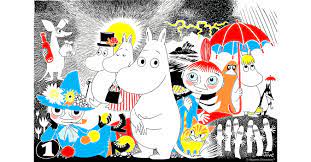
Other than Lewis Carroll and L. Frank Baum (author of The Wizard of Oz), my favorite children’s literature author is Tove Jansson of Finland. Beginning in 1945, she created a world called Moominland, inhabited by a variety of engaging non-human characters. Chief among them is the Moomintroll family, consisting of Moominmamma, Moominpappa, the Snork Maiden, and Moomintroll himself (itself?).
It has been a few decades since I picked up one of the volumes of the Moominland saga. Today, I just finished reading Moominland Midwinter (1957). I found myself falling in love with the weird, utterly engaging world of a valley inhabited by lovable weird creatures.
One of my favorites is a philosopher called Too-Ticky. At one point, she muses:
I’m thinking about the aurora borealis. You can’t tell if it really does exist or if it just looks like existing. All things are so very uncertain, and that’s exactly what makes me feel reassured.
A true Scandinavian, she also ponders the following: “One has to discover everything for oneself. And get over it all alone.” Too true!
For an annotated list of all of Jansson’s Moominlit, click here.
H. L. Mencken knew how to write, but not everything he wrote holds up today. In Prejudices Second Series, he took a hatchet to the literary reputation of the American South in an essay entitled “The Sahara of the Bozart.” Since then, some of the best American writing has come from the South, including William Faulkner (at the top of the list), Flannery O’Connor, Eudora Welty, Ralph Ellison, Harper Lee, Zora Neale Hurston, Robert Penn Warren, and a host of others. Still, Mencken is fun to read:
Alas, for the South! Her books have grown fewer— She never was much given to literature.
In the lamented J. Gordon Coogler, author of these elegaic lines, there was the insight of a true poet. He was the last bard of Dixie, at least in the legitimate line. Down there a poet is now almost as rare as an oboe-player, a dry-point etcher or a metaphysician. It is, indeed, amazing to contemplate so vast a vacuity. One thinks of the interstellar spaces, of the colossal reaches of the now mythical ether. Nearly the whole of Europe could be lost in that stupendous region of fat farms, shoddy cities and paralyzed cerebrums: one could throw in France, Germany and Italy, and still have room for the British Isles. And yet, for all its size and all its wealth and all the “progress” it babbles of, it is almost as sterile, artistically, intellectually, culturally, as the Sahara Desert. There are single acres in Europe that house more first-rate men than all the states south of the Potomac; there are probably single square miles in America. If the whole of the late Confederacy were to be engulfed by a tidal wave to-morrow, the effect upon the civilized minority of men in the world would be but little greater than that of a flood on the Yang-tse-kiang. It would be impossible in all history to match so complete a drying-up of a civilization.
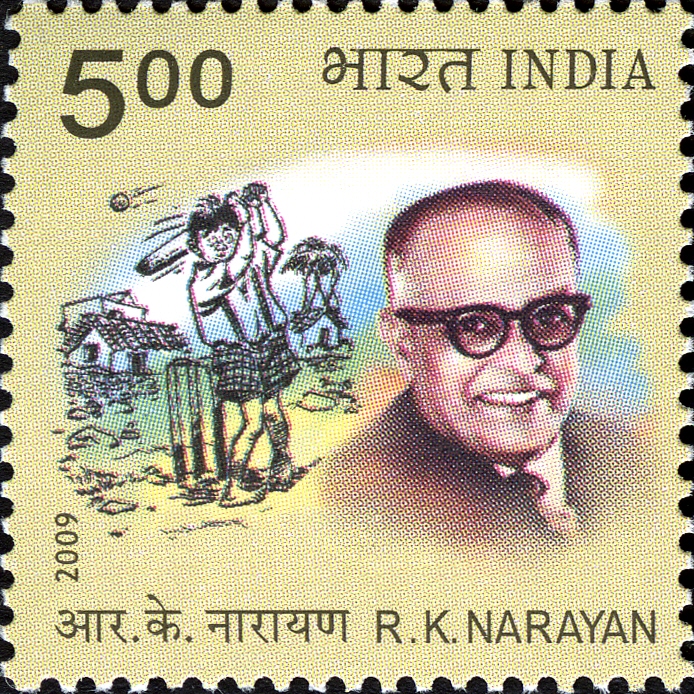
The above stamp was issued to honor the 103rd anniversary of the birth of India’s greatest writer of fiction: Rasipuram Krishnaswami Iyer Narayanaswami, better known as R. K. Narayan. Interestingly, he wrote most of his fiction in English. And it was Graham Greene whose influence led to the publication of his first four books.
I have just finished reading his short-story collection entitled Malgudi Days (1942), in which every one of the 30-odd stories competed with all the others for Best in Show. Over the years, I have also read a number of other titles—all of which I loved—including:
Swami and Friends (1935) which includes the cricket scene shown on the illustrated stamp above
The Bachelor of Arts (1937)
The Financial Expert (1952)
The Guide (1959)
The Vendor of Sweets (1967)
A Tiger for Malgudi (1983)
Under the Banyan Tree and Other Stories (1985)
Narayan’s fiction is mostly set in a mythical South Indian city called Malgudi. Once you start reading his work, it will seem like home to you.
When the dog days of summer roll around, I like to look for a good mystery novel, especially if the scene of action is in a steamy place like Florida. Ever since I discovered that I could “check out” up to ten books from the L.A. public library to read on my Amazon Kindle, I have been looking for John D. MacDonald titles. In the last few weeks, I have picked out four titles. To date, I have read eleven of his books.
In many ways, MacDonald reminds me of Georges Simenon, another of my favorites. On one hand, Simenon wrote some 75 novels featuring Inspector Jules Maigret, and hundreds of other of what he calls his romans durs, or “hard” novels. You guessed it: The latter group tend to be much more hard-bitten than the Maigret titles.
In the same way, MacDonald has his score of Travis McGee novels set in Florida and featuring the very sympathetic captain of the Busted Flush, the yacht on board of which he lives. Like Raymond Chandler’s Philip Marlowe, he is a knightly presence in the Southern California darkness. MacDonald’s non-Travis-McGee titles also tend to be a bit tougher sledding, with his detective’s humane presence absent.
I am just now starting to read some of MacDonald’s other fiction, such as Border Town Girl.
Clarice. I love her name. I love her high cheekbones and penetrating gaze. And most of all, I love the beauty of her thoughts and writings. She wrote in Portuguese, but she was born Chaya Pinkhasivna Lispector in Chechelnyk, Ukraine. To escape the horrors of the Civil War between the Red and White Russians, her Jewish parents fled with their infant daughter to Recife in northeastern Brazil. At an early age, it was discovered that she could write well enough to be published. And she became one of the great women novelists and short story writers of the 20th century.
I am reading short pieces she wrote for Brazilian publications. They are called Crônicas and were recently published in a volume called Too Much of Life, which I am slowly reading with great pleasure.
This is the first of several posts in which I will present one of her Crônicas. I hope you enjoy them.
HOW TO DEAL WITH WHAT ONE HAS
A being lives inside me as if he were entirely at home, and he is. He is a glossy black horse who, despite being entirely wild—for he has never lived inside anyone else and no one has ever put reins or a saddle on him—despite being entirely wild, he has, for that very reason, the primitive gentleness of one who knows no fear: he sometimes eats from my hand. His muzzle is moist and cool. I kiss his muzzle. When I die, the black horse will be left homeless and will suffer greatly. Unless he chooses another house that is not afraid of him being simultaneously both wild and gentle. I should say that he has no name: you just have to call him and that is his name. Or perhaps not, but summon him in a gently authoritative voice, and he will come. If he senses and feels that a body is vacant, he will trot silently in. I should also warn you not to be afraid of his neighing: we mistakenly think that we are the ones neighing with pleasure or rage.









 Tarnmoor
You must be logged in to post a comment.