Job, God, and the Devil

Something About This Old Testament Book ...

Something About This Old Testament Book …

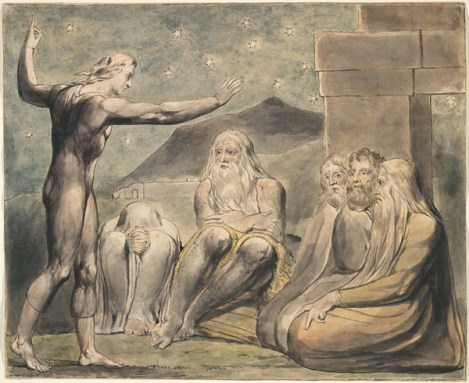
When I first read the Book of Job from the Old Testament, I didn’t think much of it. I still don’t. There was God getting together with Satan to play poker or dominoes or whatever, and making a bet that affected the happiness of one of his most devoted followers. Then, too, there were those “friends” of Job who were zero consolation to the poor man.

I don’t like the idea of a God who is, instead of being the God of Love, some sort of Parimutuel Deity. He “makes it up to” Job in the end, but not before killing off his wife and children and sending him into what for anyone else would have been the pit of despair. We can speculate that the original Mrs. Job was a hag and a shrew; and the first set of children, all strung out on meth; and the replacement wife, a blonde hottie. But we have no grounds for thinking that.

When I was a student at Dartmouth College some time before the Pleistocene Era, I saw a play by Archibald Macleish that brought together the Book of Job with Death of a Salesman. It was called J.B. I would love to have seen the stage version directed by Elia Kazan and starring Raymond Massey, Christopher Plummer, and Pat Hingle (as the Job character). In 1959 it won the Pulitzer Prize for drama.

I know that Job was held up to be the model worshiper, a man who trusted in God through the most incredible adversities. But the God he worshiped was way too snarky for me.

Incidentally, the above illustration is from William Blake’s illustrations of the Book of Job.


“A Spark from the Original Soul”

Martin Buber

Martin Buber

Question: We are commanded to love our neighbor as ourselves. How do I do this if my neighbor has wronged me?

Answer: You must understand these words rightly. Love your neighbor as something which you yourself are. For all souls are one. Each is a spark from the original soul, and this soul is inherent in all souls, just as your soul is inherent in all the members of your body. It may come to pass that your hand will make a mistake and strike you. But would you take a stick and chastise your hand because it lacked understanding, and so increase your pain? It is the same if your neighbor, who is of one soul with you, wrongs you because of his lack of understanding. If you punish him, you only hurt yourself.

Question: But if I see a man who is wicked before God, how can I love him?

Answer: Don’t you know that the primordial soul came out of the essence of God, and that every human soul is a part of God? And will you have no mercy on man, when you see that one of his holy sparks has been lost in a maze and is almost stifled?—Martin Buber, Ten Rungs: Hasidic Sayings

Gooble Gobble, One of Us!

Scene from Tod Browning’s FREAKS (1932)

Banquet Scene from Tod Browning’s Freaks (1932)

I’m going to talk about some tricky concepts here, and I’m not altogether confident that I can explain them to everybody’s satisfaction. I read an interesting review by Thomas Nagel entitled “The Taste for Being Moral” in the December 6, 2012, issue of The New York Review of Books. In passing, it takes up the difference between Liberals and Conservatives in a way I found to be interesting.

According to Nagel, American Conservatives tend to follow the norms of their own group, especially in the light of categories that the author refers to as Loyalty, Authority, and Sanctity. Liberals, on the other hand, tend to extend their aegis to all fellow men. According to Jonathan Haidt, author of The Righteous Mind: Why Good People Are Divided by Politics and Religion:

It would be nice to believe that we humans were designed to love everyone unconditionally. Nice, but rather unlikely from an evolutionary perspective. Parochial love—love within groups—amplified by similarity, a sense of shared fate, and the suppression of free riders, may be the most we can accomplish.

The “free riders” referred to can be Hispanic immigrants, African-Americans on welfare, single mothers, gays, people on Social Security and Medicare (according to Paul Ryan), and environmentalists. Even though the Catholic catechism tells us we were all made in the image of God, not all Catholics, let alone Evangelicals,. take this to heart.

The title of this blog comes from Tod Browning’s classic film Freaks (1932). It is part of a sung toast at a banquet attended by circus freaks and normal people sympathetic to them: “Gooble, Gobble! Gooble, Gobble! One of us! One of us!” We tend to place a higher value on the groups to which we belong than to outsiders or the general public as a whole—irrespective of what Christian teaching tell us to do.

Conservatives tend to view people outside their group as either “free riders” or as some unspecified threat to the values they hold dear. Think of the gun fanatics facing some unspecified threat to their God-given right to own assault weapons and enough ammo to blast all their enemies into the next world.

I, on the other hand, believe with Immanuel Kant that “the only thing that is good in itself and without qualification is good will—a will that obeys universal laws of morality…. It is in virtue of their capacity for morality—as both the authors and subjects of the moral law—that humans are ends in themselves and must always be treated as such.”

Of course, one has only to read my blog posts to note that I, too, am a member of a group, one that views American Conservatives with alarm and loathing. In my heart of hearts, which is in there somewhere, I would like to effect some sort of reconciliation with them. That will, however, be a long process. I’m only human, after all!


“Life Is a Pure Flame”

Sir Thomas Browne

Sir Thomas Browne

There is nothing strictly immortal, but immortality. Whatever hath no beginning, may be confident of no end;—all others have a dependent being and within the reach of destruction;—which is the peculiar of that necessary essence that cannot destroy itself;—and the highest strain of omnipotency, to be so powerfully constituted as not to suffer even from the power of itself. But the sufficiency of Christian immortality frustrates all earthly glory, and the quality of either state after death, makes a folly of posthumous memory. God who can only destroy our souls, and hath assured our resurrection, either of our bodies or names hath directly promised no duration. Wherein there is so much of chance, that the boldest expectants have found unhappy frustration; and to hold long subsistence, seems but a scape in oblivion. But man is a noble animal, splendid in ashes, and pompous in the grave, solemnizing nativities and deaths with equal lustre, nor omitting ceremonies of bravery in the infamy of his nature.

Life is a pure flame, and we live by an invisible sun within us. A small fire sufficeth for life, great flames seemed too little after death, while men vainly affected precious pyres, and to burn like Sardanapalus; but the wisdom of funeral laws found the folly of prodigal blazes and reduced undoing fires unto the rule of sober obsequies, wherein few could be so mean as not to provide wood, pitch, a mourner, and an urn.

Five languages secured not the epitaph of Gordianus. The man of God lives longer without a tomb than any by one, invisibly interred by angels, and adjudged to obscurity, though not without some marks directing human discovery. Enoch and Elias, without either tomb or burial, in an anomalous state of being, are the great examples of perpetuity, in their long and living memory, in strict account being still on this side death, and having a late part yet to act upon this stage of earth. If in the decretory term of the world we shall not all die but be changed, according to received translation, the last day will make but few graves; at least quick resurrections will anticipate lasting sepultures. Some graves will be opened before they be quite closed, and Lazarus be no wonder. When many that feared to die, shall groan that they can die but once, the dismal state is the second and living death, when life puts despair on the damned; when men shall wish the coverings of mountains, not of monuments, and annihilations shall be courted.

While some have studied monuments, others have studiously declined them, and some have been so vainly boisterous, that they durst not acknowledge their graves; wherein Alaricus seems most subtle, who had a river turned to hide his bones at the bottom. Even Sylla, that thought himself safe in his urn, could not prevent revenging tongues, and stones thrown at his monument. Happy are they whom privacy makes innocent, who deal so with men in this world, that they are not afraid to meet them in the next; who, when they die, make no commotion among the dead, and are not touched with that poetical taunt of Isaiah.

Pyramids, arches, obelisks, were but the irregularities of vain-glory, and wild enormities of ancient magnanimity. But the most magnanimous resolution rests in the Christian religion, which trampleth upon pride and sits on the neck of ambition, humbly pursuing that infallible perpetuity, unto which all others must diminish their diameters, and be poorly seen in angles of contingency.

Pious spirits who passed their days in raptures of futurity, made little more of this world, than the world that was before it, while they lay obscure in the chaos of pre-ordination, and night of their fore-beings. And if any have been so happy as truly to understand Christian annihilation, ecstasies, exolution, liquefaction, transformation, the kiss of the spouse, gustation of God, and ingression into the divine shadow, they have already had an handsome anticipation of heaven; the glory of the world is surely over, and the earth in ashes unto them.

To subsist in lasting monuments, to live in their productions, to exist in their names and predicament of chimeras, was large satisfaction unto old expectations, and made one part of their Elysiums. But all this is nothing in the metaphysicks of true belief. To live indeed, is to be again ourselves, which being not only an hope, but an evidence in noble believers, ’tis all one to lie in St Innocent’s church-yard as in the sands of Egypt.—Sir Thomas Browne, Hydriotaphia


The Endless Attributes of the BVM

The Immaculate Conception of the BVM

The Immaculate Conception of the BVM

Today is the feast of the Immaculate Conception of the Blessed Virgin Mary. Along with the Assumption of Mary, it is one of the more recently created holy days of obligation thanks to the inflammability of the Pope, itself a relatively recent attribute..

As one who has been through the Catholic school system (grades 2-12), I have been exposed to the rapidly expanding role of the Mother of God in Catholicism. There is a word for this: Mariolatry (Mary + Idolatry). It didn’t help that the priests who taught me at Chanel High School in Bedford, Ohio, belonged to a religious order called the Society of Mary. Just to make things more confusing, there were two Societies of Mary (both denoted with an S.M. after the priest’s name), the Marianists and the Marists. Our order were the Marists.

In addition to all the attributes of Mary, and the special devotions to her held by the Legion of Mary, to which I did not belong, there were a whole host of saints. Our school was named after St. Peter Chanel, a French Marist missionary who was martyred for his faith in Polynesia (on the island of Futuna) and eaten by cannibals—the only saint known to have suffered such a fate.

New saints are being created all the time. Just this year, Benedict XVI elevated Kateri Tekakwitha, an Indian maiden, to sainthood. Here she is:

St. Kateri Tekakwitha

St. Kateri Tekakwitha

Just so she doesn’t feel jealous, some new attributes for the Blessed Virgin Mary are even now being dreamed up by the Sacred Consistory of Adventitious Marian Attributes (SCOAMA) in the Vatican, including the ability to solve Rubik’s Cube puzzles in less than two minutes, miraculously finding parking places directly in front of whatever her destination may be, and being able to keep her girlish figure for over two millennia.

That reminds me of my friend Alain Silver, who was once offered a relic in Europe, nothing other than a piece of wood from the Blessed Virgin’s boat. Now I do not recall any tales from the Bible about Mary’s boating proclivities, but it could be true! 

Catholicism sometimes seems as cluttered as the Hindu or Graeco-Roman Pantheon, but I do not object to it. There are many aspects of Catholicism about which I feel nostalgic, though the statutory rape of altar boys and attempts to dictate what is and what is not sinful regarding human sexuality are not among them. But when I get troubled and confused, I simply return to my special devotion to the Sacred Multiplicity of the BVM.

Zeus Goes A-Wooing

Leda and the Swan

Whenever the Greek God Zeus was felt attracted toward mortal women, he disguised himself as someone or something else and just raped them. That happened in the case of Europa (either as a bull according to Ovid or as an eagle according to Robert Graves); Danae (as a golden shower—hey, I don’t make this stuff up); Callisto (as the Goddess Artemis); and Alcmene (as her husband who was away at war at the time).

Probably the most famous coupling was with Leda, for which Zeus became a swan. The result was Helen of Troy and Polydeuces. Leda’s legitimate children by King Tyndareus of Sparta were Castor and Clytemnestra. You may recall that Clytemnestra married Agamemnon and later murdered him in his bath when he returned from the Trojan War.

The above photo was taken earlier today by me at the Getty Villa in Malibu, one of the best collections of ancient Greek and Roman antiquities in the New World.

All this comes out in this magnificent poem by William Butler Yeats:

Leda and the Swan by W. B. Yeats

A sudden blow: the great wings beating still
Above the staggering girl, her thighs caressed
By the dark webs, her nape caught in his bill,
He holds her helpless breast upon his breast.

How can those terrified vague fingers push
The feathered glory from her loosening thighs?
And how can body, laid in that white rush,
But feel the strange heart beating where it lies?

A shudder in the loins engenders there
The broken wall, the burning roof and tower
And Agamemnon dead.
                    Being so caught up,
So mastered by the brute blood of the air,
Did she put on his knowledge with his power
Before the indifferent beak could let her drop?

“Altogether Too Reflective”

Søren Kierkegaard

I am well aware that as a human being I am very far from being a paradigm; if anything, I am a sample human being. With a fair degree of accuracy, I give the temperature of every mood and passion, and when I am generating my own inwardness, I understand these words: homo sum, nil humani a me alienum puto [I am a human being, I hold that nothing human is alien to me]. But humanly no one can model himself on me, and historically I am even less a prototype for any human being. If anything, I am someone who could be needed in a crisis, as a guinea pig that life uses to feel its way. A person half as reflective as I would be able to be of significance for many people, but precisely because I am altogether reflective I have none at all. As soon as I am outside my religious understanding, I feel as an insect with which children are playing must feel, because life seems to have dealt with me so unmercifully; as soon as I am inside my religious understanding, I understand that precisely this has absolute meaning for me. Hence, that which in one case is a dreadful jest is in another sense the most profound earnestness. Earnestness is basically not something simple, a simplex, but is a compositum [compound], for true earnestness is the unity of jest and earnestness. —Søren Kierkegaard, Stages on Life’s Way


On Suffering

Thomas Merton

Indeed, the truth that many people never understand, until it is too late, is that the more you try to avoid suffering, the more you suffer, because smaller and more insignificant things begin to torture you, in proportion to your fear of being hurt. The one who does most to avoid suffering is, in the end, the one who suffers the most: and his suffering comes to him from things so little and so trivial that one can say that it is no longer objective at all. It is his own existence, his own being, that is at once the subject and the source of his pain, and his very existence and consciousness is his greatest torture.—Thomas Merton, The Seven Storey Mountain

Beyond Good and Evil

Joseph Campbell

When you get down into the depths of mythology, [mythic] forms are beyond good and evil. With the Indian deities—this is the wonderful thing about them—the upper right hand will say. “Fear not” and below it is the boon-bestowing hand; and the upper left will have a sword, and in the lower a recently amputated head. These are the two aspects of power, the two aspects of being. in our traditions—and this is true even all the way back to the Greeks—the beneficent and the malfeasant aspects of power tend to be separated and contrary entities.

Is that when trouble arises?

No, not necessarily—provided the two are in play with each other. But when one is impugned, as in our tradition where the powers of the deep are consigned to Hell … It’s interesting that the symbols of Shiva and of Poseidon are exactly those that are given to the Devil in Christian mythology—the bull’s foot and the tridents. So the power which is symbolized in those forms has been pushed aside as though it should not be admitted.—Joseph Campbell, An Open Life


“All Here Are the Same”

Human beings by nature want happiness and do not want suffering. With that feeling everyone tries to achieve happiness and tries to get rid of suffering, and everyone has the basic right to do this. In this way, we all here are the same, whether rich or poor, educated or uneducated, Easterner or Westerner, believer or non-believer, and within believers whether Buddhist, Christian, Jewish, Muslim, and so on. Basically, from the viewpoint of real human value we are all the same.—The Dalai Lama, “Kindness, Clarity, and Insight”