Confronting Demons

Confronting Your Fear When It Matters Most

Perhaps the Demons Are Not Real

In The Tibetan Book of the Dead, there is a detailed discussion of how a dying person should be guided past the “wrathful deities” that are images of his fear to the desired annihilation of the self in Nirvana. There is a state between death and either rebirth or liberation from the circle of endless rebirths.

Here is a description of one of these demons, named Heruda:

O, Child of Buddha Nature, listen without distraction. Although the intermediate state of the peaceful deities did previously arise within you, you did not recognize it. So now you have wandered, [through the succession of pathways,] to here. Now, on the eighth day, the assembly of wrathful blood-drinking deities will arise. Recognize them and do not be distracted! O, Child of Buddha Nature, he who is called the Great Glorious Buddha Heruka will [now] arise, vividly manifesting before you from within your own brain. His body, blazing in a mass of light, is dark brown in colour, having three heads, six arms and four legs, which are [firmly] set apart. His right face is white, the left red and the central face dark brown. His nine eyes are fixed in a fearsome wrathful gaze, his eyebrows are quivering like lightning, his fangs are bared and gleaming, and he is laughing loudly, uttering the sounds of Alala and Haha, and Shoo oo—like whistles, in loud piercing cries. The golden-auburn hair of his head blazes and rears upward, sun and moon-discs, black serpents, and dry skulls adorn each of his heads, and black snakes and fresh skulls form a garland around his body. In his six hands he holds, on the right in the first hand, a wheel, in the middle one, an axe, and in the last hand a sword and to the left, in his first hand, he holds a bell, in the middle one, a ploughshare and in the last a skull. The female consort Buddhakrodhesvari is embracing his body, her right hand clasped around his neck and her left offering a skull-cup filled with blood to his mouth. Amidst loud pounding palatal sounds of ‘Thuk-chom’, and an [echoing] roar like the reverberation of thunder, the fire of pristine cognition blazes from the fiery indestructible pores of their bodies, and thus they stand together, [with one leg] extended and [the other] drawn in on a throne supported by garudas.

Do not be afraid! Do not be terrified! And do not be awed! Recognize this to be the buddhabody of your own intrinsic awareness. These are your own meditational deities, so do not be terrified. This, in reality, is the transcendent lord Vairocana and his consort, so do not be afraid. Recognition and liberation will occur simultaneously!

It is difficult for us to recognize what appears to be a wrathful demon as a manifestation of ourselves. By exhibiting fear in this critical Bardo state (as the Tibetans call it) will tie you to this life and the inevitable defeat of rebirth. Perhaps in our culture, we do not see rebirth as a negative: Rather, we typically frighten ourselves with demons and exhibit fear.

Whereas in our culture it is death and the pathways to it that terrify us, the Tibetans see death as a teachable moment—the last chance for non-returning to a world characterized by misery.

As I write this, Martine and I have just returned from a nearby hospice in which a longtime friend is confronting pancreatic cancer and trying to prepare his mind for—what? We don’t know for sure, but we do know that fear on that last approach is an ever-present danger. May we all be spared from this fear as we make our way out of this world and into—what?

Frank Herbert in his book Dune included this Bene Gesserit mantra which I think of often when confronting my own demons:

I must not fear. Fear is the mind-killer. Fear is the little-death that brings total obliteration. I will face my fear. I will permit it to pass over me and through me. And when it has gone past I will turn the inner eye to see its path. Where the fear has gone there will be nothing. Only I will remain.

There is great wisdom in these lines.

Inti Raymi

Inca Warrior

Inca Warrior

Before Francisco Pizarro upset the whole apple cart, Inti Raymi was one of four major Inca festivals celebrated in Cusco. It is still celebrated annually, except the venue has moved to the nearby ruins of Sacsayhuamán—usually pronounced by American tourists as “Sexy Woman.” The following description of the festival’s origin is from Wikipedia:

According to chronicler Garcilaso de la Vega, Sapa Inca Pachacuti created the Inti Raymi to celebrate the new year in the Andes of the Southern Hemisphere. The ceremony was also said to indicate the mythical origin of the Incas. It lasted for nine days and was filled with colorful dances and processions, as well as animal sacrifices to thank Pachamama and to ensure a good cropping season. The last Inti Raymi with the Inca Emperor’s presence was carried out in 1535, after which the Spanish and the Catholic priests banned it.

Since 1944, there has been a re-enactment of the Inti Raymi ceremonies on June 24 of each year. Although this re-enactment is mostly for the benefit of tourists, there are still real Inti Raymi ceremonies held by Quechuan peoples throughout the Andes.

Yes, But …

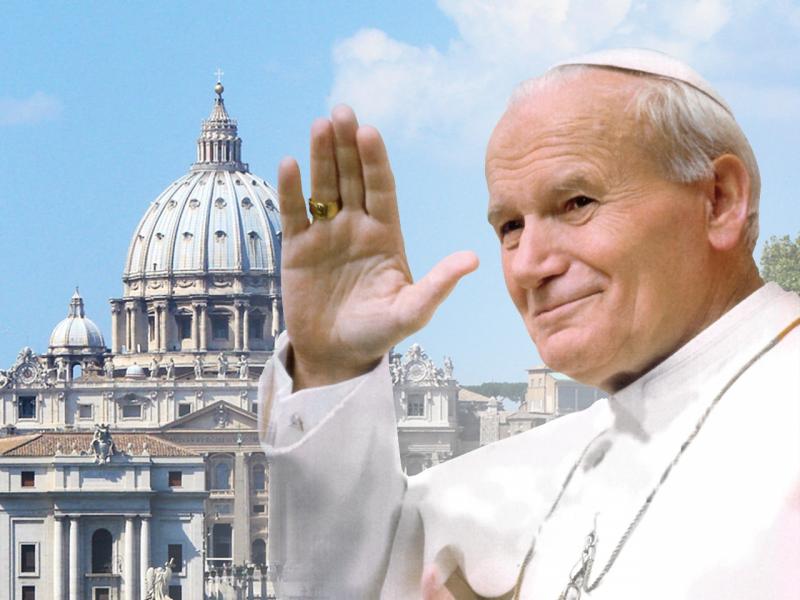
Pope (Soon To Be Saint) John Paul II

Pope (Soon To Be Saint) John Paul II

This week’s upcoming canonization of two Twentieth Century popes has many people hot under the collar. Although he did not succeed in cleaning up the child abuse mess among the Catholic clergy, I think he was an outstanding human being. His forgiveness of Mehmet Ali Agca, who came close to assassinating him on May 13, 1981, shows him to have been a real Christian.

While listening to the radio on the way to work this morning, I heard the usual complaints about his having done nothing to punish Cardinal Roger Mahony for reassigning guilty priest-predators to new parishes. This is an administrative matter, and Mahony; while certainly in the wrong, did not come under papal purview at this level. This is a problem across the entire Catholic world, with entire seminaries devoted to producing gay priests who are likely to molest the children of parishioners. At a time when the number of young people with religious callings is rapidly dwindling, many in Rome are afraid to stage what would amount to a major purge of religious.

Ultimately, the culprit is priestly celibacy. For hundreds of years, priests have not been allowed to marry in the Roman Catholic Church; but it is not forbidden among the Eastern Rites who do allow their clergy to marry. These include the West Syrian (Maronite), Armenian, Byzantine, and East Syrian rites, all of which recognize the authority of the Pope. I have always thought that the Church will ultimately change its mind on this score. Doing so would be attended with problems of its own, such as the right of priestly widows and children to inherit church property, which might put them into conflict with the laws of various countries.

But the Orthodox Churches have managed all these years, so it is not inconceivable that the Catholics will ultimately follow suit.

Looking back at what I have written above, I am somewhat disturbed that I have been criticizing John Paul more for the times in which he lived than in what he could and could not accomplish with the Roman Curia. I’m utterly delighted that the church turned to Communist Poland for its new pontiff, and that John Paul had such a major role in putting an end to the Communist Blight. He was a good man, and anyone who chooses to emulate him could not go wrong.


Dribbling the Bibble

No, Not the Bible Again!

Oh No, Not the Bible Again!

I cannot help but think that people in our society are altogether too quick to accept the Bible as the ultimate authority for, well, just about everything. At the same time, people are not really reading the scriptures with any degree of intelligence. If they were, they would feel someone let down that, in the Book of Job, Jehovah is hanging out with Satan and makes a bet with him that, regardless what He does to the prayerful man, Job will still be in His ball court. So He proceeds to impoverish Job, kill his wife and children, make off with his livestock, and saddle him with three “friends”—Eliphaz, Bildad, and Zofar—who accuse the poor man of deserving whatever befalls him.

Then, too, there is the Books of Leviticus, Deuteronomy, and Numbers, where God is laying down a law to which no one outside a small number of ultra Orthodox Jews pay any attention. Here are just some of the high points from the Book of Leviticus alone:

  • If a man also lie with mankind, as he lieth with a woman, both of them have committed an abomination: they shall surely be put to death; their blood shall be upon them.” (Leviticus 20:13) Oh, well, there goes gay marriage. Are you listening, Justice Scalia?
  • Don’t have a variety of crops in the same field, irrespective of what the U.S. Department of Agriculture urges. (Leviticus 19:19)
  • Neither cut your hair nor shave—ever! (Leviticus 19:27)
  • People with flat noses, or who are blind or lame, cannot approach the altar of God. (Leviticus 21:17-18)

And there are also a few prohibitions regarding heterosexual fornication that are incredibly strict. Most violations seem to call for the death penalty.

So I ask you, why do people accept the Bible as the ultimate authority? Parts of it are several thousand years old. And the most recent part, the Book of Revelation, is so flat-out loony that it might as well be.

People who come to my door attempting to convert me to their oddball evangelical sect are totally flabbergasted when I tell them I do not accept the authority of the Bible. That means they can’t use it to quote at me to substantiate their every argument. It effectively shuts them up and makes them go down the stairs muttering.

Withal, I can still believe in God, but without accepting all this extraneous claptrap. Oh, and I have no intention of seeing the new movie version of Noah, from which the above still is taken.

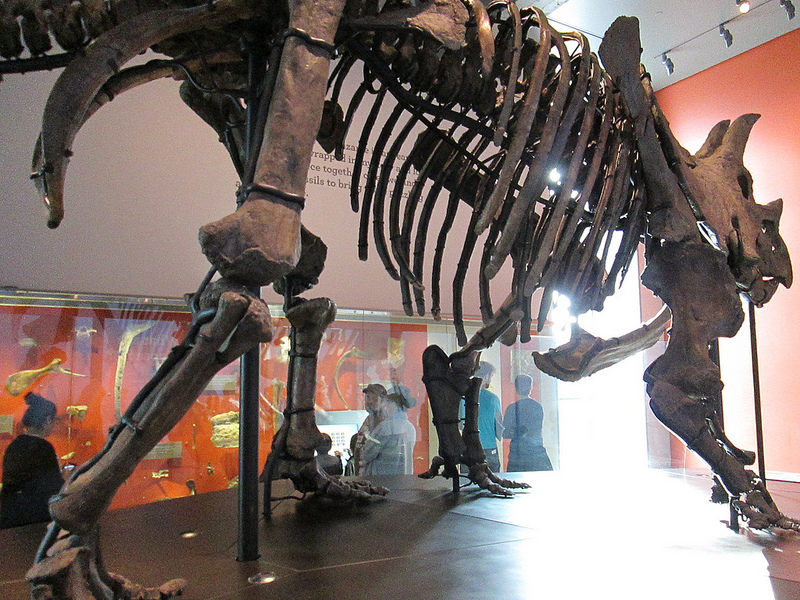
The Earth Is 6,000 Years Old? Really?

Apparently Old Enough to Have Eaten All of Ken Ham’s Ancestors

Apparently Young Enough to Have Eaten All of Ken Ham’s Ancestors

On February 4, Bill Nye the Science Guy debated a Creationist moron named Ken Ham on the subject of evolution. Of course, Mr. Ham treated the Book of Genesis (and whatever he thought about it) as his primary source. Apparently, according to the Creationist, all of creation is about 6,000 years old. What’s the point of even trying to debate a fundamentalist Christian troglodyte? I believe with Shakespeare in Hamlet (III:1):

Let the doors be shut upon him
That he may play the fool nowhere but in’s own house.

I am referring to Mr. Ham here, not Bill Nye. I mean, even Pat Robertson—no mean troglodyte himself—reproved the half-baked Ham for his beliefs:

There ain’t no way that’s possible….To say that it all came about in 6,000 years is just nonsense and I think it’s time we come off of that stuff and say this isn’t possible. We’ve got to be realistic that the dating of Bishop Ussher [who merely added the ages of the generations in the Bible] just doesn’t comport with anything that’s found in science, and you can’t just totally deny the geological formations that are out there.

“Let’s be real!” he added. “Let’s not make a joke of ourselves.”

Big Surprise!

Big Surprise!

Why do even the more stupid religious fundamentalists believe such arrant nonsense? I think that, if anyone should debate a fool like Ken Ham, it should be a comedian, not a sincere scientific figure like Bill Nye. This was in no way a victory for the Hammites, nor for the followers of scientific evolution. It was just another sad episode of rural stupidity in the former Confederacy.


Either Way Is Okay

Shinto Shrine

Shinto Shrine

It is a series of low buildings among trees. Space in a shrine is horizontal and not, as in a cathedral, vertical. In a church, space is confined. It must struggle upward, having no place else to go. In a shrine, space is spread. There are no high walls, no tight enclosures. The space is a grove and this grove seems so endless that it might be the world itself.

The sky seems low, near. There are long expanses of lawn or grove among the buildings. One is not enclosed, nor is one directed. One is liberated, and almost always alone.

Shrine prayer, as I have said, is not communal prayer. It is solitary prayer. It is not a state—it is a function. It lasts only a minute or so and it is spontaneous. One does not enter, as in churches, or descend, as in mosques. The way to the shrine is through a grove, along a walk, through nature itself, nature intensified. Through these trees, over this moss, one wanders to shrines.

This casual, unremarked acceptance of nature speaks to something very deep within us. It speaks directly to our own nature, more and more buried in this artificial and inhuman century. Shinto speaks to us, to something in us which is deep, and permanent.

Certainly we feel—which is to say, recognize—more here than in smiling Buddhism with its hopeful despair, more than in fierce man-made Islam with its heavenly palaces on earth, more than in the strange and worldly tabernacles of the Hebrews or in the confident, vaunting, expectant Christian churches.

This religion, Shinto, is the only one that neither teaches nor attempts to convert. It simply exists, and if the pious come, that is good, and if they do not, then that too is good, for this is a natural religion and nature is profoundly indifferent.—Donald Richie, The Inland Sea

A Dangerous Time

It’s the Least Wonderful Time of the Year

It’s the Least Wonderful Time of the Year

I am a great believer in the Mayan calendar—not, mind you, of the many misconceptions relating to the end of the world and such. The Mayans were, in the long run, optimists. Their calendar begins with the creation of the world of humans on August 11, 3114 B.C. and just keeps chugging along. Whenever we come to the end of a baktun, as we may (or may not) have done in December 2012, when a bunch of nattering fools predicted the end of the world, we just move on to the next baktun. As Kurt Vonnegut would have said, “So it goes.”

In the meantime, the last five days of the Mayan 365-day year were called the uayeb, about which I wrote a year ago:

In the Haab’, or Mayan Solar Calendar, there are eighteen months of twenty days each. Where does that leave the other 5.25 days? To account for the difference, the Mayans created an intercalary five-day month referred to as the uayeb. Unlike other days in the Solar Calendar, the five days of the uayeb are thought to be a dangerous time….

According to Lynn Foster in Handbook to Life in the Ancient Mayan World, “During Wayeb, portals between the mortal realm and the Underworld dissolved. No boundaries prevented the ill-intending deities from causing disasters.” It was a time of fasting with abstention from sex and all celebrations. People avoided washing their hair or even leaving their huts during this time.

This being a Saturday, I will probably violate the spirit of Uayeb by going out for lunch and getting together with friends. There are other ways of honoring the Mayan gods, probably by not making any major decisions during this time unless I absolutely have to.

Text: Still a Good Book

Bible

The Bible

Textual problems have led some modern scholars to question the credibility of the Gospels and even to doubt the historical existence of Christ. These studies have provoked an intriguing reaction from an unlikely source: Julien Gracq—an old and prestigious novelist, who was close to the Surrealist movement—made a comment which is all the more arresting for coming from an agnostic. In a recent volume of essays, Gracq first acknowledged the impressive learning of one of these scholars (whose lectures he had attended in his youth), as well as the devastating logic of his reasoning; but he confessed that, in the end, he still found himself left with one fundamental objection: for all his formidable erudition, the scholar in question had simply no ear—he could not hear what should be so obvious to any sensitive reader—that, underlying the text of the Gospels, there is a masterly and powerful unity of style, which derives from one unique and inimitable voice; there is the presence of one singular and exceptional personality whose expression is so original, so bold that one could positively call it impudent. Now, if you deny the existence of Jesus, you must transfer all these attributes to some obscure, anonymous writer, who should have had the improbable genius of inventing such a character—or, even more implausibly, you must transfer this prodigious capacity for invention to an entire committee of writers. And Gracq concluded: in the end, if modern scholars, progressive-minded clerics and the docile public all surrender to this critical erosion of the Scriptures, the last group of defenders who will obstinately maintain that there is a living Jesus at the central core of the Gospels will be made of artists and creative writers, for whom the psychological evidence of style carries much more weight than mere philological arguments.—Simon Leys, The Hall of Uselessness: Collected Essays

Two Socialists: Pope Francis & Jesus

Gee, Maybe It’s OK to Be Socialist

Gee, Maybe It’s OK to Be Socialist

Now our right wing pundits are all attacking Pope Francis for being a Marxist. He has been deemed to be guilty for caring about the poor, just as Jesus Christ was some two thousand years ago. In fact, Christ had no compunction about attacking the rich:

I tell you the truth, it is hard for a rich man to enter the kingdom of heaven. Again I tell you, it is easier for a camel to go through the eye of a needle than for a rich man to enter the kingdom of God. When the disciples heard this, they were greatly astonished and asked, “Who then can be saved?” Jesus looked at them and said, “With man this is impossible, but with God all things are possible.” Matthew 19:23-26

Southern Nazarene University has an interesting website with Old and New Testament verses regarding the poor. Here is a little nugget I found from the Epistle of James:

“Suppose a man comes into your meeting wearing a gold ring and fine clothes, and a poor man in shabby clothes also comes in. If you show special attention to the man wearing fine clothes and say, ‘Here’s a good seat for you,’ but say to the poor man, ‘You stand there’ or ‘Sit on the floor by my feet,’ have you not discriminated among yourselves and becomes judges with evil thoughts? Listen, my dear brothers: Has not God chosen those who are poor in the eyes of the world to be rich in faith and to inherit the kingdom He promised those who love Him? But you have insulted the poor. Is it not the rich who are exploiting you? Are they not the ones who are dragging you into court?” James 2:2-6

Then there is this from 1 John 3:17-18: “If anyone has material possessions and sees his brother in need but has no pity on him, how can the love of God be in him? Dear children, let us not love with words or tongue but with actions and in truth.”

One doesn’t have to delve too deeply in the Bible to find that it is all stacked on the side of the poor and against the rich. And yet, so many right-wing Conservatives believe exactly the opposite. Why? Because it is the rich who are bankrolling them, not the poor.

It seems to me that Pope Francis is the real Christian, and all the pundits aligned against him are heretics who deserve to be burned at the stake. (Dear me, it’s my Catholic background coming out again.)


The Nature of the Soul

Cicero

Cicero

It’s impossible to locate an earthly origin of souls. There’s nothing mixed or compounded in souls, they’re not earth or made of earth. They’re not even moist or airy or fiery. There’s nothing in these elements that accounts for the power of memory, mind or thought, that recalls the past, foresees the future or comprehends the present. These faculties are divine; you won’t find a way for them to get to man except from god. The natural power of the soul is therefore unique, distinct from the usual and familiar elements. Whatever it is that thinks, knows, lives and grows must be heavenly, divine, and therefore eternal. And god, who is recognized by us, can only be recognized by a mind that is free and unencumbered, distinct from any mortal compound, sensing all and setting all in motion, itself endowed with eternal movement. The human mind consists of the same element, the same nature.—Marcus Tullius Cicero, Consolation