Guess Who’s Missing from the Constitution

And He’s Not in the Declaration of Independence Either

And He’s Not in the Declaration of Independence Either

With all the Evangelical hoo-hah about the United States being a Christian nation, you will not find any of the following words in the U.S. Constitution: “Jesus,” “Christ,” “God,” “Deity,” “Christian,” or “Christians.” And the word “God” appears only once in the Declaration of Independence in a phrase that is not quite the way it would be used in an American suburban megachurch:

When in the Course of human events, it becomes necessary for one people to dissolve the political bands which have connected them with another, and to assume among the powers of the earth, the separate and equal station to which the Laws of Nature and of Nature’s God entitle them, a decent respect to the opinions of mankind requires that they should declare the causes which impel them to the separation.

Note that the word “God” appears only after the phrase “Laws of Nature.” (Sounds like something the Sierra Club would write.)

If you don’t believe me, search these two documents yourself. You can find them at http://www.archives.gov/exhibits/charters/constitution_transcript.html and at http://www.archives.gov/exhibits/charters/declaration_transcript.html. We have so many misconceptions about the Founding Fathers of our country, especially those tricorn-hatted imbeciles who go by the name of Tea Party, that we don’t realize that the particular brand of Christianity practiced then was too remote and intellectual for most of today’s Holy Rollers. I am referring specifically to Deism. You might want to follow the link to learn for yourself in what they believed.

Note in particular the phrase “rejection of revelation and authority.” In other words, the Founding Fathers were not big-time Bible-readers.

I would like to see someone like Rush Limbaugh or Glenn Beck explain this curious omission.

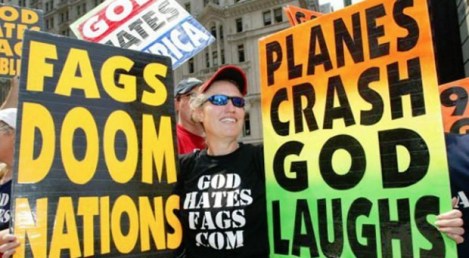
God Hates Westboro Baptist Church

Gonzo Picketer for So-Called “Westboro Baptist Church”

Gonzo Picketer for So-Called “Westboro Baptist Church”

The “Westboro Baptist Church” is no more a church than I am the Pope of Islam. They are a right-wing group that delights in fomenting outrage by picketing events where the vast majority of people attending are against their believes. That doesn’t bother the folks at WBC, who say on their website: “0 – nanoseconds of sleep that WBC members lose over your opinions and feeeeellllliiiiiings.” Also on the same page is a counter of the number of souls God has cast into hell since the web page was loaded. (Yeah, like they know!)

At a time when so much that is called political discourse is actually nothing but grandstanding in front of the media, WBC holds down a particularly odious niche. After all, their website is called GodHatesFags.Com. Whenever some disaster occurs, you can count on these hucksters to tell us all that we had it coming because of our tolerance of gays or something else these misguided white people hate or feel threatened by.

I do not think that WBC will be around for much longer: How much further can they go without bringing peoples’ wrath down on their heads or violating the law in some gross way?

So enjoy them while you can.

Mind, Matter and the Great Unknown

Sometimes Philosophy Ignores the Most Important Subjects

Sometimes Philosophy Ignores the Most Important Subjects

Sometime around a hundred years ago, philosophers decided not to talk about anything that they couldn’t prove. Over the decades, biology was reduced to chemistry, which in turn was reduced to physics, which in turn was reduced to mathematical formulas.

In the meantime, what was ignored was the whole subject of mind.

It reminds me of an old joke:

“What is mind?”

“It doesn’t matter.”

“What is matter?”

“Never mind!”

And yet, mind exists. There is this thing we have called consciousness. It is that consciousness which, from time immemorial, prompted talk about the human soul. Whether the soul exists apart from consciousness, I don’t know. Whether consciousness can exist unhooked from the whole material superstructure that is the human body, I do not know.

I tend to think that because of my sense of my own consciousness—the thing that makes me who I am—that I say I believe in God. Certainly I am not beholden to any organized religion for my belief: I think that all the scriptures are merely metaphorical attempts to create a myth around a belief in the deity.

In his recent book Mind and Cosmos: Why the Materialist Neo-Darwinian Conception of Nature Is Almost Certainly False, Thomas Nagel writes:

I would like to defend the untutored reaction of incredulity to the reductionist neo-Darwinian account of the origin and evolution of life. It is prima facie highly implausible that life as we know it is the result of a sequence of physical accidents together with the mechanism of natural selection. We are expected to abandon this naive response, not in favor of a fully worked out physical/chemical explanation but in favor of an alternative that is really a schema for explanation, supported by some examples. What is lacking, to my knowledge, is a credible argument that the story has a non-negligible probability of being true. There are two questions. First, given what is known about the chemical basis of biology and genetics, what is the likelihood that self-reproducing life forms should have come into existence spontaneously on the early earth, solely through the operation of the laws of physics and chemistry? The second question is about the sources of variation in the evolutionary process that was set in motion once life began: In the available geological time since the first life forms appeared on earth, what is the likelihood that, as the result of a physical accident, a sequence of viable genetic mutations should have occurred that was sufficient to permit natural selection to produce the organisms that actually exist?

Nagel does not provide the answers, but he asks the right questions. Is my consciousness of myself an accident? And why is my consciousness of myself so different from everyone else’s consciousness of themselves?

What has dictated that mind across so many billions of instances should be so rich, so incredibly diversified, so beautiful (and sometimes so heinous)?

The answer, my friend, is blowing in the wind.


A Jesuit Paradise?

Stamps Commemorating the Jesuit Missions of Paraguay

Stamps Commemorating the Jesuit Missions of Paraguay

It is interesting to me that, for the first time in its history, the papacy is in the hands of a Jesuit, from South America no less. In southeastern Paraguay and in the Argentinean state of Misiones, there are numerous ruins attesting to the 17th and 18th century Jesuit missions—missions that were so powerful that they were, in effect, in control of the Guarani Indians of the area. If you ever saw Roland Joffe’s 1986 movie, The Mission, with Robert DeNiro, Liam Neeson, and Jeremy Irons, you have some idea of what the Jesuit government of Paraguay was like.

You can find out even more by reading the forgotten classic history by R. B. Cunninghame Graham entitled A Vanished Arcadia: Being Some Account of the Jesuits in Paraguay 1607 to 1767.

It even finds its way into Voltaire’s Candide, but its author being such an anticlerical cuss, he has his hero kill the Jesuit commandant of one of the missions. Yet he writes in Histoire Politique et Philosophique des Indes:

When in 1768 the missions of Paraguay left the hands of the Jesuits, they had arrived at perhaps the highest degree of civilization to which it is possible to conduct a young people, and certainly at a far superior state than that which existed in the rest of the new hemisphere. The laws were respected there, morals were pure, a happy brotherhood united every heart, all the useful arts were in a flourishing state, and even some of the more agreeable sciences: plenty was universal.

I have long thought that, if my thoughts had ever taken a turn toward the Catholic priesthood, I would have become a Jesuit. My teachers at St. Peter Chanel in Bedford, Ohio, wanted me to become one of them, a Marist. But, in the end, I became neither.

So now Pope Francis is a Jesuit from Argentina. He, I am sure, is quite aware of the history of the Jesuits in the southern cone of South America. It would be nice if he did for the Catholic Church what the Jesuits did for the Guarani in Paraguay and Argentina. Benedict XVI was a good man, but not strong enough for the task of making his faith relevant to a world that is falling away from the Church.


Pope on the Ropes

Adieu Benedict XVI!

Adieu Benedict XVI!

In a way, I liked Benedict XVI (whom Martine persists in calling Ratzo after his last name, Ratzinger); but I think the job was beyond the abilities of a conservative theologian. What with the Catholic Church being against gays in theory and, in effect, for same-sex molestation of the under-aged, there is too much of a disconnect. The world does not want theology at this juncture. In fact, many Catholics are fleeing the church because they feel it is either devious or too unemotional. Their destination? The various evangelical sects, which can be even more devious and certainly insincere in their emotionalism.

I shouldn’t be surprised if Benedict’s departure will open the doors to new revelations about perfidy by members of the clergy. What is that thing about the Pope’s butler? Shades of Godfather III! And now Britain’s only Cardinal has resigned for molesting priests!? (What I want to know is, why don’t the poor nuns ever get molested? Even Martin Luther did it.)

Catholicism is a religion which its adherents must cherry-pick if they wish to remain sane. You can like the great traditions, the Latin Mass, the saints, the miracles—while, at the same time, abhorring the stance on contraception, abortion, and the punishment of wayward pederast priests. For me, the things I love about the Church are the works of Thomas Merton and G. K. Chesterton (both converts) and the great saints, stretching back to Augustine and Thomas Aquinas.

I hope that Benedict is not too torn up by the Augean Stables that the Church has become. He was basically a good man in an impossible position.

The Monolith

Flag of Saudi Arabia

Flag of Saudi Arabia

What with all the turbulence wrought by the so-called Arab Spring, what is the likelihood that Saudi Arabia will be affected? So far, there have been no large-scale demonstrations, though the monarchy has jailed a fairly large number of people of opposite political stripes.

If Saudi Arabia were to follow the example of Syria, it would have the effect of destabilizing anew the whole Muslim world. Why? Because it is the obligation for every able-bodied Muslim to perform the hajj at least once in a lifetime by visiting the sacred sites of Mecca and Medina. The thought of this pilgrimage being curtailed in any way would be enough to cause widespread panic from Morocco to Indonesia, from the Muslim inhabitants of Europe to the Sahel in Africa. Just to see how international this movement is, click on the website of the Saudi Ministry of Hajj.

Islam cannot easily change its doctrines the way that Christianity, both Western and Eastern, could. There is no unified figure or body that decides what Muslims are to believe. Ever since Ataturk abolished the Ottoman caliphate in 1924, Islam has been substantially without a head. Although the religious leaders in Saudi Arabia would like to think they are in charge, that extends mainly to maintaining order during the massive influx of pilgrims (three million in 2011) during the annual  week of the Hajj, which changes from year to year because it is based on the lunar calendar.

I can only conclude that any major changes in Saudi Arabia will be cataclysmic on a global scale. As of 2010, there were an estimated 1.62 billion Muslims, comprising some 23% of earth’s total population. Both the United States and Britain have over 2.5 million adherents each. To see how the Islamic population is distributed across the nations of the earth, click here.

We tend to believe that tomorrow’s crises are basically the same as today’s, except possibly more so. A global Muslim dust-up would be qualitatively different.


Job, God, and the Devil

Something About This Old Testament Book ...

Something About This Old Testament Book …

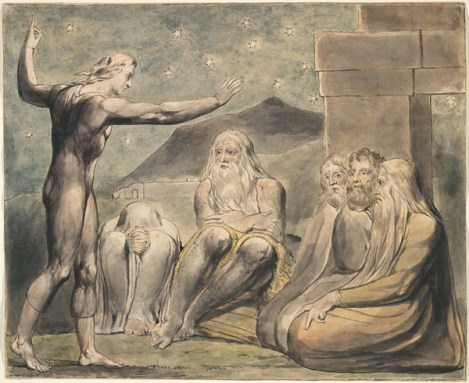
When I first read the Book of Job from the Old Testament, I didn’t think much of it. I still don’t. There was God getting together with Satan to play poker or dominoes or whatever, and making a bet that affected the happiness of one of his most devoted followers. Then, too, there were those “friends” of Job who were zero consolation to the poor man.

I don’t like the idea of a God who is, instead of being the God of Love, some sort of Parimutuel Deity. He “makes it up to” Job in the end, but not before killing off his wife and children and sending him into what for anyone else would have been the pit of despair. We can speculate that the original Mrs. Job was a hag and a shrew; and the first set of children, all strung out on meth; and the replacement wife, a blonde hottie. But we have no grounds for thinking that.

When I was a student at Dartmouth College some time before the Pleistocene Era, I saw a play by Archibald Macleish that brought together the Book of Job with Death of a Salesman. It was called J.B. I would love to have seen the stage version directed by Elia Kazan and starring Raymond Massey, Christopher Plummer, and Pat Hingle (as the Job character). In 1959 it won the Pulitzer Prize for drama.

I know that Job was held up to be the model worshiper, a man who trusted in God through the most incredible adversities. But the God he worshiped was way too snarky for me.

Incidentally, the above illustration is from William Blake’s illustrations of the Book of Job.


“A Spark from the Original Soul”

Martin Buber

Martin Buber

Question: We are commanded to love our neighbor as ourselves. How do I do this if my neighbor has wronged me?

Answer: You must understand these words rightly. Love your neighbor as something which you yourself are. For all souls are one. Each is a spark from the original soul, and this soul is inherent in all souls, just as your soul is inherent in all the members of your body. It may come to pass that your hand will make a mistake and strike you. But would you take a stick and chastise your hand because it lacked understanding, and so increase your pain? It is the same if your neighbor, who is of one soul with you, wrongs you because of his lack of understanding. If you punish him, you only hurt yourself.

Question: But if I see a man who is wicked before God, how can I love him?

Answer: Don’t you know that the primordial soul came out of the essence of God, and that every human soul is a part of God? And will you have no mercy on man, when you see that one of his holy sparks has been lost in a maze and is almost stifled?—Martin Buber, Ten Rungs: Hasidic Sayings

Gooble Gobble, One of Us!

Scene from Tod Browning’s FREAKS (1932)

Banquet Scene from Tod Browning’s Freaks (1932)

I’m going to talk about some tricky concepts here, and I’m not altogether confident that I can explain them to everybody’s satisfaction. I read an interesting review by Thomas Nagel entitled “The Taste for Being Moral” in the December 6, 2012, issue of The New York Review of Books. In passing, it takes up the difference between Liberals and Conservatives in a way I found to be interesting.

According to Nagel, American Conservatives tend to follow the norms of their own group, especially in the light of categories that the author refers to as Loyalty, Authority, and Sanctity. Liberals, on the other hand, tend to extend their aegis to all fellow men. According to Jonathan Haidt, author of The Righteous Mind: Why Good People Are Divided by Politics and Religion:

It would be nice to believe that we humans were designed to love everyone unconditionally. Nice, but rather unlikely from an evolutionary perspective. Parochial love—love within groups—amplified by similarity, a sense of shared fate, and the suppression of free riders, may be the most we can accomplish.

The “free riders” referred to can be Hispanic immigrants, African-Americans on welfare, single mothers, gays, people on Social Security and Medicare (according to Paul Ryan), and environmentalists. Even though the Catholic catechism tells us we were all made in the image of God, not all Catholics, let alone Evangelicals,. take this to heart.

The title of this blog comes from Tod Browning’s classic film Freaks (1932). It is part of a sung toast at a banquet attended by circus freaks and normal people sympathetic to them: “Gooble, Gobble! Gooble, Gobble! One of us! One of us!” We tend to place a higher value on the groups to which we belong than to outsiders or the general public as a whole—irrespective of what Christian teaching tell us to do.

Conservatives tend to view people outside their group as either “free riders” or as some unspecified threat to the values they hold dear. Think of the gun fanatics facing some unspecified threat to their God-given right to own assault weapons and enough ammo to blast all their enemies into the next world.

I, on the other hand, believe with Immanuel Kant that “the only thing that is good in itself and without qualification is good will—a will that obeys universal laws of morality…. It is in virtue of their capacity for morality—as both the authors and subjects of the moral law—that humans are ends in themselves and must always be treated as such.”

Of course, one has only to read my blog posts to note that I, too, am a member of a group, one that views American Conservatives with alarm and loathing. In my heart of hearts, which is in there somewhere, I would like to effect some sort of reconciliation with them. That will, however, be a long process. I’m only human, after all!


“Life Is a Pure Flame”

Sir Thomas Browne

Sir Thomas Browne

There is nothing strictly immortal, but immortality. Whatever hath no beginning, may be confident of no end;—all others have a dependent being and within the reach of destruction;—which is the peculiar of that necessary essence that cannot destroy itself;—and the highest strain of omnipotency, to be so powerfully constituted as not to suffer even from the power of itself. But the sufficiency of Christian immortality frustrates all earthly glory, and the quality of either state after death, makes a folly of posthumous memory. God who can only destroy our souls, and hath assured our resurrection, either of our bodies or names hath directly promised no duration. Wherein there is so much of chance, that the boldest expectants have found unhappy frustration; and to hold long subsistence, seems but a scape in oblivion. But man is a noble animal, splendid in ashes, and pompous in the grave, solemnizing nativities and deaths with equal lustre, nor omitting ceremonies of bravery in the infamy of his nature.

Life is a pure flame, and we live by an invisible sun within us. A small fire sufficeth for life, great flames seemed too little after death, while men vainly affected precious pyres, and to burn like Sardanapalus; but the wisdom of funeral laws found the folly of prodigal blazes and reduced undoing fires unto the rule of sober obsequies, wherein few could be so mean as not to provide wood, pitch, a mourner, and an urn.

Five languages secured not the epitaph of Gordianus. The man of God lives longer without a tomb than any by one, invisibly interred by angels, and adjudged to obscurity, though not without some marks directing human discovery. Enoch and Elias, without either tomb or burial, in an anomalous state of being, are the great examples of perpetuity, in their long and living memory, in strict account being still on this side death, and having a late part yet to act upon this stage of earth. If in the decretory term of the world we shall not all die but be changed, according to received translation, the last day will make but few graves; at least quick resurrections will anticipate lasting sepultures. Some graves will be opened before they be quite closed, and Lazarus be no wonder. When many that feared to die, shall groan that they can die but once, the dismal state is the second and living death, when life puts despair on the damned; when men shall wish the coverings of mountains, not of monuments, and annihilations shall be courted.

While some have studied monuments, others have studiously declined them, and some have been so vainly boisterous, that they durst not acknowledge their graves; wherein Alaricus seems most subtle, who had a river turned to hide his bones at the bottom. Even Sylla, that thought himself safe in his urn, could not prevent revenging tongues, and stones thrown at his monument. Happy are they whom privacy makes innocent, who deal so with men in this world, that they are not afraid to meet them in the next; who, when they die, make no commotion among the dead, and are not touched with that poetical taunt of Isaiah.

Pyramids, arches, obelisks, were but the irregularities of vain-glory, and wild enormities of ancient magnanimity. But the most magnanimous resolution rests in the Christian religion, which trampleth upon pride and sits on the neck of ambition, humbly pursuing that infallible perpetuity, unto which all others must diminish their diameters, and be poorly seen in angles of contingency.

Pious spirits who passed their days in raptures of futurity, made little more of this world, than the world that was before it, while they lay obscure in the chaos of pre-ordination, and night of their fore-beings. And if any have been so happy as truly to understand Christian annihilation, ecstasies, exolution, liquefaction, transformation, the kiss of the spouse, gustation of God, and ingression into the divine shadow, they have already had an handsome anticipation of heaven; the glory of the world is surely over, and the earth in ashes unto them.

To subsist in lasting monuments, to live in their productions, to exist in their names and predicament of chimeras, was large satisfaction unto old expectations, and made one part of their Elysiums. But all this is nothing in the metaphysicks of true belief. To live indeed, is to be again ourselves, which being not only an hope, but an evidence in noble believers, ’tis all one to lie in St Innocent’s church-yard as in the sands of Egypt.—Sir Thomas Browne, Hydriotaphia