
Lessons from a Spider

Orb Weaver Spider in Its Web

Probably the most famous lesson learned from a spider weaving its web is of Robert the Bruce, King of Scotland, who, hidden in a cave, marveled at a spider’s persistence in completing its web. Supposedly, it inspired him to attack the English at Bannockburn in 1314 and win a decisive victory. American naturalist Loren Eiseley learned a very different lesson watching an orb spider weaving its web. The following quote comes from his collection of essays entitled The Unexpected Universe.

For example, I once received an unexpected lesson from a spider.

It happened far away on a rainy morning in the West. I had come up a long gulch looking for fossils, and there, just at eye level, lurked a huge yellow-and-black orb spider, whose web was moored to the tall spears of buffalo grass at the edge of the arroyo. It was her universe, and her senses did not extend beyond the lines and spokes of the great wheel she inhabited. Her extended claws could feel every vibration throughout that delicate structure. She knew the tug of wind, the fall of a raindrop, the flutter of a trapped moth’s wing. Down one spoke of the web ran a stout ribbon of gossamer on which she could hurry out to investigate her prey.

Curious, I took a pencil from my pocket and touched a strand of the web. Immediately there was a response. The web, plucked by its menacing occupant, began to vibrate until it was a blur. Anything that had brushed claw or wing against that amazing snare would be thoroughly entrapped. As the vibrations slowed, I could see the owner fingering her guidelines for signs of struggle. A pencil point was an intrusion into this universe for which no precedent existed. Spider was circumscribed by spider ideas; its universe was spider universe. All outside was irrational, extraneous, at best, raw material for spider. As I proceeded on my way along the gully, like a vast impossible shadow, I realized that in the world of spider I did not exist…..

I began to see that among the many universes in which the world of living creatures existed, some were large, some small, but that all, including man’s, were in some way limited or finite. We were creatures of many different dimensions passing through each other’s lives like ghosts through doors.

Bishop Ussher’s Presumption

James Ussher, Archbishop of Armagh (1581-1666)

According to his careful calculations, the world was created on “the entrance of the night preceding the 23rd day of October… the year before Christ 4004.” That would make Earth 4,259 years old. And, of course, it had to be true because one couldn’t question the Bible in any particular. It was just a matter of adding up the years of all the “begats” in Genesis, and adding to it the generations of men in the following books of the Old Testament.

I am reading a fascinating book by Loren Eiseley called The Firmament of Time about how the age of the Earth grew by leaps and bounds after discoveries by geologists, astronomers, and other scientists.

There are still people who believe in the literal truth of every word in the Good Book. The Scopes trial took place in Tennessee exactly a hundred years ago. In some corners of the United States, there has been little or no movement since then.

At the Equator

Straddling the Yellow Line Indicating the Equator

When I was in grade school, I couldn’t tell the difference between Ecuador the Country and the Equator (Latitude 0). In November 2016, my brother and I traveled to both the country and the zero latitude. Just north of Quito is a park called Ciudad Mitad del Mundo, or “Middle of the Worlkd City.” Dan and I took in the exhibits and spent the night at a nearby hotel perched atop a crater that hung over a heavy fog prior to driving to the cloud forest town of Mindo.

Actually, the equator as currently defined is 790 feet (240 meters) north of the yellow line. Like many similar geographic markers, it tends to move around. Take, for instance, the Tropic of Cancer. According to Wikipedia:

The Tropic of Cancer’s position is not fixed, but constantly changes because of a slight wobble in the Earth’s longitudinal alignment relative to the ecliptic, the plane in which the Earth orbits around the Sun. Earth’s axial tilt varies over a 41,000-year period from about 22.1 to 24.5 degrees, and as of 2000 is about 23.4 degrees, which will continue to remain valid for about a millennium. This wobble means that the Tropic of Cancer is currently drifting southward at a rate of almost half an arcsecond (0.468″) of latitude, or 15 m (49 ft), per year. The circle’s position was at exactly 23° 27′N in 1917 and will be at 23° 26’N in 2045. The distance between the Antarctic Circle and the Tropic of Cancer is essentially constant as they move in tandem. This is based on an assumption of a constant equator, but the precise location of the equator is not truly fixed.

How Far Do We Have to Move This Thing?

You know, I can actually feel that wobble sometimes. But then, if you’re going to sink millions of dollars into a park, you can’t always be re-drawing the line.

The Little Ice Age in Holland

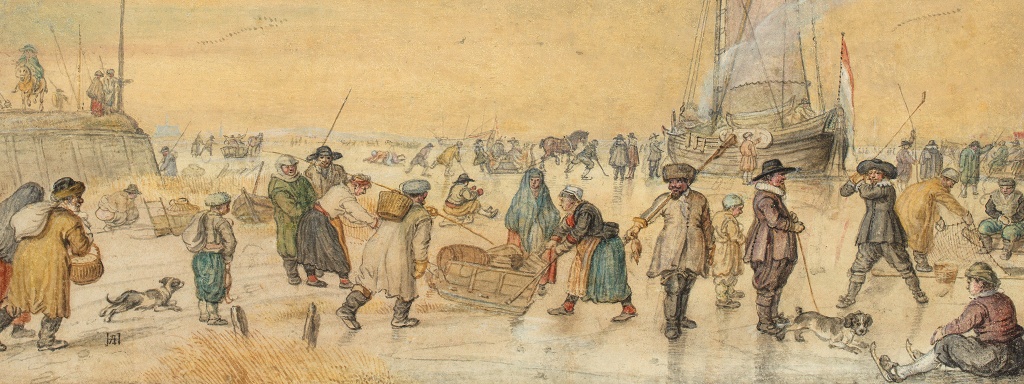
Skating on the Ice in Holland

One of the exhibits I saw at the Getty Center last week was a collection of drawings depicting cold weather in Holland during the 17th century. According to the Getty website:

In the 17th century, frigid winters and unusually cool summers blanketed northern Europe in what became known as the Little Ice Age. Dutch artists depicted this persistent global cooling in scenes of daily activities like ice skating and fishing. Highlighting human vulnerability and resilience in the face of a changing climate, these works offer opportunities to reflect on our current environmental crises. This exhibition features works by Hendrick Avercamp and other Dutch artists of the 1600s.

It was during this Little Ice Age that the Greenland colony of Scandinavian and Icelandic colonists was abandoned at some point between 1350 and 1400.

Dutchmen Playing Ice Hockey

I have always been fond of Dutch art, and that was only reinforced when Martine and I visited Amsterdam more than twenty years ago. Uniquely, it seems, Dutch painting elevated the humdrum to the level of high art in the works of Vermeer, Rembrandt, Hals, Bosch, and Bruegel.

As I looked at all the drawings of the Dutch enjoying themselves in what looked like wickedly cold weather, I wondered if the global warming that the news media talks about is a permanent feature, or just another of earth’s mysterious centuries-long cycles that we don’t understand. Not that we shouldn’t do everything in our power from making it worse than it is, but it does make one think.

Heat » Evaporation » Clouds » Rain » Flooding

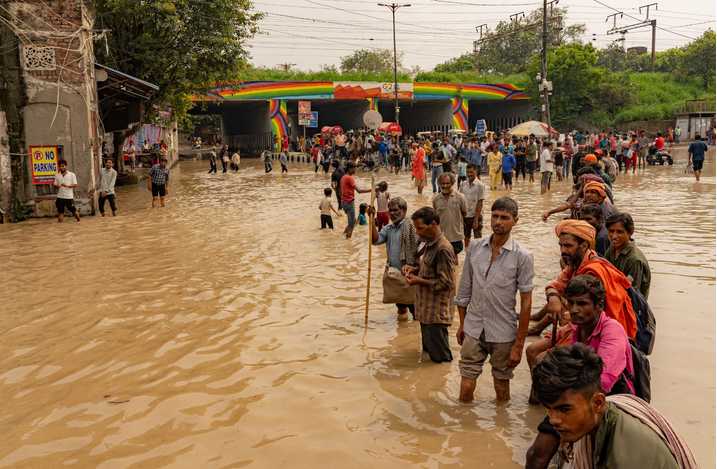
Scene of Flooding in Delhi, India

This isn’t altogether scientific, but I think I might possibly see how global warming translates into disastrous weather such as tornadoes, hurricanes, typhoons, and other types of storms associated with heavy rains and flooding.

It all begins with hot weather. According to National Geographic Magazine, the hotter it gets, the more evaporation takes place;

The National Weather Service in the United States measures the rate of evaporation at different locations every year. Scientists there found that the rate of evaporation can be below 76 centimeters (30 inches) per year at the low end, to 305 centimeters (120 inches) per year on the high end.

The variability is based on temperature. The evaporated vapors form clouds until the air in a place just can’t take any more. The article continues:

Once water evaporates, it also helps form clouds. The clouds then release the moisture as rain or snow. The liquid water falls to Earth, waiting to be evaporated. The cycle starts all over again.

Many factors affect how evaporation happens. If the air is already clogged, or saturated, with other substances, there wont be enough room in the air for liquid to evaporate quickly. When the humidity is 100 percent, the air is saturated with water. No more water can evaporate.

Then—you guessed it!—it comes down as rain. Sometimes, lots of rain. Such as Los Angeles received when a hurricane hit Southern California a couple weeks ago with record rainfall. Those record rainfalls have been happening all over the globe: Burning Man at Black Rock City in Nevada; Derma in Libya, at the edge of the Sahara Desert; and Delhi, India.

So I think that the whole cycle of drought and flood will become ever more extreme, sometimes in the most unlikely places.

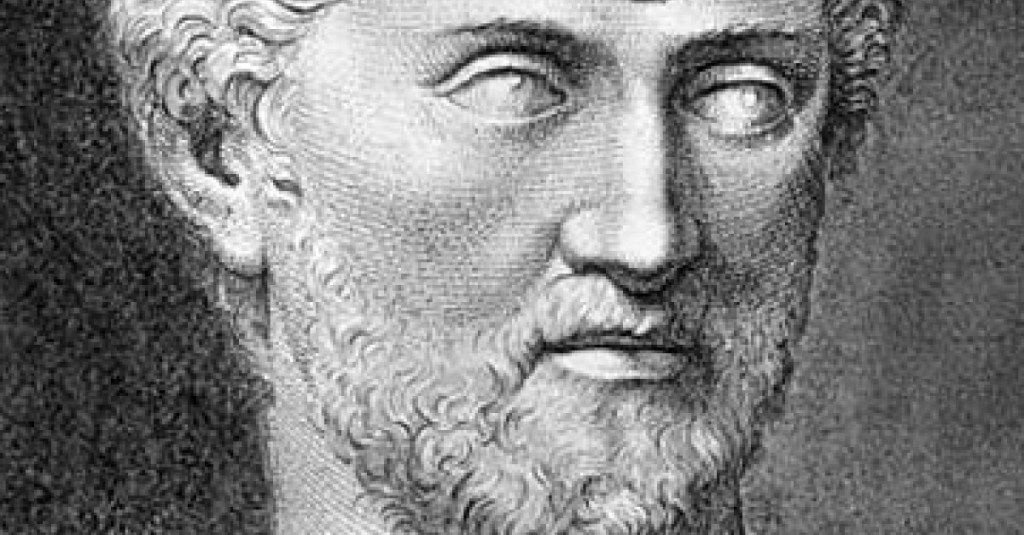
Lucretius on the Nature of Things

Titus Lucretius Carus (1st Century BC)

It’s not easy to read The Nature of Things by Lucretius. Not only does he attempt to summarize the philosophy of Epicurus and the science knowledge of his day (40-55 BC), but he did in in rhymed couplets, which in this edition are translated as heptameter (“fourteeners”).

Not to worry: If you press on, you will get the gist of what Lucretius writes, and you will encounter some great passages such as this one on the role of the gods in life:

If you possess a firm grasp of these tenets, you will see
That Nature, rid of harsh taskmasters, all at once is free,
And everything she does, does on her own, so that gods play
No part. For by the holy hearts of gods, who while away
Their tranquil immortality in peace!—who can hold sway
Over the measureless universe? Who is there who can keep
Hold of the reins that curb the power of the fathomless deep?
Who can juggle all the heavens? And with celestial flame
Warm worlds to fruitfulness? And be all places at the same
Time for all eternity, to cast a shadow under
Dark banks of clouds, or quake a clear sky with the clap of thunder?
What god would send down lightning to rend his own shrines asunder?
Or withdraw to rage in desert wastes, and there let those bolts fly
That often slay the innocent and pass the guilty by?

It is a far different world than hours. Instead of the Periodical Table of the Elements, Lucretius had earth, wind, air, and fire. You can see him bending in obscure directions to explain such phenomena as magnetism, thunder, earthquakes, and plagues. Yet one could not help but admire the ingenuity of an astute observer who had no notion of Newtonian Physics, let alone Quantum Physics, yet tried his hardest to explain what he saw.

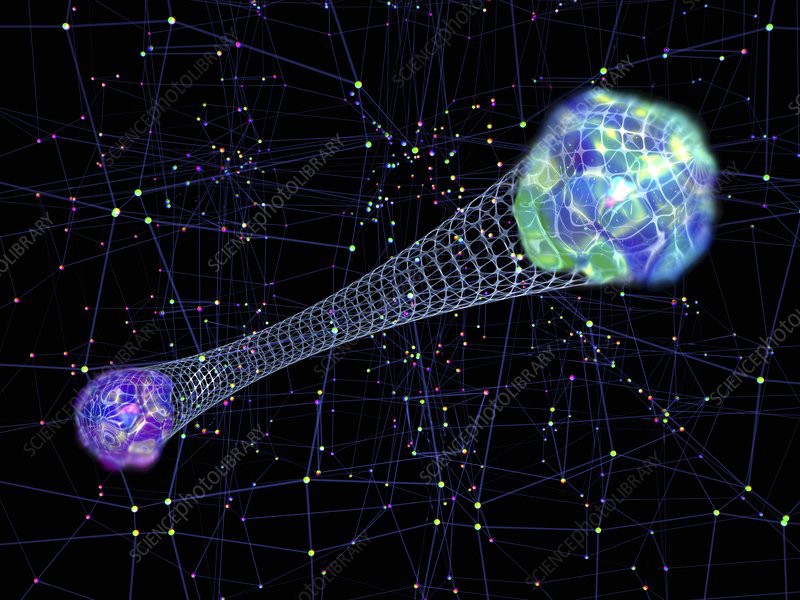
Entanglement

It Baffled Einstein, But Suggests a Whole Different Outlook on the Universe

Einstein called it “spooky action at a distance” and quipped, “God does not play dice with the universe!” But apparently, He does. Mind-bending experiments have seemingly invalidated the speed of light (186,000 miles per second) when two protons shot in opposite directions sped away from each other at that speed. A measurement of one of the two protons affected the other one instantaneously, although theoretically communication between them was impossible. Here is one recent explanation by a physicist.

In the Wikipedia article on Quantum Entanglement, it says:

Measurements of physical properties such as position, momentum, spin, and polarization performed on entangled particles can, in some cases, be found to be perfectly correlated. For example, if a pair of entangled particles is generated such that their total spin is known to be zero, and one particle is found to have clockwise spin on a first axis, then the spin of the other particle, measured on the same axis, is found to be anticlockwise. However, this behavior gives rise to seemingly paradoxical effects: any measurement of a particle’s properties results in an irreversible wave function collapse of that particle and changes the original quantum state. With entangled particles, such measurements affect the entangled system as a whole.

Apparently some things in the universe are linked together in ways we do not yet understand.

At the same time, I think people are also similarly “entangled.” For example, I firmly believe one cannot avoid auto accidents without being able to make a good guess whether the other driver (whose face you have not seen) is going to cut in front of you. Unless I am distracted by conversing with a passenger, I am pretty good at “reading” traffic. How is that possible?

Then there is the whole question of presentiments of disaster which are proven to be true, There have been studies that people who have survived disasters had some foreshadowing of what was to occur. Does that mean that people are in some strange way entangled with events?

We are used to seeing people, things, and events as existing in separate “boxes.” What if some elements are in fact separate, and others are interlinked in ways we cannot foresee? Perhaps in future scientists will be able to describe how some of these entanglements work. Until then, we will just have to open our minds to a certain degree of strangeness. Which is probably a good idea in any case.

Impact

Now that NASA may have a solution to the problem, it’s interesting to see how, some 200 years ago, people viewed the possibility of a comet or asteroid crashing into the earth. The quote below comes from Tales of Terror from Blackwood’s Magazine from a story by Samuel Warren entitled “The Thunder-Struck.”

“Great God, Dr ——!” said he, laying his hand suddenly on my arm, his great black eyes gleaming with mysterious awe—“Think, only think! What if, at the moment we are talking together, a comet, whose track the peering eye of science has never traced—whose very existence is known to none but God, is winging its fiery way towards our earth, swift as the lightning, and with force inevitable! Is it at this instant dashing to fragments some mighty orb that obstructed its progress, and then passing on towards us, disturbing system after system in its way?—How—when will the frightful crash be felt? Is its heat now blighting our atmosphere?—Will combustion first commence, or shall we be at once split asunder into innumerable fragments, and sent drifting through infinite space?—Whither—whither shall we fly! what must become of our species?—Is the Scriptural JUDGMENT then coming? Oh, Doctor, what if all these things are really at hand?

When Scientists Go Awry

The following is from an exhibit at Honolulu’s Bishop Museum of humorous attempts at classifying plants and animals. The surnames of the scientists involved appear in parentheses.

Abra cadabra (Eames & Wilkins) 1957 – A variety of clam

Hebejeebie (Heads) 2003 – A genus of flowering plant that must give people the creeps

La cucaracha (Blesynski) 1966 – A moth that reminds one of a cockroach

Ba humbugi (Solem) 1983 – A snail much beloved of Ebeneezer Scrooge

Ittibittium (Houbrick) 1993 – A mollusc genus even smaller than genus Bittium

Heerz lukenatcha and Heerz tooya (Marsh) 1993 – Two wasps you would rather notencounter

Riga toni (Evenhuis) 2013 – A fly for pasta lovers

Ytu brutus (Spangler) 1980 – Beware the Ides of March!

North (and Central) American Nebula

Looks Like the Map of North America from Yucatán to Panama

Every once in a while, I check out NASA’s Astronomy Picture of the Day which frequently has images which make me think. The above picture is technically called the Cygnus Wall of Star Formation. According to the website:

The North America nebula on the sky can do what the North America continent on Earth cannot — form stars. Specifically, in analogy to the Earth-confined continent, the bright part that appears as Central America and Mexico is actually a hot bed of gas, dust, and newly formed stars known as the Cygnus Wall. The featured image shows the star forming wall lit and eroded by bright young stars, and partly hidden by the dark dust they have created. The part of the North America nebula (NGC 7000) shown spans about 15 light years and lies about 1,500 light years away toward the constellation of the Swan (Cygnus).

Makes me yearn to visit Yucatán—yet again.